
A Short-Form Video Scripting Template: Step-by-Step Guide
Most B2B teams have product knowledge, founder insights, webinars, and demos sitting idle. The gap isn't content, it's structure. Without a repeatable short-form video scripting process, even your best ideas get buried in a scroll. This guide gives you the exact template I use at Komet Media to turn long-form assets into short videos that educate buyers, build trust, and drive pipeline. Whether you're scripting from scratch or repurposing existing content, this is the framework that makes it repeatable.
TL;DR
- Short-form video scripting follows a four-part structure: hook, bridge, value, CTA.
- Your hook must land in the first 3 seconds or viewers are gone.
- The sweet spot for short-form video in 2026 is between 30 and 60 seconds.
- A great script is the difference between content that moves the pipeline and content that just fills a calendar.
What Is Short-Form Video Scripting and Why Does It Matter in 2026?
Short-form video scripting is the practice of writing structured, word-for-word (or beat-for-beat) copy before you hit record. It sounds obvious. Most B2B teams skip it anyway, and it shows. Short-form video delivers the highest ROI of any content format, according to HubSpot's 2026 State of Marketing Report. That stat means nothing if your video loses viewers before the first sentence is done. A script prevents that. It forces you to make every second intentional.
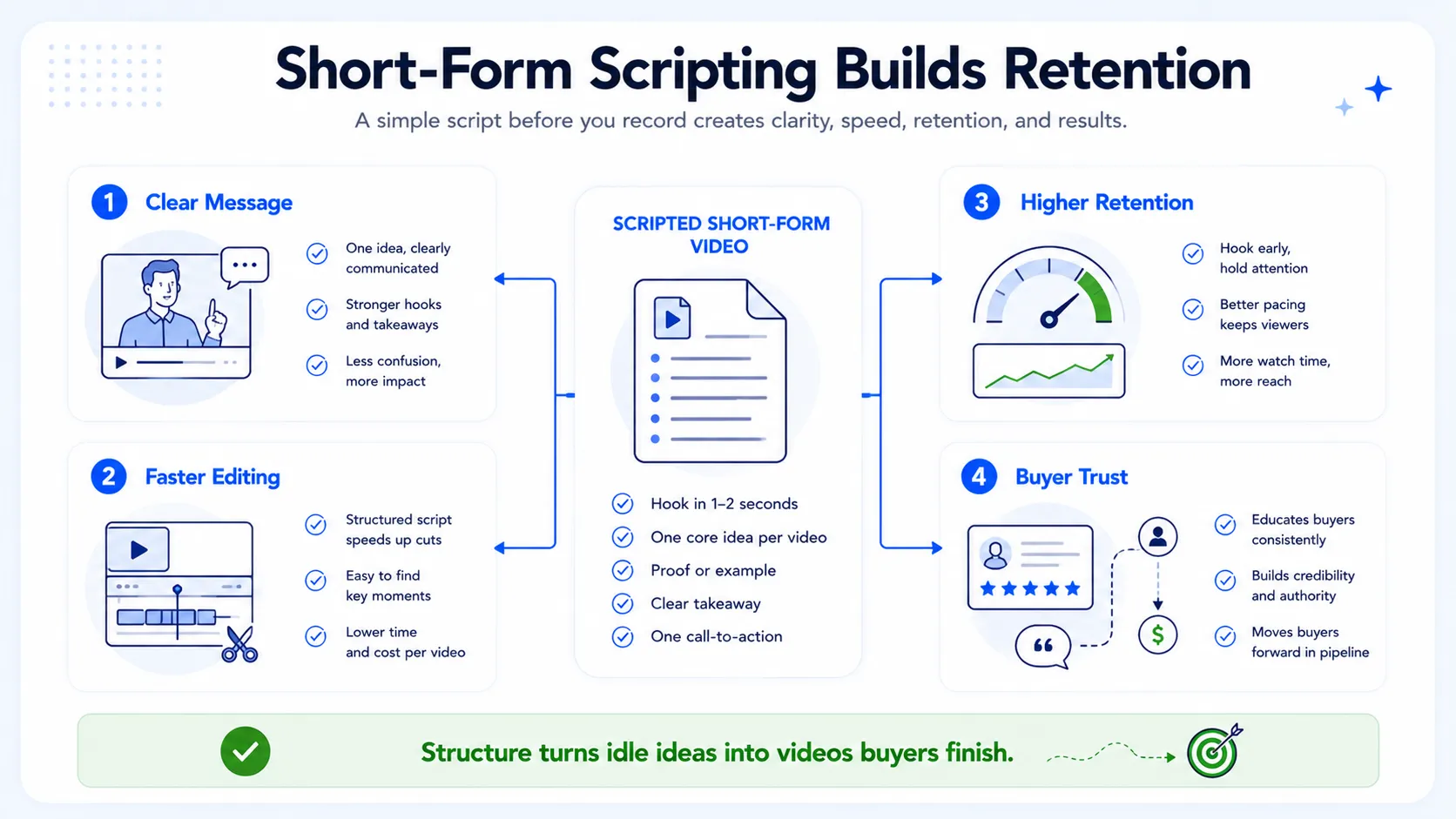
71% of viewers decide within the first few seconds whether a video is worth continuing. That's not a margin for improvisation. That's a mandate for scripting. For B2B SaaS teams specifically, the stakes are higher. Your buyers are skeptical, time-poor, and surrounded by noise. A rambling demo clip or a talking-head video without a clear narrative arc doesn't just fail to convert, it signals low production quality and erodes product trust. Short-form video scripting is what separates content that educates buyers from content that disappears into the feed.
A video script is the written backbone of any video, it keeps you on message, reduces editing time, and prevents the rambling that kills viewer retention. Structure matters more than writing talent: hook (5–10 seconds), intro, body sections, CTA.
At Komet Media, we use scripting as the foundation of every short video we produce, whether we're building from a client's webinar, podcast, demo recording, or writing net-new content. The script is what makes repurposing fast and what makes original content consistent.
Resist the urge to wing your content. Planning saves a ton of time and generally leads to more cohesive, concise videos. Think about what your audience cares about, then outline your key points and create a simple script or bullet list. That's the floor. What follows in this guide is the ceiling.
How to Write a Script for a Short Video: The 4-Part Framework
Every high-performing short video follows the same underlying logic, regardless of platform. Here's the framework:
The 4-Part Short-Form Script Structure:
- Hook (0–3 seconds): Stop the scroll. One bold statement, a surprising fact, or a direct call-out of the viewer's pain point. No "hey guys," no logo, no warm-up.
- Bridge (3–8 seconds): Connect the hook to the value coming. Set up why this video matters to this specific viewer right now. One or two sentences max.
- Value Delivery (8–50 seconds): The substance. One clear idea, explained or demonstrated. For B2B, this is where product knowledge, founder thinking, or a customer result lives. Storytelling structure helps here, problem, insight, resolution.
- Call-to-Action (final 5–7 seconds): Tell the viewer exactly what to do next. "Comment X if you want the full breakdown." "Watch part 2." "Book a demo at the link." Make the CTA earn its place, it should feel like a natural continuation, not an afterthought.
The hook earns attention, the body proves the promise, and the CTA turns interest into a next step.
Script pacing rule: Write at roughly 125–150 words per minute of finished video. A 45-second script is approximately 95–115 words. Time it aloud before filming. If it sounds stiff, rewrite it. Write for the ear, not the eye. Short sentences. Contractions.
Formatting tip: Use a two-column format, audio on the left, visual direction on the right. Your editor, your teleprompter operator, or your team knows exactly what appears on screen at every beat. This is especially valuable when repurposing content across a content calendar.
What's the Best Structure for a 60-Second Video Script?
A 60-second video is the most versatile format in short-form video scripting. It's long enough to deliver one complete idea and short enough to retain most viewers.
Here's a time-mapped template for a 60-second B2B video:
The ideal length for a short video is between 21 and 60 seconds. Videos that are 90 seconds or less hold about half of the viewers until the end. For B2B use cases, product explainers, founder POV clips, feature walkthroughs, or sales enablement clips, the 60-second format maps cleanly to a narrative arc: here's the problem your buyers feel, here's the shift in thinking, here's what that means for your team, here's what to do next.
A pattern interrupt mid-video (a visual cut, a bold text overlay, a change in delivery tone) keeps audience retention high between the 15-second and 45-second marks, where drop-off typically spikes. Tools like Kapwing and CapCut let editors add these elements in post without reshooting.
One structural note for B2B teams: the value delivery section should carry one idea only. The biggest scripting mistake I see from founders and marketing heads is trying to teach three things in 60 seconds. Pick the one that's most relevant to your buyer's current pain point. Leave the others for the next video in your content calendar.
What Makes a Good Hook for Short-Form Video Content?
Most drop-off happens in seconds 0–3. Win that window or the rest of your video doesn't matter. The hook is the single most important line in your short-form video script. Gary Vaynerchuk has said for years that attention is the asset, your hook is how you capture it before the algorithm even has a chance to help you.
The five hook frameworks that work for B2B short-form:
- Pain-point call-out: Name the exact frustration your buyer is living with. "Your demo videos are losing buyers before the feature even loads."
- Counterintuitive statement: Challenge a common belief. "More content won't fix your pipeline problem, better scripting will."
- Bold result: Lead with the outcome. "This one scripting change doubled our client's video watch time."
- Direct question: Address the viewer personally. "Are your short videos educating buyers or just filling your feed?"
- Pattern interrupt: Open with something visually or tonally unexpected to stop the scroll mid-habit.
Design the first frame: big readable text, a striking visual, immediate motion. No logos, no "hey guys." Use captions and text overlays so the hook lands with sound off. Aim for 4–7 words, high contrast, top/bottom safe zones. Before writing the body of your script, batch-write at least ten different hook variations. Test them to see which one performs best.
This is standard practice for scroll-stopping content. MrBeast's entire content philosophy is built around testing hook angles obsessively before committing to a production run. For Instagram Reels, the spring 2026 algorithm prioritizes 3-second retention above all else. For YouTube Shorts, the algorithm now leans hard on viewer satisfaction: retention, watch time, replays, and how people behave after your Short. The hook is what feeds both.
Short-Form Video Scripting Examples for B2B SaaS Teams
Abstract scripting advice is easy to find. Working examples are not. Here are three script formats mapped to real B2B use cases:
Example 1: Founder POV (30 seconds)
- Hook: "Most SaaS demos lose buyers in the first 90 seconds, and nobody tells you why."
- Bridge: "Here's the one scripting fix that changes it."
- Value: "Stop opening with your product. Open with the buyer's world. What are they trying to avoid? Name that first. Then show how your product removes it."
- CTA: "Comment 'DEMO' and I'll send you the full script template."
Example 2: Product Education (60 seconds)
- Hook: "Your buyers are watching your competitors' videos. Here's why."
- Bridge: "It's not the product, it's how it's explained."
- Value: "Short-form video scripting for product features follows one rule: one feature, one pain point, one result. Not three features in 45 seconds. One. Show the before state, the friction, the outcome. Repeat that structure for every asset."
- CTA: "Follow for the next breakdown, we're covering hooks next week."
Example 3: Content Repurposing (45 seconds)
- Hook: "You recorded a 45-minute webinar. You got 12 views."
- Bridge: "The content is good. The format is wrong."
- Value: "Pull the sharpest 60-second insight, write a pattern interrupt hook around it, add captions, and post it as a standalone clip. That webinar becomes five videos. Each one educates a different buyer."
- CTA: "We do this for B2B teams every week. Link in bio."
Each of these follows the same four-part structure. The video marketing services layer on top of these scripts handles pacing, captions, and visual edits, but the script is where the outcome is decided.
How Long Should a Short-Form Video Script Be?
Length follows platform and purpose. Here's the breakdown:
TikTok videos under 30 seconds have an average completion rate of 72%, while those between 30 and 60 seconds have a rate of 54%. Shorter scripts win on completion. Longer scripts win in depth. For B2B SaaS teams, a 45–60 second script that delivers one complete buyer insight typically outperforms a 20-second teaser that requires a follow-up click.
For short videos under 60 seconds, memorizing a few bullet points often works better than reading word for word. Write the script fully, then distill it to five spoken beats you can deliver naturally on camera. The written version guides the editor; the memorized version guides your delivery.
Script length also affects your short-form video editing workflow. Tighter scripts mean faster edits, fewer retakes, and more consistent output across your content calendar. When B2B teams build a scripting system before scaling production, volume becomes sustainable rather than chaotic.
What's the Difference Between a TikTok Script and a YouTube Shorts Script?
The four-part framework is the same. The execution differs at the platform level.
Neither platform is inherently better, they solve different problems. TikTok prioritizes rapid reach and cultural relevance, while YouTube Shorts focuses on durability, integration, and sustained growth. For B2B teams, the TikTok algorithm tests each video against a cold audience first. TikTok's For You Page shows every video to a cold audience of 200–500 random users first, then scales dramatically if engagement is strong, giving even a brand-new account the chance to go viral overnight.
YouTube Shorts work differently. Shorts can drive subscribers to your channel who then watch your long-form content, and long-form subscribers get served your Shorts. The algorithm considers watch time, engagement, viewer retention, and how well the content performs with the initial audience.
The practical implication for scripting: TikTok scripts need a more aggressive pattern interrupt in the hook because the audience is cold and diverse. YouTube Shorts scripts can assume slightly more context, especially if your channel already has subscribers from long-form content. For Instagram Reels, Reels achieve a 30.81% average reach rate, more than double that of carousels or image posts, making the hook even more critical because the reach potential is high but so is the competition.
If you're running video advertising alongside organic short-form, write platform-specific hooks while keeping the value delivery and CTA consistent across scripts. That's content repurposing done efficiently.
How to Write a Short-Form Video Script That Keeps Viewers Watching
Retention is the metric every platform algorithm rewards above almost everything else. Scripting drives retention more than production quality, lighting, or posting frequency.
Five scripting principles that lift audience retention:
- One idea per video: Scope creep kills retention. If your script covers three points, it's three videos.
- Open loops: Tease what's coming next before delivering it. "The second mistake is the one nobody talks about, I'll get there in 20 seconds." This mirrors the storytelling structure Gary Vaynerchuk and MrBeast both use to hold attention across the full video.
- Conversational sentence structure: Short sentences. No jargon. Write exactly how you speak to a smart colleague over coffee.
- Visual direction in the script: Note every cut, text overlay, and B-roll beat. Pacing in the edit is decided at the script stage.
- Earned CTA: Only ask for an action after you've delivered genuine value. A CTA at the 10-second mark tells viewers you're there to take, not give.
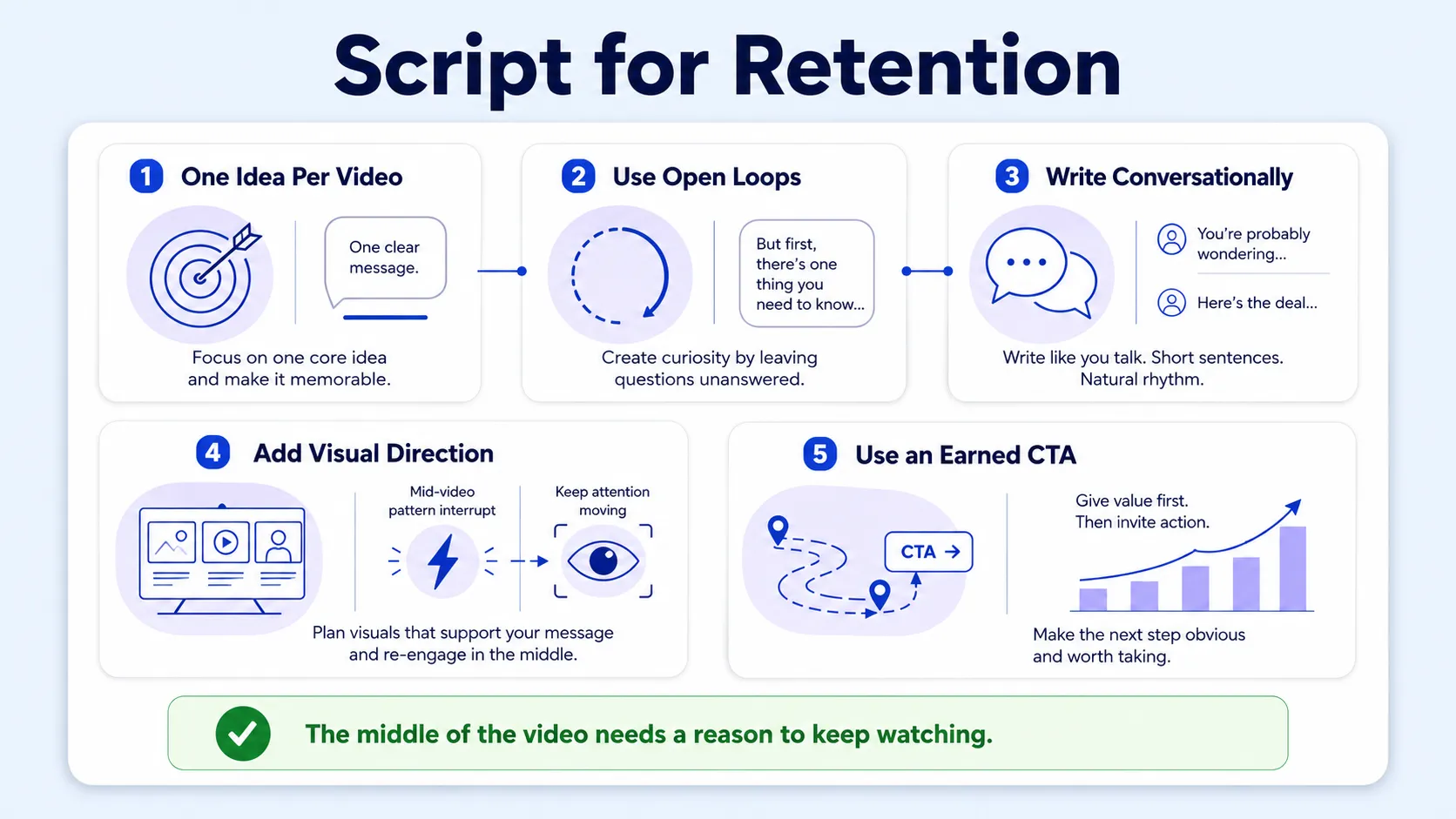
Around 60% of short-form videos are watched for 41% to 80% of their length. The drop zone is almost always in the middle, between 40% and 70% of the video's run time. Scripting a pattern interrupt or a value escalation at the midpoint (around the 20–25 second mark for a 45-second video) directly addresses this.
Wyzowl's 2026 State of Video Marketing report found that 63% of video marketers have used AI tools to help create or edit videos. The winners treat that output as a first draft, not a finished script. Use AI to generate a structure and first draft. Then rewrite it in your voice, with your buyer's specific language, before it ever gets filmed or repurposed.
The teams that build a repeatable scripting system, hooking, structuring, filming, and editing through a consistent process, are the ones showing up in their buyers' feeds week after week. That consistency is what builds the product trust and inbound demand that closes deals. If you want to see what that system looks like in practice, our services page shows how we build it for B2B teams from the ground up.
Conclusion
Short-form video scripting is not a creative exercise. It's a growth system.
- Every high-performing short video follows the same four-part structure: hook, bridge, value, CTA.
- 71% of viewers decide within the first few seconds whether a video is worth continuing, your hook is non-negotiable.
- Platform differences (TikTok vs. YouTube Shorts vs. Reels) change hook tone and pacing, not the underlying framework.
- The teams winning on short-form video in 2026 are not posting more, they're scripting better, repurposing smarter, and building systems that compound.
Start with one script, one platform, one buyer pain point. That's how the pipeline moves.
Frequently Asked Questions
Q1: How many words should a short-form video script be?
A 30-second script runs approximately 65–75 words. A 60-second script runs approximately 125–150 words. Write at a spoken pace of 125–150 words per minute, then time it aloud before filming. Tight scripts reduce editing time and improve on-camera delivery.
Q2: Can I use the same script for TikTok and YouTube Shorts?
The value delivery and CTA can stay consistent. The hook should be rewritten for each platform, TikTok requires a more aggressive, trend-native opening because your audience is cold, while YouTube Shorts can assume slightly more context from existing subscribers.
Q3: What's the fastest way to repurpose a webinar into short-form video scripts?
Identify the sharpest 45–60 second insight in the webinar, write a pattern interrupt hook around it, then script a brief bridge that connects the hook to the clip. Add captions and platform-specific visual direction. One 45-minute webinar typically yields five to eight standalone short-form scripts this way.
Q4: Do I need a full word-for-word script or just bullet points?
For beginners, a full word-for-word script reduces rambling and speeds up editing. For experienced on-camera speakers, a five-beat bullet outline works. Either way, write it out first, the discipline of scripting forces clarity even if you don't read it verbatim.
Q5: How often should a B2B team post short-form video content?
Consistency beats volume. One well-scripted video per week, posted consistently, outperforms five improvised clips. Build a content calendar around your scripting capacity, not your recording or editing speed. The script is the bottleneck most teams don't address.
Q6: What's the best call-to-action for a B2B short-form video?
The most effective B2B CTAs in short-form video are specific and low-friction: "Comment 'DEMO' for the template," "Follow for part 2," or "Link in bio to book a 20-minute call." Generic CTAs like "learn more" or "visit our website" underperform because they give the viewer no clear reason to act immediately.

