
🪄 AI Summary
Heading 1
Heading 2
Heading 3
Heading 4
Heading 5
Heading 6
Lorem ipsum dolor sit amet, consectetur adipiscing elit, sed do eiusmod tempor incididunt ut labore et dolore magna aliqua. Ut enim ad minim veniam, quis nostrud exercitation ullamco laboris nisi ut aliquip ex ea commodo consequat. Duis aute irure dolor in reprehenderit in voluptate velit esse cillum dolore eu fugiat nulla pariatur.
Block quote
Ordered list
- Item 1
- Item 2
- Item 3
Unordered list
- Item A
- Item B
- Item C
Bold text
Emphasis
Superscript
Subscript
Most B2B teams treat YouTube as a broadcast channel, upload and hope. That's a losing strategy. The YouTube algorithm and reach explained properly shows a system that now runs on viewer satisfaction, session depth, and content trust, not subscriber counts or raw watch time. For SaaS founders, marketing heads, and growth teams using video to drive pipeline, understanding what actually triggers distribution is the difference between a dead library and a compounding inbound engine.
TL;DR
- YouTube's algorithm in 2026 is built around one core idea: satisfaction-weighted discovery.
- Over 70% of all watch time on YouTube comes from algorithmic recommendations, not search or subscriptions.
- YouTube has 2.5 billion monthly active users globally as of Q1 2026.
- CTR, audience retention, and session contribution are the three metrics that move the needle most in 2026.
How Does the YouTube Algorithm Work in 2026?
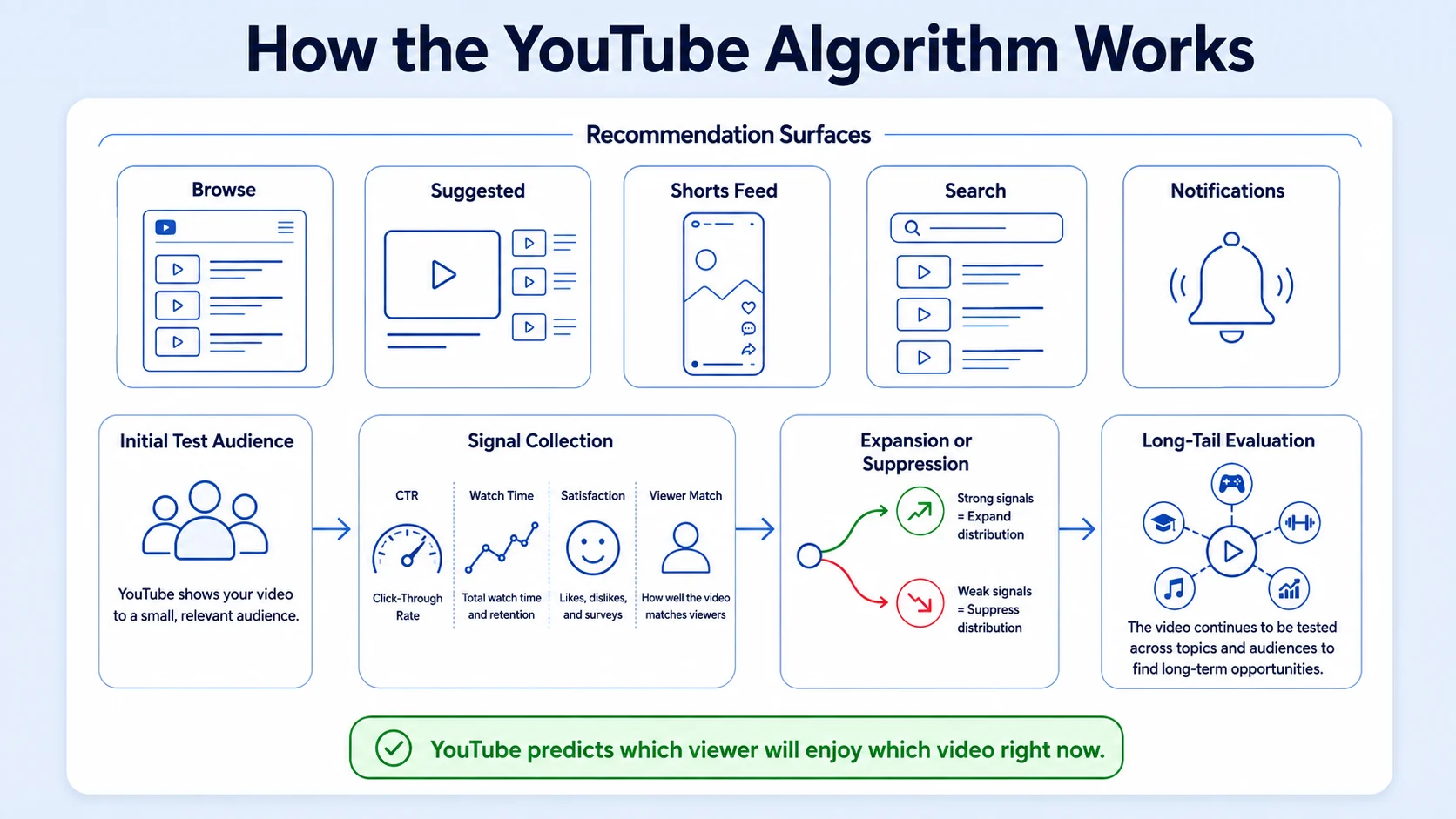
The YouTube algorithm is not a single system. It's a collection of recommendation engines, each built for a different surface: Browse (homepage), Suggested (sidebar and autoplay), Shorts feed, Search results, and Notifications. The algorithm is a machine-learning system that predicts which videos each viewer will watch and enjoy by scoring three ranking signals: engagement (CTR, watch time, comments, shares), satisfaction (post-video surveys, returns, the Not Interested button), and relevance (titles, descriptions, transcripts, on-screen text).
It ranks candidate videos by predicted satisfaction, not raw view count, and tests new uploads on small audiences before expanding reach when early signals are strong. The Content Discovery Engine works in phases. Here is how a new video moves through the system:
- Initial test distribution: YouTube shows the video to a small seed audience, weighted toward your existing subscribers who have engaged with similar content.
- Signal collection: CTR, early watch time, and comment velocity are measured against your channel's own historical baseline.
- Expansion or suppression: Strong early signals trigger wider Browse and Suggested placements. Weak signals stop distribution.
- Long-tail evaluation: Videos are evaluated based on whether viewers return, continue watching, and maintain trust in YouTube recommendations.
The recommendation system uses time of day and device as signals, identifying patterns like whether a viewer tends to prefer news in the morning and comedy at night. This means the same video gets shown to different viewers at different times, optimised per person, not per video. Two viewers searching for the same keyword can now get completely different thumbnails, creators, and video lengths, a direct result of the Viewer Satisfaction Score becoming a personalisation layer on top of standard Ranking Signals.
For B2B SaaS teams, this matters because your product demo or founder-led explainer competes not against other SaaS videos, but against whatever YouTube predicts that specific buyer will find most satisfying right now. Topical Authority Score, built through a consistent body of content on a specific problem space, is how you win that competition repeatedly.
YouTube Reach Statistics 2026-27: The Numbers That Matter
YouTube has 2.5 billion monthly active users globally as of Q1 2026, making it the second-largest social platform after Facebook. YouTube generated $36.1 billion in advertising revenue in 2025, a 14% increase from 2024's $31.5 billion. That revenue base signals where advertiser and creator attention is concentrated. Key platform benchmarks for the YouTube Algorithm and Reach Explained framework in 2026:
YouTube Shorts has 2 billion monthly users, ahead of TikTok (1.59 billion) and Instagram Reels (1.8 billion). 74% of Shorts views come from non-subscribers, making it YouTube's main discovery format. Channels that use Shorts combined with long-form grow 41% faster. The system processes over 80 billion signals daily to answer one question: "Will this specific viewer enjoy this specific video right now?"
For short-form video teams building B2B awareness, these numbers confirm that YouTube is not a supplementary channel. It is the primary video discovery infrastructure for buyers at every funnel stage.
What Factors Does the YouTube Algorithm Consider for Recommendations?
YouTube itself states that recommendations are shaped by what viewers watch, skip, search for, like, dislike, mark "Not interested," and by satisfaction surveys.
The ranking signal hierarchy in 2026, in rough order of weight:
- CTR: 4–8% is normal, 10%+ is excellent, and below 2% is critical. It is measured from impressions and read against your own channel average.
- Audience Retention Curve: Average view duration and average view percentage are core signals. Aim to keep 50%+ of viewers at the midpoint; 70%+ average retention earns priority distribution.
- Session contribution: Session contribution is the leading long-form signal. YouTube tracks whether viewers watched two more videos after yours or closed the app. Videos that extend sessions get more Suggested placements.
- Viewer Satisfaction Score: Viewer satisfaction has replaced raw watch time as the primary signal. YouTube now feeds 1–5 star pop-up surveys directly into ranking. A video viewers loved for 4 minutes beats one they tolerated for 8.
- Engagement Velocity: Comments outweigh likes significantly because they indicate time investment. Comment depth, the length of threads, back-and-forth between viewer and creator, carries more weight in 2026 than raw comment count.
- Relevance signals: Titles, descriptions, transcripts, and on-screen text feed the Search Intent Mapping layer that determines topical fit.
Transformer-based recommendation models infer topics from the content itself, which makes niche consistency matter more than hashtags.
For video marketing teams, this signal stack means production value alone does not drive reach. A well-structured, specific explainer that triggers genuine viewer response will outperform a polished generic brand video every time.
How Has the YouTube Algorithm Changed in 2026?
The 2025 playbook focused on watch time, CTR, and audience retention. Those signals still matter, but YouTube spent late 2025 and the first half of 2026 reshaping how they combine.
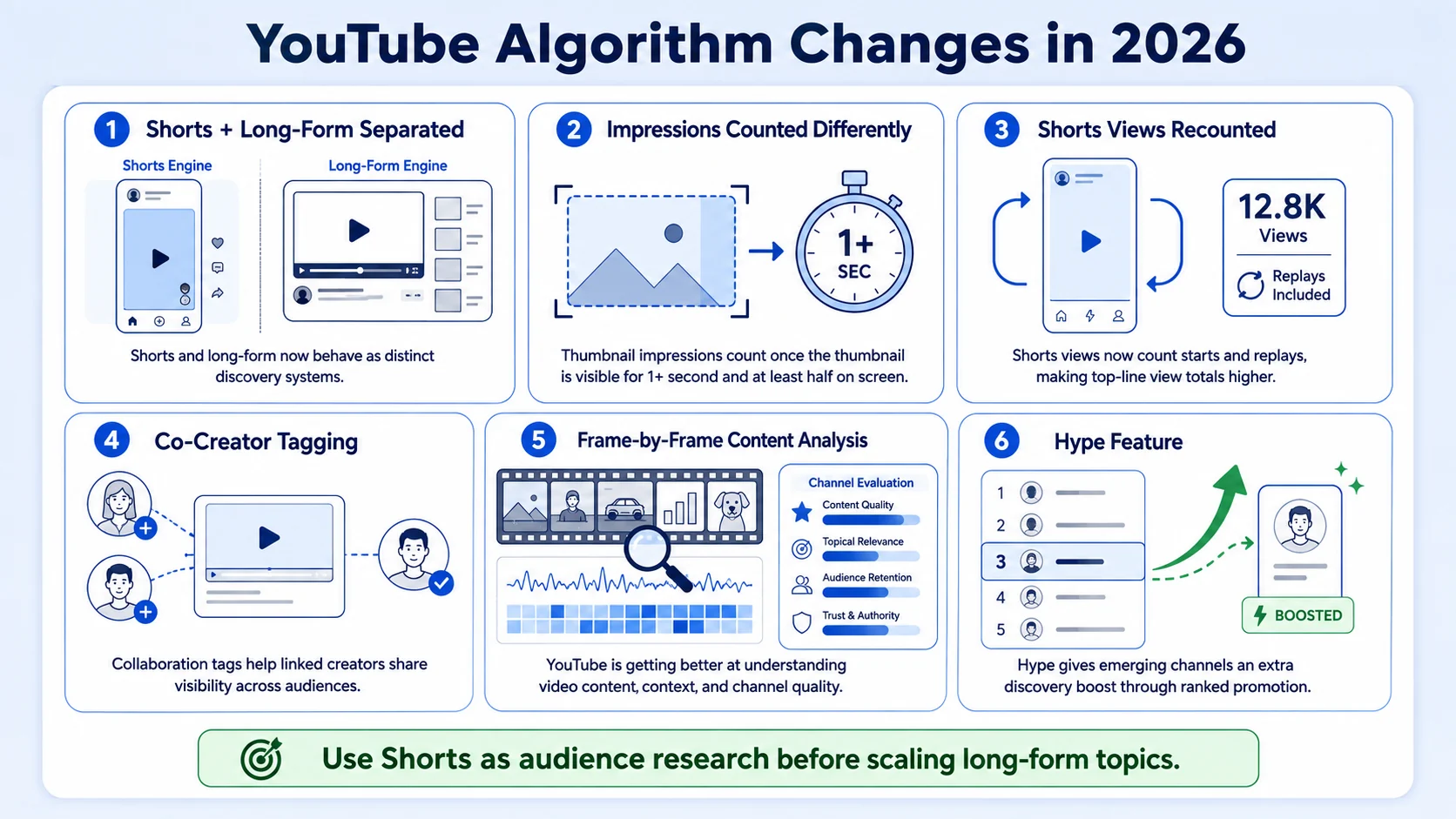
The most significant confirmed shifts:
- Shorts and long-form formally separated: The Shorts and long-form algorithms were formally separated. Bad Shorts no longer hurt long-form reach, and viral Shorts no longer pull viewers to long-form automatically. Each format is judged on its own merits.
- Impression counting overhauled: YouTube changed how impressions are counted. Previously, an impression was logged when your thumbnail appeared in a feed for a brief moment. Now, impressions are only counted when the thumbnail is visible on screen for at least 1.5 seconds. This means your impression count dropped (which is actually more accurate), and your CTR was recalculated against a smaller, more intentional pool of viewers.
- Shorts view counting changed: In March 2025, new Shorts view counting began: any play or replay counts as 1 view (no minimum watch time). Creators saw view counts jump approximately 30%.
- Co-creator tagging expanded: In September 2025, YouTube allowed tagging up to 5 creators in a single video , pushing that video to the audiences of all tagged channels simultaneously.
- AI content analysis deepened: AI content analysis now goes frame-by-frame on spoken content, with channel-level evaluation introduced and sentiment analysis added to ranking.
- "Hype" feature launched: Designed specifically for creators with 500 to 500,000 subscribers, this allows fans to "Hype" a new video, pushing it onto a dedicated leaderboard and giving it a temporary ranking boost in the Explore feed.
For B2B SaaS teams, the most actionable change is the Shorts-as-audience-research signal: Shorts have become a testing ground for long-form recommendations. Post a short clip of your webinar or demo, measure the audience response, then publish the full-length version with confidence.
Why Is My YouTube Reach Suddenly Dropping?
Channels with clean records and steady growth are reporting a sudden YouTube reach drop, sometimes 40–70% in a single week. Most of the time, the cause is diagnosable, not random. The most common reasons for declining views include seasonal changes in viewer behavior, a shift in your content that changed the audience signals the algorithm relies on, declining CTR due to thumbnail or title fatigue, or reduced retention because your content structure has become predictable.
A five-step diagnostic process using YouTube Studio Analytics:
- Check for policy issues first: Check YouTube Studio for policy notices or content warnings. Rule out a strike or demonetization before blaming the algorithm.
- Identify which metric moved: Compare CTR, retention, and satisfaction against your own channel's historical average.
- Isolate the traffic source: Check traffic sources. Did Browse, Suggested, or Search drop? Each points to a different fix.
- Match the drop to algorithm update dates: Match the drop date to the known update dates. A February dip in Browse traffic is likely the Browse feed overhaul, not your content.
- Fix one signal: Fix the one signal that broke. Ship 3 to 5 strong videos on proven topics instead of rebuilding everything.
A drop in reach is almost never the algorithm "punishing" you. It is the algorithm reacting to a change in viewer behaviour signals. The data inside YouTube Studio will tell you which one. In 2026, even subscribers only see your content if the algorithm predicts they will engage with it. Subscriber count is no longer equal to guaranteed reach. Every video is evaluated independently based on performance signals.
For SaaS teams publishing webinar content or podcast clips, the fix is almost always upstream: tighten the hook, make the first 30 seconds answer the viewer's specific question, and use end screens to extend sessions.
YouTube Algorithm vs TikTok Algorithm: Which Is Better for B2B Reach?
The honest answer is that they reward different things and serve different business goals. Here is the direct comparison:
TikTok is often better for fast early exposure, because the algorithm gives every post a chance to be tested with new viewers. But YouTube Shorts is often better for turning those early viewers into a longer-term content ecosystem.
For B2B SaaS teams focused on buyer education and pipeline, YouTube wins on two critical dimensions. First, content longevity: a well-optimised explainer video keeps generating impressions for months. Second, session depth: the Multi-Platform Distribution play works best when YouTube is the hub, with Shorts and clips driving traffic back to longer-form content that converts.
If your long-term goal is building a channel with multiple revenue streams, a loyal audience, and compounding growth, YouTube Shorts is the stronger foundation.
Native-per-platform always beats cross-posting, visible watermarks, wrong aspect ratios, and mismatched hook patterns all trigger distribution penalties.
Never simply repost a TikTok to YouTube Shorts without reformatting.
Best Practices to Beat the YouTube Algorithm in 2026
"Beat" is the wrong frame. The YouTube algorithm and reach explained correctly shows a system you align with, not a game. Here are the specific tactics that earn distribution in 2026:
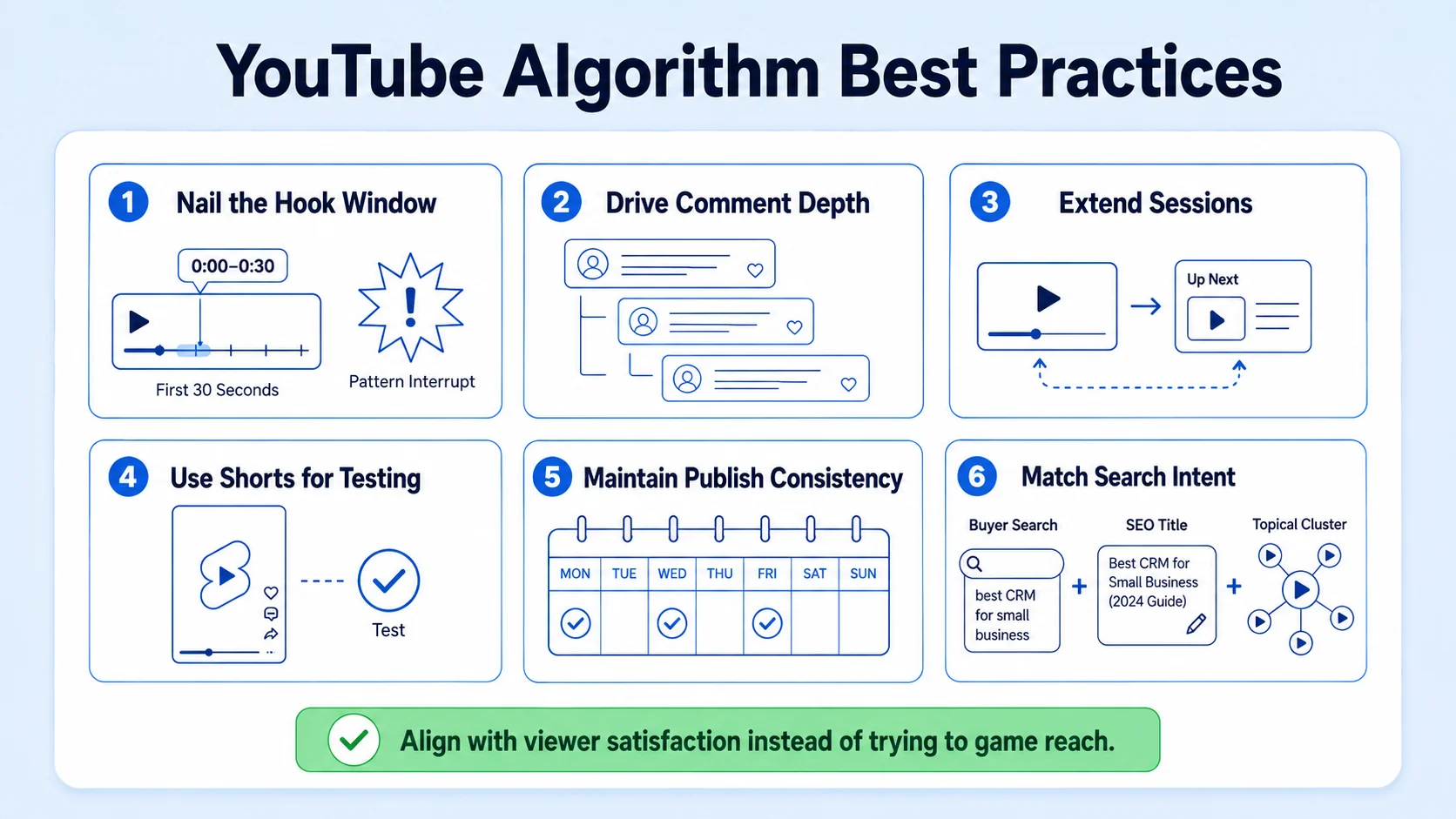
Nail the hook window: The first 7 to 30 seconds decide most of it. An early pattern interrupt keeps the retention curve from collapsing. For B2B content, open with the specific problem the buyer has, not your company name.
Drive comment depth, not just count: Channels replying to 50+ comments within 2 hours of posting see 15–20% higher reach during the test window. Seed your comment section immediately after publishing.
Optimise for session extension: When your video sits in a viewing session between two high-retention videos, you get a reach boost. Your end screen is a ranking tool. Link to a specific next video, not a generic subscribe CTA.
Use Shorts as a testing and discovery layer: 74% of Shorts views come from non-subscribers , making every Short a cold-audience test. Clips from webinars or demos that perform well as Shorts signal which full-length content to prioritise.
Maintain publish consistency: Upload gaps can cause temporary view drops because the algorithm deprioritises channels that stop publishing for extended periods, requiring a ramp-up period when you return. A Video SEO Framework built around consistent topical publishing compounds faster than burst-and-pause strategies.
Match search intent precisely: Search rewards intent match over exact keywords. Titles should answer the question a buyer is already typing, not just include the target keyword.
For YouTube video editing support that aligns production with these distribution signals, the work happens before export, structure, pacing, and hook architecture drive algorithm performance more than visual polish alone.
Conclusion
The YouTube Algorithm and Reach Explained in 2026 is a satisfaction-first, session-depth system running across five separate recommendation engines.
- Viewer Satisfaction Score and session contribution have replaced raw watch time as the primary drivers of distribution.
- CTR 10%+ and 70%+ average retention are the thresholds that unlock priority reach.
- Shorts and long-form are now independent systems, use Shorts to test audiences and drive discovery, and long-form to build trust and convert.
- For B2B SaaS teams, YouTube beats TikTok on content longevity, session depth, and buyer intent alignment.
Align your Video SEO Framework with how the algorithm actually evaluates content, and YouTube becomes a compounding inbound asset, not a content graveyard.
Frequently Asked Questions
Q1: How does the YouTube algorithm decide which videos to show on the homepage?
YouTube's algorithm recommends videos based on what you watch, how you interact with content, and when you're most active. It looks at thousands of different factors to serve up content each user is most likely to enjoy. Homepage Browse is primarily driven by past satisfaction signals and session history for that specific viewer.
Q2: Does subscriber count affect YouTube reach in 2026?
Small channels have a real shot at wide reach in 2026. The algorithm cares more about viewer response than subscriber counts or upload history. Subscriber count correlates with initial test distribution size but does not guarantee ongoing reach per video.
Q3: What is the Impressions-to-Views Ratio and why does it matter?
The Impressions-to-Views Ratio (also called CTR) measures how many people clicked after your thumbnail appeared. Videos from YouTube Search often have lower CTR (2–4%) because they appear among many options. Videos in Suggested see higher CTR (6–10%) because YouTube pre-selected them as relevant. A low CTR signals thumbnail or title misalignment with that audience.
Q4: How does Shorts Monetisation work in 2026?
YouTube collects all ad revenue from ads shown between Shorts, takes a 55% platform share, and distributes the remaining 45% to eligible creators proportionally based on their share of total monetised Shorts views in a given month. Your Shorts earnings depend not just on your own views, but on how your views compare to all other monetised Shorts in the same month.
Q5: What is Engagement Velocity and how does it affect reach?
Engagement Velocity is the speed at which comments, likes, and shares accumulate in the first 1–2 hours after publishing. The first 60 minutes are diagnostic: early engagement velocity trains the initial retrieval layer and determines whether a post reaches its second-tier audience. Publishing when your audience is active and seeding early comments directly lifts test-window reach.
Q6: Should B2B SaaS teams prioritise YouTube Shorts or long-form?
Both, in a specific sequence. Shorts handles discovery. Long-form handles conversion. Growth happens when both are used together. For SaaS teams, repurpose demos, founder interviews, and webinars into Shorts to build audience awareness, then let the algorithm surface your full-length content to warm viewers as the natural next step.