
🪄 AI Summary
Heading 1
Heading 2
Heading 3
Heading 4
Heading 5
Heading 6
Lorem ipsum dolor sit amet, consectetur adipiscing elit, sed do eiusmod tempor incididunt ut labore et dolore magna aliqua. Ut enim ad minim veniam, quis nostrud exercitation ullamco laboris nisi ut aliquip ex ea commodo consequat. Duis aute irure dolor in reprehenderit in voluptate velit esse cillum dolore eu fugiat nulla pariatur.
Block quote
Ordered list
- Item 1
- Item 2
- Item 3
Unordered list
- Item A
- Item B
- Item C
Bold text
Emphasis
Superscript
Subscript
Most funded tech startups treat YouTube like a vanity project: a few product demos, one founder interview, and a graveyard of uploads that go nowhere. That's not a YouTube strategy. The YouTube playbook for funded tech startups is about turning your capital, your product knowledge, and your founder's voice into a compounding asset that educates buyers, accelerates pipeline, and builds category authority. This guide gives you the full system, channel architecture, content mix, video SEO, distribution, and the mistakes that kill momentum before it starts.
TL;DR
- 60% of B2B buyers use YouTube during vendor research, your buyers are already there before they talk to sales.
- Fund your channel like a content system, not a one-off campaign: consistency compounds.
- Repurpose every long-form asset (webinar, demo, podcast) into short-form video to accelerate reach.
- Map every video to a funnel stage: awareness, education, or conversion, never create without a purpose.
Why Funded Tech Startups Should Prioritise YouTube Over Other Channels
You just raised. Every channel is now competing for budget: paid social, content, events, SEO. Here is why YouTube deserves a dedicated line item in your Series A marketing funnel. 73% of B2B buyers say video is their preferred way to learn about a product or solution, and 65% of executives visit a vendor website after viewing their video. That is not a soft brand metric. That is a pipeline signal.
Compare that to the other major channels:
LinkedIn and YouTube are driving the most measurable conversions in the B2B world in 2025. YouTube has one edge LinkedIn does not: permanence. A video you publish today surfaces in search results for years. A LinkedIn post is dead in 48 hours.
December 2025's algorithm overhaul reduced long-form video slots on home feeds by up to 80%, whilst YouTube Shorts now drive 200 billion daily views globally. For funded tech startups, that means one thing: you need both short-form discovery content and long-form conviction content working together. A single format is not enough. For B2B SaaS teams, the argument is even cleaner. "70% of B2B buyers watch YouTube videos during their decision-making process."
Your buyers are self-educating before they ever request a demo. The YouTube playbook for funded tech startups is how you show up in that self-education window and own it. The YouTube playbook for funded tech startups also gives your sales team something paid channels cannot: a library of evergreen assets. A great explainer video works in cold email, on your product page, and in a follow-up sequence simultaneously. YouTube is just one piece of a bigger system, a system designed to convert views into paying customers.
What Is the YouTube Strategy for Venture-Backed Startups?
The core mistake venture-backed startups make is treating YouTube as a broadcast channel. The right model is a content flywheel: publish, distribute, repurpose, and signal to the algorithm at every step.
A functional YouTube strategy for a venture-backed startup runs on three layers:
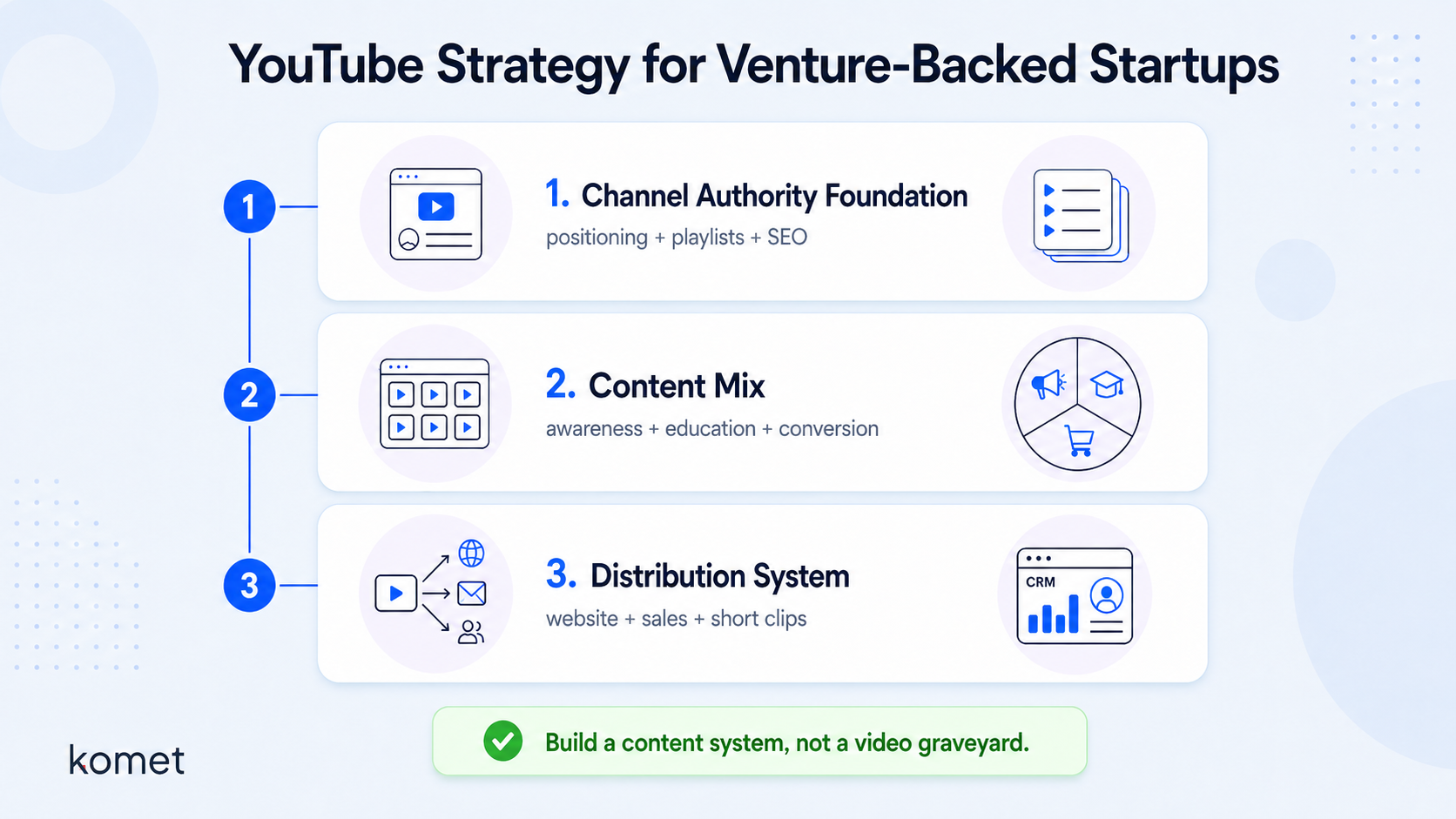
Layer 1, Channel Authority Foundation
Before you publish a single video, lock in these five structural elements:
- Channel positioning: State exactly who you serve and what problem you solve in the channel description. Buyers and algorithms need to know immediately.
- Playlist architecture: Organise content into at least three playlists mapped to funnel stages, Awareness, Education, and Conversion. Build TOFU-MOFU-BOFU playlists targeting each funnel stage.
- Visual identity: Establish a clear YouTube brand identity that aligns with your startup's overall brand strategy, consistency builds recognition and trust with your audience.
- Video SEO baseline: Conducting YouTube SEO research is critical. Use tools like VidIQ or TubeBuddy to identify low-competition, high-search-value topics relevant to your product.
- Publishing cadence: Commit to a cadence you can maintain. Inconsistency is the primary channel killer.
Layer 2, Content Mix
Every upload should serve a declared intent: awareness, buyer education, or pipeline conversion. Random tutorials with no strategic function are a waste.
Layer 3, Distribution System
YouTube content should not live on YouTube alone. Embed videos on product pages, slice clips for LinkedIn and short-form distribution, and use them in sales sequences. The channel compounds when distribution is intentional.
The YouTube playbook for funded tech startups is, at its core, a system. Not a series of uploads.
What Kind of Videos Should Funded Tech Startups Make?
This is the most misunderstood part of the YouTube playbook for funded tech startups. Most teams default to product walkthroughs. Those convert people already in-pipeline. You need content for every stage.
Here is the content matrix that actually builds channel authority:
Founder-led storytelling is your highest-leverage content type post-funding. Your investors backed a thesis. Your buyers need to understand that thesis before they'll trust your product. A founder video explaining why this problem matters and why now is more persuasive than any feature walkthrough.
Videos under 60 seconds have the highest completion rates across all platforms, and short-form videos (15–30 seconds) saw a 48% lift in click-through rate year over year. That makes Shorts a non-optional part of the mix. Use them to distribute the sharpest 30 seconds from every long-form video you produce. Every webinar, every podcast episode, every product demo has at least three clips in it.
Adding YouTube Shorts into your content mix can amplify reach. YouTube Shorts now generate over 70 billion daily views.
How Should a Series A Startup Approach YouTube Marketing?
Series A is a distinct moment. You have enough capital to build a real content infrastructure, but you are not yet at the stage where brand familiarity carries you. You are still earning trust. YouTube marketing at Series A should serve four goals simultaneously: SaaS brand awareness, buyer education, inbound demand generation, and sales enablement.
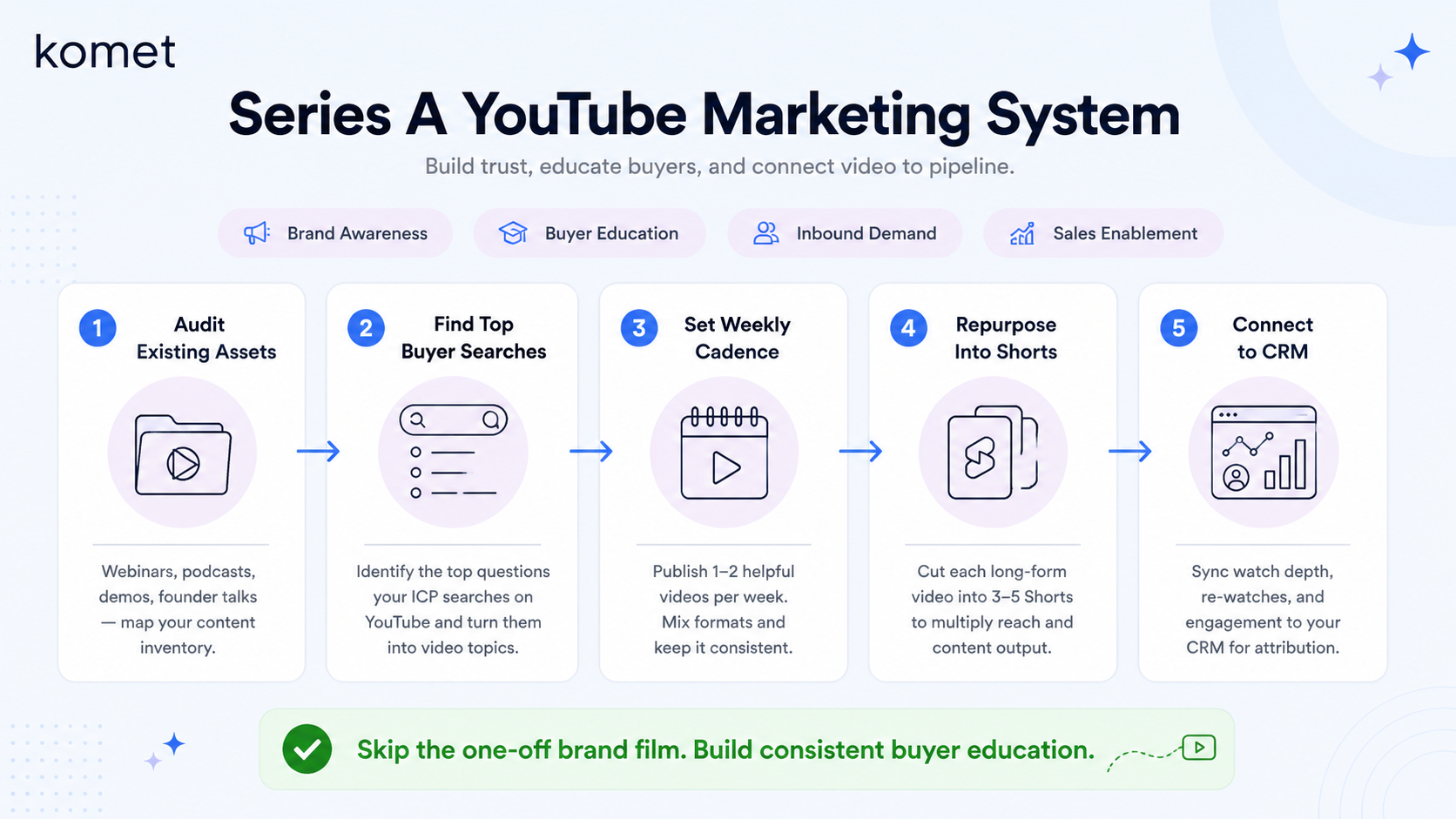
Here is the five-step build-out for a Series A YouTube approach:
- Audit what you already have: Every webinar, podcast recording, founder presentation, and demo call is raw content. Map these assets before spending a dollar on new production. Your existing content library is your starting inventory.
- Define your ICP's top five search queries: These become your first five long-form videos. What does your buyer type into YouTube before they even know your product exists? That is your SEO content brief.
- Establish a publishing cadence: Start uploading 1–2 videos per week, mixing formats like FAQs, customer journeys, or use-case walkthroughs.
- Build a short-form repurposing pipeline: Every long-form video produces three to five Shorts. This doubles your content output without doubling production cost. At Komet Media, this is the single highest-ROI move we implement for B2B video distribution.
- Connect YouTube to revenue attribution: Sync first-party engagement to the CRM. Push watch-depth, re-watch events, and chapter skips straight into HubSpot or Salesforce, then score them alongside emails and calls.
Series A teams should resist the urge to produce one expensive brand film. Consistent, specific, problem-led video will compound faster than any single polished production.
Video SEO Optimisation: How to Build YouTube Channel Authority for Startups
One of the most important aspects of a successful YouTube strategy is video optimisation, particularly the keywords you use in your video headlines and descriptions. They help tell YouTube what your video is about so your videos can appear in the right search results.
YouTube SEO for B2B startups operates differently from Google SEO. The signals that matter most are watch time, click-through rate on thumbnails, and viewer satisfaction (measured by likes, comments, and shares). Here is what to optimise on every upload:
- Title: Lead with the exact phrase your buyer searches. Not what you wish they searched, what they actually type.
- Description: Write 200+ words. Include the primary keyword in the first two sentences. Link to your demo, relevant service page, or lead magnet.
- Thumbnail: Use a 16:9 frame with bright contrast, a person's expressive look, and 4–5 words or fewer in an overlay. Show clearly what viewers will gain and keep a clean composition to avoid noise that weakens signal.
- Tags: Include primary keyword, secondary variants, and your brand name.
- Chapters: Break every video longer than five minutes into timestamped chapters. This creates index-able content inside the video and improves search snippet appearance.
- Closed captions: Enable closed captions to open accessibility, which supports diverse audiences and can lift saves and conversions.
- End screens and cards: Link viewers to the next relevant video, your playlist, or your website. End screens and cards should link to the next entry in the same series, boosting watches and keeping the player engaged.
Playlist-level SEO is underutilised. Name your playlists around search-intent phrases, not internal categories. "SaaS Onboarding Best Practices" outranks "Product Tips" every time. A video with a weak thumbnail loses 60–70% of its potential clicks before anyone watches a single second. Thumbnail investment is SEO investment.
YouTube Growth Playbook: Distribution, Repurposing, and the Content Flywheel
Publishing is the smallest part of a functioning YouTube growth playbook for B2B startups with funding. Distribution is where the compound effect lives.
The content distribution flywheel for a funded tech startup looks like this:
- Record a long-form video: founder interview, webinar, product demo, or podcast episode.
- Edit the full video for YouTube with proper SEO metadata, chapters, and a clear CTA.
- Clip three to five short-form moments (60 seconds or under) for YouTube Shorts, LinkedIn, and other channels.
- Embed the full video on relevant website pages, product pages, blog posts, landing pages.
- Distribute clips via the sales team in follow-up emails and outreach sequences.
- Analyse watch time and engagement. Double down on the topics that hold attention longest.
Video is very popular on most social networks and digital channels, so if you're taking the time to create YouTube videos, repurpose them to keep driving results. You can re-post or edit them specifically for your website and landing pages, blog, and marketing emails.
The repurposing system is the core of what we build at Komet Media for SaaS and tech-funded startup teams. Every piece of long-form content your team already produces, podcasts, webinars, founder talks, contains multiple short-form assets waiting to be extracted.
Some of the best YouTube channels for SaaS also double as learning hubs and lead magnets for product onboarding. Subscriber acquisition strategy follows the same principle. Subscribers grow when you give people a reason to return. Serialised content outperforms one-off uploads. Launch a three-part series on a single topic, with a recurring host, each episode 6–8 minutes, published on a cadence of every 3–4 days. This trains the algorithm and the audience simultaneously.
Mistakes Funded Tech Startups Make on YouTube (and How to Fix Them)
These are not theoretical mistakes. They are the patterns I see repeatedly when funded SaaS teams come to us after months of zero traction on their channel.
Mistake 1, No declared funnel intent per video. Many SaaS creators churn out videos without knowing who they're targeting or what action they want viewers to take. Every video needs a declared stage: awareness, education, or conversion. If you cannot answer "what does a viewer do next after watching this?", do not publish it yet.
Mistake 2, Product-first content. Buyers do not watch product demos of products they do not yet trust. Lead with the problem. Lead with the category. Build enough authority that the buyer wants to see how your product solves it. The best B2B films don't start with tech, they start with empathy. In every top-performing B2B video campaign, the team first asks "What keeps our buyer up at 2 a.m.?" and then reverse-engineers a story that hands them the antidote.
Mistake 3, No CTA architecture. Even if your videos get views, many SaaS companies fail to guide their audience to the next logical step, like signing up for a demo or downloading a free resource. Every video needs one CTA, stated verbally and shown on screen.
Mistake 4, Treating YouTube as isolated. YouTube without a downstream sequence is not a growth strategy. On average, it takes 2–4 weeks for someone to buy after discovering your SaaS product on YouTube. Multiple touchpoints like emails and additional videos are what turn curiosity into conversion.
Mistake 5, Skipping short-form. Long-form visibility on YouTube home feeds dropped significantly after the December 2025 algorithm update. Many B2B companies create only long-form content, missing 80% of discovery opportunities. Smart companies now use Shorts as the funnel top, mid-form for engagement, and long-form for deeper conversion-focused content.
Mistake 6, Inconsistency disguised as perfectionism. A polished video published once per quarter does less for channel authority than a well-structured, consistently published video every week. The YouTube algorithm rewards cadence. So do buyers who keep seeing your name.
Conclusion
The YouTube playbook for funded tech startups is not complicated, but it requires discipline. Here is what to take away:
- Map every video to a funnel stage before you film anything. Purpose precedes production.
- Founder-led storytelling is your highest-trust, lowest-cost content type. Use it.
- Build the repurposing flywheel: every long-form asset becomes three to five short-form clips.
- Connect YouTube watch data to your CRM. Views without pipeline context are vanity.
- Consistency and video SEO optimization compound over time. The teams that start now will own category authority in 12 months. The teams that wait will pay to catch up.
Ready to build the system? Talk to Komet Media.
Frequently Asked Questions
1) How soon after raising funding should a startup launch their YouTube channel?
Immediately after your post-funding announcement is the best time. Post-funding visibility is high, press coverage drives branded search, and YouTube captures that intent. Launch with three to five foundational videos ready, do not publish one and go quiet.
2) How many videos per week should a funded B2B startup publish on YouTube?
Start with one long-form video per week and three to five YouTube Shorts derived from it. Uploading 1–2 videos per week, mixing formats like FAQs, customer journeys, or use-case walkthroughs , is a sustainable cadence that signals consistency to the algorithm.
3) What metrics should Series A startups track on YouTube beyond views?
Track watch time, average view duration, click-through rate on thumbnails, and downstream conversions (demo requests, email signups). Views alone tell you nothing about pipeline impact. Tie YouTube engagement data to your CRM for real attribution.
4) Should a startup's founder appear on camera for YouTube?
Yes. Founder-led content outperforms brand-only content in trust and engagement, particularly in B2B. Buyers want to understand the person behind the product. Founder-led storytelling is a core part of the YouTube playbook for funded tech startups and directly supports investor pitch narrative credibility with buyers.
5) Is YouTube worth the budget compared to LinkedIn for a B2B SaaS startup?
Both channels serve different purposes. LinkedIn drives immediate reach with your existing network. 60% of B2B buyers use YouTube during vendor research , making YouTube the superior platform for organic reach acceleration and long-term SEO, your videos compound in value indefinitely. The strongest startups run both.
6) How does content repurposing fit into the YouTube playbook for funded tech startups?
Repurposing is the efficiency engine of the whole system. A single webinar or podcast episode can produce a full-length YouTube video, five Shorts, and three LinkedIn clips. This multiplies your content output without multiplying production time or cost, and it is the primary way the YouTube playbook for funded tech startups scales without a massive in-house team.