
🪄 AI Summary
Heading 1
Heading 2
Heading 3
Heading 4
Heading 5
Heading 6
Lorem ipsum dolor sit amet, consectetur adipiscing elit, sed do eiusmod tempor incididunt ut labore et dolore magna aliqua. Ut enim ad minim veniam, quis nostrud exercitation ullamco laboris nisi ut aliquip ex ea commodo consequat. Duis aute irure dolor in reprehenderit in voluptate velit esse cillum dolore eu fugiat nulla pariatur.
Block quote
Ordered list
- Item 1
- Item 2
- Item 3
Unordered list
- Item A
- Item B
- Item C
Bold text
Emphasis
Superscript
Subscript
The way B2B buyers make decisions has permanently shifted. Video in the buyer journey: what changed is no longer a theoretical question, it's a live competitive gap. Buyers research independently, shortlist vendors based on content they've already consumed, and arrive at sales calls with strong pre-formed opinions. If your team isn't showing up on screen before the first discovery call, you're being evaluated against competitors who are. Here's a complete breakdown of what's different, why it matters, and what B2B SaaS, AI, and tech startups and teams need to do about it.
TL;DR
- Half of all B2B buyers turn to video when they are actively evaluating whether to buy.
- 72% of B2B buyers say vendor video content influences their vendor shortlist decisions before a sales team enters the conversation.
- Short-form video now operates across the full funnel, not just awareness.
- Founders and product experts at B2B SaaS, AI, and tech startups who show up on video build pipeline faster than teams relying on written content alone.
How Video Changed the Buyer Journey: The Structural Shift
The old buyer journey was linear: awareness, consideration, decision, each neatly gated by a sales rep handing over the next piece of content. That model is gone. Today's buyer has already completed roughly 70% of their research independently before speaking to your sales team, and an estimated 80% of B2B sales interactions will occur via digital channels. Video is the primary medium through which that independent research now happens. About 70% of B2B buyers watch video during their purchasing journey, and buyers now use video across research, evaluation, and final vendor selection, so teams that produce video for each stage have a clear advantage in converting viewers into customers.
The mechanism behind this is what Google originally called the Zero Moment of Truth (ZMOT): the decisive pre-purchase research moment that now happens long before any human contact. For B2B buyers, that moment is increasingly spent watching product walkthroughs, founder explainers, and customer stories on LinkedIn and YouTube, not reading white papers. Critically, 72% of B2B buyers say vendor video content shapes their shortlist before the sales team is ever involved. That means the competitive cut is happening invisibly, in a buyer's feed, during research they never announce to you.
This is the core structural change: video has migrated from a sales support tool to the primary trust-building mechanism at the top and middle of the funnel. Teams without a video presence aren't just missing impressions, they're losing shortlist spots. The buying committee has also expanded. The average B2B deal now involves multiple stakeholders, and research from Demand Gen Report shows the average buyer interacts with 13 pieces of content before deciding on a vendor. Each of those stakeholders consumes content independently. Video is the only format that scales consistently across all of them.
What Role Does Video Play in B2B Buying Decisions Today?
Video's role has expanded from optional awareness play to core purchase infrastructure. The data makes this hard to argue against. 98% of B2B decision-makers have watched explainer videos, and 87% of B2B buyers say video influenced their purchase decisions. 58% of B2B decision-makers say they trust video content from brands more than blog posts (at only 39%). Trust is the operating currency in B2B deals, and video earns it faster than any other format.
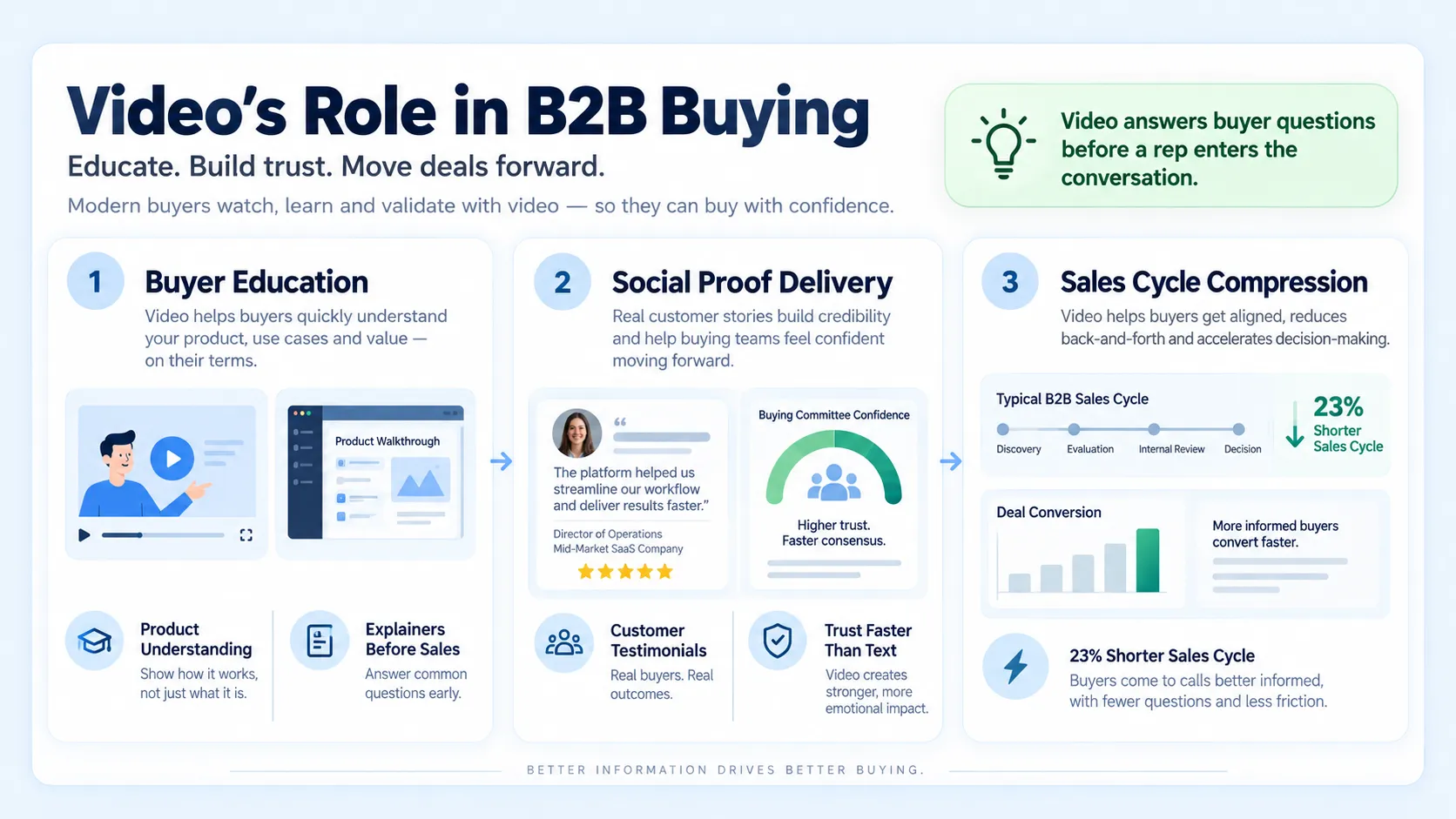
Three specific functions video now serves in B2B buying:
- Buyer education at scale: 93% of video marketers say video has helped increase user understanding of their product or service. For SaaS products with complex feature sets, this is irreplaceable.
- Social proof delivery: Videos featuring customer testimonials have a 44% higher conversion rate in the decision stage than videos without testimonials.
- Sales cycle compression: On average, B2B video content shortens the sales cycle by 23%.
The video marketing services that move the pipeline aren't high-production brand films. They're tight, specific videos that answer the exact questions a buyer has at each stage, and they're built systematically, not one-off—whether starting completely from scratch or repurposing existing assets. 62% of B2B buyers say they watch explainer videos to better understand a product before moving further in the sales process. That figure alone explains why product explainers, demo clips, and founder-led breakdowns belong at the centre of your content plan, not at the bottom of the backlog.
What Types of Video Work Best at Each Buyer Journey Stage?
Not all video formats serve all funnel stages equally. The mistake most B2B SaaS, AI, and tech teams make is producing one type of video and calling it a strategy.
Your top-performing mix will include ultra-short content for awareness, 1–2 minute explainers for consideration, and longer walkthroughs for evaluation. Vidyard usage data shows videos under one minute achieve a 65% completion rate among B2B viewers, while videos over 20 minutes retain only 20%. Completion rates are a direct signal of purchase intent, a buyer who watches to the end is a buyer who's seriously evaluating.
For B2B SaaS, AI, and tech startups specifically, the highest-leverage formats are product demos, feature walkthroughs, and founder commentary that contextualises the problem being solved. In 2026, short-form video (typically characterised as being under 90 seconds) has moved from a nice-to-have to a must-have in B2B marketing, allowing teams to distill complex information into digestible, memorable content.
Short-form video editing done well isn't about following trends, it's about matching format to where the buyer's head is at that exact moment in their research.
Has Video Replaced White Papers? How Buyers Consume Content Now
The honest answer: video hasn't fully replaced white papers, but it has displaced them from the centre of the consideration stage. 73% of B2B decision-makers prefer a short or demo video over reading a white paper. That preference gap is significant enough that building your consideration-stage content around written assets alone is a structural disadvantage.
The deeper shift is in how buyers move through content. The average buyer interacts with 13 pieces of content before deciding on a vendor, and the formats that earn the most time are the ones that are fastest to consume and highest in trust signal. Video wins both categories. What this means in practice:
- White papers still have a role for late-stage technical validation and procurement reviews.
- Video dominates early consideration: problem framing, vendor comparison, and initial trust formation.
- Short-form video content grabs attention, but customer testimonials and peer reviews drive the final decision, meaning video and social proof work best together, not in isolation.
The content repurposing strategy that actually scales is not choosing between formats—it's having the flexibility to build brand-new content from scratch or extract video from the long-form content and recordings you already have. A webinar becomes five short clips. A podcast episode becomes a LinkedIn post plus three 60-second videos. A demo call becomes a testimonial-forward case study clip. Teams that wait for a buyer to request a white paper before engaging them have already lost the consideration stage to a competitor whose video was in the buyer's feed two weeks earlier.
Why Video Is More Effective Than Text in the Consideration Stage
This comes down to decision-making psychology and cognitive load. A buyer evaluating five vendors can't give deep reading attention to each vendor's content library. Video compresses complex information into a format that's absorb-able passively, on a commute, between meetings. B2B buyers are 34% more likely to remember product details after watching a video versus reading a datasheet.
Memory is a prerequisite for influence, if a buyer can't recall what differentiates your product, your positioning didn't land. Video ads have a 95% higher retention rate compared to text-based content. In the attention economy, retention is everything. It's what keeps your brand in the consideration set when the buyer finally calls a shortlist meeting.
Founder-led content adds another layer. When a founder or senior leader appears on screen explaining the problem they solve, they're not just communicating information, they're demonstrating conviction. When paired with customer testimonials, this approach combines two of the most persuasive forces in decision-making, emotional storytelling and peer validation, which is especially powerful in B2B sales where purchases are high-stakes and involve multiple decision-makers.
LinkedIn reported a 34% year-over-year increase in video uploads in Q4 2024 and a 36% year-over-year growth in total video viewership in 2025, and this is specifically the platform where B2B consideration-stage content does its highest-value work. A founder's POV clip on LinkedIn reaches buyers in a professional context, at exactly the moment they're thinking about work problems.
If your team isn't repurposing podcast content and webinar footage into short-form clips that live on LinkedIn and YouTube, you're leaving your most persuasive content locked in long formats that most buyers never finish.
How to Use Video to Move Prospects Through the Sales Funnel Faster
The teams winning with video in 2026 aren't producing more, they're producing smarter, at each stage, with clear intent behind every asset. Here's how to structure it:
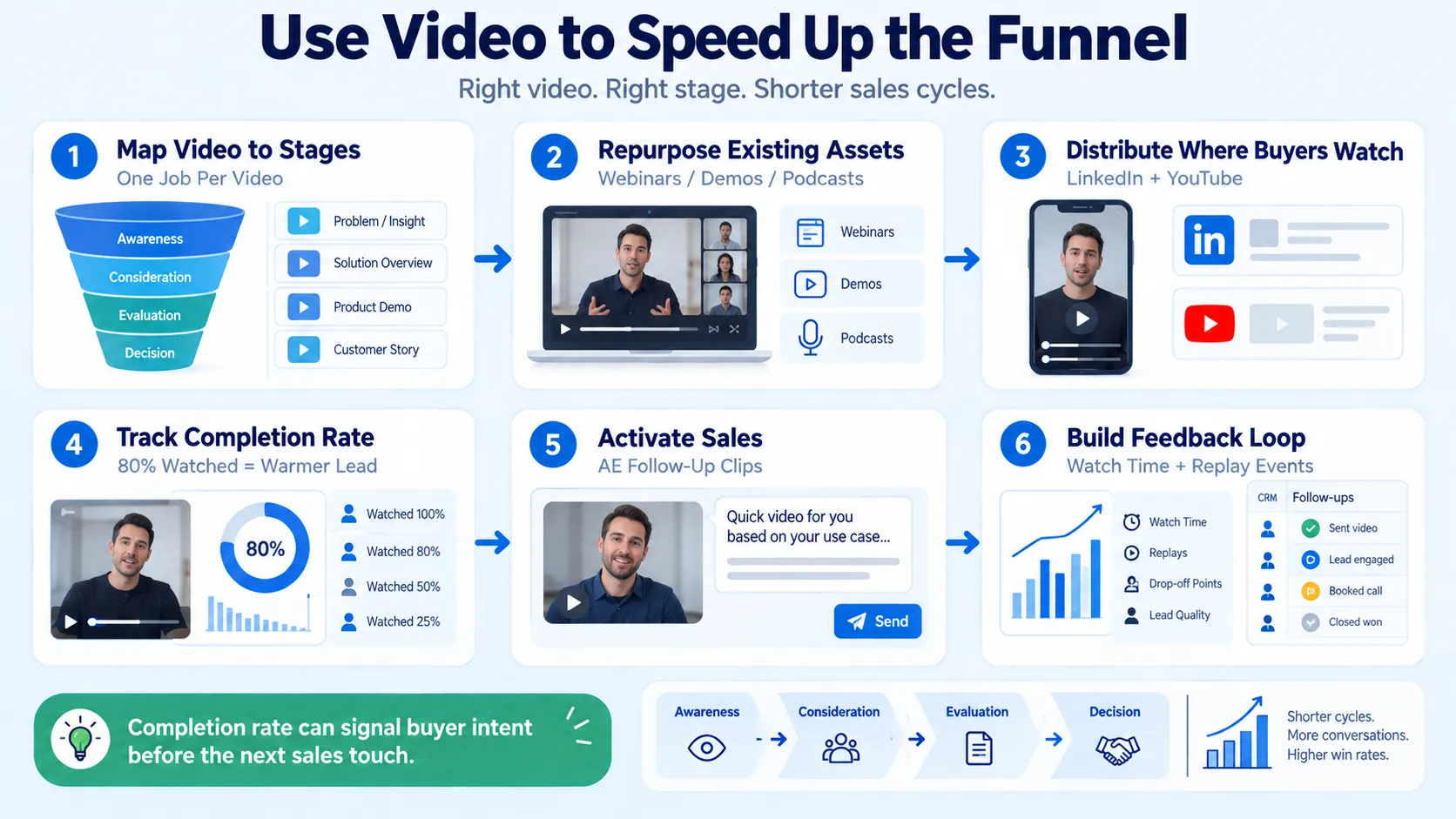
- Map your video to pipeline stages: Assign a specific video type to each stage (awareness, consideration, decision, post-sale). Every piece of content should have a single job.
- Flexible production approach: Whether producing brand-new videos entirely from scratch or pulling clips from existing webinars, demos, podcasts, and founder calls, ensure your pipeline remains steadily supplied.
- Distributed on buyer-native platforms: B2B videos published on social media generate 45% more views than videos shared via email campaigns. LinkedIn and YouTube are where consideration-stage buyers spend time, meeting them there.
- Use completion rate as a pipeline signal: A buyer who watches 80% of your demo video is a warmer lead than one who downloaded your white paper. Video matters across research, evaluation, and final vendor selection, not just at the top of the funnel.
- Activate sales with video: Short personalised clips sent by AEs after a first meeting reinforce the message, reduce objections, and keep momentum. B2B videos with clear calls-to-action generate 42% higher conversion rates than those without.
- Build a feedback loop: More than 60% of B2B companies now track video engagement metrics as part of their campaign performance evaluation. Watch time, completion rates, and replay events are purchase intent signals, use them to prioritise follow-up.
Explore Komet Media's B2B video growth services to see how we build these systems for B2B SaaS, AI, and tech startups and teams.
Conclusion
Video in the buyer journey: what changed is structural, not cosmetic. Buyers now self-educate through video before your team ever speaks to them, and the shortlist is shaped by what they watch, not what they read.
Key takeaways:
- 70% of B2B buyers engage with video during purchasing, and 72% say vendor video shapes their shortlist.
- Short-form video wins at awareness and consideration; testimonials close the gap at decision stage.
- The best content strategy combines creating content from scratch with repurposing existing assets (podcasts, webinars, demos) into targeted short-form clips.
- Founder-led video builds the kind of trust that written content cannot replicate at scale.
Talk to Komet Media about building your video system.
Frequently Asked Questions
Q1: How has video changed the B2B buyer journey?
Video moved from a sales support tool to the primary trust-building mechanism across the entire funnel. Buyers now research via video independently before engaging sales, and vendor shortlists are shaped by content consumed, not conversations had.
Q2: What role does short-form video play in B2B buying decisions today?
Short-form video, typically under 90 seconds, has moved from a nice-to-have to a must-have in B2B marketing, allowing teams to distill complex information into digestible content that captures busy executives in seconds. It dominates awareness and early consideration.
Q3: Has video replaced white papers in the B2B sales funnel?
Not fully, but 73% of B2B decision-makers prefer a short or demo video over reading a white paper. White papers retain value for late-stage technical review; video owns the consideration stage where initial trust and preference are formed.
Q4: What types of video convert best at the decision stage?
Videos featuring customer testimonials have a 44% higher conversion rate in the decision stage than videos without testimonials. Case study walkthroughs and specific ROI-focused clips also perform strongly when the buyer is evaluating final shortlist options.
Q5: How does video content shorten the B2B sales cycle?
Video compresses buyer education that would otherwise require multiple sales calls. On average, B2B video content shortens the sales cycle by 23%. Buyers arrive at sales conversations more informed, reducing the time spent on basic discovery and objection handling.
Q6: What is the most common mistake B2B teams make with video?
Producing one format and treating it as a full strategy. Most teams create a brand explainer and stop. The higher-leverage approach is building stage-specific video assets—awareness clips, consideration explainers, decision-stage testimonials—either by creating new videos from scratch or leveraging existing recordings and footage. This ensures video in the buyer journey works as a connected system, not a single touchpoint.