
🪄 AI Summary
Heading 1
Heading 2
Heading 3
Heading 4
Heading 5
Heading 6
Lorem ipsum dolor sit amet, consectetur adipiscing elit, sed do eiusmod tempor incididunt ut labore et dolore magna aliqua. Ut enim ad minim veniam, quis nostrud exercitation ullamco laboris nisi ut aliquip ex ea commodo consequat. Duis aute irure dolor in reprehenderit in voluptate velit esse cillum dolore eu fugiat nulla pariatur.
Block quote
Ordered list
- Item 1
- Item 2
- Item 3
Unordered list
- Item A
- Item B
- Item C
Bold text
Emphasis
Superscript
Subscript
If you are a B2B Founder or Marketer and you've been thinking about starting your Personal Brand or a social media channel but don’t know where to start. This blog solves that.
You don't need a production studio. You don't need a professional camera. You don't need 10,000 followers before anyone takes you seriously. What you need is the right first video and then the second, and the third until creating content becomes as natural as sending an email.
The problem isn't that B2B founders and marketers lack things to say. You have years of hard-earned experience, opinions that would genuinely help your buyers, and stories that no one else can tell. The problem is the blank screen. The blinking cursor. The "where do I even begin?"
That's exactly what this blog is for.
What Makes a Good B2B Video?
Before diving into the 10 ideas, let’s understand what separates B2B videos that get traction from the ones that disappear. The best first B2B videos all share a few qualities:
1/ They have a clear, specific audience. "This is for SaaS founders struggling with churn in their first 12 months" will always outperform "this is for anyone in business." The narrower your audience, the louder your message lands for the right person.
2/ They have a point of view. Educational content is everywhere. What's rare is a human being who says "here's what I actually think about this." A perspective is your biggest competitive advantage as a creator, especially in B2B, where most content is deliberately bland so it offends no one.
3/ They respect the viewer's time. B2B buyers are busy. They will click away from anything that doesn't earn their attention in the first five seconds. Get to the point fast, stay there, and stop when you're done.
4/ They are easy to share. The best B2B content gets forwarded in Slack channels, linked in newsletters, referenced in team meetings. Ask yourself before you publish: "Would someone send this to a colleague?" If the answer is no, sharpen the angle.
5/ They don't require a studio. If your first video requires professional lighting, a video editor, and a script consultant, you will never publish it. The best B2B videos are filmed on a smartphone in a quiet room. Start there.
Below are 10 Video Format Ideas for New B2B Creators
For each idea, you'll get a breakdown of what it is, why it works, and how to execute it.
Let's get into it.
IDEA 1: FOUNDER STORY
Your origin story is the most slept-on asset you have as a B2B founder. Buyers do business with people they trust. Trust starts with understanding why you exist. Film a single-take, face-to-camera video telling the moment you decided to build your company. Keep it raw, not polished.
This is your highest-leverage first video. It answers the question every new follower has: "Who are you and why should I care?" It also ranks in search when people look up your name + company.
Example: Marshall Hass
Marshall Haas opens with a powerful hook. He says he built and sold his last company for 52 million in four years and only worked 782 hours on the business because he tracked every hour. That instantly builds credibility and challenges the hustle narrative.
He reframes success as systems, clear delegation, and documented processes, not long hours. Then he highlights a common founder's pain. Everyone knows they need SOPs, but almost no one creates them because documenting processes is slow and painful.
That is why he built the Outliner. The tool lets founders record their process while working and automatically turns it into structured SOPs using AI.
The story works because it moves from credibility to shared struggle to solution, making the product feel like a natural outcome of lived experience, not a sales pitch.
How can you execute this?
- Find a quiet space. The phone camera is fine, seriously.
- Tell it in this structure: Problem you faced → Moment of decision → What you built → Who it's for.
- Keep it under 90 seconds. If it's longer, cut the middle.
- Don't write a script, be natural. Authenticity beats polished content every time in B2B.
IDEA 2: DOCUMENT JOURNEY VIDEOS
One of the most powerful content strategies for a B2B founder is simple. Share the journey while you are still in it. Most founders only post when they have a big win, a funding announcement, or a polished success story. But buyers do not connect with highlight reels. They connect with progress. They connect with momentum. They connect with honesty.
Sharing the journey means documenting what is happening right now inside your company. What you are testing. What is working? What is failing? What changed your mind about this week? This builds trust faster than traditional marketing because people feel like they are growing with you, not being sold to.
Example: Vin Matano’s Reels
A strong example of this approach is Vin Matano. Instead of positioning himself as a finished success, he documents the journey of building his B2B company in real time. His content openly shares early struggles, in progress thinking, wins and failures, and lessons learned while building his company.
He does not act like he has everything figured out, and that is precisely why it works. The journey feels relatable instead of aspirational. In a market crowded with experts, buyers increasingly trust founders who are transparent about the process more than those who pretend to have all the answers.
How can you execute this?
- Post about what is happening inside your business right now, not after it is resolved, but while you are still in the middle of it. That is where the real story lives.
- Pick one thing you changed your mind about this week. Film a 60-second explanation of why.
- Share a failure or a stuck moment before you know the outcome. "We tried X. It didn't work. Here's what we're doing next."
- End each video with the next step you are taking. This gives your audience a reason to come back and follow the thread. It turns isolated posts into an ongoing narrative, and narratives build loyalty.
IDEA 3: FEAR REMOVING VIDEOS
One of the most powerful types of founder content is removing a common fear. Many B2B founders believe they cannot build a tech product because they do not know how to code. That belief alone keeps great ideas stuck.
Instead of pitching features, address that fear directly. Show what is actually possible today. When you make the path look simpler, you build trust and authority at the same time.
Example: Kevin’s Reel
In this reel, Kevin says he is a non technical founder building a tech product with zero coding skills. He walks through the AI tools he uses for coding, backend, storage, and transcription. He keeps it practical and straightforward. He also admits that he still reaches out to developers or designers if he gets stuck.
The message is simple. You do not need to be technical to start building. You need the right tools and the willingness to experiment. That clarity is what makes this format powerful for B2B founders.
How can you execute this?
- Talk about the fear your audience secretly has. Not enough funding. Not technical enough. Not ready yet. Then break it down with your real experience.
- Show what you are using right now. What tools made it easier. What surprised you. What is still hard.
- Be honest about where you needed help. That makes it credible.
- End with a clear belief shift. Something like, you do not need to be technical to start. You just need to start.
- When you remove fear, you remove friction. And when you remove friction, people move closer to action.
IDEA 4: MISTAKE STORIES
One of the most powerful types of founder content is sharing a real client mistake you made early on. Not a polished case study. Not a big win. A genuine misstep.
In B2B, most founders only talk about successful launches and happy testimonials. But mistakes build more trust than perfection ever will. They show maturity, accountability, and growth.
Example: jaeyippy’s Reel
In this story, the founder shares one of her worst early client disasters. It was a crucial launch project. The client warned that responses might be slow, but the founder did not proactively remind her about deadlines. Communication delays piled up. The launch date got too close. The project was nowhere near ready.
The client was upset. The founder felt blamed. Instead of resetting expectations clearly, the project was passed to another Shopify developer and the relationship quietly ended. No dramatic fight. Just disappointment on both sides.
The lesson was simple but powerful. Do not assume clients will manage their own deadlines. A soft reminder can save a project. A simple message like, “Hey, just flagging this so we stay on track for launch,” can protect both sides.
How You Can Execute This
1. Set the stage clearly. Briefly describe what the project was and why it mattered.
2. Be honest about what went wrong. Focus on your decision or assumption that contributed.
3. Share the emotional truth. How did it feel at the time? What was awkward or uncomfortable?
4. Reveal what you changed. For example, “Now I send deadline reminders proactively.”
5. End with a lesson your audience can apply. This turns a personal story into universal value.
Stories like this work because they show that you are a thoughtful founder who learns and improves from real challenges, not a perfectionist hiding behind filtered results.
IDEA 5: SPEND THE DAY WITH ME
One of the most powerful types of creator content is documenting a real, high-pressure day while building your career or company. Not a motivational quote. Not a highlight reel. A genuine behind-the-scenes look at what it actually takes.
In B2B, most creators talk about strategies and frameworks. But showing the work builds more trust than explaining the work ever will. It shows stamina, ownership, and operational depth.
Example: Natasha Badger
Natasha documents a day where she hosts two back-to-back events while juggling three roles:
- Demand Gen Marketer at a tech startup
- Founder of The Marketing Groupe community
- Content Creator
The day starts with setting up an executive luncheon for customers and prospects. She oversees marketing channels and adds personalized, influencer-style touches to make B2B feel human and fun.
Right after wrapping, she rushes home with only 10 minutes to change before heading to her second event. In the chaos, she forgets one of the most important branding elements - the community poster. She has to go back and retrieve it because aesthetics and brand experience matter deeply for community growth.
The event ends up being a success. Twenty marketers show up. The theme lands. People make new connections. She closes the day exhausted but proud.
How You Can Execute This
- Pick one high-pressure day where multiple responsibilities overlap.
- Film small, real moments instead of staging perfect shots.
- Show at least one problem or unexpected challenge.
- Capture the outcome, whether messy or successful.
- End with one clear lesson about execution or time management.
IDEA 6: LIFE OOO (Out Of Office) VIDEOS
Life Outside the Office videos show the human side of a founder beyond meetings, metrics, and marketing. This can include travel series, dream activities like cliff jumping or bungee jumping, fitness routines, hobbies, or team offsites. Instead of only focusing on products or services, this content highlights personality, passions, and real experiences that make you relatable and approachable.
Example: Rajan’s Travel Series
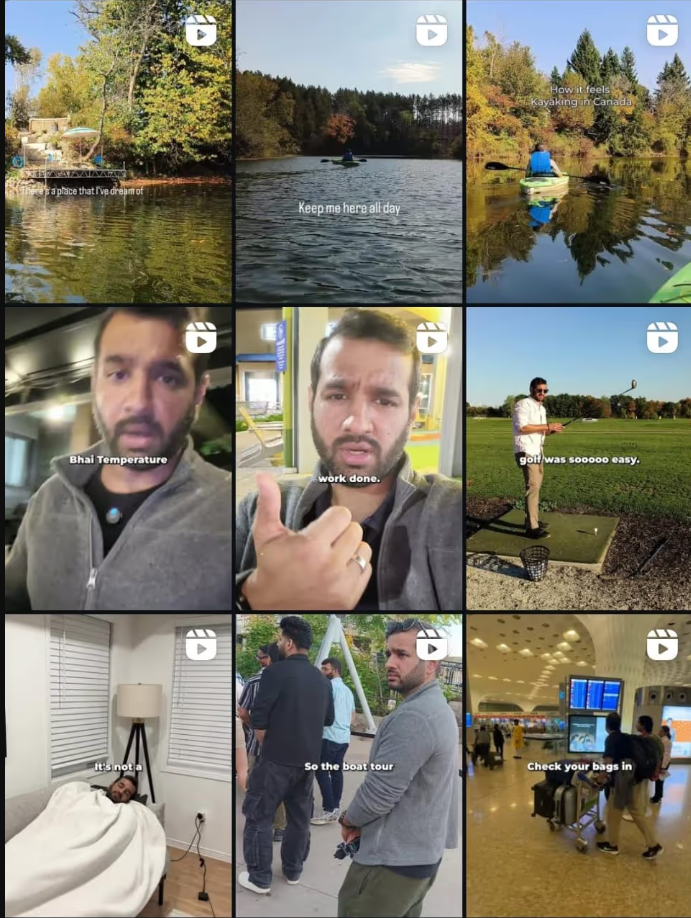
A strong example of this approach is Rajan Soni. Through his travel series, he shares adventures and behind the scenes moments from different cities. It is not about pitching services. It is about showing perspective, ambition, and lifestyle.
This works because the audience sees the person behind the brand. They understand how he thinks, how he spends his time, and what drives him outside of work. That familiarity builds trust faster than another service explainer ever could.
In B2B, this matters even more. High ticket decisions are emotional. People buy from founders they like and relate to, not just companies with polished decks and perfect presentations. Showing your life outside the office does not reduce authority. It strengthens connection.
How can you execute this?
- Film moments that are already happening in your life. A morning workout before work. A team dinner after a big milestone. A travel day while attending a conference. Do not stage it. Capture it.
- Add light narration explaining what the moment means to you. Not just where you are, but why it matters. What did you learn. What did it change about your thinking.
- Keep it short and simple. Thirty to sixty seconds is enough. The goal is not cinematic perfection. The goal is familiarity.
- Most importantly, do not force inspiration. Just show real life. When people feel like they know you beyond your business, they trust you faster when it is time to buy.
IDEA 7: BOLD OR BACKFIRED STORIES
This category is about sharing unconventional marketing plays you attempted, especially the ones that almost worked or completely backfired. These videos are not about perfection. They are about creativity, risk, and thinking differently.
In B2B, most marketing feels predictable. Sponsored booths. LinkedIn ads. Safe messaging. When you share a bold stunt, even one that got you kicked out, you instantly stand out.
Example: Vin Matano’s Reel
At the Drive conference hosted by Dave Gerhardt, this founder could not afford a sponsorship. So instead of skipping the opportunity, he created a guerrilla marketing plan.
He posed as a local Vermont farmer, offered to donate honey jars as welcome gifts, added a QR code that redirected to his website, wore a beekeeper mask to avoid recognition, and handed them out to attendees. It worked. Website traffic jumped 34 percent.
Until the host found out. He got confronted. Called out. Kicked out. And banned from the event. The stunt created buzz, attention, and a story far more memorable than a booth ever could.
In B2B, buyers are not just evaluating products. They are evaluating founders. A bold marketing story positions you as someone resourceful and willing to experiment.
How can you execute this?
- Share a marketing experiment you tried. Even better if it almost failed.
- Break it down clearly - What was the idea, Why you did it, What happened, What you learned.
- End with a strong call to action. Ask the audience what they would have done differently. Or ask if they think you crossed the line.
- Controversy drives conversation. Conversation drives distribution. Distribution builds brands.
IDEA 8: PODCAST CLIPS
One of the fastest ways to build authority as a B2B founder is to borrow trust from someone else’s audience. Podcast appearances and collaboration reels instantly position you in higher level conversations.
Instead of only posting on your own channel, show up where your audience is already listening. When someone credible invites you to speak, that credibility transfers to you.
Example: Guillaume Moubeche on The Twenty Minute VC (20VC) hosted by Harry Stebbings
In this clip, Guillaume explains why founders need to create content. He says creating content actually makes you a better founder because it forces you to clarify your thinking and share your story. He highlights that millions of great businesses exist, but nobody knows them because they never document anything.
His point is simple. Content becomes your digital introduction. When someone watches your videos and finds your thinking interesting, the conversation becomes easier. Instead of cold outbound, your content becomes a warm entry point for partnerships, hiring, investors, and customers.
The reel works because it is not promotional. It is perspective driven. He shares a belief that other founders resonate with.
How can you execute this?
- Actively look for podcast opportunities in your niche. Start small if needed. Industry podcasts, founder communities, LinkedIn Lives, or Twitter Spaces.
- After the episode goes live, repurpose a long podcast episode into 30 to 60 second reels with one strong idea. Not the entire story. Just one clear insight. If you you have long form podcast and want to repurpose it and extract gold content out of it then book a demo call today or fill this form today to get a free sample clip in 48 hours
- Tag the host. Tag the show. Add a simple context line like “Spoke about why founders must create content.”
- This does two things. It builds authority through association and it introduces you to a new audience without running ads.
- Collaboration content accelerates trust because you are not speaking alone. You are part of a bigger conversation.
IDEA 9: BUILD IN PUBLIC VIDEOS
The highest-retention format in B2B creator content isn't a single viral video, it's a series of videos that gives people a reason to come back. "Building in public" content creates serialized investment: your audience starts rooting for you, and they return to see how the story ends (or continues).Think of it like a business reality show, but you're the star and the episodes are 60 seconds long. This is the meta-strategy that ties all your other videos together.
Example - Rajan Soni’s Reels
"Building a personal brand and posting videos online is self-improvement disguised as vanity… I'm posting a video every single day. I'll see you tomorrow."
Here Rajan doesn't open with a product pitch or a growth metric, he opens with an honest, vulnerable reframe of what building in public actually costs you personally. That last line, "I'll see you tomorrow," is the whole strategy in five words. It's a public commitment. It creates a reason to follow. And it makes the audience feel like they're part of the journey from day one and not just subscribers, but witnesses. That's the difference between an audience and a community.
How can you execute this?
- Pick one goal you're working toward for the next 90 days. Make it specific and measurable.
- Film a 60-second "starting point" video today: where you are, where you want to go, why it matters.
- Commit to weekly updates - wins, losses, learnings. Even 30 seconds counts.
- End every episode with: "Next week I'm going to try [X]. Follow to see if it works.
IDEA 10: A DAY IN A LIFE OF A FOUNDER VIDEOS
Most founders think "day in the life" content means a perfectly edited vlog with a drone shot and a morning routine. It doesn't. The best day-in-the-life content is messy, fast, and honest because that's what a real founder's day actually looks like. Back-to-back shoots, grabbing food between calls, closing a deal on the way home, a flight delay that turns into a dessert run. That's the content. You don't need a production crew. You need your phone and the willingness to hit record.
This format works in B2B because it collapses the distance between you and your buyer. They stop seeing you as a brand and start seeing you as a person. And people buy from people.
Example: Orla’s Reels
Her reel does not try to be impressive. It is a rapid cut montage of a real two day stretch. A shoot that wrapped fast, a café run because everyone was starving, a sale closed mid commute, a 5am coffee, a delayed flight, and dessert to kill time. There is even a moment where the filming gets skipped entirely because things got too busy.
That is exactly what makes it work. The imperfection is the point. It signals that this is real, not staged. When someone watches this, they do not feel like they are watching a founder’s highlight reel. They feel like they tagged along for the day.
How can you execute this?
- Set a timer on your phone for every two hours tomorrow. When it goes off, record a 10 second clip of whatever is happening. A call, a commute, a meal, a win, or even a problem.
- Do not wait for interesting moments. The mundane ones, the coffee, the commute, the waiting, are what make it feel real.
- String six to eight clips together with a simple voiceover narrating what happened and why it mattered.
- Keep it under 60 seconds. Speed is credibility. It signals that your time is valuable and so is theirs.
Before You Start Posting Consider These 3 Non-Negotiables
1. Volume beats perfection always. Every creator on this list built their audience by posting consistently before they felt "ready." Dave Gerhardt nearly quit his podcast twice. Guillaume posted daily videos for months before anything took off. Vin Matano posted his first TikTok in March 2022 with zero following. Your first 10 videos will not be your best 10 videos. Post them anyway.
2. Repurpose ruthlessly. One talking-head video should become: an Instagram Reel, a YouTube Short, a LinkedIn post, and 3 tweets. You're not a media company with infinite resources. Be smart about distribution. Every creator in this list cross-posts aggressively.
3. Pick one platform first. LinkedIn is the safest default for US B2B founders, your buyers are already there. Instagram Reels work extremely well for B2B creators building personal brands (Vin Matano and Rajan are proof). YouTube Shorts are the best long-term bet for search. Pick one, post consistently for 90 days, then expand.
Common Questions from New B2B Video Creators
Do I need a professional camera and lighting?
No. Many of the most successful B2B creators film on their Android Phone or iPhone with a $30 ring light and a decent microphone. Audio quality matters more than video quality so invest in a USB microphone before a camera. Natural window light is often enough to start.
Should I post on LinkedIn or YouTube?
Both have merit, and the right answer depends on where your buyers spend time. LinkedIn is better for content that gets shared in professional networks and generates direct leads from your connections. YouTube is better for search-driven content that compounds over time. If you're just starting, pick one, master it, and expand later. LinkedIn is often the faster path to early traction for B2B creators.
How often should I post?
Consistency matters more than frequency. One video per week, published reliably, will outperform three videos in one week followed by silence. Start with one video per week and increase only when you can do it without sacrificing consistency.
What if I'm not naturally comfortable on camera?
Nobody is at first. The fastest way to get comfortable is to record and publish without watching it back. Seriously. Your 10th video will look dramatically better than your first, but only if you make the first one. Don't let perfectionism keep you from starting.
Should I use a script?
For your first 5–10 videos, a rough outline beats a full script. A script tends to produce stiff, unnatural delivery. Know your 3–5 main points, know your opening line, know your close, and let the rest be conversational. It will feel better and watch better.
How long should B2B videos be?
As long as they need to be, not a second longer. Talking head opinions and reactions: 60–3 minutes. Walkthroughs and tutorials: 5–15 minutes. Interviews: 5–10 minutes. Day-in-the-life: 8–15 minutes. The audience will watch as long as the content earns their attention.
The One Thing That Separates B2B Creators Who Build Audiences from Those Who Don't
It isn't talent. It isn't equipment. It isn't even the quality of the ideas.
It's publishing.
The creators referenced in this blog have one thing in common: they hit publish before they were ready. They published videos that weren't perfect. They kept publishing through the period when nothing seemed to be working. And eventually, the work compounded.
Your first video will not be your best. Your 10th will be dramatically better than your 1st. Your 50th will make your 10th look amateur. But none of that happens without the first one.
Pick one idea from this list. Spend 30 minutes preparing. Record it. Press publish.
The B2B creator you're going to become is one video away from starting.
Ready to start? Pick idea #1, #2, or #3. Record it this week with your phone. Post it. That's the whole plan.