
🪄 AI Summary
Heading 1
Heading 2
Heading 3
Heading 4
Heading 5
Heading 6
Lorem ipsum dolor sit amet, consectetur adipiscing elit, sed do eiusmod tempor incididunt ut labore et dolore magna aliqua. Ut enim ad minim veniam, quis nostrud exercitation ullamco laboris nisi ut aliquip ex ea commodo consequat. Duis aute irure dolor in reprehenderit in voluptate velit esse cillum dolore eu fugiat nulla pariatur.
Block quote
Ordered list
- Item 1
- Item 2
- Item 3
Unordered list
- Item A
- Item B
- Item C
Bold text
Emphasis
Superscript
Subscript
Most B2B marketers still write TikTok off as a Gen Z dance app. That's a strategic mistake. TikTok for B2B brands represents one of the last platforms where a brand-new account with zero followers can reach decision-makers at scale, purely on content merit. At Komet Media, I help SaaS founders and funded tech teams turn their product knowledge into short-form video that builds pipelines. This guide explains exactly how the algorithm works and how your team can use it to generate real demand in 2026.
TL;DR
- TikTok's interest graph surfaces your content to relevant professionals regardless of follower count, making it uniquely powerful for B2B demand generation.
- Video completion rate and watch-time per impression are the two highest-weighted algorithm signals in 2026.
- B2B brands perform best at 3–4 high-value posts per week, not daily volume.
- Content repurposing from webinars, demos, and podcasts is the fastest path to a sustainable TikTok video library.
How Does the TikTok Algorithm Work for B2B Brands?
The mechanics here are non-negotiable to understand before you post a single video. TikTok's recommendation system operates in two stages: initial distribution and scaled distribution. When you publish a video, TikTok shows it to a small test audience of 500–1,000 users. What happens in that test window determines everything.
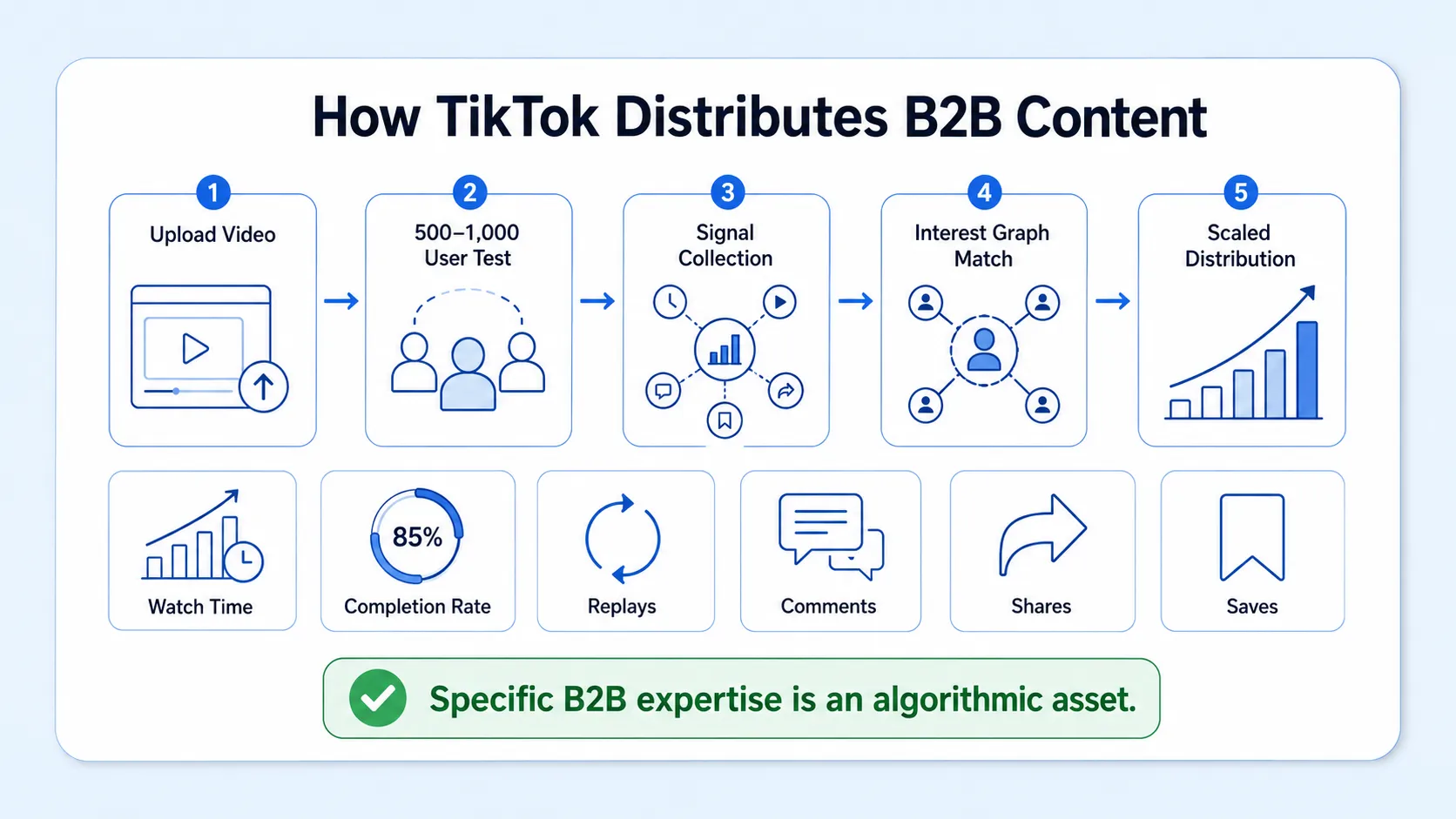
TikTok ranks videos based on a mix of signals, including watch time, completion rate, replays, likes, comments, shares, follows, and negative feedback. It also looks at video information like captions, hashtags, sounds, and on-screen text. The weighting matters. Engagement signals account for 40–50% of the ranking weight, with watch time, completion rates, shares, and saves being the most important metrics. Content signals (captions, hashtags, trending sounds, and visual elements) account for roughly 35%. One 2026 shift is especially relevant for B2B content.
Watch-time per impression replaced raw view count as the primary signal, and comments are now weighted higher than likes. For B2B brands producing educational, insight-heavy content, this is an advantage: thoughtful comments from buyers and professionals carry more algorithmic weight than passive likes. The fundamental design philosophy also favors challenger brands. TikTok uses an interest graph rather than a social graph, recommending content based on what you will enjoy rather than who you follow. Watch time and completion rate are the number-one ranking factor, accounting for roughly 40–50% of the algorithm's weight.
Crucially, the algorithm rewards specificity over broad appeal, and TikTok does not consider follower count when ranking content. For a B2B SaaS brand creating tightly targeted content on topics like "API integration errors" or "SaaS churn signals," this means your niche expertise is actually an algorithmic asset, not a liability. 96% of watch time on TikTok comes from the For You Page, driven by this interest graph technology. That single number explains why organic reach optimization matters more on TikTok than on any other platform your marketing team is currently using.
Does TikTok Work for B2B, or Is It Just B2C?
The honest answer is: it works, but the ROI looks different from LinkedIn. TikTok for B2B brands is primarily a top-of-funnel awareness and trust channel, not a bottom-of-funnel conversion engine. The 35–44 age group is the fastest-growing segment on TikTok, and users over 45 now represent a meaningful share of the audience.
These are department heads, VPs, and founders, exactly the buyer personas B2B SaaS teams are trying to reach. Those early users grew up. They are now 28-year-old managers with purchasing power. And they are still on TikTok. 95% of B2B buyers use video in product research, and TikTok captures attention where decision-makers scroll. B2B SaaS companies can succeed on TikTok through educational, behind-the-scenes, and thought leadership content.
The ROI timeline is real, but it requires patience. Brands typically see engagement and visibility growth within 4–6 weeks, with compounding ROI as campaigns scale. B2B cycles are longer, expect 3–6 months to see pipeline impact from TikTok awareness campaigns. Where measurement gets tricky is attribution. Measurement should focus on engagement quality, lead quality, and influenced pipeline rather than pure volume.
I tell clients at Komet Media to track dark social signals: email subscribers mentioning your TikTok content, demo request forms citing "saw you on TikTok," or inbound LinkedIn connections from accounts that also follow you on TikTok. TikTok is where the most dramatic organic expansion is happening, for brands willing to adopt an entertainment-first content approach and commit real resources to the platform. The brands treating TikTok as a repurposing dump will see no results. The brands building for TikTok's native format will build a compounding awareness engine.
How Does TikTok Decide Who Sees Your Content With No Followers?
This is the question every B2B founder asks before they commit. The answer is genuinely different from every other platform. A brand-new account with zero followers can reach millions of people within 24 hours of posting, something that is algorithmically impossible on any other major platform. Here is the exact mechanism. TikTok's initial distribution uses content signals (captions, hashtags, audio, visual elements) to build a profile of your video before it finds an audience. It then serves it to a test cohort of users whose behavior patterns match that content profile. If your video on "SaaS onboarding mistakes" earns strong watch-time from that test group, TikTok widens distribution to a larger cohort.
When three people like the same video, the algorithm groups those users together, then serves similar content to that micro-community. Hootsuite's Social Trends 2025 Report calls this "micro-virality." A 5,000-view video that deeply resonates with a #FinanceTok-style niche community is more valuable than a generic 50,000-view video that no one remembers. For B2B brands, this micro-virality mechanism is more valuable than a single viral hit. A video reaching 4,000 CFOs or IT directors is worth more pipeline than a video reaching 400,000 mixed consumers. The interest graph technology rewards you for knowing your buyer persona precisely and making content for them specifically.
According to Hootsuite's 2025 Social Trends Report, TikTok videos with a save rate above 2% were 3.4x more likely to appear on the For You Page than videos with similar view counts but lower save rates. Reference content, checklists, frameworks, tactical how-tos, that buyers want to save and revisit is the format B2B brands should build around.
Best TikTok Content Types for B2B Audiences
Not all video formats perform equally for professional audience engagement. Here is what consistently works across the B2B SaaS and funded tech brands I work with at Komet Media's short-form video service: The most effective TikTok content in 2026 includes educational how-to videos, behind-the-scenes glimpses, trend participation with brand-relevant spins, and user-generated content. For B2B specifically, these formats map to real pipeline goals:
B2B brands can use TikTok for thought leadership, employer branding, and demand generation by translating complex topics into short, engaging explainers. Content can include behind-the-scenes, customer stories, and "explain it simply" series. The content repurposing workflow is where most B2B teams leave value on the table. Your last webinar contains six to eight standalone TikTok clips. Your product demo recording has three or four "aha moment" clips waiting to be cut. Our video editing services exist specifically to extract those assets from long-form content and format them natively for short-form distribution.
A short video showing a workflow, customer pain point, or product benefit can make even niche topics feel accessible. SaaS brands use TikTok to break down automation or data analytics through quick, animated explainers or real-life demos. Founder-led content earns comments. Comments earn algorithm push. Algorithm push earns pipeline. It starts with the founder showing up on camera.
How to Increase Organic Reach on TikTok as a B2B Brand
Organic reach optimization on TikTok is a repeatable system, not a luck exercise. These are the levers that move the needle:
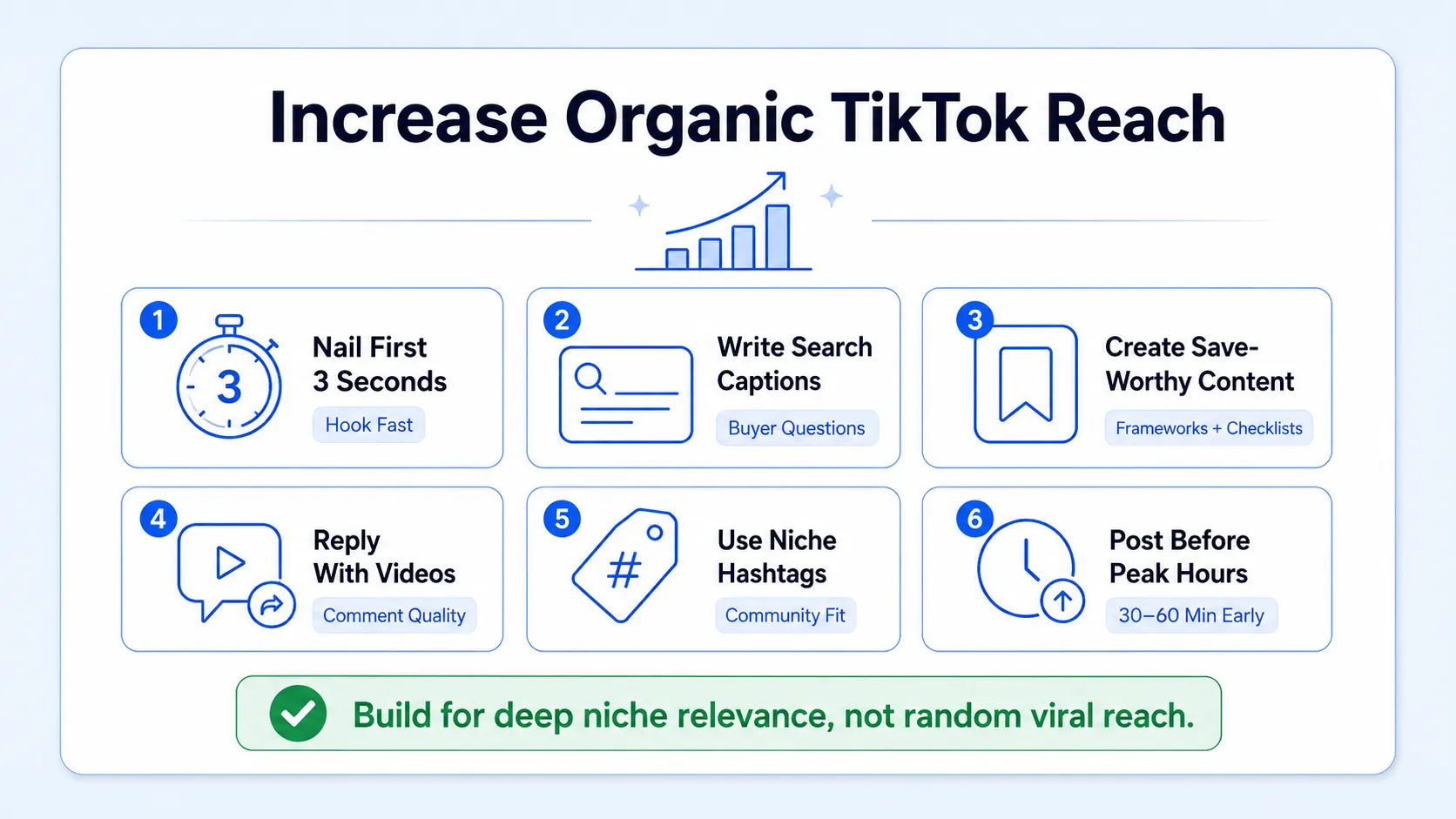
- Nail the first three seconds: Watch time in the first few seconds is the strongest ranking signal. Starting videos with a compelling hook keeps people watching and tells the algorithm your content is worth recommending.
- Optimize your captions for search: TikTok SEO can help capture searches related to industry terms and problems. Write captions the way your buyer would type a question, not the way your marketing team would write a tagline.
- Hit the save-rate threshold: The save rate benchmark for brand accounts is 1.2%, per Socialinsider's 2025 data. Create reference content that buyers bookmark. Frameworks, checklists, and numbered breakdowns drive saves.
- Reply to comments with follow-up videos: Responding to comments, sometimes with a follow-up video that directly addresses what someone asked, is one of the more effective growth moves on the platform. It signals high engagement quality to TikTok's algorithm and builds the kind of community that makes B2B TikTok marketing sustainable.
- Use niche community hashtags: The 2026 TikTok algorithm prioritizes community-aligned content over random viral hits. Niche relevance matters more than broad reach, so focus on resonating deeply within specific groups rather than chasing unpredictable virality.
- Post 30–60 minutes before your audience's peak hours: TikTok's creator and business dashboards show when your followers are active. Post 30 to 60 minutes before those peaks so the video is indexed and climbing as they arrive.
73% of marketers are now prioritizing short-form video, Reels, TikTok, Stories, while 47% are prioritizing user-generated content video. The competition is arriving. Brands that build their organic systems now will own the niche communities that competitors will later try to buy their way into.
B2B Brands Seeing Success on TikTok in 2026
Proof matters. Here are real examples from across the B2B landscape: Companies like Shopify and Adobe are growing audiences through educational and behind-the-scenes content on TikTok, proving that B2B has a place on the platform.
ClickUp (@clickup), a leading project management and productivity software brand, used the platform to boost brand awareness by creating engaging short-form videos explaining workplace productivity hacks, project management tips, and team collaboration strategies.
Canva drives strong TikTok performance with tips, tricks, and product use cases, averaging roughly one post every four days, a sustainable cadence that prioritizes quality over volume. SaaS company tl;dv built an ambassador program with a pay-per-performance model for content , turning its user community into a content velocity engine.
The pattern across every successful B2B brand on TikTok: storytelling beats jargon-heavy messaging. The SaaS teams that win are the ones who explain what their product does by showing a real problem being solved in under 60 seconds, not by reciting feature lists. TikTok's median brand follower growth in 2025 hit 200% year-over-year , driven by brands that committed to native content rather than cross-posting LinkedIn graphics. 16.47% of TikTok accounts moved up a follower tier between 2025 and 2026, compared to 8.87% on Instagram, 6.89% on LinkedIn, 4.36% on YouTube, and 3.86% on Facebook.
The platform still rewards early movers. 74% of marketers have not yet committed to TikTok as a paid channel, which for brands that move now represents a genuine first-mover advantage in lower CPMs, less saturated creative formats, and the ability to build organic audiences before increased advertiser competition pushes costs higher.
How Often Should a B2B Brand Post on TikTok to Grow Reach?
Volume strategy is where B2B teams often overcomplicate things. The data is clear and consistent across sources. B2B content performs best at 3–4 high-value posts weekly, reflecting the different audience consumption patterns of professional buyers. This contrasts with B2C brands where 2–3 daily posts are common.
Most brands see the best results posting 3 to 5 times per week, then adjusting cadence by format and audience signal rather than a fixed quota. A sustainable cadence beats a sprint. The quality-over-quantity principle is backed by data. High-engagement posts receive 2x more shares than rushed content. For a B2B team with limited production capacity, two excellent videos per week will consistently outperform five mediocre ones.
The schedule fails when it depends on inspiration. Build it around repeatable formats so you can produce without reinventing each video, for example: Monday education, Wednesday trend, Friday behind-the-scenes or UGC. Timing also matters. B2B content typically performs 31% better during standard business hours , so posting Tuesday through Thursday between 8 AM and 2 PM in your buyers' time zone is a reasonable starting point to test against.
Frequency helps only when watch-time and completion stay strong, posting more weak videos can hurt your overall account reach by training the algorithm that your content underperforms. This is the mistake I see most B2B teams make when they push for daily volume without the video production infrastructure to sustain quality. The sustainable formula: build a content repurposing workflow from your existing long-form assets (webinars, demos, podcasts, sales calls), cut 3–4 clips per week, and let the algorithm find your audience from there. Our podcast editing and repurposing service is designed exactly for this workflow.
Conclusion
TikTok for B2B brands is no longer a question of "should we?", it is a question of "how fast?"
- The interest graph algorithm rewards content quality and niche relevance, not follower count or ad spend, giving B2B brands with real expertise a structural advantage.
- Video completion rate and save rate are the two most actionable signals to optimize, create reference-worthy, problem-solving content and the distribution follows.
- 3–4 high-quality posts per week, built from repurposed long-form content, is the most sustainable and effective cadence for B2B teams.
- Brands building their TikTok presence in 2026 are entering before 74% of marketers have committed to the platform, the first-mover window is still open, but narrowing.
Ready to build a video system that turns your product expertise into a pipeline? Talk to Komet Media.
Frequently Asked Questions
Q1: Does TikTok's audience skew too young for B2B marketing?
It used to. Not anymore. The 35–44 age group is now TikTok's fastest-growing demographic, and users over 45 represent a growing share of the platform. The early Gen Z users who drove TikTok's initial growth are now mid-career professionals with real purchasing authority.
Q2: How does the TikTok algorithm rank a video from a new brand account with no followers?
TikTok evaluates every video independently using an interest graph, not a social graph. It tests your video with a small cohort based on content signals (captions, hashtags, audio, visuals), then expands distribution if watch-time and completion rate are strong. Follower count is not a ranking input.
Q3: What video completion rate should B2B brands target on TikTok in 2026?
The completion rate bar for broader distribution is approximately 70%, up from roughly 50% in 2024. For B2B educational content, keeping videos tightly focused on a single insight, typically 45–90 seconds, makes hitting that threshold achievable without sacrificing depth.
Q4: How is TikTok B2B ROI different from LinkedIn ROI?
LinkedIn drives direct, last-touch conversion signals. TikTok drives awareness, trust, and influenced pipeline earlier in the buyer journey. Measure TikTok by engagement quality, inbound volume, and pipeline influence over a 3–6 month horizon rather than by immediate lead form fills.
Q5: Can a B2B brand repurpose existing content for TikTok instead of creating from scratch?
Yes, and this is the most efficient path for most B2B teams. Webinars, product demos, sales call recordings, and podcast episodes all contain multiple high-value clips. The key is reformatting them for TikTok's native vertical format with a strong hook in the first three seconds, not simply cropping and reposting.
Q6: What types of B2B TikTok content drive saves and shares (the highest-weight algorithm signals)?
Saves are driven by reference content: step-by-step frameworks, comparison breakdowns, and tactical how-tos buyers want to revisit. Shares are driven by content that makes the viewer look informed or helpful to a colleague, surprising data points, counterintuitive takes, and clearly articulated problems your buyer's manager doesn't yet understand.