
🪄 AI Summary
Heading 1
Heading 2
Heading 3
Heading 4
Heading 5
Heading 6
Lorem ipsum dolor sit amet, consectetur adipiscing elit, sed do eiusmod tempor incididunt ut labore et dolore magna aliqua. Ut enim ad minim veniam, quis nostrud exercitation ullamco laboris nisi ut aliquip ex ea commodo consequat. Duis aute irure dolor in reprehenderit in voluptate velit esse cillum dolore eu fugiat nulla pariatur.
Block quote
Ordered list
- Item 1
- Item 2
- Item 3
Unordered list
- Item A
- Item B
- Item C
Bold text
Emphasis
Superscript
Subscript
Every founder and marketing head I talk to asks the same thing: "How much video do we actually need?" It's the wrong question framed the right way. The real question is: which videos move buyers, at what frequency, across what funnel stage? This guide answers all three. Understanding how much video a B2B brand actually needs isn't about matching a competitor's output, it's about building a system that earns trust, educates buyers, and supports your pipeline with precision.
TL;DR
- Most B2B teams publishing consistently post 2–6 videos per month, enough to cover every funnel stage without burning out the team.
- Frequency matters less than format-to-funnel alignment: one well-placed demo video outperforms five generic clips.
- SaaS brands need a core library of 8–12 foundational videos before volume becomes the right lever.
- Content repurposing (turning one webinar or podcast into 5–8 clips) is the fastest path to content velocity without a new budget.
How Much Video Content Does a B2B Company Actually Need?
The honest answer: more than you're making, less than you fear. The benchmark most teams land on is a sustainable monthly cadence, not a sprint. 74% of marketers share between two and six videos per month across various channels, a figure that has grown slightly as AI-enabled production tools reduce the friction of hitting publish consistently. That range, roughly one to two videos per week, is the production floor for a brand that wants real visibility, not a ghost town channel. But the raw number of videos is not the same as the right number.
Most companies produce videos on a monthly or weekly cadence, with 76% making at least one video a month, signaling that more teams are settling into a sustainable groove. What actually determines your ideal volume is your funnel position. A B2B SaaS brand with a 60-day sales cycle and a 6-person buying committee needs to cover multiple touchpoints simultaneously, awareness, consideration, and late-stage trust, which means different video types running in parallel, not a single stream.
The average B2B buyer watches 3.2 videos per session when researching solutions , which means a buyer who finds you is already in multi-video consumption mode. If your library only has two videos, they exhaust your content in minutes and move on to a competitor with more depth.
My recommendation for early-stage SaaS teams: start with a core library of 8–12 foundational pieces (explainer, demo, founder POV, 2–3 customer stories, and a few educational short-form clips). Once that base is live, shift to a monthly cadence of 4–6 new videos using content repurposing from existing recordings. This keeps content velocity high without requiring a full production team on standby.
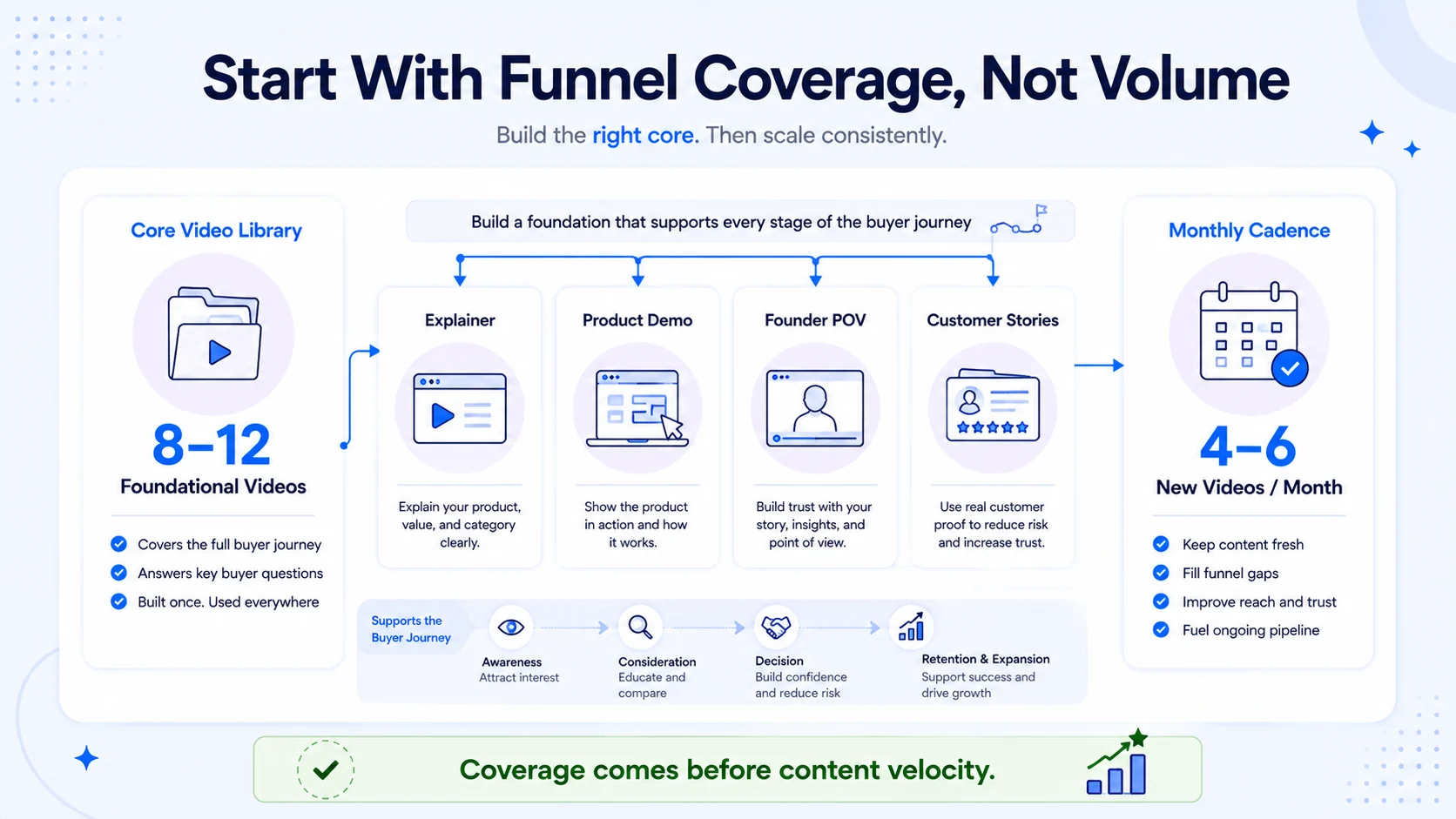
Rule of thumb: Before asking "how many," ask "do I have video at every stage of my buyer's journey?" If the answer is no, volume is not your problem, coverage is.
What's the Right Amount of Video for B2B Marketing? (It Depends on Your Funnel)
The "right amount" changes by funnel stage, and most B2B brands are wildly lopsided, heavy on awareness content, nearly empty at the decision layer. The B2B video ecosystem spans awareness-driven formats like short social clips and thought-leadership interviews; mid-funnel content like demos, explainers, and educational webinars; and conversion-oriented formats like testimonial videos and customer case studies. Each layer needs its own inventory.
Here's the coverage model I use with clients:
72% of B2B buyers report that video content from vendors influences their vendor shortlist decisions, meaning a gap at the decision layer is a real pipeline leak, not just a content gap. 73% of B2B decision-makers prefer to watch product demo videos rather than read whitepapers or brochures. So if your only decision-stage asset is a PDF deck, you're already losing deals to brands that have even a basic demo video.
The most underfunded video layer in SaaS marketing is almost always social proof. 53% of B2B buyers prefer video case studies over written testimonials, which are favored by only 29%. Two or three strong customer story videos will do more for your close rate than a month of LinkedIn clips.
How Many Videos Should a B2B Brand Post Per Month?
For a funded SaaS team with an active demand generation funnel, the realistic target is 4–8 videos per month across channels. Here's how that breaks down:
- 2–3 LinkedIn short-form clips (60–90 seconds, repurposed from long-form content or founder commentary)
- 1 educational or thought leadership video (3–5 minutes, hosted on your site or YouTube)
- 1 product or demo-adjacent video (feature spotlight, use case walkthrough)
- 1 social proof or customer voice video (rotating quarterly)
Over half of teams (57%) spend more time creating videos than promoting them, while only 20% spend more time on promotion. This is the trap most marketing teams fall into. Producing more without distributing better is wasted effort. Every video published should have a LinkedIn organic post, an email touchpoint, and an embed on a relevant landing page or product page. LinkedIn is now B2B's #1 video channel, with 8 in 10 teams saying it is their primary place to share videos. That makes LinkedIn video the non-negotiable starting point, not YouTube, not Instagram.
For teams with a podcast or regular webinar program, the math changes completely. A single 45-minute episode can become 6–10 short-form clips, 1 long-form highlight reel, and multiple audiograms. That's an entire month of video content from one recording session, which is exactly how we build content calendars at Komet Media.
What Types of Video Does a B2B Brand Actually Need to Make?
Volume without variety is just noise. Format selection is where most B2B brands make their biggest strategic error, producing only one type of video and wondering why it doesn't move the needle at scale.
The four formats that consistently drive pipeline for SaaS and funded tech teams:
- Explainer videos: 68% of B2B marketers use explainer videos at the top of the sales funnel to introduce their products or services. A tight 60–90 second explainer on your homepage and key landing pages is the highest-leverage single asset any B2B brand can own.
- Product demo videos: Product demo videos lead to a 46% increase in purchase intent compared to non-video product pages. A recorded async demo that lives on your site captures intent from buyers who will never book a live call first.
- Customer testimonial and case study videos: Customer testimonial videos increase trust levels for 62% of viewers, while written testimonials impact only 34%. These are the most underproduced, highest-converting formats in B2B.
- Short-form thought leadership clips: These are the awareness engine, founder takes, team perspectives, and educational clips distributed natively on LinkedIn. LinkedIn video content sees 15% more engagement than non-video content among B2B audiences.
Supporting formats that matter at scale: webinar recordings repurposed into clips (our webinar content services are built specifically for this), sales enablement videos for your team to use in outreach, and onboarding videos that reduce churn.
Is One Video Per Week Enough for B2B Marketing?
One video per week, roughly four per month, is a defensible floor for most B2B teams, but only if those four videos are strategically distributed across the funnel and across channels. The problem with "one video per week" as a strategy is that it implies a single stream when B2B buyers need coverage in multiple places simultaneously. A prospect discovering you on LinkedIn, researching you on your website, and sitting in a sales sequence needs to encounter video in all three places, not just one.
72% of B2B buyers report that video from vendors influences their vendor shortlist decisions , and on average, B2B video content shortens the sales cycle by 23%. That pipeline compression only happens when video is embedded into the full buyer journey, not just posted on social media. B2B organizations using video report 27% higher marketing-qualified lead (MQL) rates than those that don't.
Those MQL gains don't come from one video per week posted to LinkedIn, they come from video embedded in landing pages, email sequences, sales outreach, and the product experience simultaneously. One video per week is fine if it's the right video in the right place. The short-form video editing workflow we use at Komet Media is designed to maximize distribution from a single recording, so one piece of raw content becomes 4–6 placements across channels without requiring 4–6 separate production sessions.
The real benchmark: Not "how many did we publish" but "did a buyer encounter video at every stage they needed it?"
B2B Video Production Frequency Best Practices for SaaS Teams
For SaaS and funded tech teams, production frequency should be tied to your growth stage, your content library, and your sales cycle, not an arbitrary number.
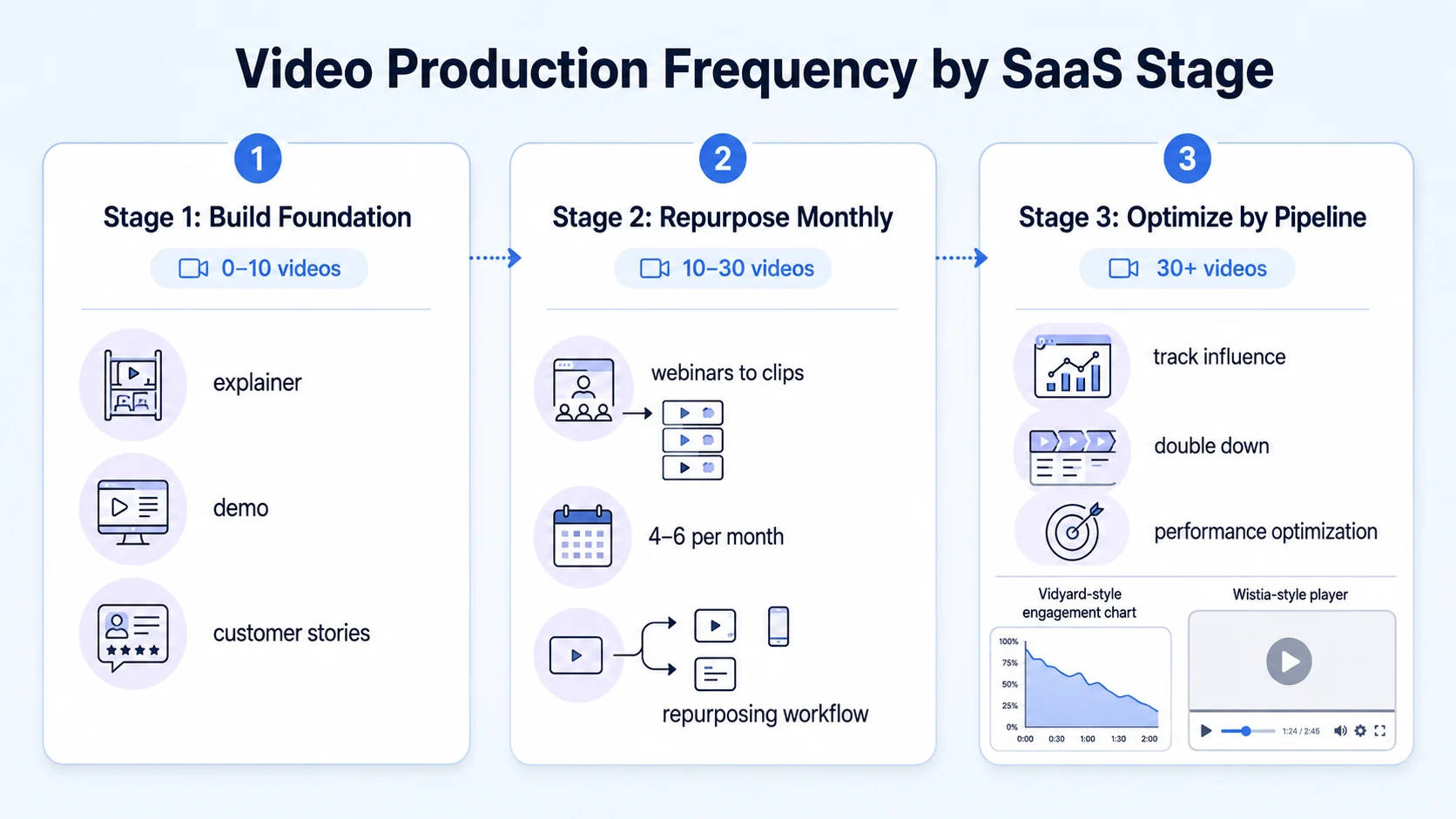
Stage 1 (0–10 videos in library): Prioritize foundation over frequency. Build your explainer, demo, and 2–3 customer story videos before worrying about weekly output.
Stage 2 (10–30 videos): Introduce a content repurposing strategy. Every webinar or podcast episode becomes a batch of short-form clips. Target 4–6 new videos per month.
Stage 3 (30+ videos): Optimize distribution and measure video's impact on pipeline. Use tools like Wistia analytics or Vidyard engagement tracking to understand which videos are influencing deals, then double down on those formats.
On-demand webinars keep getting plays for up to 12 months after the live event, and educational videos, product videos, social videos, and webinars are where teams are investing and doubling down. 73% of B2B decision-makers prefer to watch product demo videos rather than read whitepapers or brochures, which means every SaaS team should treat demo video production as a recurring activity, not a one-time project. As your product evolves, so does your demo library. Content velocity is the real unlock.
Over half of companies repurpose their video content into social clips, with LinkedIn as the top platform for sharing them, 67% of teams posting clips there, followed by Instagram at 49% and YouTube at 41%. Repurposing isn't a shortcut, it's the sustainable engine of a B2B video system that doesn't require a full production budget to stay active.
Conclusion
- How much video does a B2B brand actually need is answered by funnel coverage, not headcount or budget, map your buyer journey first.
- Most SaaS brands need a foundation of 8–12 core videos, then a repurposing-led cadence of 4–6 per month.
- The highest-ROI formats remain demo videos, explainer videos, and customer testimonials, prioritising these before chasing volume.
- LinkedIn is the primary distribution channel; embed video everywhere else in the buyer journey simultaneously.
- Measure by pipeline influence (MQL rate, demo requests, sales cycle length), not view counts.
Ready to build a video system that actually moves the pipeline? Talk to the Komet Media team.
Frequently Asked Questions
Q1: How much video does a B2B brand actually need to get started?
Start with a core library of 8–12 foundational assets: one homepage explainer, one product demo, two to three customer testimonial videos, and a handful of short-form educational clips for LinkedIn. Volume becomes relevant only after this foundation is in place.
Q2: How many videos should a B2B SaaS company post per month?
A realistic and sustainable target is 4–8 videos per month, covering LinkedIn short-form clips, one educational long-form piece, and one product or social-proof video. Teams running webinar or podcast programs can hit this number through repurposing alone.
Q3: Is LinkedIn really the best platform for B2B video distribution?
Yes, for most B2B teams. LinkedIn is now B2B's #1 video channel, with 8 in 10 teams naming it their primary place to share videos, outpacing even YouTube. Start your distribution there and syndicate to your website and email sequences.
Q4: What video types drive the most pipeline for B2B brands?
Demo videos, customer testimonials, and explainer videos consistently outperform other formats for pipeline impact. 73% of B2B decision-makers prefer product demo videos over whitepapers or brochures , making the demo your highest-priority production investment.
Q5: Can content repurposing replace original video production?
Not entirely, but it dramatically reduces production burden. A single webinar or podcast episode can yield 6–10 short-form clips, a highlight reel, and multiple audiograms, covering an entire month of LinkedIn content from one recording. Repurposing and original production work together, not against each other.
Q6: How do I measure whether my B2B video strategy is actually working?
Move beyond view counts. Track video's influence on MQL rate, demo request volume, sales cycle length, and which videos appear in closed-won deal paths via tools like Wistia analytics or Vidyard engagement tracking. B2B organizations using video report 27% higher MQL rates than those that don't, that's your north star metric.