
🪄 AI Summary
Heading 1
Heading 2
Heading 3
Heading 4
Heading 5
Heading 6
Lorem ipsum dolor sit amet, consectetur adipiscing elit, sed do eiusmod tempor incididunt ut labore et dolore magna aliqua. Ut enim ad minim veniam, quis nostrud exercitation ullamco laboris nisi ut aliquip ex ea commodo consequat. Duis aute irure dolor in reprehenderit in voluptate velit esse cillum dolore eu fugiat nulla pariatur.
Block quote
Ordered list
- Item 1
- Item 2
- Item 3
Unordered list
- Item A
- Item B
- Item C
Bold text
Emphasis
Superscript
Subscript
Most video editing partnerships fail quietly. Not because the editing is bad, but because nobody defined what "fast" means before the contract was signed. Setting turnaround SLAs with a video editing partner is the single structural decision that separates a content calendar that ships on time from one that constantly slips. This guide covers exactly what to put in your SLA, what benchmarks are realistic in 2026, and how to negotiate terms that protect your pipeline without burning your partner.
TL;DR
- SLAs for video editing must cover first-draft delivery, revision turnaround, final delivery, and escalation procedures, not just a headline speed claim.
- Industry-standard turnaround for ongoing short-form content is 24–48 hours; complex productions run 3–5 business days.
- Your feedback quality and brief completeness determine delivery speed as much as your partner does.
- Missed SLAs need a pre-agreed remedy (credit, repriority, or escalation), not a vague conversation.
What Are Turnaround SLAs for Video Editing, and Why Do They Break?
A Service Level Agreement in video editing is a documented commitment between you and your editing partner that specifies turnaround times, quality standards, and remedies when those standards fail. In a video editing context, the SLA typically covers first-draft delivery time (business days from brief and footage receipt), revision turnaround (hours or days from feedback submission), final delivery time, rush delivery options, and escalation procedures for missed deadlines. The reason most SLAs break down is a gap between what's marketed and what's measured.
Standard SLAs quote turnaround to first draft only. A "48-hour turnaround" claim can be technically accurate while the finished, approved, publish-ready deliverable actually takes 10–12 business days, and this gap is invisible in the sales process. Experienced video teams will confirm: the editor is rarely the bottleneck. The bottleneck is almost always upstream, in the client's preparation, the brief quality, or the internal approval chain.
For B2B SaaS teams running product launches, demo series, or founder-led content, a slipped publish date isn't just inconvenient. Slow turnaround has a real price tag: every day a video sits unedited is a day it is not generating views, leads, or pipeline. Miss your publishing window and you lose the algorithmic momentum that consistency builds. The fix is not demanding faster editing. It is setting turnaround SLAs with a video editing partner that account for the full delivery cycle, not just the edit chair time.
The founding question: Before you sign any contract, ask for median delivery time, not the stated SLA headline. The gap between those two numbers tells you everything.
What Should Be Included in a Video Editing Service Level Agreement?
A complete client-agency contract for video work covers five clauses, not one. Here is what each must contain:
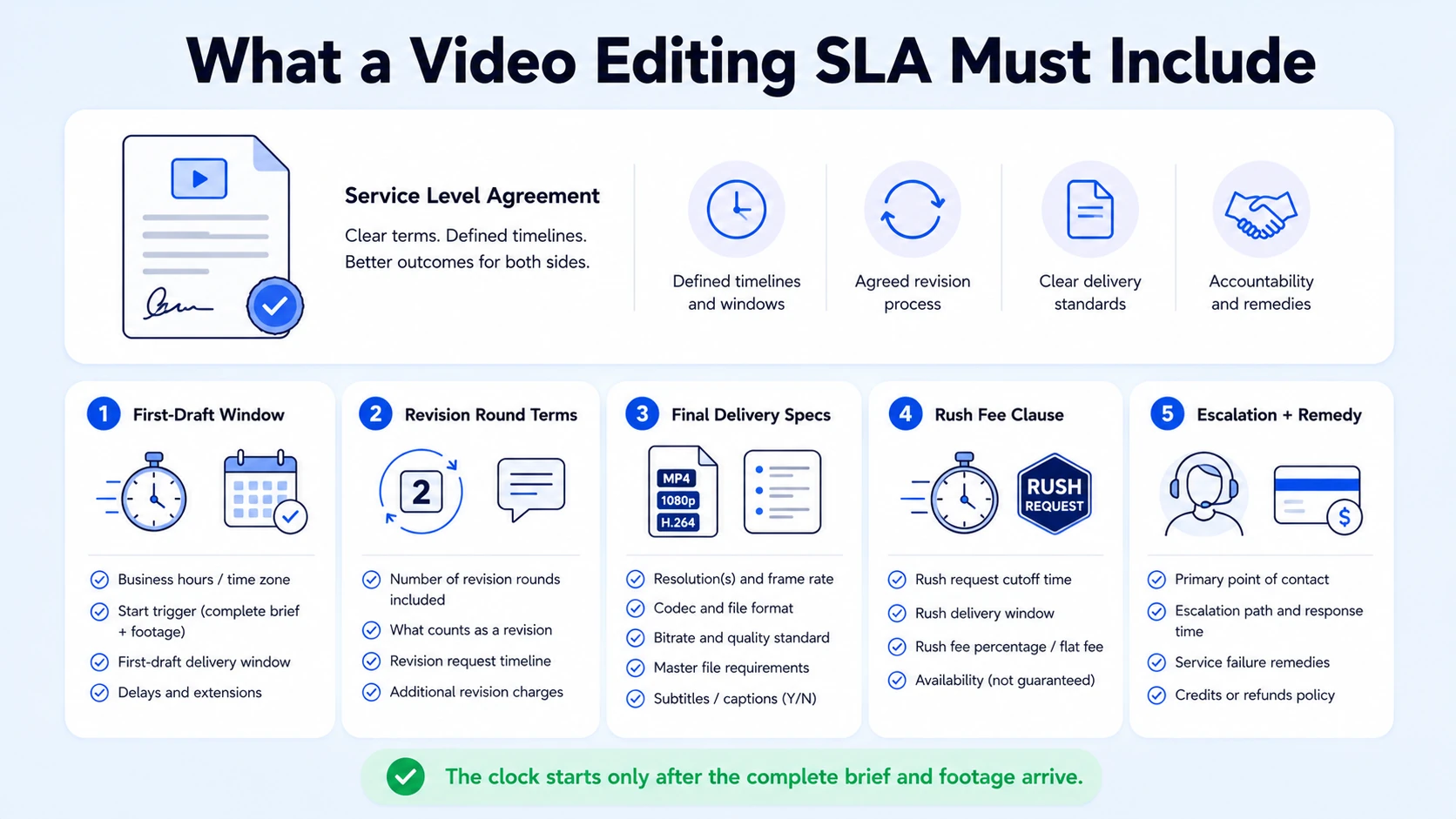
- First-draft delivery window: Stated in business days from confirmed receipt of footage and an approved creative brief. "Confirmed receipt" should be defined, a Frame.io upload notification or an Asana task status change, not a verbal acknowledgment.
- Revision round terms: How many rounds are included, what turnaround applies per round (typically 24 hours for short-form), and what defines a "round" versus a new project.
- Final delivery and asset management specs: File format, resolution, naming convention, and delivery platform (Frame.io, Google Drive, Dropbox). This prevents back-and-forth on specs after the edit is done.
- Rush fee clause: Defines what qualifies as a rush request and the cost uplift. Most professional agencies charge a rush fee of 20–50% of the regular rate to accommodate urgent requests requiring 24–48 hour turnaround.
- Escalation and remedy clause: What happens when a deadline is missed, account credit, reprioritization, or a dedicated escalation contact. An SLA is not a weapon, it is a mutual commitment. It protects you from slow delivery AND protects your editing partner from unreasonable last-minute demands. Both sides benefit from documented expectations.
The scope of work attached to the SLA should also define what a "complete brief" looks like. If footage arrives unlabeled, without flagged selects, or with unsynced audio, add 1–3 business days to any stated turnaround. An incomplete brief generates clarifying questions, and clarifying questions are how SLAs die quietly.
At Komet Media, our intake process requires a completed brief template before the clock starts. That single rule has eliminated most first-draft delays on our end.
How to Set Realistic Turnaround Times with a Video Editing Partner
Realistic timelines are defined by video type and complexity. Use this table as your baseline when setting turnaround SLAs with a video editing partner:
Turnaround rates for social media video edits range from 24–48 hours for simple edits to 5–10+ business days for complex productions, with footage volume, technical specifications, and revision cycles significantly impacting timelines. Two realities determine whether you hit these benchmarks:
- Brief completeness: Locked script or talking points, brand style guide, reference examples, and any required on-screen text, all submitted with the footage.
- Feedback consolidation: Sending feedback in three separate Slack messages over two days forces your editor to wait, compile notes, and re-interpret intent. One consolidated feedback document with timestamped notes, sent within 24 hours of receiving the draft, keeps the revision cycle moving.
A new editor needs 3–5 videos to fully learn your style. During that ramp-up period, expect 30–50% longer turnaround and more revision rounds, which is why switching editors repeatedly is costly. You pay the ramp-up tax every time.
Setting Turnaround Expectations with Outsourced Video Editors: Tools and Workflows That Actually Work
The SLA is only as good as the workflow supporting it. These are the tools and protocols that make setting turnaround SLAs with a video editing partner enforceable in practice:
Project management (Asana or equivalent): Every project milestone, brief submitted, footage uploaded, first draft due, feedback due, revision due, final delivery due, should live as a task with a due date and an owner. Verbal timelines disappear. Asana tasks do not.
Review and approval (Frame.io): Frame.io allows timestamped, frame-accurate comments directly on the video. This replaces the scattered Slack thread with a single, exportable feedback document your editor can action immediately. It also creates a revision history your team can reference if SLA disputes arise.
Communication protocol (Slack with defined channels): Separate channels for assets (#raw-footage), feedback (#video-feedback), and delivery (#video-delivery) prevent messages from getting buried. Set a rule: no feedback via DM, only via Frame.io comments.
Adobe Premiere Pro project files on shared storage: For teams repurposing recurring formats (weekly product demos, podcast clips), sharing the Premiere Pro project template with your editing partner eliminates setup time on every new deliverable.
Content calendar integration: Your delivery schedule should be published in the shared project management tool, not just in your internal marketing calendar. When your editing partner can see that a video is needed by Tuesday for a Thursday LinkedIn post, they can plan their queue accordingly, rather than learning about the deadline on Monday.
Centralizing all briefs, assets, feedback, and revisions in one place makes it easier to track progress and maintain consistency across projects. That centralization is not optional, it is the infrastructure your SLA runs on.
For teams running webinar or podcast content at volume, this stack is the difference between consistent weekly clips and a backlog that never clears.
What Happens If a Video Editing Partner Misses an SLA Deadline?
If turnaround time matters to your business (and it should), get it in writing. An SLA protects both parties and sets clear expectations. Not every provider will agree to formal SLAs, and that tells you something. If an editor or agency won't commit to specific turnaround times in writing, their consistency is probably not something they're confident in.
When a deadline is missed, your pre-agreed remedy clause determines what happens next. Define these three levels before you sign:
- First miss (within 4 hours of deadline): Automatic same-day reprioritization at no extra charge. No escalation required.
- Second miss or full business day late: Credit applied to next invoice, equal to the proportional day rate for that deliverable. This removes ambiguity from "we'll make it right."
- Pattern of misses (two or more in a rolling 30-day period): Formal review call with an account manager and a written post-production workflow audit. This is not punitive, it is diagnostic. Something upstream is broken.
Ask your vendor directly: if your assigned editor is out, who covers the work? A real SLA has an answer. A freelancer often does not. This single question separates a production partner with team depth from a solo operator wearing an agency logo. Also, consider the client-side obligations. If your team is consistently late with feedback, five days to review a first draft, for example, your editing team may deliver a first draft in 3 days while you take 5 days to provide feedback, meaning the project is already 8 days in and only through the first draft. A fair SLA pauses the delivery clock when client feedback is overdue, and restarts it when consolidated notes are received.
How to Negotiate Turnaround SLAs with a Video Production Vendor
Negotiating well means understanding what is flexible and what is structural. Here is how to approach it:
Lead with volume, not pressure. Vendors move faster for clients with predictable, high-volume workflows. If you commit to 8–12 short-form videos per month, you earn queue priority and faster standard turnarounds, without asking for special treatment.
Separate standards from rush, and price them differently. Trying to negotiate rush-speed turnarounds at standard pricing destroys the relationship. Agree on a standard SLA (e.g. 2 business days for short-form) and a clearly priced rush tier (e.g. same-day at a defined rate).
Tie the SLA clock to deliverables, not the calendar date. Your contract should read: "The first-draft delivery window begins on confirmed receipt of approved brief and complete footage package." Not "within 2 business days of project kickoff." This protects your editing partner from being penalized for incomplete assets.
Negotiate revision scope before turnaround speed. Two rounds of revisions with a 24-hour per-round SLA is more valuable than one round at 12 hours. More rounds at lower speed beats fewer rounds at higher speed for most B2B content.
Ask for a pilot project before finalizing SLA terms. Run a single real video as a test project, judge it on clarity and turnaround, then scale. Pilot terms can be less formal, but track actual delivery times against stated ones. That data becomes your negotiating baseline.
When evaluating partners for video editing services or short-form video editing, pay attention to how they respond to SLA questions during the sales process. Vague answers there predict vague delivery later.
Common Mistakes When Setting Video Editing Turnaround SLAs
These are the mistakes I see most often from SaaS teams and founders who have been burned:
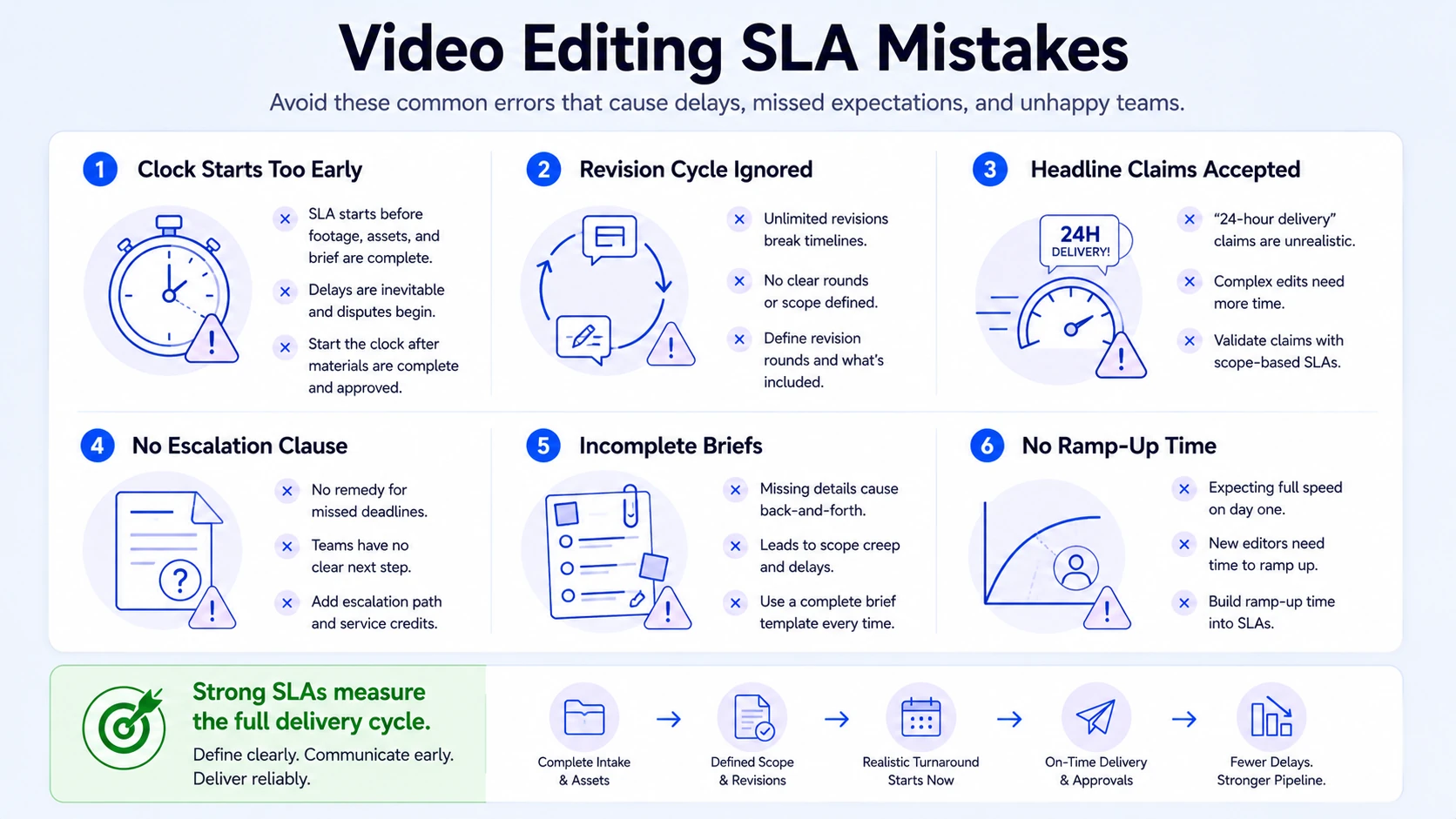
- Measuring from kickoff, not from complete brief receipt. The most common mistake. Your SLA clock must start from the moment your partner has everything they need, not the moment you asked for the video.
- Ignoring the revision cycle in the total timeline. The first draft usually represents only 40–60% of the total timeline. Budget the revision rounds or your content calendar math will always be wrong.
- Accepting headline turnaround claims without asking for median delivery data. Before signing any contract, ask for median delivery time, not the stated SLA headline. Every vendor in the video editing market leads with speed.
- Skipping the escalation clause. Most contracts define delivery time. Very few define what happens when it's missed. Without a remedy clause, every missed deadline becomes a negotiation.
- Treating SLA speed as a substitute for brief quality. A 24-hour SLA with an incomplete brief will always produce a poor first draft, more revision rounds, and a longer total cycle than a 48-hour SLA with a locked brief.
- Not accounting for ramp-up time on new partnerships. A new editor needs 3–5 videos to fully learn your style, and during that ramp-up period, expect 30–50% longer turnaround and more revision rounds. Build that into your first-month expectations explicitly, not as a surprise.
Conclusion
Setting turnaround SLAs with a video editing partner is not a procurement task, it is a pipeline decision. The content your team publishes, and when it publishes, directly affects demo demand, buyer education, and inbound velocity.
Key takeaways:
- SLAs must cover the full cycle: brief receipt, first draft, revision rounds, and final delivery, not just headline speed.
- Standard short-form turnaround is 1–2 business days; revision rounds add 24–48 hours each.
- Your brief quality and feedback consolidation control delivery speed as much as your partner's capacity does.
- Every SLA needs a remedy clause, not just a timeline clause.
Ready to build a video system that ships on schedule? Explore Komet Media's services or get in touch.
Frequently Asked Questions
Q1: What is a turnaround SLA in video editing?
A turnaround SLA is a written commitment in your client-agency contract specifying how long each stage of the video production pipeline takes, first draft, revisions, and final delivery, plus the remedies that apply if those timelines are missed. It makes "we'll get it done fast" a measurable obligation.
Q2: How long should video editing turnaround times be for B2B short-form content?
For ongoing content production, 24–48 hours is the industry standard for professional agencies. For repurposed webinar clips, podcast highlights, and demo snippets under 90 seconds, 1–2 business days is a realistic and enforceable first-draft target when the brief is complete.
Q3: What happens if my video editing partner misses an SLA deadline?
Your pre-agreed remedy clause should activate automatically: same-day reprioritization for minor misses, invoice credit for full-day delays, and a formal workflow audit for patterns. Without a remedy clause defined in the contract, every missed deadline becomes an ad hoc negotiation.
Q4: Should revision rounds be included in the SLA turnaround time?
Yes, always. Standard SLAs quote turnaround to first draft. A typical project with two revision rounds looks very different on the calendar from the headline number. Define revision rounds, per-round turnaround, and what constitutes a "new project" versus a revision within the original scope.
Q5: What is a reasonable rush fee for expedited video editing?
For a rush turnaround of 24–48 hours, most professional agencies charge a rush fee of 20–50% of the regular rate. Define the rush tier explicitly in your SLA so both parties know the cost before the urgent request arrives, not during it.
Q6: How do I know if a video editing partner will actually honor their SLA?
Ask for their median delivery time on projects similar to yours (not their best-case time), request two or three client references who can speak to delivery consistency, and run a paid pilot project before committing to a long-term retainer. Not every provider will agree to formal SLAs, and that tells you something. If an agency won't commit to specific turnaround times in writing, their consistency is probably not something they're confident in.