
🪄 AI Summary
Heading 1
Heading 2
Heading 3
Heading 4
Heading 5
Heading 6
Lorem ipsum dolor sit amet, consectetur adipiscing elit, sed do eiusmod tempor incididunt ut labore et dolore magna aliqua. Ut enim ad minim veniam, quis nostrud exercitation ullamco laboris nisi ut aliquip ex ea commodo consequat. Duis aute irure dolor in reprehenderit in voluptate velit esse cillum dolore eu fugiat nulla pariatur.
Block quote
Ordered list
- Item 1
- Item 2
- Item 3
Unordered list
- Item A
- Item B
- Item C
Bold text
Emphasis
Superscript
Subscript
If your marketing team wakes up Monday morning already behind on content, you are not alone, and you are not under-resourced. You are trapped. The daily grind of creating net-new videos, posts, and decks from scratch is the content hamster wheel, and it is draining teams dry. Escaping the video content hamster wheel with repurposing is not a workaround, it is the operating model that serious B2B SaaS growth teams are switching to right now. Here is exactly how it works and why it compounds faster than anything else in your content calendar.
TL;DR
- The problem: Most SaaS teams keep creating new content while their existing assets quietly die with one use.
- The fix: Build a repurposing system that extracts 8–12 assets from every long-form video, webinar, or podcast.
- The payoff: More pipeline coverage, more buyer touchpoints, and a team that is not burning out.
- The move: Start with your highest-value existing content, one pillar asset becomes your full content calendar.
What Is the Content Hamster Wheel and Why B2B SaaS Teams Get Stuck on It
The content hamster wheel has a simple, brutal mechanic: publish, scramble, publish again. You hit post on a LinkedIn video or ship a webinar and immediately feel the pressure to create the next thing. The asset you just made gets a 48-hour window before the feed buries it, and then it is done forever. Most SaaS marketing teams are producing more content than ever but seeing less return on each piece. The blog gets published, the webinar wraps up, the case study goes live, and then everything quietly collects digital dust while the team scrambles to create the next thing. That is the content trap. The burnout is real and measurable.
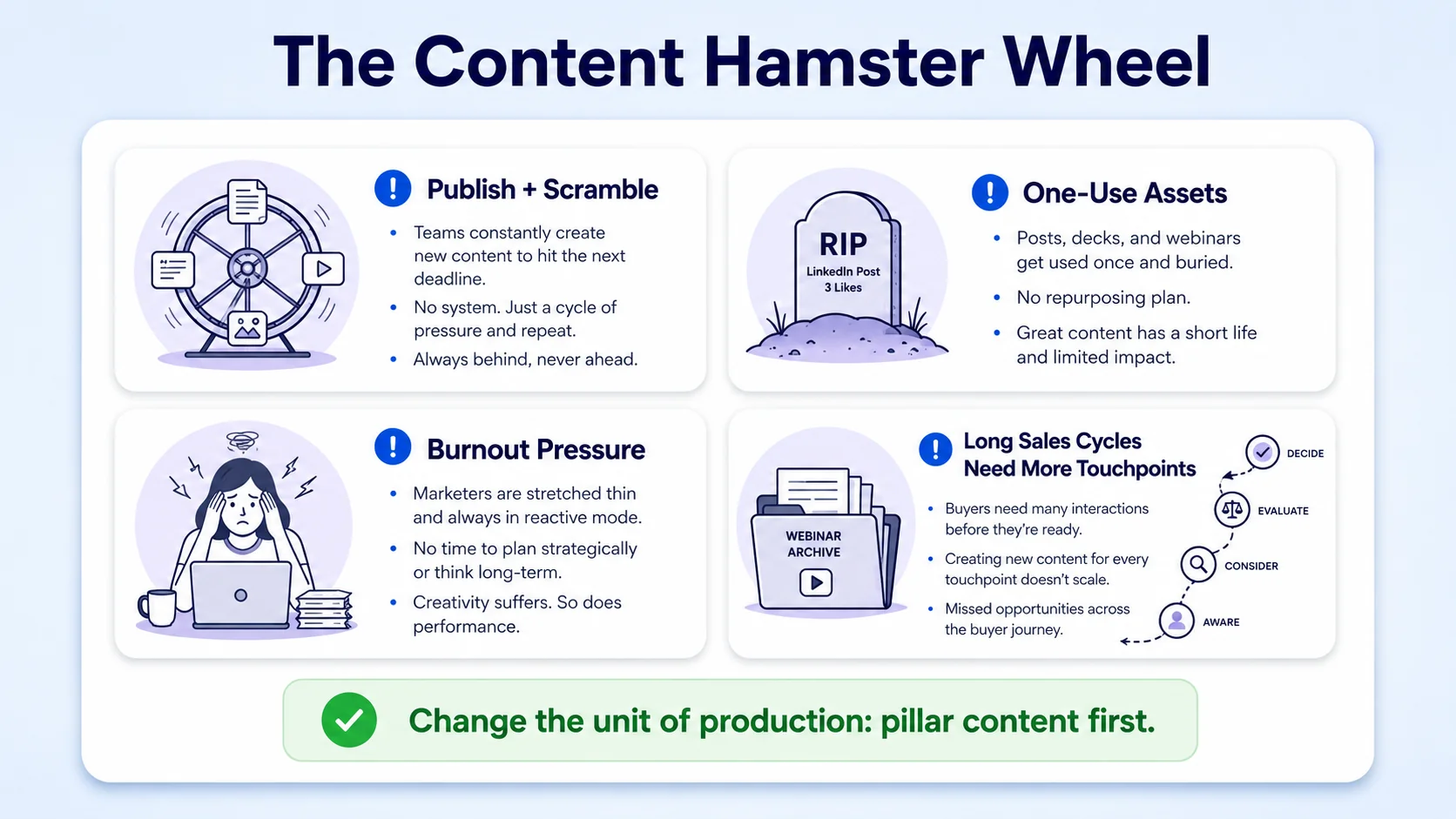
73% of marketers experience burnout , and the content volume pressure is a primary driver. Among marketing leaders, burnout and overwork are the top concerns, cited by 25.9% of leaders, reflecting teams stretched beyond capacity to deliver more campaigns, more content, across more channels, all while under constant pressure to justify ROI. For SaaS teams specifically, the problem is structural. SaaS sales cycles are long, and leads require significant nurturing along the way, which means a lot of content.
You need presence across LinkedIn, YouTube Shorts, email, and sales sequences simultaneously, yet your team has finite creative hours. The answer is not hiring three more content people. It is changing the unit of production. Escaping the video content hamster wheel with repurposing means your team stops creating one-and-done assets and starts producing pillar content designed to be atomized from day one.
In 2026, the SaaS companies winning in content are not necessarily the ones publishing the most, they are the ones distributing what they have most intelligently.
What Content Repurposing Actually Means (and Why It's Not Recycling)
Content repurposing is the strategic practice of taking existing content and presenting it in a new format on a new platform to extend its lifespan and reach a wider audience. That definition matters because it rules out the lazy version, copying and pasting the same transcript into five tabs.
True repurposing is format transformation with audience intent. A 45-minute webinar is not a LinkedIn post. But the three most counter-intuitive insights from that webinar, clipped into 60-second vertical videos with captions, distributed across YouTube Shorts and LinkedIn, each pointing back to a registration page for the full webinar recording, that is repurposing. Gary Vaynerchuk popularized this as the "Document, Don't Create" framework, pulling micro-content from pillar content rather than generating fresh ideas for every channel.
The Pillar Content Framework looks like this in practice:
Repurposing content, or content syndication, means taking an existing piece of content and transforming it for a different platform. The content is often heavily adapted and turned into a different type of content, for example, turning a blog post into a few tweets or a podcast episode into a blog post. This is not just about reposting the same content but reimagining it to make it fresh and engaging in a completely new context. The ROI case is clear. Repurposing existing content improves ROI by an average of 32%. And 38% of marketers rank updating and repurposing existing content among their top success factors.
How to Stop Creating New Content Every Day: Build the Repurposing System
Escaping the video content hamster wheel with repurposing is a systems problem, not a creativity problem. Here is the process we use at Komet Media for SaaS teams:
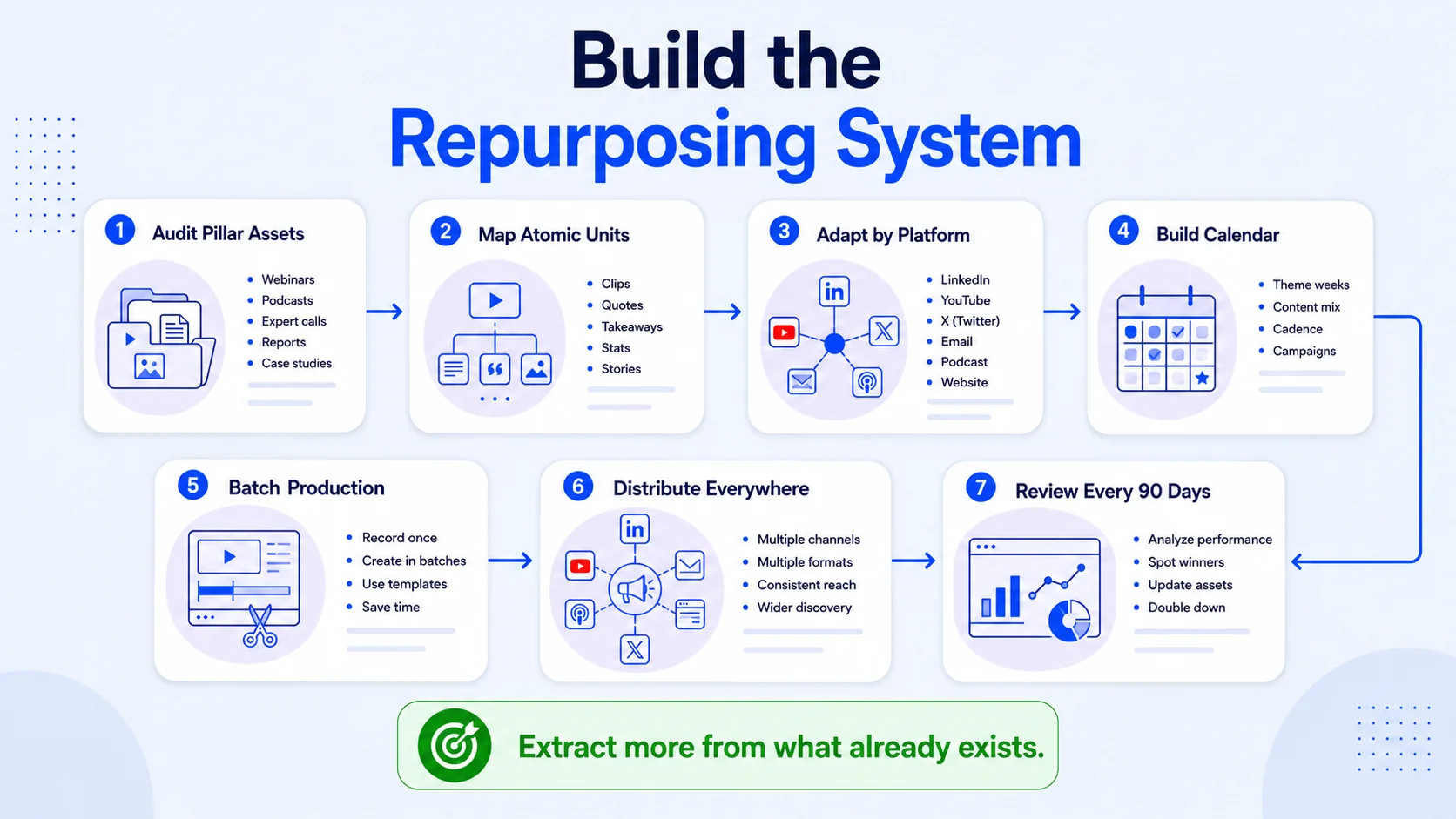
- Identify your pillar assets: Audit your existing library, webinars, podcast episodes, product demos, founder talks. These are your raw materials. Prioritize the ones where your best thinking lives.
- Define your atomic content units: For each pillar, map every format you can extract, short clips, carousels, quote graphics, blog sections, email sequences, and sales enablement snippets. Aim for 8–12 assets per pillar.
- Assign platform-native treatment: Each platform has a different grammar. LinkedIn carousels reward structured insights. YouTube Shorts reward fast hooks and clear payoffs. Do not cross-post the same file, adapt the format for the feed.
- Build a content calendar from extraction, not ideation: Your monthly content calendar should be driven by which pillar asset you are atomizing that week, not by a blank brainstorm every Monday.
- Batch produces the derivatives: Short-form video editing, captioning, thumbnail creation, and carousel design should all happen in a single production sprint, not scattered across five separate days.
- Distribute to every audience touchpoint: Schedule omnichannel distribution across LinkedIn, YouTube Shorts, email, and your sales team's outreach, the same insight reaches buyers in the format they prefer.
- Review content lifecycle performance: Every 90 days, audit which atoms drove the most pipeline conversations. Use that data to choose your next pillar asset.
Build modular content that can be repurposed across formats, for example, webinar to article to social to sales enablement. The SaaS teams doing this well are not producing more; they are extracting more from what already exists.
How to Turn One YouTube Video into 10+ Pieces of Content Without Feeling Repetitive
This is the question every SaaS founder or marketing head has when they first hear about repurposing: "Won't it feel like the same thing over and over?" No, and here is why. Each format surfaces a different dimension of the same insight. A 60-second vertical clip hooks with a bold claim. A LinkedIn carousel teaches the framework behind it. A blog post goes three levels deeper with context and data. An email covers the same point with a direct CTA for a demo. Each of these has a different job for a different buyer at a different stage of awareness.
This method is essential for maximizing the ROI of your "pillar" content. Instead of a single promotional push, you create a sustained campaign of valuable, bite-sized insights that appeal to different segments of your audience on their preferred platforms. For B2B firms, this is one of the most powerful content repurposing strategies because it systematically extends the reach of your core expertise, turning one major effort into dozens of engagement opportunities.
Practical extraction map for one YouTube video:
- Clip 1 (0:00–1:00): Hook moment as a YouTube Short or LinkedIn native video
- Clip 2–4: Three distinct insight moments as vertical short-form videos with captions
- Clip 5: Customer story or objection moment as a standalone social proof clip
- LinkedIn carousel: The 5-step framework you explained, visualized in slides
- Blog post: Expanded version with examples, internal links, and SEO structure
- Email 1: "Here is the one thing from last week's video most people miss"
- Email 2: CTA to book a demo based on the core problem the video addresses
- Sales enablement asset: The most powerful 90-second clip your AE can send pre-call
Update your content with new examples, statistics, or information personalized by ICP or industry. A blog on industry trends could be repurposed into "industry trends for [specific vertical]" and so on. That specificity is what kills the repetitive feeling.
Content Repurposing Strategy for Small SaaS Teams with Limited Time
Most SaaS marketing heads reading this are running a team of two to five people. The repurposing system has to be lean or it will never happen. Here is how to make it work with limited bandwidth.
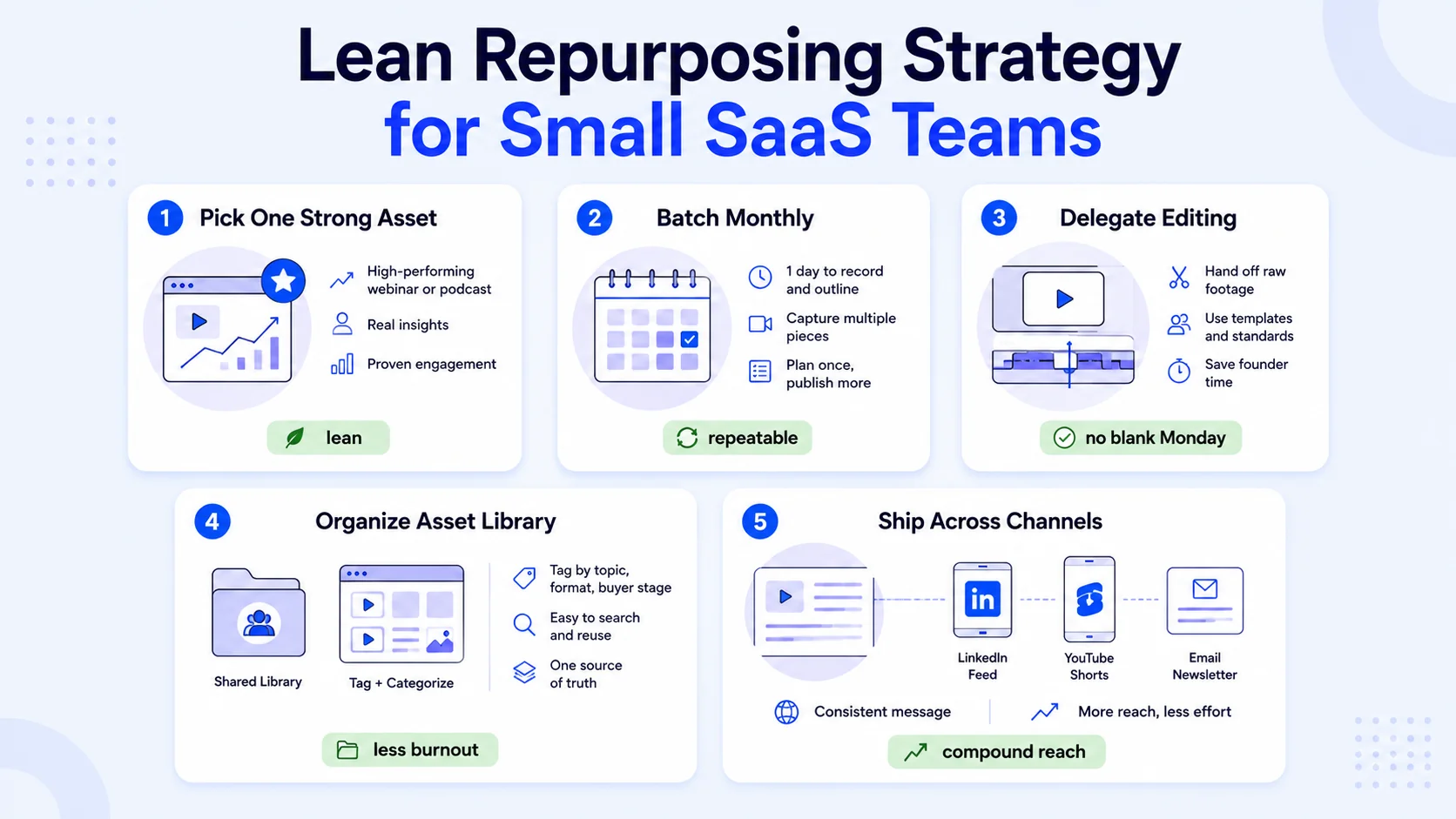
Prioritize ruthlessly. High-performing, evergreen content is the best repurposing source, comprehensive blog posts, webinars, popular videos, podcasts, original research, and detailed case studies. Do not repurpose average content; it multiplies mediocrity. Start with your one best-performing asset this quarter.
Use batch content creation. Dedicate one full day per month to pillar recording, a long-form interview, a founder Q&A, or a webinar, and then use the following week to extract all derivative assets. One production day feeds a full month of omnichannel distribution.
Delegate video editing and formatting. Clipping, captioning, carousel design, and podcast production are execution tasks, not strategy tasks. Your marketing head should not be spending time in a timeline editor. That time should go to pipeline thinking.
Maintain a digital asset management system. Every clip, transcript, graphic, and blog draft lives in one shared folder, tagged by pillar asset and format. This prevents re-creation of assets that already exist and makes content lifecycle management tractable for a small team.
Content repurposing, the practice of taking an existing asset and reshaping it for different formats, channels, and audiences, is how the most efficient SaaS marketing teams are stretching their budgets, reaching new buyers, and staying consistent across every platform without burning out. The content calendar practically builds itself once the system is running. You are never staring at a blank Monday again.
How Repurposed Video Content Drives Pipeline, Demos, and Buyer Trust for SaaS
This is the section most content guides skip. Repurposing is not just an efficient play, it is a pipeline play. For SaaS teams, video content that is thoughtfully repurposed directly supports demo demand, sales enablement, and founder-led growth. Nearly 83% of buyers still define their purchase requirements before speaking to a rep, even as digital research tools increasingly inform their decisions. That means your buyers are educating themselves on your product, and if your video content is not reaching them across every channel they use, a competitor's is.
60% of B2B marketers plan to increase their investment in short-form video for content marketing in 2025. Short-form video clipped from your webinars, demos, and founder conversations is the format buyers are consuming to shortlist vendors before they ever fill out a form. Repurposed content also serves your sales team directly. Sales teams are often underserved by marketing content because assets are never adapted into formats that fit a sales conversation, repurposing fixes this.
A 90-second clip of your founder explaining the core problem your product solves is more powerful than any PDF one-pager, and it takes one editing sprint to produce. Extend the value of each webinar by recording it and repurposing the content: publish the recording on-demand, chop it into short video clips for social media, and write follow-up blog posts. For events and webinars specifically, the post-event repurposing window is where most of the pipeline value actually lives, not in the live attendance numbers.
Brand storytelling compounds over time when the same core message appears across multiple formats and channels. Buyers need multiple audience touchpoints before they trust a vendor enough to book a demo. Repurposing is how you manufacture those touchpoints without manufacturing new content every time. Every clip, carousel, and short video is another moment of recognition, and recognition is the first step in trust. 97% of B2B buyers say trust is a decisive purchase factor. Repurposing your best thinking into micro-content that reaches buyers on LinkedIn, in their inbox, and in their YouTube feed is how you build that trust at scale without a broadcast budget.
Conclusion
- Escaping the video content hamster wheel with repurposing is a system change, not a tactics swap, it requires designing every piece of pillar content for extraction from the start.
- One high-quality long-form asset (webinar, podcast, demo, founder talk) should produce 8–12 derivative assets across short-form video, carousels, blog, and email.
- The ROI compounds: more buyer touchpoints, more pipeline coverage, less team burnout, and a content calendar that runs on existing assets rather than blank-page panic.
- If your team is still creating net-new content every day, the Komet Media services team can help you build the repurposing system and handle the production so your strategists can stay strategic.
Frequently Asked Questions
Q1: What is content repurposing and why does it matter for B2B SaaS teams?
Content repurposing means transforming one existing asset into multiple formats for different platforms and audiences. For SaaS teams with long sales cycles and limited bandwidth, it matters because it multiplies pipeline coverage from a single production effort, without requiring net-new ideas every week.
Q2: How many pieces of content can I realistically get from one webinar?
A 45–60 minute webinar can produce 8–12 assets: 5–6 short video clips, 1 long-form blog post, a LinkedIn carousel, 2–3 emails, show notes, and a sales enablement clip. The key is planning the extraction before you record, not after.
Q3: Won't repurposing the same content feel repetitive to my audience?
Not if each format serves a different buyer intent. A 60-second clip hooks attention. A carousel teaches the framework. A blog post adds depth. An email drives action. Each format meets a different buyer at a different moment, the same insight, four different jobs.
Q4: What types of content are best to repurpose for SaaS lead generation?
High-performing, evergreen content is ideal, comprehensive blog posts, webinars, popular videos, podcasts, original research, and detailed case studies
are the assets with the longest repurposing runway because the underlying insight stays relevant across quarters.
Q5: How does repurposed video content support pipeline and sales specifically?
Short video clips from webinars and demos give your sales team pre-call assets that warm buyers before discovery. A founder explaining the core problem your product solves in 90 seconds does more trust-building work than a cold deck. It also feeds inbound buyers who discover a clip on LinkedIn and then book a demo on their own terms.
Q6: My team is small. Where do we start with content repurposing?
Start with your single best-performing existing asset, the webinar, the podcast episode, or the demo that already resonated. Extract five things from it this week: two short video clips, one LinkedIn post, one email, and one blog section. Run that cycle once. Once you see how much mileage one asset generates, the system becomes obvious.