
🪄 AI Summary
Heading 1
Heading 2
Heading 3
Heading 4
Heading 5
Heading 6
Lorem ipsum dolor sit amet, consectetur adipiscing elit, sed do eiusmod tempor incididunt ut labore et dolore magna aliqua. Ut enim ad minim veniam, quis nostrud exercitation ullamco laboris nisi ut aliquip ex ea commodo consequat. Duis aute irure dolor in reprehenderit in voluptate velit esse cillum dolore eu fugiat nulla pariatur.
Block quote
Ordered list
- Item 1
- Item 2
- Item 3
Unordered list
- Item A
- Item B
- Item C
Bold text
Emphasis
Superscript
Subscript
Your brand's video content is not underperforming because it's bad. It's underperforming because it's posted from a company page. With organic reach declining for branded content on platforms like LinkedIn, the smartest distribution lever you have is already on your payroll. Employee advocacy for B2B video reach turns your team's personal networks into a distribution engine that no ad budget can replicate. This guide covers exactly how to build, run, and measure that engine, with the practical depth B2B SaaS founders, marketing heads, and growth teams actually need.
TL;DR
- Content shared by employees gets 8x more engagement than the same post shared from a brand account.
- Employee advocacy for B2B video reach works because people trust people, not logos, especially on LinkedIn.
- Build your programme around short-form video first: it's the highest-performing content format for personal profiles.
- Measure pipeline influence and earned media value, not just likes.
What Is Employee Advocacy in B2B Marketing, and Why Does It Matter Now?
Employee advocacy is the practice of mobilising your team, founders, sales reps, engineers, customer success leads, to share and amplify company content from their personal social profiles. In a B2B context, that means turning every employee's LinkedIn post into a distribution node for your brand's ideas, product stories, and expertise. The urgency in 2026 is real.
The biggest challenge for B2B marketers right now isn't creating content, it's getting anyone to trust it. As AI-generated noise floods every social feed, brand accounts are seeing record-low engagement. Employee-shared content sidesteps that problem entirely because LinkedIn's algorithm actively favours personal profiles over company pages. As of 2025, 92% of B2B buyers trust employee recommendations over traditional advertising.
That trust gap is why an employee post about your SaaS product, even a 60-second clip, outperforms a polished brand video by a wide margin. The Edelman Trust Barometer 2025 reinforces this: "trust has become a new axis of competition," with trust now equal to price and quality in brand purchase decisions.
For B2B SaaS teams specifically, the stakes are even higher. Your buyers are busy, skeptical, and drowning in vendor content. They respond to people they recognise in their feed, a product manager who talks about real problems, a founder who shares a contrarian take on their category, a sales engineer who breaks down an integration in 45 seconds. That's employee advocacy for B2B video reach in practice: authentic, peer-to-peer, and algorithm-friendly.
Only 31% of B2B companies have formal employee advocacy programmes, according to HubSpot's 2025 research. The other 69% are leaving massive distribution potential untapped. If your competitors haven't activated this yet, you have a narrow window to own the space.
How Employee Advocacy Increases Video Reach on LinkedIn
LinkedIn's algorithm rewards content that sparks genuine peer interaction fast. Employee-shared content systematically outperforms brand-page content because LinkedIn's ranking model weights peer-to-peer interactions more heavily, and a 2025 analysis of 1.8 million posts showed that posts with 3+ commenters in the first 60 minutes get approximately 5.2x amplified reach. Video compounds this effect.
Video posts from CEOs have increased by 68% on LinkedIn over the last two years, which signals that the platform is actively surfacing executive and employee video content to broader audiences. Short-form video, think 30 to 90 seconds, native upload, no external links in the caption, performs best on personal profiles. The network math is critical here.
Employees average 10x more connections than their company has followers on LinkedIn. A 50-person SaaS team with average networks of 800 connections each controls a potential first-degree reach of 40,000 people, people who already trust the sender. No company page matches that without paid amplification. LinkedIn drives 75–85% of B2B social leads, and advocacy programmes that achieve CPC under $1 have been benchmarked at 18% of programmes versus $5–$10 for paid LinkedIn ads.
When employees share your video content, you're generating earned media at a fraction of the cost of sponsored posts. The dark social dimension matters too. A significant portion of B2B buying conversations happen in private DMs, Slack channels, and group chats, spaces where brand content never travels. Employee videos do. A prospect who watches a founder's LinkedIn video will often forward it directly to their buying committee. That attribution rarely shows up in your dashboard, but it absolutely shows up in the pipeline.
How to Build an Employee Advocacy Programme for B2B Video: Step by Step
A programme that fizzles after three weeks is worse than no programme at all, it burns trust and goodwill. Build it deliberately.
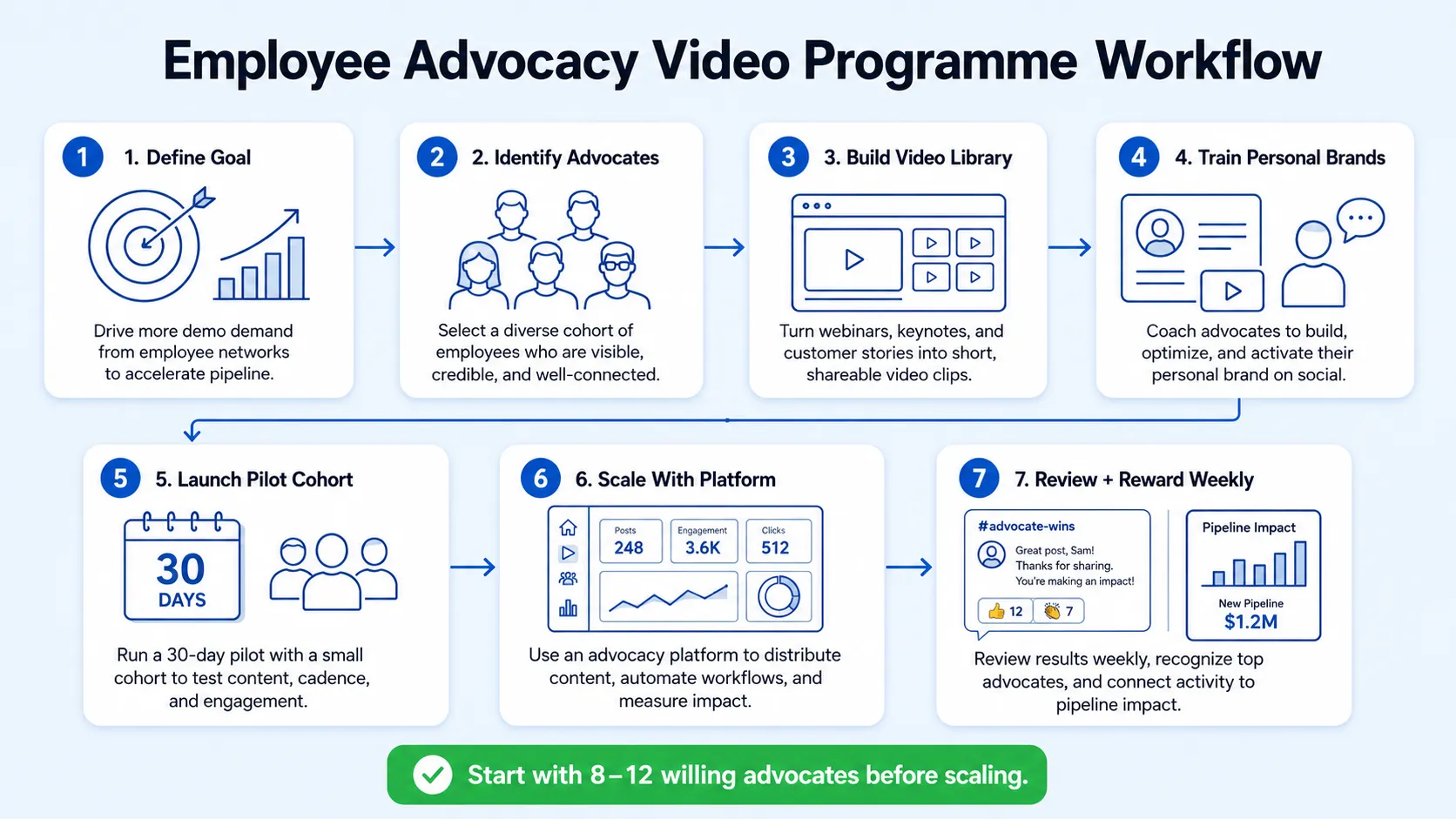
- Define your goal first: Are you driving demo demand, supporting sales enablement, building founder-led thought leadership, or all three? Your goal determines which employees you activate and what video content you produce.
- Identify your advocates: Start with 8–12 willing participants across sales, product, and leadership. Pre-written posts kill authenticity. LinkedIn posts written in employees' own words outperform pre-written shares by 9x. Pick people who have opinions and can speak naturally on camera.
- Build your video content library: Turn existing assets, webinars, podcast clips, demo recordings, and founder interviews into short-form videos. This is where Komet Media's content repurposing system and their end-to-end employee advocacy programme creation become the engine: they turn long-form sessions into advocate-ready clips while building the strategic framework for your team.
- Train advocates on personal branding: Teach them the difference between sharing a post and owning a point of view. A 60-second opinion clip beats a company repost every time.
- Launch with a pilot cohort: Run 30 days with your core advocates before scaling. Track what resonates, iterate, then expand.
- Scale with a platform: Once the pilot proves traction, use a tool to streamline content distribution and track reach at scale.
- Review and reward weekly: Publicly recognise top advocates in Slack or team meetings. Recognition drives sustained participation more than software alone.
Why Employee Advocacy Outperforms Brand Posts for Video Content
The performance gap between employee and brand content is not marginal, it's structural. LinkedIn's algorithm, buyer psychology, and the nature of video trust all stack in the same direction. Content shared by employees receives 8x more engagement than corporate shares, according to B2B influencer marketing studies. For video specifically, the gap widens. A product demo shared by an engineer who built the feature carries authenticity that a brand-page video cannot manufacture.
The 8 to 10% of buyers McKinsey identifies as "influentials" generate 3x more word-of-mouth messages per recommendation, each with 4x more impact on purchase decisions, and in a B2B context, that maps directly to technical practitioners, department heads, and thought-visible employees whose LinkedIn networks are dense with buyers.
Brand posts signal marketing. Employee posts signal belief. That distinction is what makes employee advocacy for B2B video reach a sales enablement asset, not just a content play. When a sales rep shares a product video they genuinely find useful, prospects receive it as a recommendation, not an ad. The Edelman Trust Barometer consistently finds that employees rank among the most trusted sources of company information.
CMI's 2026 B2B Content Marketing report, surveying 1,015 marketers, confirms that employee advocacy programmes are among the top-3 fastest-growing B2B content tactics. The convergence of algorithm changes, declining brand trust, and rising video consumption has made this shift structural, not a trend.
How to Measure the ROI of Employee Advocacy for Video Content
Most programmes measure advocacy wrong. They track impressions and celebrate reach. What you actually need to connect is shares to the pipeline. Effective employee advocacy measurement requires moving beyond vanity metrics to KPIs that directly connect employee shares to pipeline and revenue outcomes through CRM integration. A tiered approach tracking awareness, engagement, and pipeline metrics enables organisations to prove the full business impact.
Here's the measurement framework I recommend for B2B video advocacy:
Use standardised UTM codes for all advocate-shared content and capture these parameters directly in your CRM to connect clicks to leads, opportunities, and closed deals.
For earned media value: LinkedIn CPM for B2B audiences typically ranges from £15 to £40. Using your actual campaign CPM as a benchmark, 200,000 advocacy impressions at £25 CPM equals £5,000 in media value equivalent.
LinkedIn's Social Selling Index data shows that SSI leaders have 45% more sales opportunities than peers with lower scores and are 51% more likely to hit their quotas. Social selling also cuts average sales cycle time by 20 to 30%. Those are the numbers to present to your CEO when justifying the programme.
Best Tools for Managing Employee Advocacy Programmes in B2B
The right tool depends on your team size, budget, and whether you need CRM integration or just content distribution. Pricing ranges from free tiers to $10,000+ per year for enterprise.
Oktopost is best for B2B teams focused on deep CRM integration and lead attribution. For early-stage SaaS teams without an enterprise budget, GaggleAMP or a lightweight tool like Vulse lets you run a structured programme without a six-figure commitment.
One critical warning: many organisations fail because advocacy feels like "extra work" for employees. Understanding why employee advocacy programmes fail and fixing those underlying issues is essential before selecting software. No tool compensates for missing buy-in.
At Komet Media, we offer full employee advocacy programme creation from scratch in addition to our content repurposing system. We turn webinars, podcasts, and demos into advocate-ready clips while building the strategic framework for your team to succeed. The tool handles distribution; we solve both the strategic setup and the "what do employees actually share?" problem that kills most programmes.
Employee Advocacy vs. Influencer Marketing for B2B Video Reach
Both use third-party voices to extend reach. The similarities stop there.
For B2B SaaS, employee advocacy wins on pipeline contribution and cost efficiency. Influencer marketing has a role in category awareness but rarely connects to demo demand. The deeper differentiator: employees have real product knowledge. An engineer who explains exactly why a feature works the way it does creates buyer education that no external creator can replicate.
The exception is founder-led content that scales beyond a team's network. If you want to reach a cold audience with a specific ICP, a targeted B2B creator with that exact audience can complement your advocacy programme. But use it as amplification, not a substitute for internal advocacy architecture.
Common Mistakes B2B Companies Make with Employee Advocacy Video Campaigns
These are the patterns I see kill programmes before they find traction.
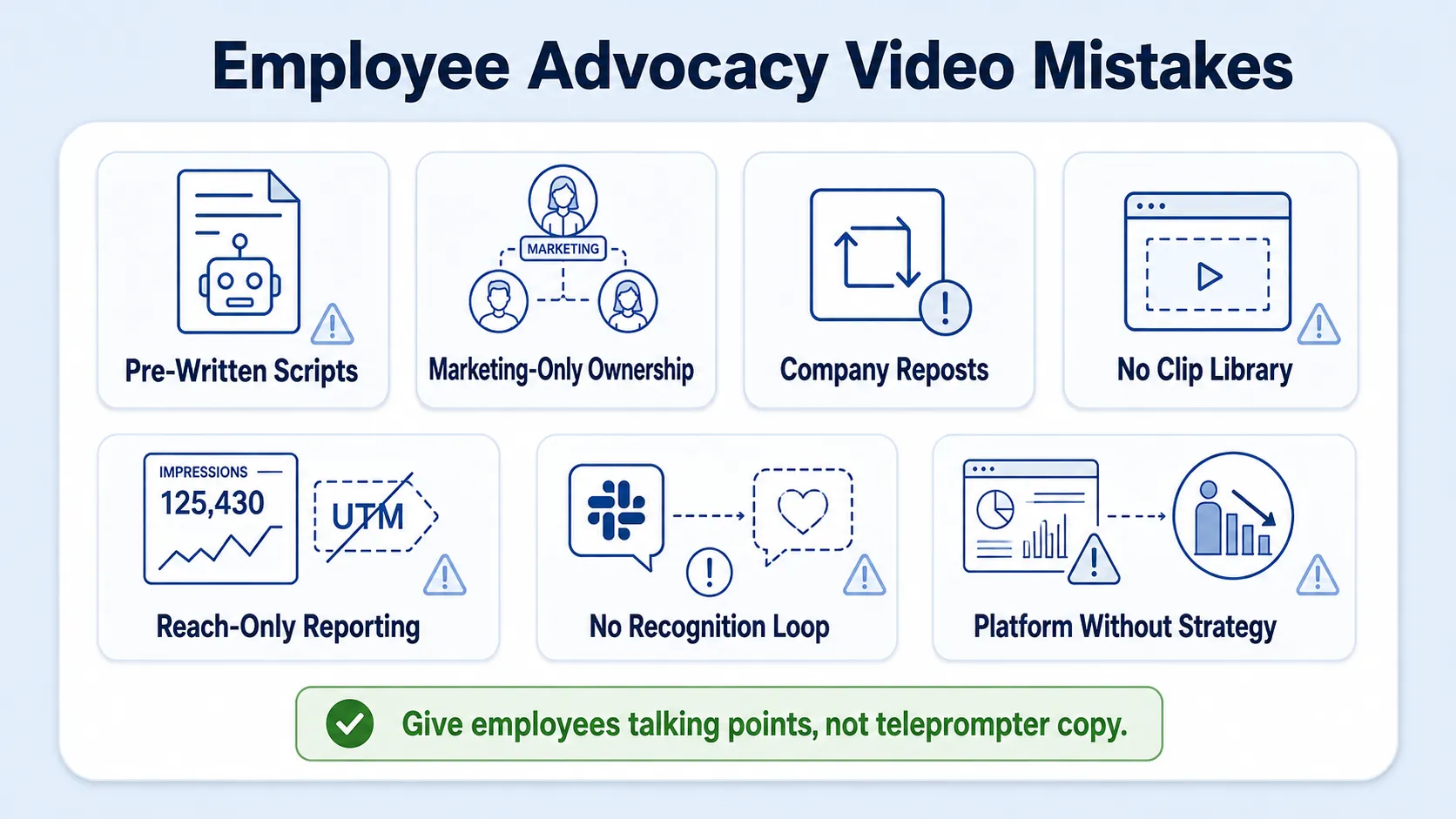
- Launching with pre-written scripts: Employees sound robotic, engagement craters, participation drops within 30 days. Give them talking points, not teleprompter copy.
- Treating it as a marketing department project: Advocacy requires buy-in from sales, leadership, and product. If it sits only with marketing, it stays siloed.
- Sharing brand posts instead of original video: Reposts from the company page add zero network advantage. Original content on personal profiles is what triggers the algorithm.
- Skipping the content repurposing step: Most teams lack a library of short-form clips. Without ready-to-use video assets, pulled from webinars, podcasts, or events, employees default to doing nothing.
- Measuring only reach: Impressions without UTM tracking and CRM connection prove nothing to a revenue-focused team.
- No recognition loop: A platform is only as good as the number of people who actually use it. In many organisations, advocacy programmes fail because they feel like "extra work" for employees. Public recognition and internal visibility change that dynamic.
- Going platform-only without a content strategy: Software distributes content. It doesn't create conviction. If employees don't believe in what they're sharing, no tool fixes that.
Conclusion
Employee advocacy for B2B video reach is the highest-leverage distribution move available to SaaS teams in 2026. The data, the algorithm, and the trust economy all point in the same direction: people trust people, and short-form video shared by real employees outperforms everything a brand page can produce. Here's what to lock in:
- Start with a small cohort of willing advocates and build a repurposed video content library before touching any platform.
- Prioritise original, opinion-led short-form video over corporate reposts.
- Measure pipeline impact, UTM-tagged links, CRM attribution, and earned media value, not just reach.
- The content production layer is the part most programmes get wrong; solve that first.
Ready to turn your team's product knowledge into advocate-ready video content? Talk to us at Komet Media.
Frequently Asked Questions
Q1: What content format works best for employee advocacy on LinkedIn?
Short-form video, 30 to 90 seconds, uploaded natively, consistently outperforms text, carousels, and image posts on personal profiles. Clips pulled from webinars, demos, and podcast episodes perform particularly well because they carry real subject-matter depth without feeling produced.
Q2: How many employees do I need to start an advocacy programme?
Eight to twelve engaged advocates is enough to build a meaningful pilot. Volume matters less than quality of participation. A team of ten employees posting consistently will outperform fifty who share once and disengage. Start small, prove traction, then scale.
Q3: How do I get employees to actually share content without it feeling forced?
Give them content that genuinely reflects their expertise and opinions, not corporate messaging. Make sharing frictionless, one click, pre-loaded captions they can edit, mobile-accessible. Recognise top advocates publicly. The programmes that sustain participation treat advocacy as professional development, not a marketing task.
Q4: How is employee advocacy different from social selling?
Social selling focuses on sales reps using LinkedIn to prospect and nurture individual buyers. Employee advocacy is broader, it involves any employee amplifying brand content to grow reach and trust across their network. The two strategies complement each other and often run through the same platform.
Q5: What's a realistic timeline to see ROI from an employee advocacy programme?
Most B2B teams see measurable reach and engagement gains within 30 days. Pipeline impact typically appears in 60 to 90 days, once content-assisted touchpoints begin showing up in CRM attribution. The employee advocacy software market is projected to grow from $523.7 million in 2025 to over $1.1 billion by 2035, which signals sustained investment and maturing ROI benchmarks across the industry.
Q6: Can a small SaaS startup run employee advocacy without a dedicated platform?
Yes. A shared Notion or Google Drive content library, UTM-tagged links, and a simple Slack channel for content drops is enough for a 10–20 person team. Add a dedicated platform once you have consistent participation and need the analytics. Start with processes and habits, then add tooling.