
🪄 AI Summary
Heading 1
Heading 2
Heading 3
Heading 4
Heading 5
Heading 6
Lorem ipsum dolor sit amet, consectetur adipiscing elit, sed do eiusmod tempor incididunt ut labore et dolore magna aliqua. Ut enim ad minim veniam, quis nostrud exercitation ullamco laboris nisi ut aliquip ex ea commodo consequat. Duis aute irure dolor in reprehenderit in voluptate velit esse cillum dolore eu fugiat nulla pariatur.
Block quote
Ordered list
- Item 1
- Item 2
- Item 3
Unordered list
- Item A
- Item B
- Item C
Bold text
Emphasis
Superscript
Subscript
Is Instagram worth it for HR tech and martech brands? Sometimes, and rarely as a lead channel on its own. The evidence supports social media as a place buyers form impressions, not as the place they sign contracts. Instagram earns its cost when your team can sustain expert-led video and when familiarity with buyers or candidates is a real goal. This guide sets out the evidence, the costs, and a way to decide.
Quick Answer
It is worth it when you can produce video steadily and want visibility with buyers or candidates. It is not worth it as a quick lead source. Test for 90 days with clear metrics.
Verdict by Situation
What the Evidence Says
The evidence is useful but incomplete. None of these sources isolates Instagram for HR tech or martech, so I treat them as context.
The question "is Instagram worth it for HR tech and martech brands" starts with a plain reading of that evidence. Buyers trust practitioners and peers, social media influences research, and candidates look at social profiles. Instagram can support all three if your content comes from real people. It cannot, on this evidence, replace events, reviews, or sales conversations.
Why HR Tech and Martech Differ from Other B2B
The two categories share a trait: the audience watches how you present yourselves.
For deeper category detail, see our guides to Instagram growth for HR tech brands and Instagram growth for martech brands.
What "Worth It" Should Mean
Be specific before you answer "is Instagram worth it for HR tech and martech brands". A channel can be worth it for brand and not for lead generation. Decide which jobs you expect.
Attribution will be imperfect. Do not credit Instagram for every demo, and do not dismiss it because last-click reports show little.
Early Signals That It Is Working
Before pipeline numbers appear, other signals show whether the account is on track. Use this table to read the first quarter.
None of these proves revenue impact on its own. Taken together they show direction. If every signal is flat after a full quarter of consistent posting, change the content or stop. That is the honest answer for your team.
Reputation Risks to Weigh
A weak account can cost more than no account, because buyers and candidates will look. Weigh these before you start:
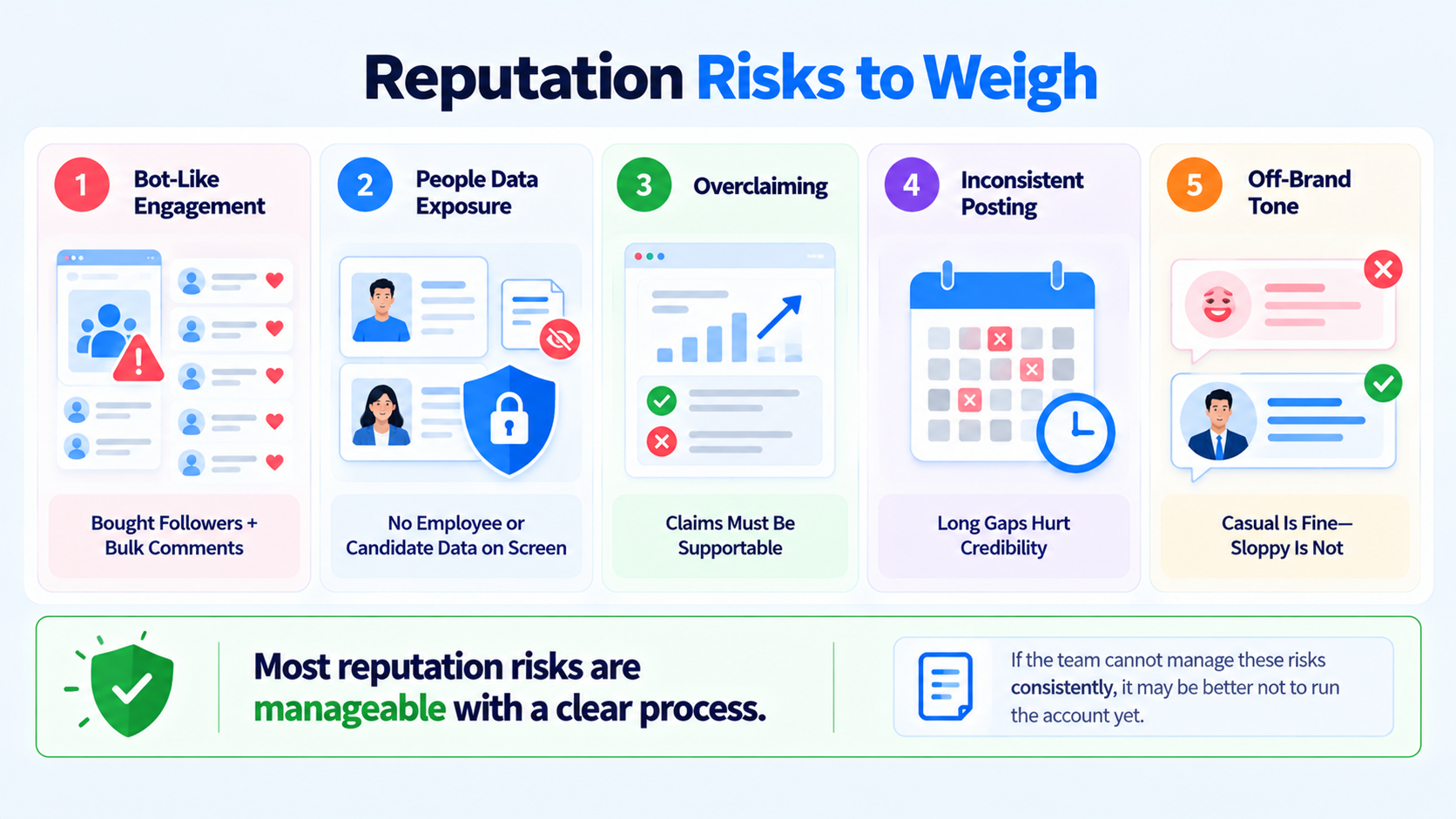
- Thin or bot-like engagement. Bought followers and bulk comments are visible to sceptical marketers and HR leaders.
- People data. HR content must avoid real employee or candidate data on screen.
- Overclaiming. Product claims should be supportable and reviewed.
- Inconsistency. An account that goes quiet for weeks signals a team that lost interest.
- Off-brand tone. Casual is fine, but sloppy is not.
These risks are manageable with process, which is one reason teams use a managed partner. They are also a reason to say no if you cannot manage them.
What It Costs
Cost has two parts: money and time.
Money. Public prices vary widely. Kicksta lists $39 to $129 a month for a self-serve tool, Vidpros lists $1,000 and $4,000 a month for editing, and Vidico states subscriptions from $5,000 a month. Komet Media's typical retainers run around $2,500 to $5,000, depending on scope, volume, production difficulty (whether repurposing existing material or creating new videos from scratch), turnaround, and distribution needs. That is a working range, not a fixed package.
Time. Expert time is often the real cost. A managed service reduces it, but it does not remove it. In our model—whether repurposing existing content or producing original videos from scratch—recording and review usually take about 8 to 10 hours a month, and videos arrive in weekly batches for approval.
Put your own numbers into a simple frame:
- Estimate the monthly cost of the option you are considering.
- List the outcomes you would value, such as a qualified conversation, a hire, or a rep using a video.
- Decide how many such outcomes would justify the cost over six months.
- Compare that to what you could reasonably expect, using your own history, not an industry average.
I do not offer a universal return figure because I could not verify a reliable one for these categories. See our overview of video marketing ROI statistics for the data that does exist.
What Instagram Rewards
Instagram's head, Adam Mosseri, has said that watch time, likes, and sends are top ranking signals, according to Social Media Today. That tells you what to produce: video people watch through and forward to a colleague.
A few practical consequences for these two categories:
- Specific beats broad. One workflow tip travels further than a trend overview.
- People beat logos. Named experts and real team moments earn watch time.
- Captions matter. Many viewers watch without sound.
- Consistency matters. A few strong Reels each week beat a burst followed by silence.
Three Illustrative Scenarios
These hypothetical examples show how the answer shifts. They are not client stories.
In each case the answer turns on people and process, not on the platform.
Alternatives to Compare
Instagram competes for the same marketing time as other channels.
The best approach is often not to choose. For many teams, is Instagram worth it for HR tech and martech brands gets a better answer when Instagram is one output of a wider video system. A single recording session or repurposed existing asset can feed a podcast, a webinar, LinkedIn clips, and Instagram Reels. See our comparison of short-form vs long-form video for B2B and the guide on Instagram for B2B: what is working in 2026.
When It Is Not Worth It
Be honest about the cases where Instagram is a poor use of time:
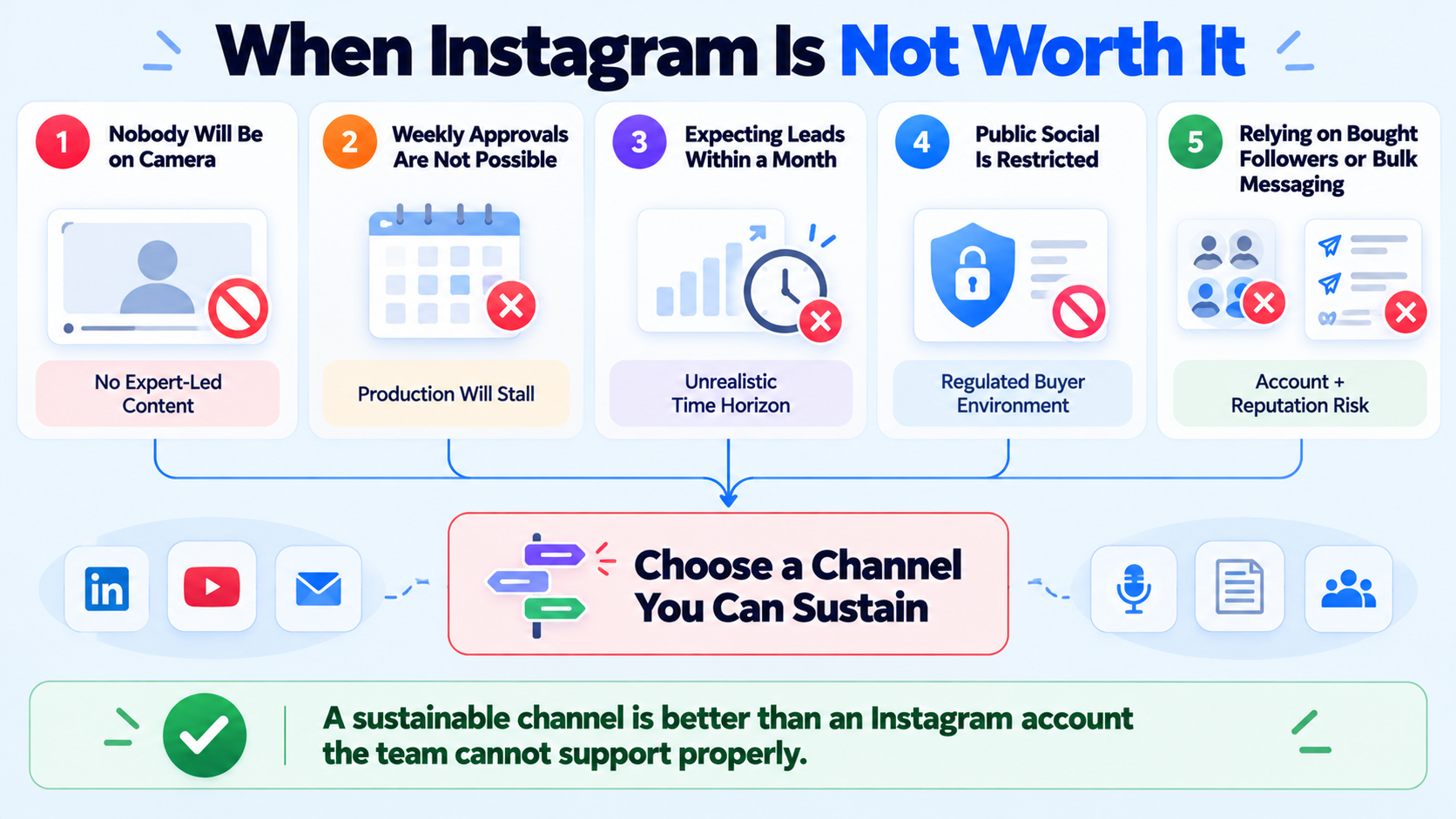
- Nobody will be on camera.
- You cannot approve work weekly.
- You expect direct leads within a month.
- Your buyers are in a regulated segment where public social content is discouraged.
- You plan to buy followers or rely on bulk messaging. Instagram said in 2018 it would remove activity from accounts that use third-party apps to boost popularity.
If you ask "is Instagram worth it for HR tech and martech brands" and these apply, invest in a channel you can sustain first.
A 90-Day Test
A clean answer to "is Instagram worth it for HR tech and martech brands" needs an experiment with a start and an end.
A managed service can run this test with less load on your team. Our guide on whether an Instagram growth service is worth it goes into the service question, and how to choose an Instagram growth service for B2B helps with provider selection.
Conclusion
Is Instagram worth it for HR tech and martech brands? It is worth it when it is treated as a credibility and familiarity channel, fed by real experts, and judged by watch time, shares, and conversations over a quarter or more. It is not worth it as a shortcut. Editing creates the asset. Distribution and consistency give it a chance to produce business value. If you want help deciding, you can book a call.
FAQ
Is Instagram worth it for HR tech and martech brands?
Often, if you can produce expert-led video steadily and want visibility with buyers or candidates. It is rarely a fast lead source. Test for 90 days against clear metrics.
How much does it cost to run Instagram for an HR tech or martech company?
Costs range from tools under $100 a month to managed subscriptions at $5,000 a month or more. Komet Media's typical working range for retainers is around $2,500 to $5,000, depending on scope. Expert time is also a cost.
How long does it take to see results?
Plan for at least three months. The first month goes to production and testing, and watch time and shares usually show patterns before sales conversations do.
Do HR buyers use Instagram for vendor research?
The sources I reviewed do not measure that. They show that HR buyers use events, vendor websites, content sites, and video. Instagram can add familiarity, but I would not claim it is a primary research channel.
Should we start with LinkedIn instead?
Many B2B teams do. Cross-posting lets one video serve LinkedIn and Instagram, so you can start on both if capacity allows.
Should we hire a freelancer or an agency?
A freelancer suits teams that have content and strategy. An agency suits teams that need research, scripting, video production from scratch or repurposing, editing, and posting handled together. See our freelance editor vs agency comparison.
Can we reuse webinars and podcasts on Instagram?
Yes. Repurposed webinars, podcasts, and event footage can supply early batches, but video can also be created completely from scratch. See our guide on what is organic Instagram growth.
Does Komet Media work with HR tech and martech companies?
Yes. Komet Media's Instagram growth service covers research, scripting, video production from scratch or repurposing, editing, posting, and cross-posting for B2B teams, including HR tech and martech. See the Instagram growth FAQ.