
🪄 AI Summary
Heading 1
Heading 2
Heading 3
Heading 4
Heading 5
Heading 6
Lorem ipsum dolor sit amet, consectetur adipiscing elit, sed do eiusmod tempor incididunt ut labore et dolore magna aliqua. Ut enim ad minim veniam, quis nostrud exercitation ullamco laboris nisi ut aliquip ex ea commodo consequat. Duis aute irure dolor in reprehenderit in voluptate velit esse cillum dolore eu fugiat nulla pariatur.
Block quote
Ordered list
- Item 1
- Item 2
- Item 3
Unordered list
- Item A
- Item B
- Item C
Bold text
Emphasis
Superscript
Subscript
I'm Rajan Soni, Founder and Video Director at Komet Media. If your team is evaluating how to choose a SaaS video agency in San Francisco for product and sales videos, you're making a real revenue decision, not a creative one. The San Francisco Bay Area tech ecosystem is saturated with agencies claiming B2B SaaS fluency. Most produce visually polished content that never moves a deal. This guide cuts through the noise and gives you a practical framework for choosing an agency that actually connects your product to the pipeline.
TL;DR
- Prioritize agencies with verifiable SaaS portfolio work, demos, sales enablement, and buyer journey mapping, not just brand films.
- Understand the difference between product videos and sales videos before you brief any agency.
- Expect to spend $6,000 to $15,000 for a high-quality SaaS product demo video in the US market in 2026.
- Vet agencies on process, creative brief development, storyboarding, and revision structure, not reel quality alone.
Why the San Francisco Bay Area Raises the Stakes for SaaS Video
San Francisco remains a global leader for SaaS innovation in 2026, home to thousands of vertical SaaS companies driving cloud growth and digital transformation. That concentration means your buyers are sophisticated. They've seen every generic product walkthrough. A video that doesn't speak to their specific workflow gets skipped. 70% of B2B buyers and researchers watch video content during their purchasing journey, according to Google's 2025 research. That's not optional viewing, that's the default research behavior of the people your sales team is trying to close.
96% of B2B buyers say video is an important factor when deciding whether to advance in the buying journey, per Brightcove. The Silicon Valley startup culture pressure compounds this. Investors, enterprise buyers, and procurement committees at Bay Area companies expect product communication that mirrors product quality. A screen recording with a voiceover signals a company that doesn't take itself seriously. The San Francisco Bay Area is dense with SaaS companies, venture-backed startups, and the agencies that serve them, all with the same recurring need: turning raw footage, screen recordings, and webinars into finished video, over and over.
That recurring demand is exactly where most agencies fail. They're built for one-off productions, not the ongoing video systems that funded SaaS teams actually need. When learning how to choose a SaaS video agency in San Francisco for product and sales videos, the first filter is simple: does this agency understand B2B SaaS pipelines, or do they understand film? Those are very different skill sets. You need someone who thinks in terms of buyer journey mapping and conversion rate optimisation, not just cinematography.
Wyzowl's 2026 report found that 83% of marketers report video has directly increased sales, and 82% say video has helped increase web traffic. The question for your agency search isn't whether video works. It's whether the agency can build video that works for your funnel specifically.
Product Video vs. Sales Video: Know the Difference Before You Shop
Most teams conflate these two formats. Briefing the wrong one wastes the budgetwastes budget and produces an asset that sits unused. A demo video gives viewers a real look at your product's interface and how it works, while an explainer video breaks down big-picture ideas or value props. Both formats have a role in a complete B2B software marketing strategy, but they answer different buyer questions. An explainer video answers "what is this?" A product demo video answers "does this actually work for my situation?" Sales videos operate at an entirely different layer.
A sales enablement video is a short, trackable, shareable video asset that sales reps use to move deals forward, covering everything from personalized outreach to product demos to competitive comparisons. Marketing videos drive awareness at the top of the funnel. Sales enablement videos are tactically designed to handle objections, demonstrate specific features, or accelerate a deal that's already in motion.
Here's how the formats map to your SaaS funnel:
A clear, concise product demo video that your champion can share internally is one of the most powerful sales tools you can create. It lets your champion do the selling even when you are not in the room. That single insight shapes how I'd brief an agency: build for the buyer's internal sell, not just for your homepage.
Product demo videos need to be updated every time your product UI changes significantly. If your SaaS ships major updates quarterly, budget for re-recording your demo every 3 to 6 months. Explainer videos, because they are conceptual, typically last 1 to 3 years before needing a refresh. Factor this into your agency contract before signing.
What to Look for in a SaaS Video Agency: Non-Negotiables
When evaluating how to choose a SaaS video agency in San Francisco for product and sales videos, apply these filters before reviewing a single reel.
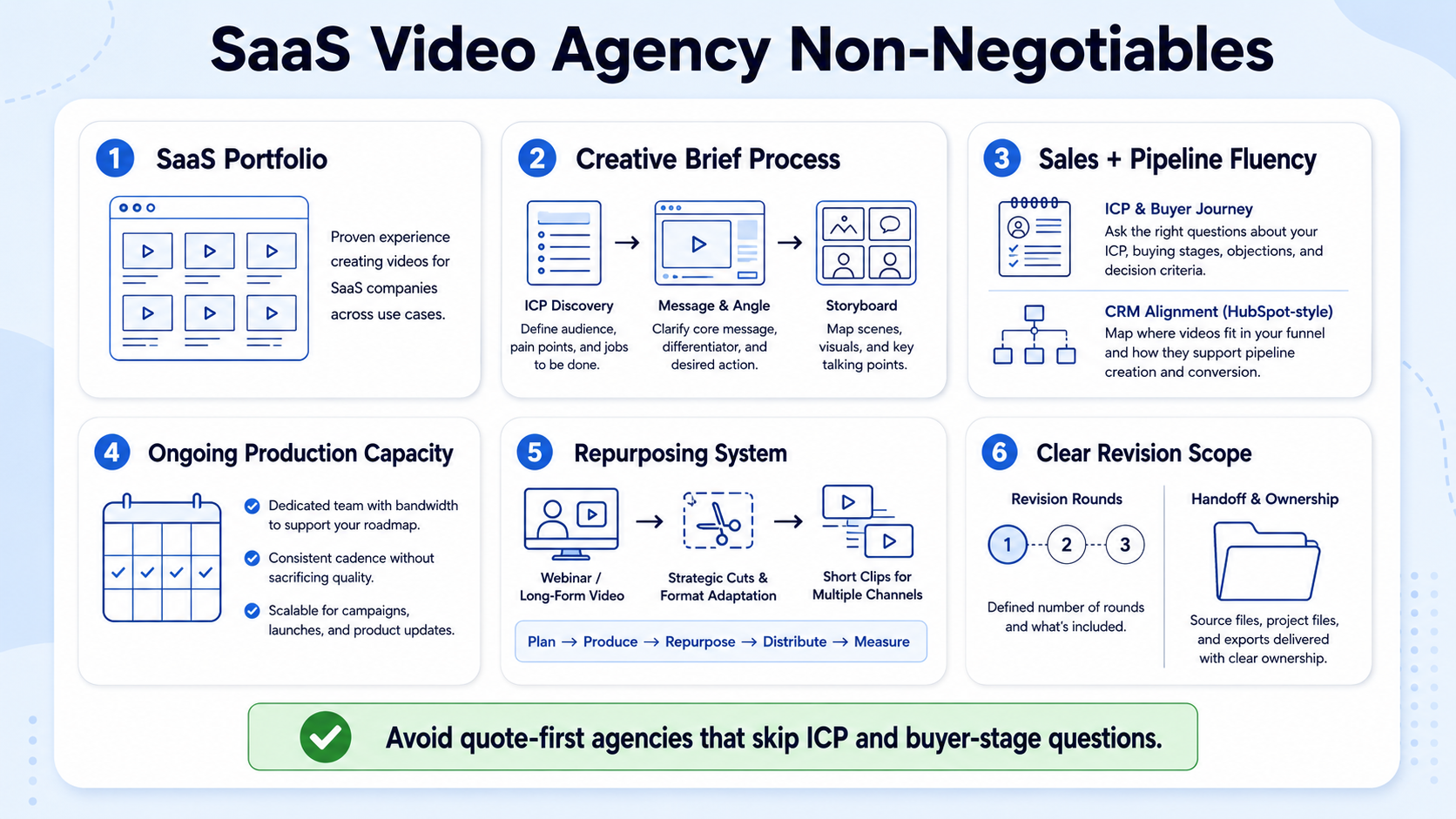
1. SaaS-specific portfolio, not general B2B work. Ask to see product demo video production for software products only. UI walkthroughs, motion graphics callouts, screen recording workflows, these require different editorial instincts than corporate brand films.
2. A defined creative brief and storyboarding process. Any agency worth hiring starts with discovery before production. If they're quoting you before asking about your ICP, buyer journey stage, or conversion goal, walk away.
3. Sales and pipeline fluency. SaaS demos perform best when aligned with buyer journeys, not generic feature walkthroughs. The agency should ask what happens after the video, where it lives, who sees it, how it integrates with HubSpot video integration or Wistia analytics.
4. Ongoing production capacity, not just project work. The best video agencies for SaaS in San Francisco fall into three distinct groups: local production studios built for shoots, creative agencies built for brand storytelling, and remote subscription partners built for ongoing volume. Funded SaaS teams need ongoing volume, new feature videos, ABM clips, webinar repurposing, not one-off hero films.
5. Repurposing and content system thinking. At Komet Media, we treat every long-form asset, webinar, podcast, founder interview, as a source file for short-form sales and marketing content. An agency that only thinks in standalone productions will leave your existing content library sitting idle.
6. Clear revision and scope of work structure. Vague revision language is where agency relationships collapse. Require milestone-based approvals, defined revision rounds in the contract, and explicit handoff formats for video hosting platforms.
What Questions to Ask a SaaS Video Agency Before You Hire Them
These are the questions I recommend every SaaS founder and marketing head ask before signing a scope of work.
- Show me SaaS-specific work: Can you share three product or sales videos you've produced for B2B software companies, with context on the conversion goals?
- How do you handle the creative brief? Walk me through your process from discovery call to script approval.
- What's your storyboarding and scriptwriting process? Who writes the script, a strategist or a copywriter? How is the SaaS product positioning captured?
- How do you structure revisions? How many rounds are included, what counts as a revision, and what's out of scope?
- Do you integrate with our video hosting and CRM? Can you deliver assets formatted for Wistia analytics and HubSpot video integration workflows?
- What's your turnaround for ongoing content? If we're producing demo clips monthly, what does that production system look like?
- How do you measure success? 67% of video marketers measure ROI primarily through views, and 63% rely on engagement metrics like likes and shares, rather than downstream pipeline signals, according to Wyzowl's 2026 report. A strong agency measures pipeline contribution, not vanity metrics.
The final question, and the one most teams forget, is account-based marketing alignment: can the agency produce variant cuts of a hero video for specific target accounts, industries, or personas?
How Much Does a SaaS Product Video Cost in San Francisco in 2026?
Pricing in the Bay Area is materially higher than the national average because, as one local studio noted, "everything costs more to operate in the Bay Area, day rates, studio rentals, permits, parking logistics, the floor is set by the city before scope even enters the conversation." Here's a realistic cost breakdown for 2026:
For B2B SaaS companies, the sweet spot for balancing quality and ROI sits in the $7,000–$12,000 range, where the video feels polished. Batching allows a company to capture 6–12 months of content in a 48-hour production window. By consolidating production costs into a single block, startups can reduce their per-video cost by nearly 50% while maintaining brand consistency across all channels.
One critical budgeting reality for SaaS teams: the agency's day rate is not the whole number. Scriptwriting, storyboarding, motion graphics and animation, voiceover talent, revision rounds, and platform-formatted exports (LinkedIn, Wistia, HubSpot) all add to final cost. Always require a fully scoped line-item estimate, not a headline project fee. For teams that need ongoing short-form video editing and repurposed content at volume, a subscription or retainer model consistently outperforms one-off project pricing on a per-asset basis.
How to Evaluate a Video Production Portfolio for SaaS
Portfolio evaluation is where most SaaS buyers make mistakes. They watch videos and judge on production aesthetics. That's the wrong frame.
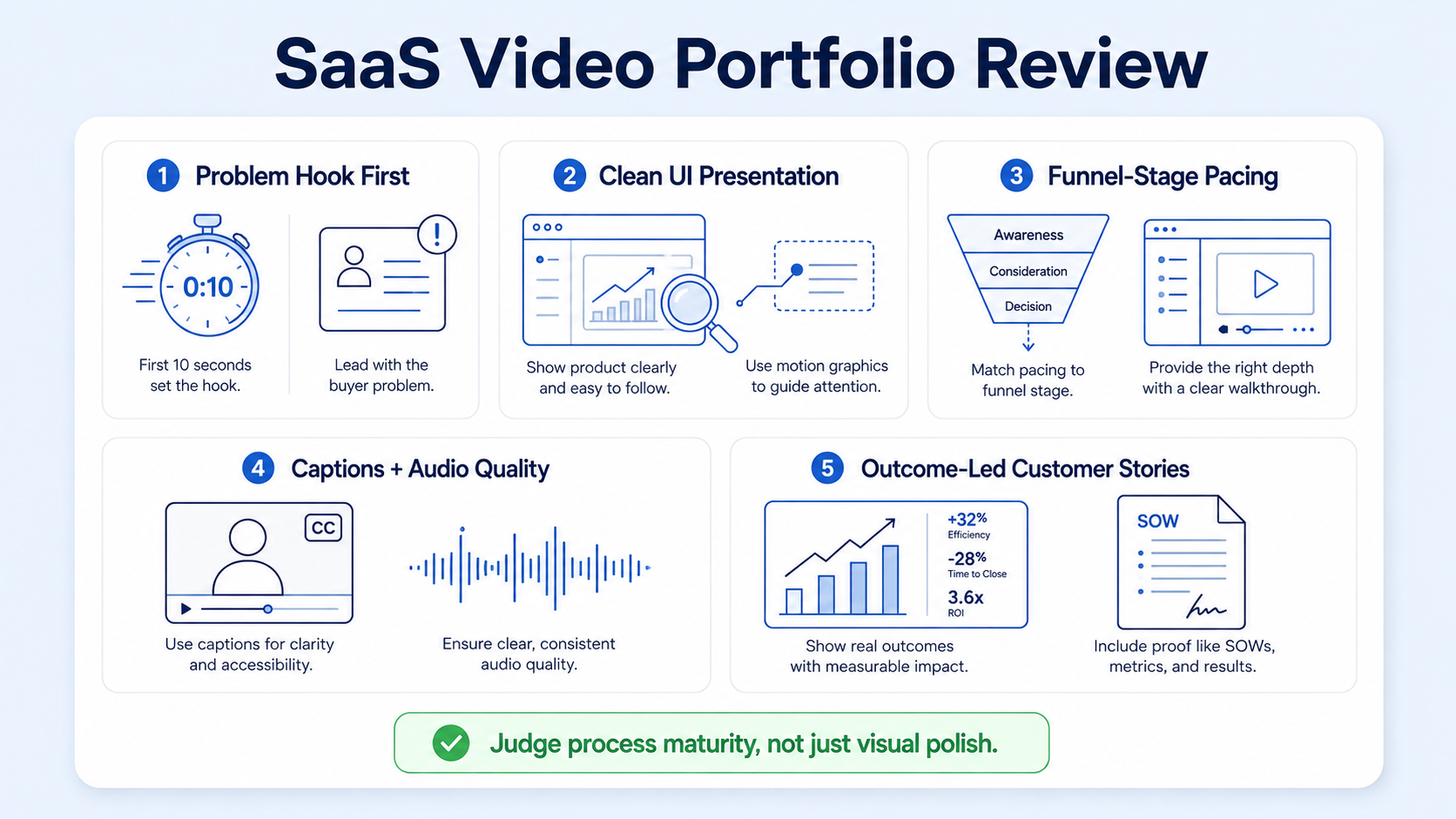
Watch for these specific signals:
- Buyer-problem clarity in the first 10 seconds. Does the video open with a pain point your buyer recognizes, or does it open with a logo animation? Explainer video strategy 101 says hook the problem first.
- UI presentation quality. Are screen recordings clean, zoomed, and motion-graphics-enhanced? Or are they raw screen captures with a cursor darting around a cluttered interface?
- Pacing appropriate to the funnel stage. A top-of-funnel brand video should move fast. A product walkthrough for late-stage buyers can breathe more. An agency that paces every video the same doesn't understand buyer journey mapping.
- Caption and audio quality. Video on landing pages increases conversions by 86% compared to text-only equivalents. The effect is strongest for complex products and services where video reduces cognitive load. Captions and clear audio are not optional polish, they're conversion infrastructure.
- Customer success storytelling. Do their testimonial and case study videos lead with measurable business outcomes, or do customers just say "we loved working with them"?
Also examine agency scope of work documentation. A professional agency will share sample SOW templates on request. The detail level of that document tells you more about their process maturity than any reel.
For teams building founder-led growth content, turning podcast episodes, webinars, and recorded demos into short-form sales assets, visit Komet Media's services page to see how we structure video content and repurposing systems for B2B SaaS teams specifically.
Best SaaS Video Agencies in San Francisco: How Komet Media Fits
The San Francisco Bay Area has strong local production talent across the full stack. Thinkmojo, based in San Francisco and Montreal, collaborates with businesses from tech startups to Fortune 500 companies to clearly and innovatively communicate the value of their ideas, products, and technologies.
Luma Creative is a SaaS video production company in the San Francisco Bay Area working with software and technology businesses from seed-stage startups to the largest platforms, covering product and launch films, animated explainers, customer and founder interviews, and live session recording.
Where Komet Media is built differently is in the system layer. While most San Francisco agencies focus on finished video assets, Komet Media offers end-to-end production, handling both new projects created entirely from scratch and repurposing your existing long-form content (founder podcasts, product webinars, sales calls, recorded demos) into ongoing short-form pipelines that feed your B2B SaaS marketing funnel continuously.
Our work is built around four outcomes B2B SaaS teams actually care about:
- Pipeline: Short-form clips from demos and webinars that run as LinkedIn and paid social assets to generate inbound demand.
- Sales enablement content: Repurposed founder interviews and product explainers formatted for email sequences and deal follow-up.
- Buyer education: Feature-specific short videos that reduce pre-sales friction and lift trial-to-paid conversion.
- Founder-led growth: Turning your founder's thinking, from podcasts, events, and keynotes, into consistent short-form presence.
61% of B2B content marketers plan to increase video investment in 2026, per Content Marketing Institute's 2025 annual research. The teams that win aren't the ones who produce one great hero video. They're the ones who build a repeatable video production system that keeps feeding the funnel.
If you have existing long-form content and need it turned into short-form sales assets, explore how Komet Media works with SaaS teams. If you're starting from scratch, see our full service menu including motion graphics and video marketing.
Conclusion
Choosing a SaaS video agency in San Francisco for product and sales videos comes down to four things:
- Verify SaaS portfolio depth, demos, sales enablement, and UI walkthroughs, not just brand films.
- Understand what you need before you brief, product video, sales video, and explainer video serve different funnel stages and have different production economics.
- Budget honestly, San Francisco production costs are 20–40% above national averages; batch production and retainer models offset the premium.
- Choose a system thinker, not a project shop, the agencies that compound your ROI are the ones that turn every piece of long-form content into ongoing pipeline fuel.
Ready to start? Contact Komet Media to talk through your video system.
Frequently Asked Questions
Q1: What makes a SaaS video agency different from a general video production company?
A SaaS video agency understands B2B buying cycles, product demo video production, sales enablement workflows, and conversion rate optimization. General production companies are skilled at cinematography but rarely think in terms of pipeline impact, buyer journey mapping, or Wistia analytics integration.
Q2: How do I find a video agency that understands SaaS products specifically?
Ask to see their SaaS-only portfolio, then request context on the conversion goals behind each video. Ask whether they've worked with product-led growth teams. If they can't explain what a sales-qualified lead is, they don't understand SaaS.
Q3: What is the difference between a product video and a sales video for SaaS?
Sales enablement demos support conversations between the sales team and potential customers. These videos focus on practical use cases and how the product solves real business problems. Compared to marketing videos, they often explore deeper functionality and real product workflows. Product videos live on your website and drive inbound; sales videos live in your reps' outboxes and close deals.
Q4: How much does a SaaS product video cost in San Francisco in 2026?
A clean motion graphics explainer for a SaaS product launch runs $8,000 to $20,000 in San Francisco. Full live-action and animation hybrids run $20,000 to $50,000. Repurposed short-form clips from existing long-form content cost significantly less, often $1,500 to $5,000 per asset, making content repurposing the most capital-efficient video strategy for funded SaaS teams.
Q5: What questions should I ask a video agency before hiring them for SaaS videos?
Ask for SaaS-specific portfolio examples, their creative brief and storyboarding process, how they structure revisions, whether they integrate with HubSpot or Wistia, and how they measure success beyond views. Any agency that measures success in views alone is not pipeline-aligned.
Q6: Should I hire a local San Francisco agency or a remote specialist?
Choosing the right partner depends on SaaS understanding, not location or studio size. A remote agency that specializes in B2B SaaS content repurposing and short-form video systems will consistently outperform a local generalist studio for ongoing demo, enablement, and social content needs. Reserve local studios for high-production-value shoots that require on-site crews.