
🪄 AI Summary
Heading 1
Heading 2
Heading 3
Heading 4
Heading 5
Heading 6
Lorem ipsum dolor sit amet, consectetur adipiscing elit, sed do eiusmod tempor incididunt ut labore et dolore magna aliqua. Ut enim ad minim veniam, quis nostrud exercitation ullamco laboris nisi ut aliquip ex ea commodo consequat. Duis aute irure dolor in reprehenderit in voluptate velit esse cillum dolore eu fugiat nulla pariatur.
Block quote
Ordered list
- Item 1
- Item 2
- Item 3
Unordered list
- Item A
- Item B
- Item C
Bold text
Emphasis
Superscript
Subscript
Your webinar ends. A few hundred people saw it live. Then it sits in a Zoom folder, shared once, and quietly disappears. That's not a content strategy, it's a waste. A single 49-minute webinar holds roughly 10,000 spoken words, enough to fuel weeks of derivative clips, posts, and email sequences. This guide breaks down the best webinar repurposing examples for B2B teams in 2026, with a step-by-step workflow you can run this week.
TL;DR
- Repurposing 65% of marketers focused on audience engagement considers webinar recordings the most effective time and cost-saving strategy.
- One recorded webinar can produce short-form video clips, LinkedIn posts, blog posts, email sequences, and gated assets.
- The best B2B teams build repurposing into the plan before the webinar goes live, not after.
- Distribution speed matters: the first 48 hours post-webinar capture the highest organic reach.
What Content Can You Create from a Single B2B Webinar Recording?
Most marketing teams under-extract from their webinars. Inside a single one-hour webinar are 10 to 20 genuinely useful moments, sharp insights, real case studies, product walkthroughs, and expert perspectives. That content doesn't expire when the session ends. It just stops being seen. Here's the full asset map for one webinar:
Every webinar your team runs can turn into 20–30 distinct content assets across LinkedIn, blog, email, podcast, and short-form video. The key is knowing which moment to pull before you start editing, not after.
For SaaS teams specifically, product demos, customer training webinars, and industry education sessions generate recordings that contain dozens of clip-worthy moments. Repurposing ensures the insights continue to reach new buyers long after the live session.
Webinar Repurposing Examples for B2B: 6 Formats That Work
These are real formats used by B2B SaaS and tech teams with clear outcomes, not theoretical ideas.
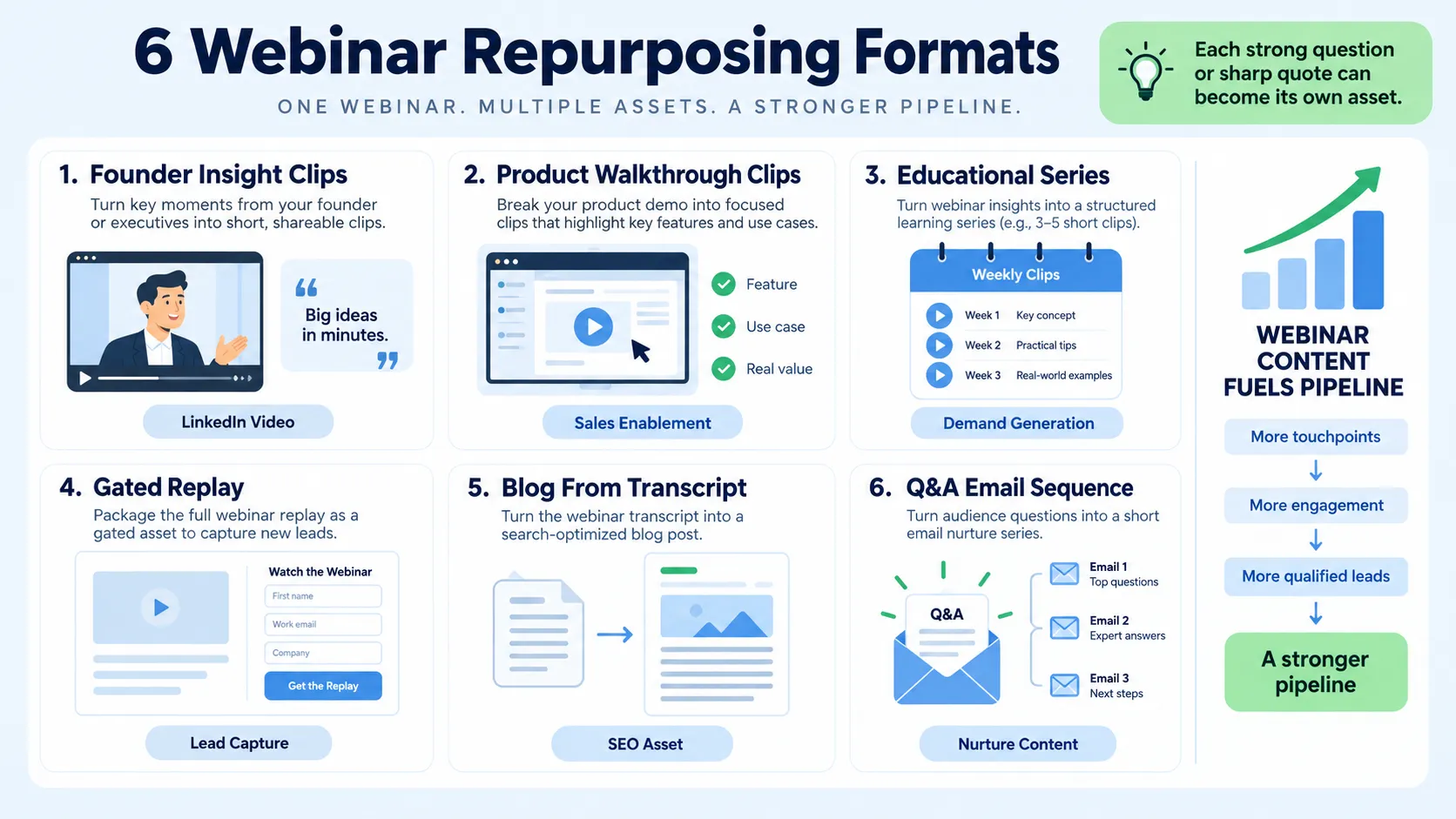
1. Founder insight clips for LinkedIn video marketing. Pull 60–90 second segments where the founder or executive states a sharp, contrarian position. High-performing teams design their pillar content with repurposing in mind, using modular sections and encouraging speakers to deliver clean, standalone ideas. Identify 60 to 90 second segments that contain one complete thought or a clear position. These become the foundation of founder-led growth on LinkedIn.
2. Product walkthrough clips for sales enablement. Clip the product demo segment into 2–3 focused pieces. Each clip isolates one feature or use case. Sales reps embed these in outbound sequences or deal-room follow-ups to accelerate buyer decisions.
3. Short-form educational series for demand generation. When atomizing a webinar, use timestamps to identify the most impactful 30–60 second clips. These can be turned into short video reels for LinkedIn, YouTube Shorts, and TikTok. Publish one per week across four weeks and tag the original panelists to extend organic reach.
4. Gated on-demand replay for lead generation. Gate the full recording behind a landing page. Promote it via email and LinkedIn ads. This turns a one-time live event into an evergreen lead generation asset that works passively for months.
5. Blog post from the transcript. Pull the transcript, structure it around the webinar's core argument, and add SEO context. Each webinar can become a blog article, a few social media posts, and short highlight clips.
6. Email nurture sequence from Q&A. KLA Group found success by repurposing webinar content into bite-sized YouTube Shorts, carefully selecting impactful moments from longer presentations and adding clear graphics and subtitles. Apply the same logic to your Q&A section, every strong question is the subject line for one email in your nurture sequence.
How to Repurpose a B2B Webinar: Step-by-Step Workflow
Instead of a single recording and a generic follow-up email, webinars now automatically turn into entire content and nurture systems that feed blogs, LinkedIn posts, email nurtures, and sales follow-ups. Here's how to build that system:
- Pre-webinar planning: Map the repurposing plan before the live session. Identify which segments will become clips, which panelist quote will become the LinkedIn hook, and what the blog post angle will be.
- Flag key moments during recording: Have one team member watch live and timestamp standout quotes, product moments, and audience questions in real time.
- Transcript the recording immediately: Automated transcription usage grew 8x among B2B webinar teams in 2025. Use Descript or Riverside. The transcript becomes the raw material for blogs, email copy, and caption overlays.
- Extract short-form clips (48-hour window): Export each clip targeting 30–60 seconds for feed distribution, up to 90 seconds for thought leadership. For most B2B content, 30–90 seconds is the range that works.
- Format clips for platform: For LinkedIn, crop to 1:1 or 4:5 and burn in captions. For YouTube Shorts, use vertical 9:16. Add a strong hook in the first 3 seconds.
- Distributed in sequence: In the first 48 hours, send the replay link with a 90-second highlight reel, LinkedIn posts from each speaker, email to registrants, and 3 short-form videos. In weeks 1–2, publish the blog post, podcast cut, carousels, stat graphics, and additional LinkedIn posts.
- Gate the full replay for ongoing lead capture: Keep the on-demand landing page live and promote it in outbound sequences and LinkedIn ads for 60–90 days.
How B2B Marketers Turn Webinars into LinkedIn and Email Content
LinkedIn is where most B2B buyer decisions are influenced, and short-form video is now the dominant feed format. A day after a webinar, a marketing team clips a 30-second highlight from the event, and suddenly the insight is everywhere on LinkedIn, it's even picking up traction on other platforms. That's the velocity advantage of webinar repurposing examples for B2B. For LinkedIn video marketing, the highest-performing formats from webinar content are:
- Founder takes: A 60–90 second clip where the founder stakes a position on an industry trend.
- Stat callouts: A short video or graphic pulling one surprising data point from the webinar.
- Customer story clips: Any moment where a customer result or case study was referenced, isolated into a standalone social proof asset.
- Contrarian takes: Panelist moments that push back on conventional wisdom, these generate comments and shares.
For email nurture sequences, structure a 5-email cadence from one webinar:
ON24 reports personalized CTAs lifted clicks 118%, which is why each email in this sequence should reference the specific webinar topic the recipient originally registered for, not a generic CTA.
Webinar Repurposing Examples for B2B Lead Generation: The Content Atomization Model
Content atomization is the core logic behind every high-output B2B content team: one pillar recording generates a structured cascade of micro-assets across every buyer touchpoint in the B2B buyer journey. Webinars without a repurposing engine capture only 20% of their value. That gap is a direct cost to your pipeline. Here's how the atomization model maps to lead generation funnel stages:
63% of AI-adopting B2B marketers cite webinar repurposing as their primary AI use case in 2026, which signals this is not a niche tactic anymore. It's core infrastructure. For funded SaaS and AI startups, the most valuable atom is the product explanation clip. A 60-second clip from your founder's webinar demo, edited cleanly with captions and a hook, outperforms most paid ad creatives because it carries real product context and founder credibility rather than polished marketing speak.
A single webinar repurposed correctly produces enough content to run 4–6 weeks of organic LinkedIn, one email nurture sequence, an SEO-optimized blog post, and active sales enablement materials, all from one hour of recording.
Our webinar repurposing service at Komet Media handles the extraction, editing, formatting, and sequencing end to end so your team's product knowledge keeps working long after the live session.
Best Webinar Repurposing Strategies for B2B Companies in 2026: What Separates High-Output Teams
The teams getting the most value from webinar repurposing examples for B2B don't improvise. They operate a system.
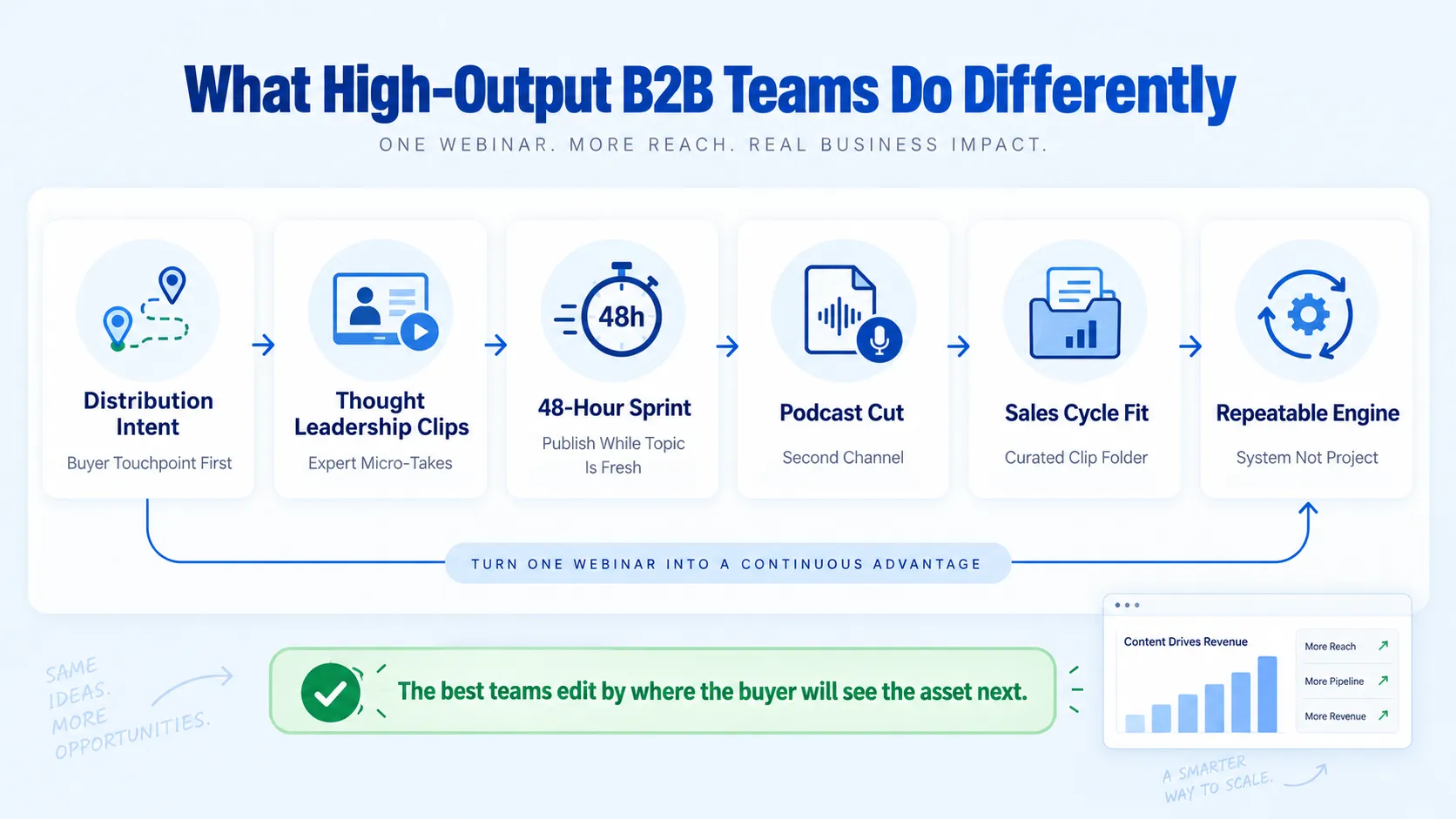
Successful B2B video strategies rely on repeatable formats that teams can batch-produce efficiently. Here's what separates the top 10% from everyone else:
They repurpose with distribution intent, not just content intent. The question isn't "what can I make from this?", it's "where does this buyer need to encounter us next?" A clip meant for a sales rep's outreach sequence is edited differently than a clip meant for organic LinkedIn reach.
They use the webinar to create thought leadership content, not just marketing clips. Expert snippets and micro-takes of 30–45 seconds work well for sharing perspectives on industry trends or highlighting customer insights. Tap into subject-matter experts or internal data storytellers to surface fresh insights that customers actually care about.
They run a 48-hour distribution sprint: The post-webinar window is where organic reach is highest. Teams that publish their first clips within 48 hours capture the most attendee engagement while the topic is still active in their audience's memory.
They treat the podcast cut as a second channel: The Content Marketing Institute reports 55% of B2B marketers now use webinars as a content distribution channel, ranking them the second-most-effective channel behind only in-person events. Teams that also extract an audio-only podcast episode from each webinar compound that reach across a separate subscriber base. Our podcast editing and production services exist precisely for this workflow.
They align repurposed content with active sales cycles. The sales team receives a curated clip folder from each webinar, product moments, customer proof, objection-handling exchanges, ready to drop into deals. This closes the loop between demand generation and sales enablement.
They run it as a system, not a project. The difference between a B2B team that repurposes occasionally and one that generates consistent pipeline from video is operational discipline. If you want to see how we build that for SaaS and tech teams, the workflow is repeatable and predictable.
Conclusion
Webinar repurposing examples for B2B show one clear truth: the recording is not the product. The content cascade is. Key takeaways:
- One 60-minute webinar generates 20–30 distinct assets when processed with a real system.
- Short-form clips, email sequences, gated replays, and blog posts each address a different buyer touchpoint.
- Speed matters, the 48-hour window post-webinar is your highest-leverage distribution moment.
- The teams winning on LinkedIn video, inbound demand, and sales enablement are running this as a repeatable engine, not a one-off project.
If your team is sitting on a library of webinar recordings that never got repurposed, reach out to Komet Media and we'll show you exactly what your content is worth.
Frequently Asked Questions
Q1: How many assets can one B2B webinar realistically produce?
Every webinar can turn into 20–30 distinct content assets across LinkedIn, blog, email, podcast, and short-form video. A 60-minute session with strong panelists or a founder demo will sit at the higher end of that range. Shorter or lighter webinars still yield 10–15 usable assets.
Q2: What are the best webinar repurposing examples for B2B SaaS specifically?
Product demo clips for sales outreach, founder insight clips for LinkedIn, Q&A-driven email nurture sequences, and gated on-demand replays for lead generation. SaaS companies producing product demos, customer training webinars, and industry education sessions generate recordings that contain dozens of clip-worthy moments.
Q3: How long should short-form video clips from a webinar be?
Target 30–60 seconds for feed distribution, up to 90 seconds for thought leadership. For most B2B content, 30–90 seconds is the range that works. Clips longer than 90 seconds see significant drop-off on LinkedIn and YouTube Shorts.
Q4: When should we publish repurposed content after a webinar?
In the first 48 hours, distribute the replay link with a 90-second highlight reel, LinkedIn posts from each speaker, email to registrants, and 3 short-form videos. The 48-hour window captures peak audience attention and algorithmic momentum.
Q5: Does webinar repurposing work if attendance was low?
Yes. The recording quality and content depth matter far more than live attendance. At $72 per lead on average, webinars offer a highly cost-effective path to high-quality B2B leads, and when you factor in content repurposing, engagement, and SEO potential, webinars are arguably the best-value lead generation channel in B2B marketing.
Q6: Do we need a dedicated team to repurpose webinar content?
Not internally. A specialist agency can handle the editing, formatting, captioning, and distribution sequencing. Most teams know they should repurpose webinar content, but it requires watching the full recording, identifying the right moments, editing platform-ready clips, and distributing consistently. A specialist team handles the entire process. That's exactly what Komet Media's video editing services are built for.