
🪄 AI Summary
Heading 1
Heading 2
Heading 3
Heading 4
Heading 5
Heading 6
Lorem ipsum dolor sit amet, consectetur adipiscing elit, sed do eiusmod tempor incididunt ut labore et dolore magna aliqua. Ut enim ad minim veniam, quis nostrud exercitation ullamco laboris nisi ut aliquip ex ea commodo consequat. Duis aute irure dolor in reprehenderit in voluptate velit esse cillum dolore eu fugiat nulla pariatur.
Block quote
Ordered list
- Item 1
- Item 2
- Item 3
Unordered list
- Item A
- Item B
- Item C
Bold text
Emphasis
Superscript
Subscript
I'm going to keep this short for you. Because the answer isn't complicated. And most people are overthinking way too much.
I've been creating video content consistently for a few years now. PodcastClips, Webinar Videos, Explainer Videos, and LinkedIn Videos. And the number one question I get from founders and marketers is some version of:
"How do you always know what to write about?"
Here's the truth: I don't wait for ideas. I built a habit around finding them. That's it. That's the whole secret. You can close the tab now if you want.
Still here? Okay. Let me actually break it down.
The One Thing Nobody Tells You About Video Ideas
You need to be creative. No, You don't. You need to be damn good observant. The best content ideas aren't invented. They're noticed. They come from conversations you're already having. Questions your audience is already asking. Frustrations people already feel but nobody has said out loud yet. Wishing someone would just explain something clearly. That right there? That is your content. Already written. Already delivered to you. For free.
Think of it this way. Imagine you're a doctor. Every day, patients walk in and describe exactly what's hurting them. You don't have to guess. You don't have to invent their symptoms. They're telling you directly.
.png)
The Real Reason You're Running Out of Ideas
.png)
You don't have a system for catching ideas when they show up. That's it. Ideas are floating around you constantly i.e, in every conversation, every comment section, every frustrated email you receive but without a habit of collecting them, they just disappear. It's like trying to carry water in your hands. The water is everywhere. You just need a cup.
Everything I'm about to share with you here is essentially about building that cup.
9 Ways to Never Run Out of Disgustingly Good Video Ideas
1. Start Noting the Conversations You're Already Having
.png)
This is genuinely the most overlooked source of video content and I cannot understand why more people don't talk about it. Every single week you are having conversations with clients, customers, followers, or colleagues. And in those conversations, people are asking you questions. Real questions. Questions they actually need answered.
I started keeping a simple note on my google sheet, called "Questions People Asked Me" and every time someone asked me something interesting in a call or a DM or an email, I'd write it down word for word exactly as they asked it. Not cleaned up. Not made to sound smart. Just raw, as it came.
What I noticed pretty quickly was that the same questions kept coming up from completely different people. And when three or four separate people are asking you the same thing in the same week, that's not a coincidence. That's a signal. That means there are thousands of people out there typing that exact question into Google right now and probably not finding a great answer.
So here's what I'd suggest. After your next three client calls or conversations, just write down every question that came up. Don't overthink it. You'll probably have enough content ideas to last you the next month sitting right there in front of you.
2. Go Where People Complain and Listen Carefully
.png)
I know this sounds a little odd but hear me out. Reddit and Quora are basically the internet's complaint department. And for a content creator, that is an absolute goldmine.
What I do is go to subreddits related to my niche or my client’s niche, filter the posts by Top of All Time, and just read. Specifically I'm looking for questions that have hundreds of upvotes. Because when hundreds of strangers take the time to upvote a question, it means they all felt the same frustration. They're voting with their clicks. They're saying "yes, I have this exact problem too and nobody has explained it well yet."
I started calling these "upvoted pain posts" in my own head. A post where someone describes a struggle and the comment section just fills up with people saying me too, same here, I've been dealing with this for months. That gap, a widespread problem with no really good content addressing it is where you want to plant your flag and make your video. And a little bonus tip while you're there, also check the New section, not just the Top posts. Fresh questions with no good answers yet mean you get to be the first person to show up with something genuinely helpful. That's a nice position to be in.
3. Read Your Competitors' Comment Sections
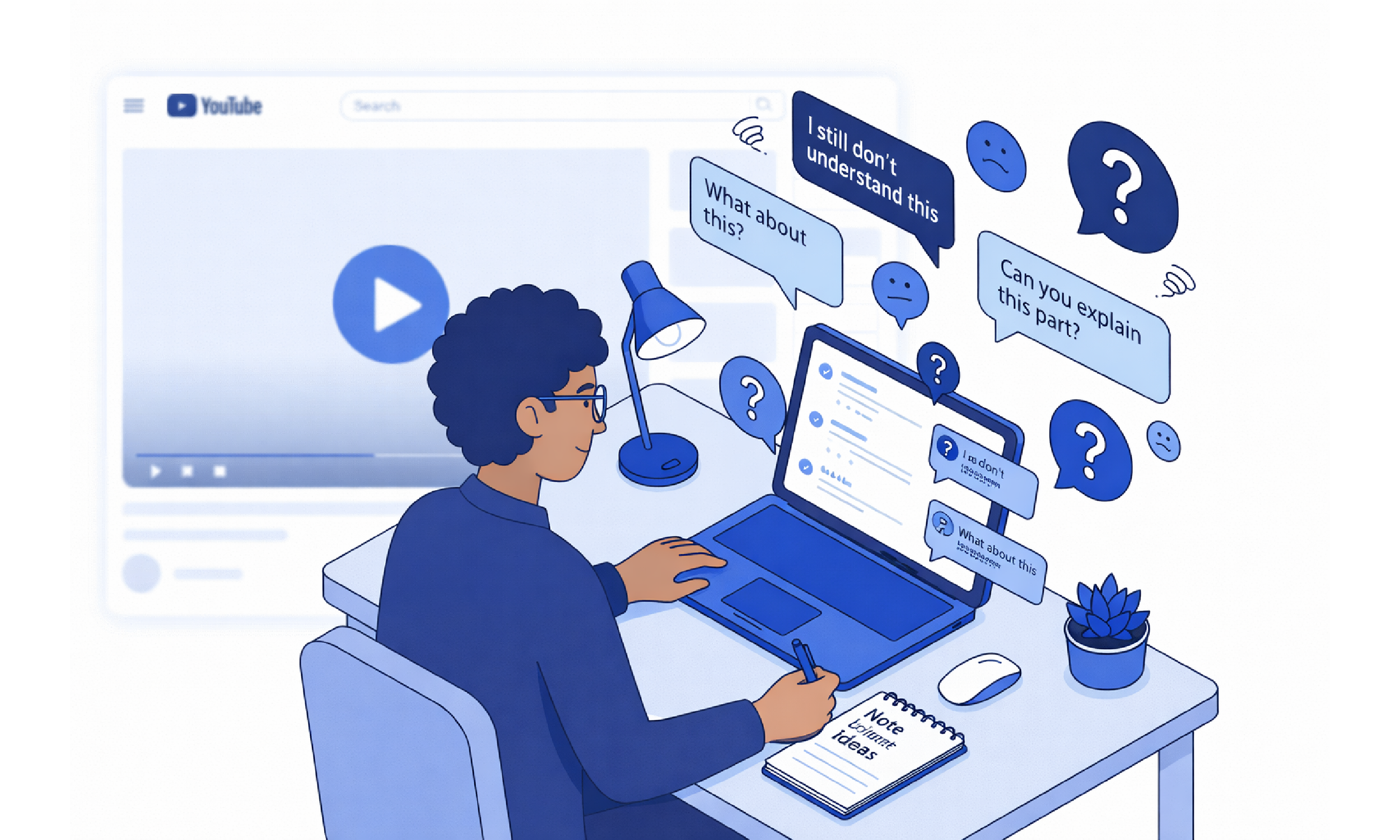
This one feels almost like cheating once you start doing it. Go to the biggest creators in your space. Find the videos that performed best for them. Now here's the important part, don't watch the video first. Go straight to the comments.
Read through what people are saying. Look for questions the video didn't answer. Look for people asking for a follow up. Look for viewers who disagreed with something or got confused halfway through. Look for comments that say "great video but I still don't understand this specific part."
Every single one of those comments is someone raising their hand and saying I still need help with this. That is your video. You're not copying anyone. You're not stealing ideas. You're finishing a conversation that someone else started and didn't complete. You're walking in and saying - actually, let me answer that properly. I've gotten some of my best performing videos this way. And it takes maybe twenty minutes to do a proper audit of someone's comment section.
4. Do Competitor Research on Social Platforms
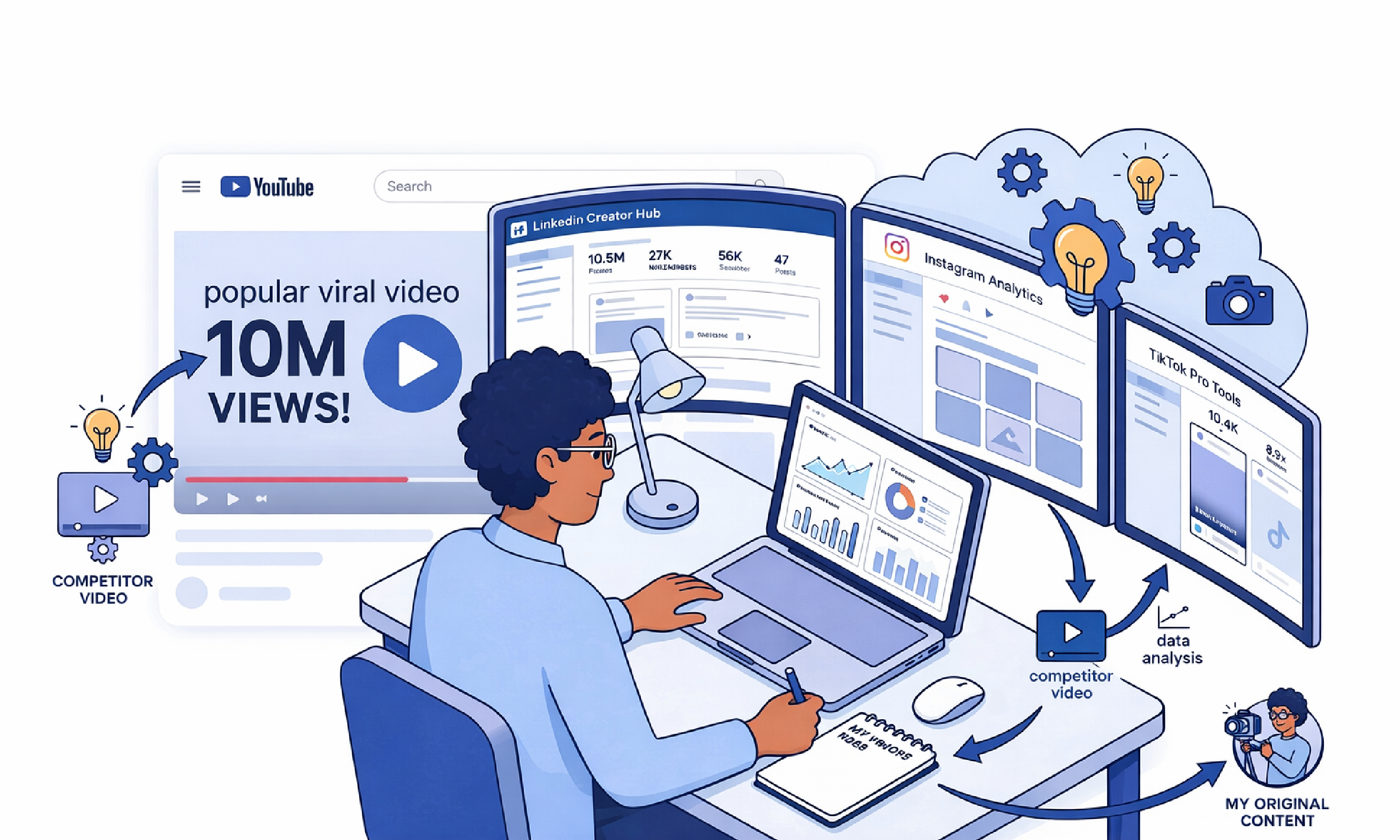
Go to the top creators and brands in your niche on the platforms that matter most - LinkedIn, YouTube, Instagram, TikTok, wherever your audience actually hangs out. Don't look at just anyone. Look specifically at the videos that performed well for them. High views, strong engagement, lots of comments. These aren't random. The algorithm surfaced them because real people responded to them.
Now here's the key move: don't copy the video. Repurpose the concept for yourself. Take the topic, the angle, or the format that worked for them and ask yourself, “How would I cover this through my lens, my experience, my audience? What would I add that they didn't say? What would I say differently?”
This works because you're not guessing what your audience wants. You already have proof. Someone in your niche made a video and the market responded. You're just taking that validated signal and applying it to your own voice and positioning. That's not stealing. That's smart. Spend 20-30 minutes a week just scrolling through your top 5 competitors' most-viewed content. You'll never be short of ideas again.
5. Trust Your Gut and Go With What Feels Right
All the research in the world won't help if you ignore the ideas that genuinely excite you. Sometimes you'll have a thought in the shower, or catch yourself explaining something to a friend and notice they lean in and say "wait, really?" That moment of genuine interest or surprise? That's a video.
Don't dismiss the ideas that feel obvious to you just because they feel too simple. What's obvious to you after years in your field is genuinely unknown to the person who just started. And don't dismiss the ideas that feel too niche or too specific. Specificity is what makes content resonate. "Here's how I doubled our demo call conversions by changing one line in our follow-up email" will always outperform "tips for better sales emails."
When an idea makes you think "I really want to talk about this", that energy comes through on camera. Audiences feel it. Give yourself permission to make the video you actually want to make, not just the one you think you're supposed to make.
6. Build a Swipe File and Actually Use It!!! Or else all your efforts will be in Vain
This is not just a nice-to-have habit. This is a core part of the system you must follow if you want to stop starting from zero every time you sit down to create content.
Every time you come across a headline, a video title, a tweet, or an email subject line that makes you want to click immediately, save it somewhere. I use a simple folder in my notes app but honestly it doesn't matter where you put it.
The important thing is that when you save it, you also write a little note about why it made you want to click. Was it because it described your exact problem in a weirdly specific way? Was it a claim that surprised you? Was it a question you'd been wondering about yourself?
When you do this for thirty days straight, something interesting starts to happen. You begin to understand the difference between a topic and an angle. And that difference is everything. Here's an example. "How to post on LinkedIn" is a topic. Boring. Overdone. Nobody's clicking that. But "Why your LinkedIn posts get nine views even when you're posting every single day" that's an angle. It takes the same basic subject and frames it around a specific frustration that a very real person is experiencing right now. One makes you scroll past. The other makes you stop dead. Same topic. Different angle. Completely different result.
7. Ask Yourself the Most Powerful Question in Content Creation
This one requires no research, no tools, no internet connection. Just honest reflection.
Ask yourself, what do I wish someone had told me three years ago? Think back to when you were just starting out in whatever you do now. What confused you? What did you get completely wrong for longer than you'd like to admit? What mistake cost you weeks of wasted time and energy that a simple explanation could have prevented?
That stuff right there is your most powerful content. Not the advanced material. Not the complicated frameworks. The simple, human, "I got this wrong and here's what I learned" kind of content. That's what resonates. That's what people share. That's what builds an audience that actually trusts you. It works because it's real. And in a world full of overly polished content, real stands out more than ever.
8. Mix What's Happening Now With What Will Always Matter
This is a slightly more strategic point but I promise it's still simple. The content that tends to do really well in 2026 combines two things - something that's relevant and timely right now, paired with a lesson or insight that will still be true five years from now.
Think of it like a news story. The anchor leads with today's headline to get your attention. Then the segment unpacks something deeper and more lasting. You do the exact same thing with your videos. So instead of making a video purely about a trending topic, which gets clicks now but dies in a week or a purely evergreen video that's solid but hard to get traction on, you combine them. Lead with the trending thing. Deliver the timeless lesson. You get the clicks from what's current and you get the longevity from what's lasting. It's genuinely one of the most effective structural decisions you can make for your content right now.
9. Do a 15-Minute Weekly Idea Sprint Every Single Week
Everything we have covered so far only works if you have a system to bring it all together. This is that system. Follow it every single week without skipping and you will never stare at a blank page again.
Once a week, same day, same time, sit down for just fifteen minutes. Not to film. Not to edit. Just to think and collect. In those fifteen minutes, look back over the week and ask what questions came up in your conversations. Check your swipe folder for angles you haven't used yet. Skim one comment section or Reddit thread in your niche. Then write down five raw ideas. Messy, unpolished, half-formed doesn't matter. Just get them on paper.
Over four weeks, that's twenty ideas. From those twenty, at least five will be genuinely good. From those five, at least two will perform really well. I've run this process more times than I can count and that math holds up every single time without fail. The fifteen minutes is the thing. It sounds too small to matter. It's not.
And If You're Too Busy to Even Do the 15 Minutes?
Look, I get it. You've read all of this and thought "this makes sense, I just don't have the time to actually do it." That's a completely valid place to be. You're running a business. You're not supposed to be a full-time content strategist on top of everything else.
That's exactly why my team exists.
We help B2B founders and marketers who know content matters but simply don't have the bandwidth to do it consistently. We handle the idea generation, the scripting, the production, the whole thing so you don't have to think about it.
It's a done-for-you video content system built around your business, your audience, and your goals. You show up and film, we handle the rest.
If that sounds like something worth a conversation, Book a Call and let's talk about what that looks like for you.
Just a straight conversation about whether we're the right fit.