
🪄 AI Summary
Heading 1
Heading 2
Heading 3
Heading 4
Heading 5
Heading 6
Lorem ipsum dolor sit amet, consectetur adipiscing elit, sed do eiusmod tempor incididunt ut labore et dolore magna aliqua. Ut enim ad minim veniam, quis nostrud exercitation ullamco laboris nisi ut aliquip ex ea commodo consequat. Duis aute irure dolor in reprehenderit in voluptate velit esse cillum dolore eu fugiat nulla pariatur.
Block quote
Ordered list
- Item 1
- Item 2
- Item 3
Unordered list
- Item A
- Item B
- Item C
Bold text
Emphasis
Superscript
Subscript
Many coaches assume that posting more content will generate more clients. They commit to a content calendar, publish consistently, and spend hours creating educational posts. Weeks later, they're still wondering why discovery calls remain unpredictable.
The issue usually isn't effort. Most coaches work hard to stay visible online. They share insights, answer questions, create videos, and engage with their audience. Despite all that activity, many struggle to turn attention into actual business opportunities.
Social media can become one of the most reliable client acquisition channels for coaches when every piece of content serves a specific purpose. Instead of treating content as a visibility tool, successful coaches use it to guide prospects through a clear journey, from awareness to trust to conversation.
When someone books a discovery call, they rarely do so because of a single post. They often consume multiple pieces of content, visit your profile, read testimonials, and evaluate whether your approach can help them achieve a specific outcome. Every post contributes to that decision-making process.
This guide will show you how to build a social media strategy that attracts qualified prospects, starts meaningful conversations, and turns content into booked calls consistently.
Why Followers Don't Equal Clients

One of the biggest misconceptions in social media marketing for coaches is the belief that audience size determines business success.
Many coaches spend months trying to increase their follower count because they assume a larger audience will automatically produce more leads. In reality, follower count is often one of the least important indicators of business growth.
Consider two different coaches.
The first coach has 50,000 followers on Instagram. Most followers discovered the account through motivational content and viral reels. The engagement looks impressive, but very few followers match the coach's ideal client profile.
The second coach has 3,000 followers. Most are professionals actively looking to solve the exact problem the coach specializes in. The audience is smaller, but the alignment is much stronger.
Which coach is more likely to book discovery calls consistently?
In many cases, it's the second one.
Qualified attention creates opportunities. Random attention creates noise.
This is why social media strategy should begin with audience quality rather than audience size. Before focusing on growth tactics, ask yourself:
- Does my audience understand what I help people achieve?
- Am I attracting potential clients or casual followers?
- Does my content address real problems my prospects face?
- Do people know what action to take after consuming my content?
These questions reveal far more about your social media performance than follower count ever will.
Why Most Coaching Content Fails to Generate Discovery Calls

Many coaches create content that informs people but doesn't move them closer to a buying decision.
Educational content plays an important role in building authority. However, authority alone doesn't generate clients. Prospects need a reason to connect your expertise with their specific situation.
A common coaching content strategy looks something like this:
- Monday: Motivational quote
- Tuesday: Productivity tip
- Wednesday: Industry insight
- Thursday: Personal story
- Friday: Mindset advice
Each post may be valuable on its own. The problem appears when there is no clear connection between the content and the coaching offer.
A prospect might consume weeks of content and still have no idea:
- Who the coach helps
- What problem the coach solves
- What outcomes clients achieve
- How the coaching process works
- Why they should book a call
Content should create clarity.
Every piece of content should reinforce your positioning and help prospects understand the transformation you provide.
For example, if you're a career coach helping professionals secure leadership roles, your content should repeatedly address leadership readiness, promotion strategies, executive presence, interview performance, and career growth obstacles.
That repetition isn't boring. It creates recognition. Prospects begin associating you with a specific solution. When a relevant problem becomes urgent, you're the first person they think about.
Start With the End Goal: Booked Calls

Many content strategies fail because they start with the wrong question.
Instead of asking, "What should I post today?" start by asking, "What would make someone book a discovery call?"
This shift changes how you approach content creation.
Discovery calls happen when prospects move through several stages of trust and understanding. They need to recognize a problem, believe a solution exists, trust your expertise, and feel confident enough to take action.
Your content should support that journey.
Think of your social media presence as a bridge between awareness and conversation. Every post helps prospects move one step closer to understanding their problem and seeing your coaching as a potential solution.
This means your content should accomplish one of four objectives:
- Create awareness
- Build trust
- Demonstrate expertise
- Encourage action
If a post doesn't contribute to one of those objectives, it may not deserve a place in your content strategy. Successful coaches don't create content simply to stay active. They create content that supports a business outcome.
Define Your Ideal Coaching Client
One of the fastest ways to improve content performance is to become more specific about who you're speaking to. Many coaches describe their audience in broad terms.
Examples include:
- Entrepreneurs
- Professionals
- Business owners
- Leaders
These categories are too wide to create strong connections. Specificity makes content feel personal. A leadership coach might focus on first-time managers. A business coach might specialize in service-based business owners generating less than $10,000 per month. A career coach might work exclusively with mid-level professionals pursuing executive roles.
The more clearly you define your audience, the easier it becomes to create relevant content.
Start by identifying:
Their Current Situation
What are they experiencing today?
A first-time manager might feel overwhelmed by delegation, performance reviews, and team dynamics.
Their Desired Outcome
What do they want?
They may want confidence, stronger leadership skills, and greater respect from their team.
Their Obstacles
What's preventing progress?
Many struggle with self-doubt, lack of experience, and uncertainty about leadership responsibilities.
Their Language
How do they describe their problem?
Using your audience's language helps content feel more relatable and relevant.
When prospects feel understood, they pay attention. When they pay attention consistently, trust begins to develop.
Choosing the Right Social Media Platform

Many coaches make social media harder than it needs to be by trying to maintain a presence everywhere. Instagram, LinkedIn, Facebook, YouTube, TikTok, and emerging platforms all offer opportunities. Trying to master all of them often leads to inconsistent execution.
Focus on the platform where your ideal clients spend the most time.
For example, LinkedIn works particularly well for:
- Executive coaches
- Leadership coaches
- Career coaches
- Business consultants
Instagram tends to perform well for:
- Mindset coaches
- Health coaches
- Wellness coaches
- Personal development coaches
Facebook remains effective for coaches who build communities through groups and long-form discussions. Your goal isn't platform dominance. Your goal is reaching the right people consistently.
One platform executed well usually produces stronger results than five platforms managed inconsistently.
The Content-to-Call Framework
Once you've identified your audience and chosen your primary platform, you need a system that moves people toward conversations. One of the most effective approaches is the Content-to-Call Framework.
This framework consists of four stages that mirror how prospects make buying decisions.
Stage 1: Attract Attention
Before someone can trust you, they need to notice you. Attention-grabbing content highlights problems, misconceptions, frustrations, and opportunities.
Examples include:
- Three signs you're ready for a leadership role
- Why your coaching offer isn't attracting clients
- The career mistake that slows promotions
This content helps prospects recognize themselves in your message.
Stage 2: Build Trust
Attention creates awareness. Trust creates momentum. This stage focuses on demonstrating expertise through practical insights, frameworks, lessons, and educational content.
Instead of sharing generic advice, explain how you think about problems and how you help clients solve them.
For example, a business coach might explain the exact process used to help clients improve lead generation. A career coach might break down a proven framework for interview preparation.
Detailed content positions you as someone who understands the path forward.
Stage 3: Create Desire
At this stage, prospects understand the problem and trust your expertise. Now they need evidence that your approach works.
This is where client stories become powerful. People want to see proof.
Share examples that highlight:
- The client's starting point
- Their biggest obstacle
- The process you used
- The outcome they achieved
Success stories help prospects visualize their own transformation.
Stage 4: Drive Action
Many coaches create awareness, build trust, and demonstrate expertise. Then they stop. Every content strategy needs a mechanism that encourages action.
Your audience should know exactly how to move forward.
Some effective calls-to-action include:
- Downloading a guide
- Joining a webinar
- Sending a direct message
- Booking a discovery call
When action becomes simple and clear, prospects are far more likely to take the next step.
The Four Content Pillars Every Coach Needs
Many coaches struggle with content consistency because they sit down to create content without a clear framework. Every week starts with the same question: "What should I post today?"
Content pillars solve that problem. They provide structure without making your content repetitive. More importantly, they ensure your content supports your business goals instead of drifting into topics that attract engagement but not clients.
The most effective coaching content strategies typically revolve around four core pillars.
Let's look at how each pillar contributes to the client acquisition process.
Authority Content
Authority content helps prospects understand that you have expertise in a specific area. This is where you share practical advice, frameworks, processes, and observations based on your experience.
For example, a leadership coach might publish content such as:
- Five delegation mistakes first-time managers make
- A framework for handling difficult conversations
- How to improve team accountability without micromanaging
This type of content answers a critical question in your prospect's mind:
"Can this coach actually help me?"
When authority content consistently addresses relevant problems, prospects begin associating you with solutions.
Connection Content
People hire coaches they trust. Trust develops when prospects feel connected to the person behind the expertise. Connection content allows your audience to see your values, experiences, and perspective.
Examples include:
- Lessons from your own career journey
- Mistakes you've made and what they taught you
- Behind-the-scenes insights from your coaching business
- Reflections on industry trends
This content doesn't replace authority content. It adds depth to it. Prospects gain confidence when they see the person behind the advice.
Proof Content
Authority tells people what you know. Proof demonstrates what you've helped others achieve.
Many coaches underutilize this content category because they worry about appearing self-promotional. In reality, proof content helps prospects understand what's possible.
Examples include:
- Client success stories
- Before-and-after transformations
- Testimonials
- Milestones achieved by clients
When someone sees another person overcome a challenge similar to their own, the possibility of change feels more realistic.
Conversion Content
Many coaches spend weeks educating and inspiring their audience but rarely invite them to take action. Conversion content closes that gap.
Examples include:
- Discovery call invitations
- Program breakdowns
- Frequently asked questions
- Common objections and responses
- Lead magnet promotions
Your audience should never have to guess how to work with you. Make the next step visible and simple.
Recommended Weekly Content Mix
A balanced content strategy often looks like this:
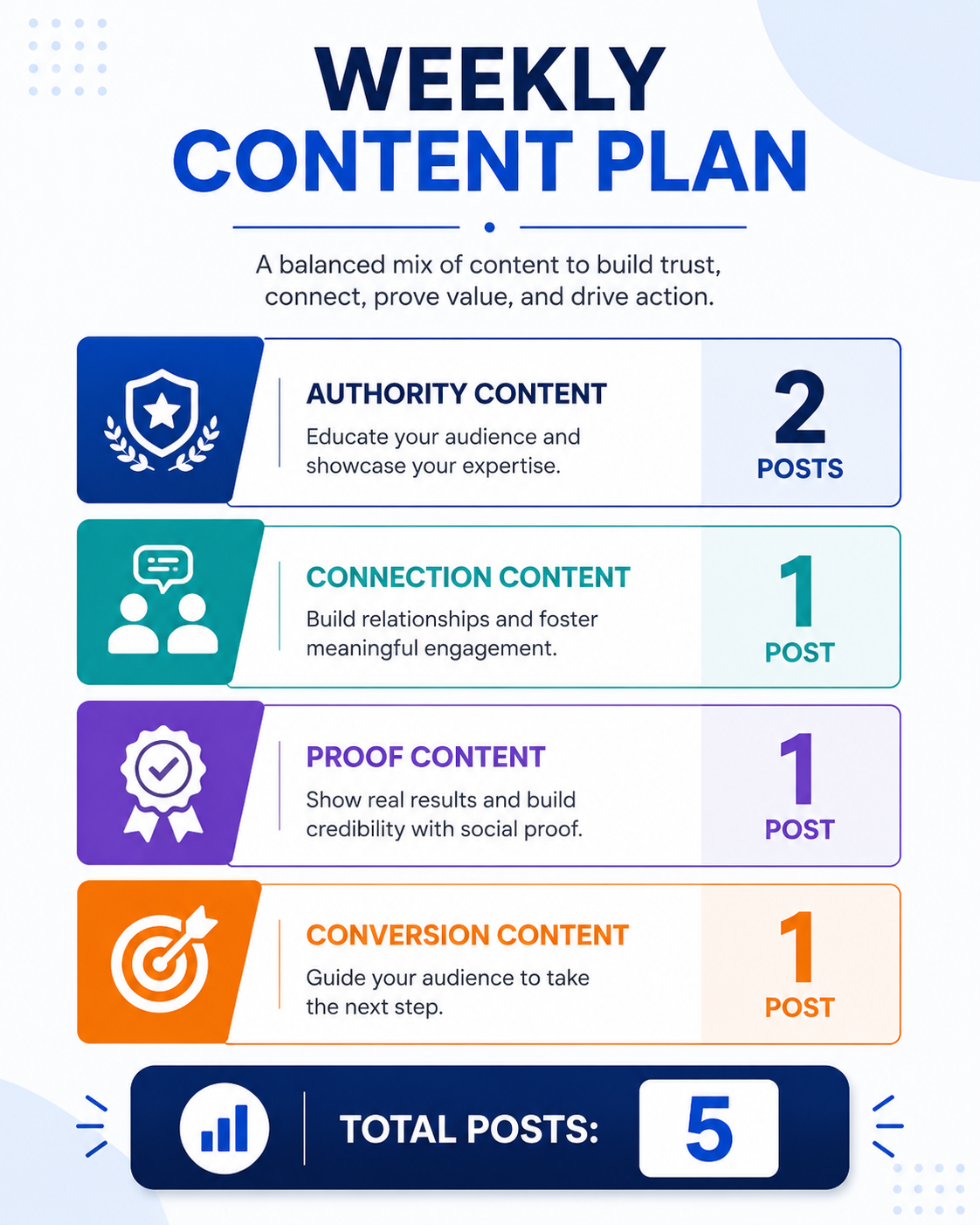
This mix allows you to build credibility, strengthen relationships, demonstrate results, and generate opportunities without overwhelming your audience with promotional content.
Quick Audit
Review your last 10 social media posts.
- How many demonstrate expertise?
- How many showcase client results?
- How many encourage action?
- How many help prospects understand your offer?
If most of your content falls into a single category, your strategy may need more balance.
How to Repurpose Content Without Creating More Work
One reason coaches struggle to maintain consistency is the belief that every platform requires completely different content. This assumption often leads to burnout. The reality is that one strong idea can fuel an entire week's worth of content.
Imagine you've written a LinkedIn post explaining a framework for overcoming imposter syndrome.
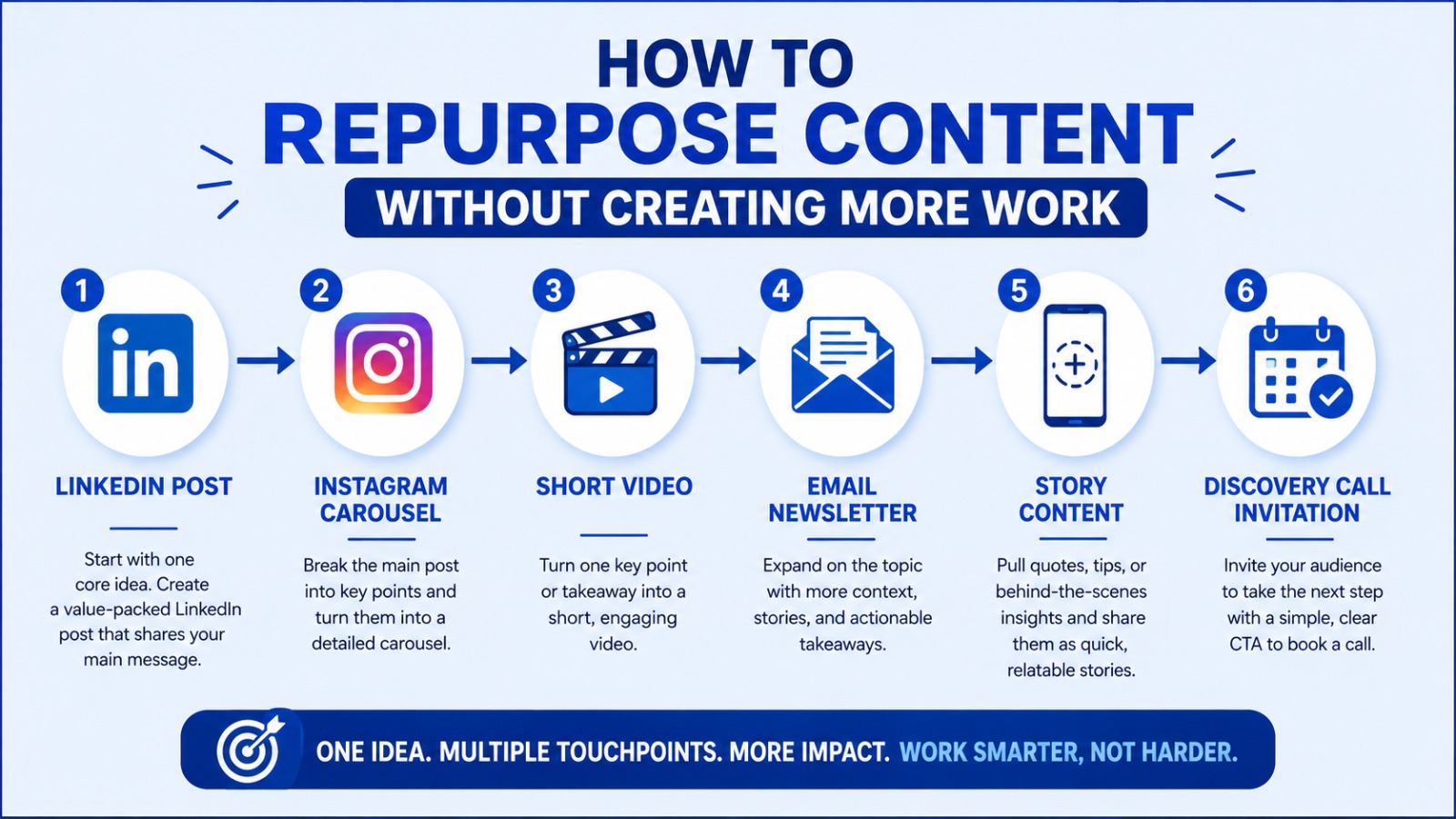
Instead of constantly searching for new topics, focus on extracting more value from the ideas you already have.
A practical workflow might look like this:
This approach increases consistency without increasing workload.
It also reinforces your message. Prospects often need repeated exposure before taking action. Repurposing helps them encounter the same ideas across different formats and platforms.
How to Use Direct Messages Without Feeling Salesy
Many discovery calls begin with a direct message. Unfortunately, direct messaging has developed a bad reputation because of aggressive outreach tactics. Most people have received messages that immediately jump into a sales pitch without any context.
Effective conversations work differently. The goal is to understand, not persuade. Start with people who already engage with your content. They have shown interest in your ideas, making the conversation more natural.
A simple framework can help.
Notice that the conversation focuses on the prospect rather than your services. People are far more likely to continue a conversation when they feel heard and understood.
Remember: Content generates attention. Conversations generate clients.
A discovery call should feel like the next logical step in the conversation, not a sudden sales pitch.
Calls-to-Action That Generate Responses
Many coaches spend hours creating valuable content and then end their posts with weak calls-to-action. A generic question such as "What do you think?" may generate engagement, but it rarely creates business opportunities.
Strong calls-to-action create clarity.
People are more likely to respond when they know exactly what action to take.
Examples of High-Converting Calls-to-Action
The best call-to-action depends on where the prospect is in the buying journey. Someone discovering your content for the first time may not be ready for a discovery call. They may be willing to download a resource or start a conversation.
Someone who has followed your content for several months may be ready for a more direct invitation.
The goal is to create a natural progression toward deeper engagement.
Turn Client Wins Into High-Converting Content
Many coaches spend most of their time teaching and very little time demonstrating results. Educational content establishes credibility. Client stories help prospects picture themselves achieving similar outcomes.
One of the simplest ways to structure a case study is through the following framework:
For example, a business coach might share the story of a consultant struggling to generate leads consistently.
The case study could explain:
- The consultant relied entirely on referrals.
- Revenue fluctuated from month to month.
- A structured content strategy was implemented.
- Discovery calls increased over the next quarter.
- Lead generation became more predictable.
This type of content works because prospects don't just see advice. They see evidence.
A strong case study also reduces risk in the mind of a potential client. They begin to think, "If this worked for someone in a similar situation, it might work for me as well."
When sharing client stories, focus on the transformation rather than the testimonial itself. The journey often resonates more strongly than the praise.
"Prospects rarely book a discovery call because of one post. They book after repeated exposure to valuable content, clear positioning, and evidence that your approach delivers results."