
🪄 AI Summary
Heading 1
Heading 2
Heading 3
Heading 4
Heading 5
Heading 6
Lorem ipsum dolor sit amet, consectetur adipiscing elit, sed do eiusmod tempor incididunt ut labore et dolore magna aliqua. Ut enim ad minim veniam, quis nostrud exercitation ullamco laboris nisi ut aliquip ex ea commodo consequat. Duis aute irure dolor in reprehenderit in voluptate velit esse cillum dolore eu fugiat nulla pariatur.
Block quote
Ordered list
- Item 1
- Item 2
- Item 3
Unordered list
- Item A
- Item B
- Item C
Bold text
Emphasis
Superscript
Subscript
Most lean B2B teams are burning hours creating net-new content while sitting on a library of webinars, podcasts, demos, and founder talks nobody's seen twice. The repurposing-first video content strategy for lean teams flips that logic: treat creation as the exception, not the default. I'm Rajan Soni, Founder at Komet Media, and this guide breaks down exactly how to build a content engine that multiplies what you already have into short-form video assets that move buyers.
TL;DR
- The repurposing-first video content strategy for lean teams means extracting maximum content from existing assets before producing anything new.
- Repurposing saves 60–80% of content creation time compared to building each piece from scratch.
- Short-form video is the highest-ROI format, and your webinars, demos, and podcasts are the raw material.
- You don't need a bigger team. You need a smarter workflow.
What Is a Repurposing-First Content Strategy (and Why Lean Teams Need It in 2026)?
A repurposing-first approach means your content calendar is built around atomising existing long-form assets, not generating new ideas from zero. Before anyone writes a brief or books a recording session, the first question is: "What do we already have?" For a B2B SaaS or funded tech team, the answer is almost always: more than you think. Product demos. Founder interview recordings. Webinar replays. Podcast episodes. Sales call transcripts. Each of these is a pillar content asset waiting to be broken into 10 to 15 short-form video clips, carousels, email snippets, and LinkedIn posts.
This is content atomisation in practice. Gary Vaynerchuk popularised the model: create one long-form "document of your thinking," then reverse-engineer the distribution. The mechanics have only gotten sharper since then, with tools like Repurpose.io, Descript, and Buffer automating distribution steps that used to eat hours.
Why does this matter for lean teams specifically? Because only 35% of marketers are actively repurposing content across channels , which means the teams doing it are getting outsized reach while competitors manufacture content from scratch every week.
That adoption gap is a significant competitive advantage for those who do repurpose: more content, more platforms, higher ROI with the same headcount. The business case is equally clear for the pipeline. 81% of B2B buyers say they trust video more than text-based content, and 88% say video influenced their final vendor selection. Your buyers are already watching. The repurposing-first model makes sure your product thinking and founder voice show up in every channel they use, without requiring a film crew or a full content team.
Short-form video is the highest-ROI content format available to B2B teams today. A repurposing-first strategy is how lean teams get there without burning out.
At Komet Media, we help SaaS teams build exactly this kind of system around content they already have.
How to Repurpose Content with a Small Team: The Core Workflow
The repurposing-first video content strategy for lean teams lives or dies on operational simplicity. Here is the core workflow we use with clients:
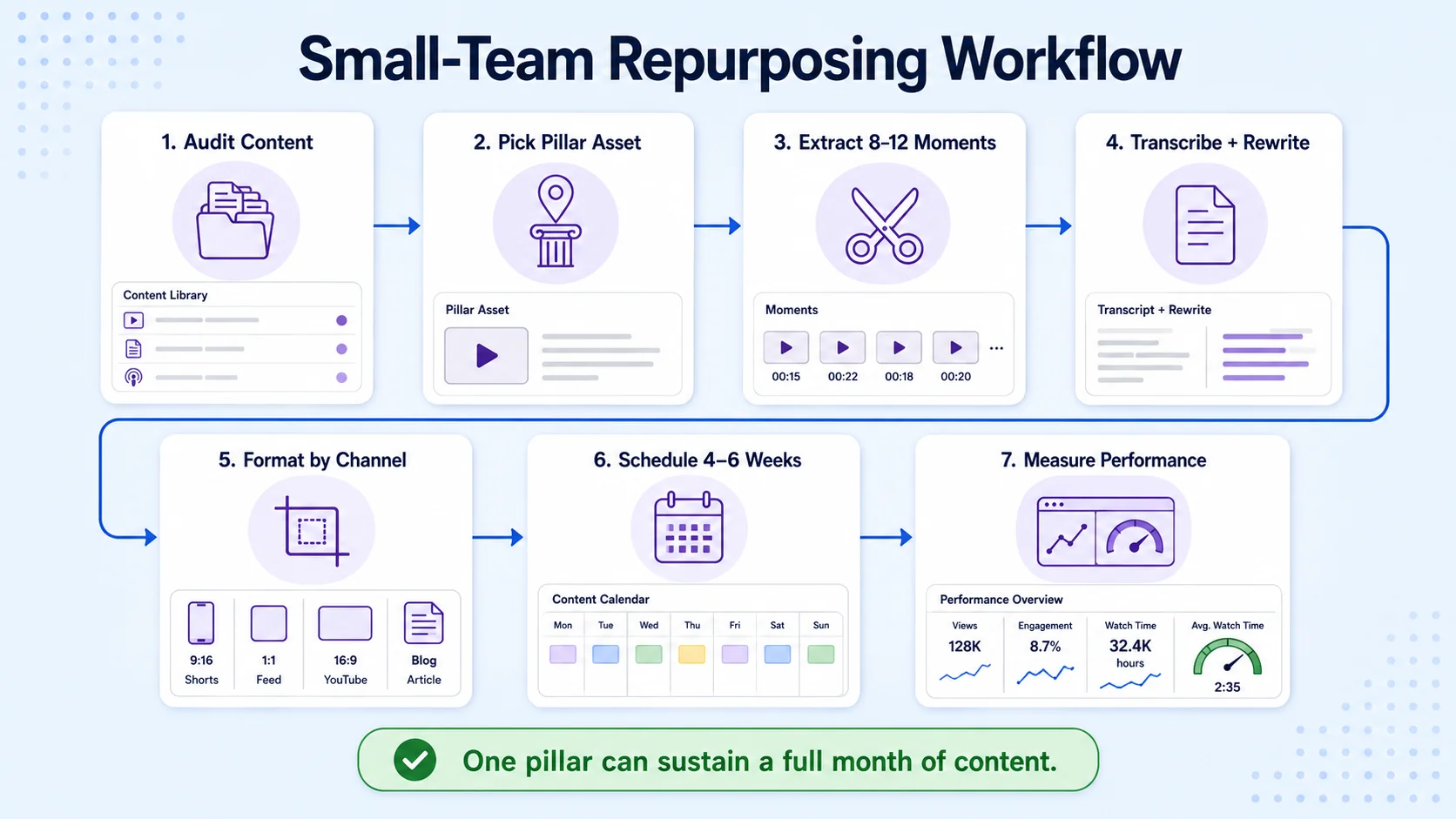
- Audit your existing content: Pull every long-form asset produced in the past 12 months: webinars, podcasts, demo recordings, founder talks, team interviews. Rank by engagement or conversion signal.
- Identify your pillar asset: Pick the single piece with the most buyer-relevant substance. A 60-minute webinar or a 45-minute podcast episode is ideal.
- Extract the core moments: Clip 8–12 standalone moments of 30–90 seconds each. These become your short-form video library for the quarter.
- Transcribe and repurpose text: Convert the transcript into LinkedIn posts, email copy, and a blog post. Every 2,000-plus word piece contains 5–10 key insights that work perfectly as individual LinkedIn posts or social updates.
- Format for each platform: Vertical for LinkedIn and Instagram Reels; horizontal for YouTube. Add captions (85% of social video is watched without sound). Use Canva to transform listicles or step-by-step formats into visually engaging carousel sequences.
- Schedule with a content calendar: Load clips into Buffer or Hootsuite. Space distribution across 4–6 weeks per pillar asset. One webinar should comfortably sustain a full month of content.
- Measure and pick the next pillar: Look at watch time, saves, and link clicks. Let performance data choose your next repurposing target.
Active repurposing programs typically save 10–20-plus hours per week, enabling marketing teams to support broader campaigns with fewer incremental resources. That's the output of a full-time hire, reclaimed through workflow design. For teams running podcast production or regular webinars, the raw material is already there. The bottleneck is never content. It's the editorial workflow.
What Content Formats Work Best for Repurposing?
Not all long-form assets repurpose equally well. Here is a breakdown by format and what each yields:
According to marketers, the top three ROI-driving content formats are all video-based: short-form video (49%), long-form video (29%), and live-streaming video (25%). That means if your repurposing output prioritises short-form video clips from long-form source material, you are already aligned with what moves the needle. Short-form videos of 15–30 seconds saw a 48% lift in click-through rate year over year, and 52% of B2B buyers say they prefer concise videos that get to the point quickly.
For SaaS teams with complex products, that brevity is not a limitation. It is a forcing function to get to the value faster. 93% of marketers say video has increased user understanding of their product, making it the most effective format for bridging the gap between technical complexity and buyer comprehension.
One key principle: do not try to repurpose everything into everything. Pick the two or three output formats your buyers actually consume, and build your editorial workflow around those. For most B2B SaaS teams, that means LinkedIn short clips, a YouTube long-form version, and a written companion piece.
How to Turn One Piece of Content into 10+ Assets (Minimum Viable Content System)
This is where the repurposing-first video content strategy for lean teams becomes a genuine content operations system. The concept here is Minimum Viable Content: one pillar asset, 10 or more derivative outputs, distributed across a full content calendar.
Using a 60-minute webinar as the starting pillar:
- Full webinar replay posted to YouTube
- 8–10 short clips (30–90 seconds each) for LinkedIn and Instagram Reels
- Highlight reel (3–5 minutes) for YouTube Shorts and the website
- Audiogram of the best 60-second insight for podcast promotion
- Blog post (1,200–1,500 words) built from the transcript
- LinkedIn text post (key framework or insight from the webinar)
- Email newsletter recap with link to replay
- 3–5 LinkedIn carousel slides (step-by-step frameworks from the talk)
- Pull-quote graphic using Canva for Instagram Stories
- Sales enablement clip (the moment that handles the most common buyer objection)
When one piece becomes a YouTube video, five social clips, an email newsletter, and a podcast segment, the original investment generates returns across six channels instead of one, dramatically improving the content ROI equation. Updating high-performing content can boost traffic by 146%, making content refreshing one of the highest-return repurposing activities available for existing content libraries. Once a clip performs, turning it into a paid retargeting ad or an updated version six months later extends its lifespan further.
Teams running video editing services or working with a partner to produce these assets consistently can scale this system without adding headcount. The model is the same whether you have one video editor or a full production team: one pillar, maximum atoms.
Building a Content Repurposing Workflow for Teams with Limited Resources
The operational side of the repurposing-first video content strategy for lean teams is what most guides skip. Here is how to build it without overengineering:
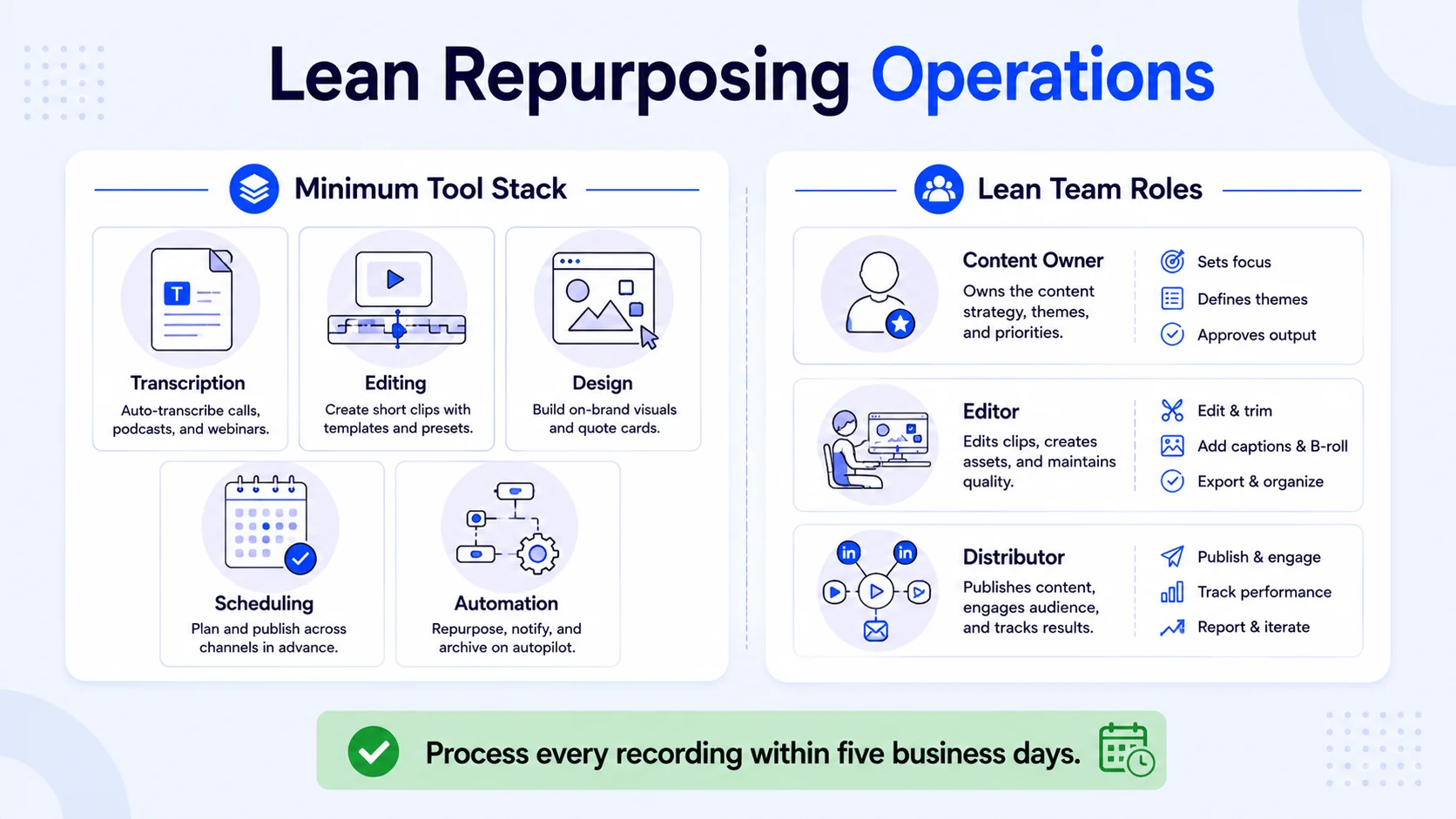
Tool stack (minimum viable):
- Transcription: Descript or Otter.ai to pull text from video and audio
- Editing: Descript or Adobe Premiere for clip extraction; Komet Media's editing services for teams without in-house editors
- Design: Canva for carousels, quote graphics, and thumbnails
- Scheduling: Buffer or Hootsuite to plan the content calendar and automate distribution
- Automation: Repurpose.io to automatically push finished clips to multiple platforms
Roles (lean team of 2–3):
- Content owner: reviews source asset and identifies key moments
- Editor: extracts clips, adds captions, formats for platforms
- Distributor: schedules posts, writes copy, tracks performance
Teams that document their repurposing workflow, including which formats to create, which platforms to target, and which metrics to track, consistently outperform those who repurpose ad hoc. The simplest trigger rule: every recorded webinar, podcast, or demo gets processed within five business days. That discipline alone is what separates teams with a content backlog from teams with a content engine.
Content lifecycle extensions through updates and refreshes improved organic traffic by 28% in 2025 , which means evergreen content that gets periodically refreshed compounds over time. Build that refresh loop into your editorial workflow from day one. For teams that want to scale without hiring, the Komet Media services page covers the full production-to-distribution stack that handles this end-to-end.
How Repurposing Content Builds Pipeline and Supports Founder-Led Growth
The repurposing-first video content strategy for lean teams is not just an efficient play. It is a trust-building and pipeline-generation system. Here is why that matters for B2B SaaS and funded tech teams specifically. Buyers in 2026 are completing most of their vendor evaluation before speaking to sales. Buyers are engaging vendors earlier, yet they are still around 73% through the decision-making process before initial contact, meaning influence opportunities are shrinking while competition is intensifying. That means your content needs to do the selling before your sales team ever enters the conversation.
Short-form video clips from demos, founder talks, and customer conversations are exactly the type of content that builds that pre-sales trust. 72% of B2B buyers report that video content from vendors influences their vendor shortlist decisions. Repurposed clips from your existing material hit LinkedIn and YouTube exactly when buyers are in research mode. For founder-led growth specifically, repurposing is the most sustainable content model.
A founder records one podcast or webinar per month. That single recording becomes 10 LinkedIn posts, 8 short clips, and a blog post. The founder's thinking is visible across every channel, every week, without requiring 40 hours of content creation. On average, B2B video content shortens the sales cycle by 23%. For a SaaS team with a 60-day sales cycle, that is a two-week compression per deal, compounding across every deal in the pipeline.
Content repurposing strategies improve ROI by 32% on average. Combined with video's trust advantage and the efficiency of atomisation, this is the clearest ROI argument for any lean team that wants inbound demand without doubling their content budget. If your team runs webinars or podcasts, the repurposing system turns every session into a pipeline asset that works for weeks after the live date.
Conclusion
The repurposing-first video content strategy for lean teams is the clearest path to sustainable content output without burning out your team or inflating your budget. The evidence is consistent:
- Content repurposing saves 60–80% of content creation time compared to starting from scratch for each platform.
- Short-form video from existing assets delivers the highest ROI of any content format available in 2026.
- One pillar asset, atomised correctly, sustains a full month of omnichannel content distribution.
- Buyer trust and pipeline velocity both improve when your video content is present throughout the research phase.
Build the workflow. Pick your first pillar. Ship 10 assets from one recording before you create anything new.
Frequently Asked Questions
Q1: What is a repurposing-first content strategy?
It means your content calendar is built around extracting value from existing long-form assets, such as webinars, podcasts, and demos, before creating anything new. Creation is the exception. Atomisation is the default. It saves time, extends reach, and improves content ROI.
Q2: How many pieces of content can one webinar produce?
A single 60-minute webinar can reliably yield 10 or more assets: short clips, a highlight reel, a full replay, a blog post, a newsletter, LinkedIn carousels, pull-quote graphics, audiograms, and sales enablement clips. One session can sustain four to six weeks of omnichannel content distribution.
Q3: What tools do lean teams need for content repurposing?
The minimum viable stack is Descript or Otter.ai for transcription, Adobe Premiere or Descript for clip editing, Canva for graphics, Buffer or Hootsuite for scheduling, and Repurpose.io for cross-platform automation. Many lean teams also partner with a specialist agency to handle editing and distribution at scale.
Q4: How does repurposing support B2B pipeline generation?
Repurposed short-form video clips from demos and founder talks appear on LinkedIn and YouTube during the buyer's self-directed research phase. B2B video content shortens the sales cycle by 23% on average , meaning consistent video presence directly compresses deal timelines and improves demo conversion rates.
Q5: What is content atomisation and how does it work?
Content atomisation is the practice of breaking one large content asset into many smaller, platform-specific pieces. A 60-minute webinar becomes clips, posts, carousels, and emails. Each atom carries a single clear idea, formatted for its specific channel, making the core message accessible across every platform a buyer might use.
Q6: How is a repurposing-first strategy different from traditional content marketing?
Traditional content marketing prioritises net-new creation: new blog posts, new videos, new campaigns each week. A repurposing-first approach prioritises extraction over creation. The strategy flips the workflow so that every piece of new content also generates 10 or more derivative assets, dramatically improving content ROI and reducing the time burden on small teams.