
🪄 AI Summary
Heading 1
Heading 2
Heading 3
Heading 4
Heading 5
Heading 6
Lorem ipsum dolor sit amet, consectetur adipiscing elit, sed do eiusmod tempor incididunt ut labore et dolore magna aliqua. Ut enim ad minim veniam, quis nostrud exercitation ullamco laboris nisi ut aliquip ex ea commodo consequat. Duis aute irure dolor in reprehenderit in voluptate velit esse cillum dolore eu fugiat nulla pariatur.
Block quote
Ordered list
- Item 1
- Item 2
- Item 3
Unordered list
- Item A
- Item B
- Item C
Bold text
Emphasis
Superscript
Subscript
Most developer tool and API companies record strong podcast conversations with engineers, founders, and DevRel leaders, then publish them once and move on. That's a significant waste. Podcast repurposing for developer tools and API brands is how you convert a single 45-minute conversation into documentation pages, LinkedIn clips, newsletter issues, GitHub-ready code walkthroughs, and pipeline-driving short-form video, without recording anything new. This guide covers the exact workflows, tools, and distribution logic that serious B2B dev teams use to make every episode earn its keep.
For teams starting with zero existing recordings, Komet Media also builds content engines completely from scratch—handling strategy, scripting, recording guidance, and end-to-end production.
TL;DR
- A single podcast episode can generate 6–8 distinct content assets that reach developers on LinkedIn, GitHub, Hacker News, Stack Overflow, and in their inboxes.
- Technical blog posts, short-form video clips, newsletters, and code-adjacent guides are the four highest-leverage formats for API and devtool audiences.
- The goal is not more content volume. It's more targeted touch points at each stage of the developer adoption journey.
- Repurposing works best when planned before you record, not after.
How to Repurpose Podcast Content for Developer Audiences
Developers are skeptical of marketing. They trust peer explanations, working code, and honest technical context. That means your repurposing strategy has to lead with usefulness, not promotion. Content is how DevRel reaches developers who have not yet heard of you: blog posts, tutorials, sample apps, video walkthroughs, conference talks, reference architectures. Your podcast already contains all of this in raw form. The repurposing job is extraction and reformatting, not invention.
Here is how to approach a single episode with a developer audience in mind:
- Transcribe immediately: Use a tool like Descript or Castmagic to generate a clean transcript with speaker labels and filler-word removal as soon as the episode is edited. This is your raw material for every downstream asset.
- Identify the technical claims: Scan the transcript for specific API behaviors, SDK patterns, architectural decisions, or error-handling approaches your guest mentioned. These become the seeds for blog posts and documentation supplements.
- Pull the insight moments: Every episode has 3–5 moments where the guest says something genuinely useful to an engineer evaluating your product. Timestamp these. They become short-form video clips for LinkedIn and YouTube Shorts.
- Extract the framework or mental model: Developers share content that gives them a new way to think about a problem. If the episode produced a mental model, name it and build a carousel or a thread around it.
- Identify the question being answered: Every strong technical podcast episode is really answering one big question a developer has. Naming that question turns the episode into SEO-targeted content.
The point of content for developers is to make the developer's life easier, whether that's presenting a novel solution to the problem they are working on or providing clear documentation and quickstart tutorials. Bad content dilutes brands; good content builds trust.
Most businesses view podcasts only as a channel, missing the chance to use them as a content source. Podcasts produce media-rich and engaging content that performs well across multiple channels, including social media, blogs, and newsletters.
Best Ways to Turn Podcast Episodes Into Technical Blog Posts
This is the single highest-leverage repurposing format for API and devtool brands because it creates indexable, discoverable content that ranks in search and gets surfaced in AI assistants like Perplexity and ChatGPT. Done well, an episode-turned-article becomes more than a piece of written content. It becomes a discoverable, shareable, and conversion-ready asset that works across search engines, social platforms, and emerging AI tools.
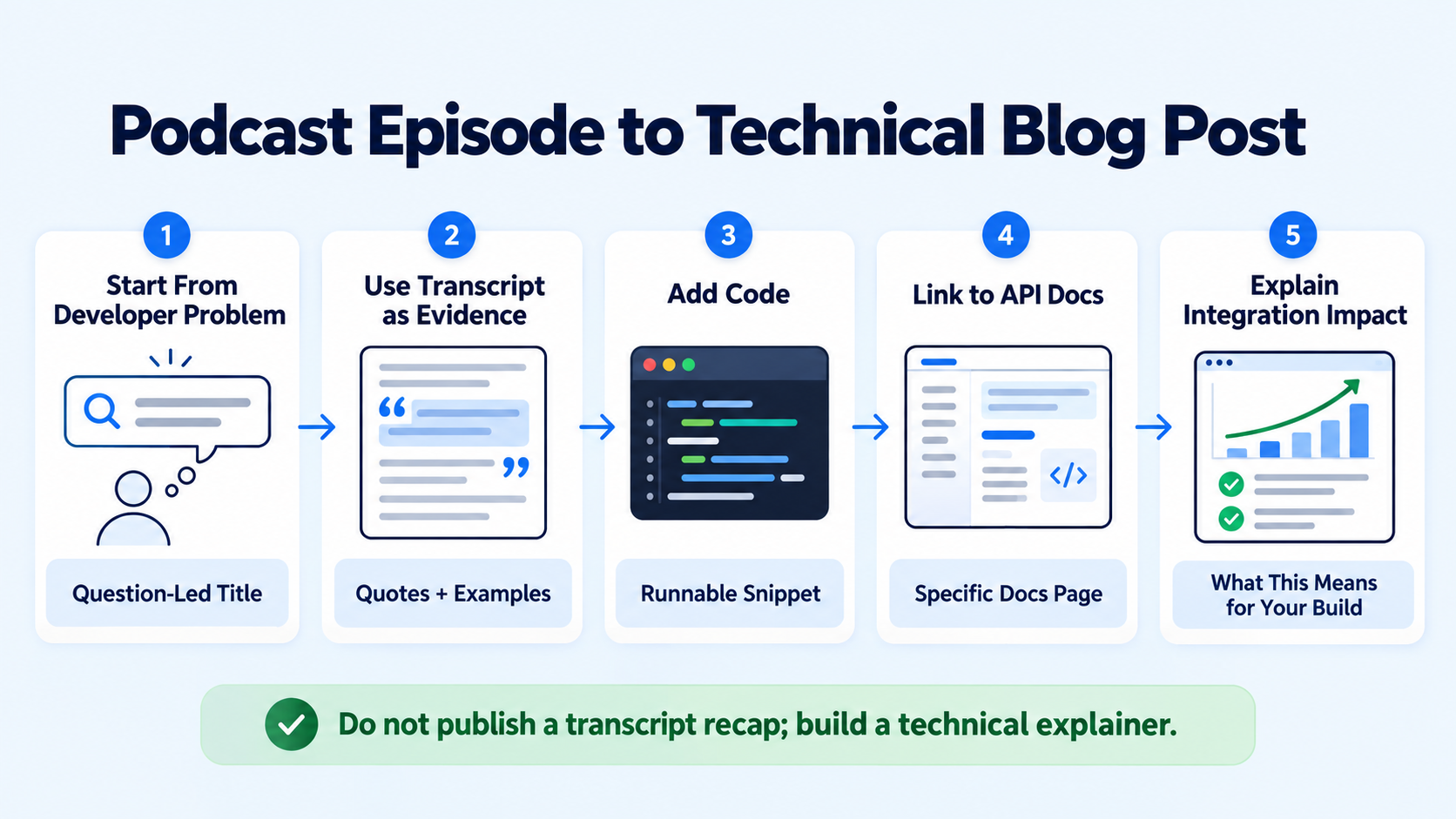
The key distinction for developer audiences: your blog post should not be a transcript summary. It should be a technical explainer that uses the conversation as a source of depth and credibility.
Structure for a podcast-to-technical-blog workflow:
- Start from the developer problem, not the episode: Write the title around the specific technical question the episode answered, such as "How to handle webhook retries in Stripe's event model" rather than "Episode 42: Stripe Developer Experience."
- Use the transcript as evidence, not structure: Pull quotes and examples from the episode to support points you're making independently. This gives the post authority without making it feel like a recap.
- Add code: If the guest described an API pattern, implementation approach, or error scenario, write a short code snippet that demonstrates it. This is what separates a B2B blog post from a DevRel post.
- Link to API documentation: Where relevant, link directly to the specific documentation page the episode referenced. This improves the post's usefulness and signals to search engines and AI crawlers that your content is accurate.
- Include a "What this means for your integration" section: Developers evaluating your product want to know how the insight changes their implementation decisions.
A single podcast episode can boost a site's organic search visibility by 53% within one month when the transcript and derived content are properly optimized.
At Komet Media, the blog posts we build from podcast episodes for our B2B SaaS clients consistently outperform standalone articles because they carry a real conversation's specificity, not just keyword density.
Podcast Repurposing Strategy for API Companies: The Full Asset Map
Repurposing each episode into 6–8 content assets multiplies ROI: a 45-minute episode yields 1 blog post, 3 short video clips, 8 audiogram quotes, 1 email newsletter, and 5 social media posts, extending content reach by 400%. For API companies specifically, the asset map should include formats that meet developers at each stage of their evaluation journey. Here is the complete repurposing output from a single well-recorded episode:
The key principle: distribute each asset natively. A 90-second clip pulled from your podcast interview belongs on LinkedIn with captions and a direct value proposition in the first two seconds. It does not belong as an embedded YouTube link with no context.
For API brands running DevRel programs, the documentation supplement is the most underused format. A podcast conversation about an edge case in your SDK often contains better explanations of that behavior than what currently lives in your official docs.
Our podcast repurposing and content creation services are designed to extract these assets from your existing recordings or produce fresh technical video content from scratch without requiring extra lift from your DevRel team.
How to Convert Podcast Episodes Into LinkedIn Content for Developers
According to the State of DevRel survey, LinkedIn is the most effective channel for reaching developers at 39.8%, followed by a branded developer portal at 28.5%, the company website at 26%, and YouTube at 26%. That makes LinkedIn the primary distribution channel for podcast-repurposed content targeting developer buyers. However, most devtool teams post a link to the episode and stop there. That approach is largely ignored by the LinkedIn algorithm and by developers who are not actively searching for podcast content.
What actually performs for technical audiences on LinkedIn:
- Native short-form video clips: Pull the sharpest 60–90 second insight from the episode. Add captions, a bold first frame, and a clear topic label in the caption. Do not start with "We just dropped a new episode." Start with the insight itself.
- Founder or DevRel perspective posts: Write a 200–300 word post in first person from the founder or DevRel lead that takes one idea from the episode and extends it. Reference the episode as the source. This is the core of founder-led growth for technical brands.
- Carousel posts with technical frameworks: If the episode surfaced an architectural pattern, decision tree, or mental model, build a 6-slide carousel. Developers share carousels that they would otherwise bookmark in their notes.
- Quoted pull moments: Short posts that lead with a single provocative sentence from the guest, followed by 3–4 lines of context from you, and a link to the full episode in the comments.
Video is becoming one of the most important DevRel channels, with examples including YouTube videos, livestreams, conference recordings, tutorials, and short-form content.
Our short-form video editing service specifically handles the clip selection, captioning, and formatting work that most in-house DevRel teams do not have capacity to execute consistently.
Podcast to Newsletter Workflow for Developer Tool Companies
A developer-focused newsletter is one of the most reliable pipeline assets a B2B devtool brand can build. Shows with active newsletters grow 2–3x faster than shows relying solely on platform notifications. The podcast is your best raw material for it.
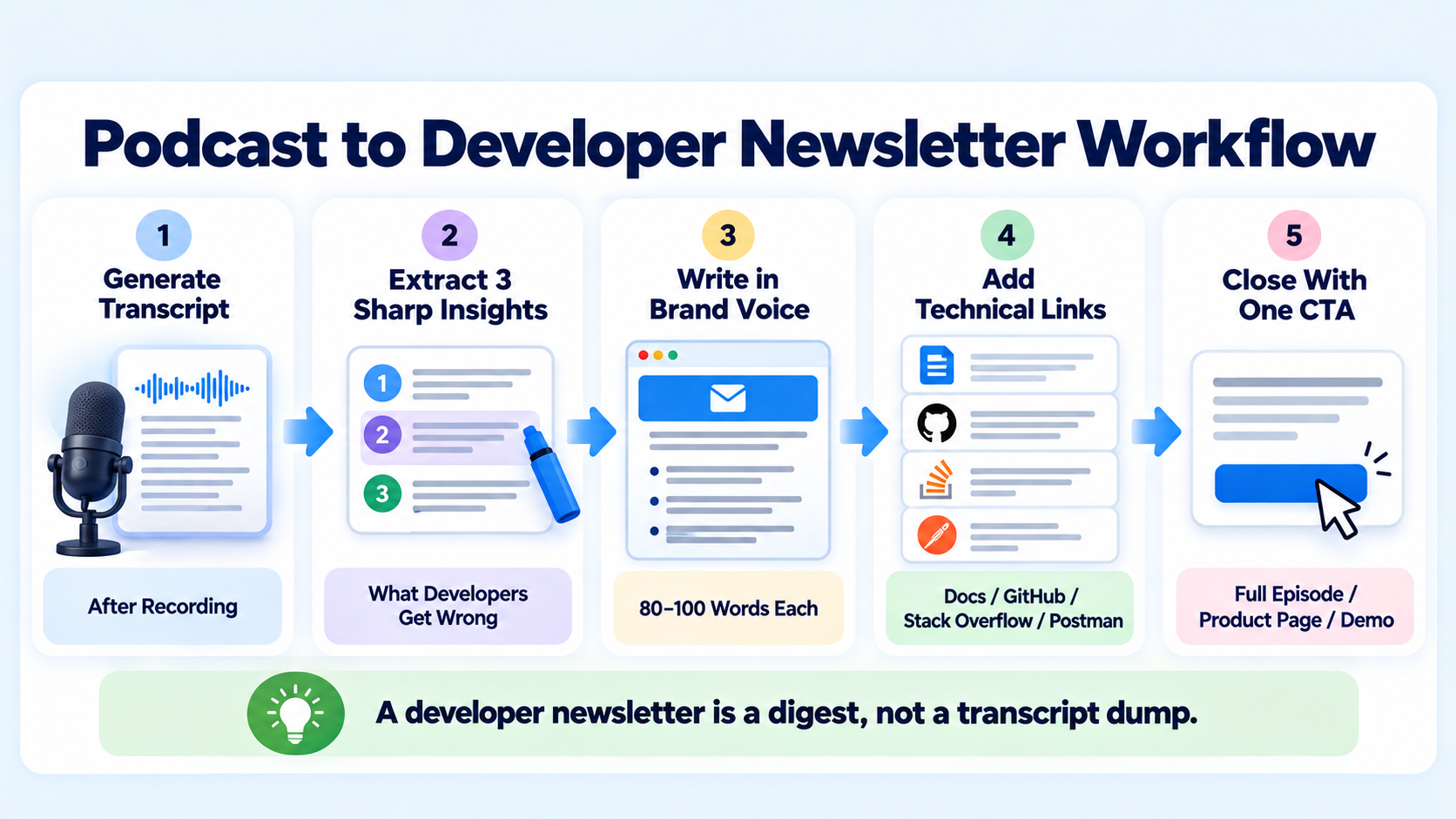
The workflow has five steps:
- Generate the transcript immediately after the episode is recorded and edited.
- Extract the three sharpest insights: Look for the moments where the guest explained something most developers get wrong, or shared an approach that is non-obvious. These become your newsletter's three sections.
- Write the newsletter in your brand's voice, not the guest's: Summarize the insight in 80–100 words, credit the guest by name and company, and link to the full episode. The newsletter is a digest, not a transcript dump.
- Add one technical link per section: Each insight should link to a relevant documentation page, GitHub repo, Stack Overflow thread, or Postman collection that the reader can act on immediately. This is what separates a developer newsletter from a marketing email.
- Close with one specific CTA: One link per newsletter. Point to the full episode, a relevant product page, or a demo booking. Not all three.
Adding AI-generated transcriptions boosted web traffic to podcast episodes by 30% within six months, as the text improved SEO performance. When that transcript also feeds a newsletter with consistent distribution, the compounding effect on organic reach and pipeline touchpoints is measurable.
What Content Formats Work Best When Repurposing Podcasts for API Brands
Not all repurposed formats perform equally for developer tool audiences. The format choice should follow where developers actually consume content and what signals credibility in their evaluation process. Short-form videos have the highest ROI (31%) among content formats , making them the top priority for awareness and top-of-funnel reach. But for API brands, the evaluation and activation stages require formats that go deeper.
Here is how the formats rank by developer stage:
Awareness (new developer, not yet evaluating):
- Short-form video clips on LinkedIn and YouTube Shorts carry the highest reach-per-effort ratio for devtool brands.
- Technical blog posts indexed on Google, surfaced on Hacker News, or cited on Stack Overflow drive high-intent traffic.
Evaluation (developer actively comparing tools):
- Documentation supplements drawn from podcast conversations answer the specific edge-case questions developers ask during evaluation. Stripe's developer experience, Twilio's documentation culture, and Postman's community approach all rely on this type of content.
- Code walkthroughs posted to GitHub or embedded in blog posts give developers something they can run, not just read.
Activation and enablement (post-signup or post-demo):
- Video walkthroughs repurposed from webinar or podcast content reduce time-to-first-integration.
- Newsletter archives become an onboarding resource when they are organized by topic.
The question is not "what format should we create?" The question is "where is our buyer's attention at each stage, and what format do they trust in that context?" The bar for developer content is technical accuracy and usefulness, not polish. A blog post that walks an engineer from zero to a working integration in fifteen minutes beats a glossy white paper at higher altitude.
For brands running a full podcast repurposing for developer tools and API brands strategy, the podcast transcription and podcast show notes services we run at Komet Media create the foundational text layer from which every other format is derived.
Can You Repurpose a Podcast Into Code Examples or Technical Guides?
Yes, and this is the format most devtool brands miss entirely. It is also the format most likely to get shared inside developer Slack groups, cited on Stack Overflow, and bookmarked by engineers doing integration research.
The pathway from podcast to code example has four stages:
- Identify the technical pattern discussed: Listen or scan the transcript for any moment where your guest described how they built something, why they chose a specific approach, or what they would do differently. These are the seeds of code-adjacent content.
- Abstract the pattern into a reusable example: Take the specific case they described and generalize it into a working code snippet. For API brands, this typically means a request-response example, an error-handling pattern, or an authentication flow.
- Wrap the code in narrative context: A raw code block on its own does not explain why. Wrap it in 200–400 words that explain the problem being solved, the tradeoff involved, and when this pattern applies. This is what makes it a technical guide, not a snippet dump.
- Distribute through developer-native channels: Post the guide on your developer docs, create a GitHub Gist, reference it in a Stack Overflow answer, or include it in a Postman collection. Announce it through your newsletter and a LinkedIn post.
Developer relations is a strategic function that connects a company's product to the developer community. The work spans technical content, community building, conference speaking, sample code, SDK design, documentation, product feedback loops, and customer enablement.
Podcast repurposing for developer tools and API brands reaches its highest value when it supplements the official Software Development Kit documentation with real-world usage patterns, the kind that only emerge in candid conversations, not in formal docs.
Technical video content is a core developer marketing strategy. Free tools and content drive awareness before a developer is even searching. Community and DevRel build the advocacy layer that drives word-of-mouth at scale. Video and SEO extend reach at each stage without requiring a sales motion to initiate the relationship.
The Open Source Community angle matters here too. When your code examples are good enough to share publicly, contributors and community members begin referencing them, creating organic Technical Evangelism that no paid campaign can buy.
Want to build this pipeline from your existing podcast library? See how Komet Media approaches podcast repurposing for B2B and devtool teams, or get in touch directly.
Conclusion
Podcast repurposing for developer tools and API brands is not a content volume play. It is a precision strategy for building trust with technical buyers across every stage of the developer adoption journey.
Key takeaways:
- Plan repurposing before you record, not after. The best episodes for repurposing are structured around one specific technical problem.
- Short-form video clips, technical blog posts, newsletters, and code examples are the four formats that move the needle for API and devtool audiences.
- LinkedIn is your primary distribution channel for developer buyers; GitHub and Hacker News are your credibility channels.
- Whether you have a rich library of past podcasts or are creating video content completely from scratch, building a defined production and repurposing workflow is the key to a scalable developer content engine.
Frequently Asked Questions
Q1: How many pieces of content can you realistically get from one podcast episode?
A systematic repurposing workflow can generate 6–8 distinct assets from a single 45-minute episode, including a blog post, 3 short-form video clips, a newsletter issue, a LinkedIn carousel, a documentation supplement, and a code walkthrough. The actual number depends on the episode's technical depth and your distribution channels.
Q2: Do you need a large podcast audience for repurposing to be worth it?
No. Businesses do not need a large podcast audience; they need the right audience. Instead of tracking downloads and subscribers, they should measure content engagement, brand mentions, lead generation, and business relationships. A 200-listener episode with strong technical guests can generate content that reaches thousands through search and social.
Q3: What is the best tool stack for podcast repurposing for developer tools and API brands?
A mid-market stack for generating 30–50 assets per episode includes Castmagic at $39/month for automated content generation, OpusClip for clips, and Descript for editing. For dev-specific output like code examples and documentation supplements, layer in a technical writer or DevRel contractor to add the engineering context that AI tools cannot produce alone.
Q4: Where should developer-focused podcast clips be distributed first?
Start with LinkedIn, which is the most effective channel for developer outreach at 39.8% according to State of DevRel data, then YouTube Shorts for technical walkthroughs, and Hacker News or relevant subreddits for posts that have genuine technical value. Never post a clip without native captions.
Q5: How does podcast repurposing support a DevRel strategy specifically?
DevRel content must demonstrate technical credibility and community goodwill. Repurposed podcast content delivers both: the guest's expertise builds credibility, and the distribution across GitHub, Stack Overflow, and developer newsletters signals that your team is genuinely engaged with the problems your community faces.
Q6: How long does it take to build a full repurposing workflow?
With a defined process and the right tool stack, a team can reduce the time to repurpose one episode to 3–5 hours of total work spread across roles. Castmagic and Descript handle transcript generation and clip pulling; a writer handles the blog post and newsletter; a video editor handles clip formatting. Komet Media's podcast production service manages this end-to-end for B2B and devtool teams that do not want to own the workflow internally.