
🪄 AI Summary
Heading 1
Heading 2
Heading 3
Heading 4
Heading 5
Heading 6
Lorem ipsum dolor sit amet, consectetur adipiscing elit, sed do eiusmod tempor incididunt ut labore et dolore magna aliqua. Ut enim ad minim veniam, quis nostrud exercitation ullamco laboris nisi ut aliquip ex ea commodo consequat. Duis aute irure dolor in reprehenderit in voluptate velit esse cillum dolore eu fugiat nulla pariatur.
Block quote
Ordered list
- Item 1
- Item 2
- Item 3
Unordered list
- Item A
- Item B
- Item C
Bold text
Emphasis
Superscript
Subscript
Launching an app is one thing. Getting people to discover and install it is another.
With millions of apps competing for attention across the App Store and Google Play, most founders assume they need a large advertising budget to acquire users. The reality is that many successful apps build their first wave of growth through organic channels before spending heavily on paid acquisition.
Instagram is one of the most effective platforms for that approach.
The biggest advantage of Instagram is that people can discover your app even when they are not actively looking for it. A productivity tip can introduce someone to your task management app. A fitness transformation story can attract users to your workout platform. A budgeting tutorial can generate interest in your finance app.
That makes Instagram far more than a social network. It is a discovery engine.
In this guide, you'll learn how to use Instagram to drive app installs without paid ads. From optimizing your profile to creating content that earns shares, saves, and downloads, you'll discover a practical framework for turning Instagram into a consistent user acquisition channel.
Why Instagram Is an Ideal Platform for Organic App Growth
Most people don't open Instagram to look for apps. They open it to solve problems, learn something new, discover trends, or pass the time.
That behavior creates an opportunity for app marketers.
Every app exists to solve a problem. Whether you're helping users track expenses, learn a language, book travel, improve productivity, or stay fit, Instagram gives you a platform to demonstrate that value before asking for a download.
Unlike search engines, where users already know what they're looking for, Instagram helps you reach people earlier in their decision-making process.
A user struggling to stay organized might come across a productivity tip in their feed. Someone trying to improve their fitness could discover a workout tutorial through Reels. A traveler planning a vacation may watch destination content and eventually find a travel-planning app. The discovery happens naturally.
Instagram also offers multiple content formats that support different stages of the user journey.
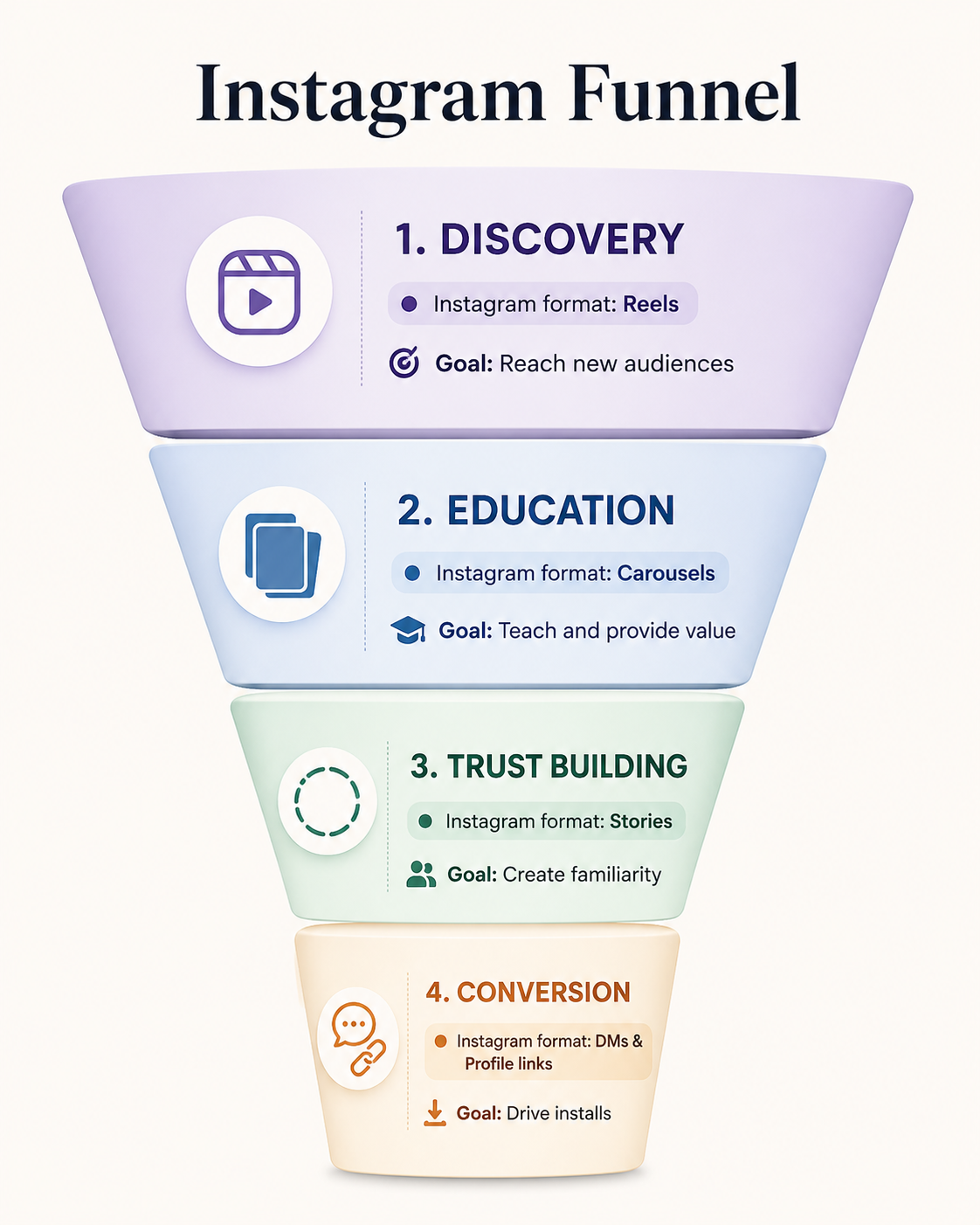
The strongest app marketing strategies use all four stages. Many founders focus exclusively on conversion content. They create posts that immediately ask people to download the app. The problem is that most users are not ready for that step.
People install apps after they understand the problem, trust the solution, and believe it will improve their lives in some way. Instagram allows you to build that trust consistently through content.
It also offers one advantage many other acquisition channels lack: shareability. A useful Reel can be shared with friends. A carousel can be saved for later. A story can spark a conversation in direct messages.
Every interaction increases the chances of your content reaching people beyond your current audience. For app startups operating with limited budgets, organic distribution can become a significant source of growth.
Why Most Apps Fail to Get Installs From Instagram
Many app companies create an Instagram account with high expectations, publish product screenshots, share feature announcements, and add an App Store link to their bio, only to wonder why downloads never increase.
In most cases, the issue isn't the app itself, it's the content strategy.
They Talk About Features Instead of Outcomes
Users care far more about what an app helps them achieve than the technology behind it. Consider these two examples:
Feature-focused post:
"Our app now includes AI-powered task categorization."
Outcome-focused post:
"Spend less time organizing tasks and more time finishing them."
The second example connects directly to a user benefit and makes it easier for potential users to understand the value of the app. People install apps because they want results, so your content should emphasize those outcomes whenever possible.
They Post Like a Company Instead of a Creator
Corporate messaging often performs poorly on Instagram because users are naturally drawn to creators, personalities, and accounts that feel authentic and relatable. Many app brands make the mistake of sounding overly formal, with captions that read like press releases and content that comes across as purely promotional.
The accounts generating the strongest engagement tell stories, share lessons, reveal behind-the-scenes moments, and communicate like real people.
Even large brands have adopted this approach.
They Ignore Educational Content
Education is often one of the fastest ways to generate organic reach because it provides immediate value to your audience. A budgeting app can share practical saving habits, a language-learning app can publish quick vocabulary lessons, and a fitness app can explain common workout mistakes that people should avoid.
This type of content attracts users who are already interested in the problem your app solves, making them far more likely to engage with your brand and eventually install your app.
They Treat Every Post Like a Sales Pitch
When every post asks users to install the app, audiences quickly lose interest. Instagram rewards content that keeps people engaged. Your goal should be to provide value consistently and earn attention over time.
A useful piece of content today often creates a download days or weeks later.
They Give Up Too Soon
Organic growth takes time. Many app marketers expect results within a few weeks. The reality is that Instagram works through repeated exposure.
A potential user may see several Reels, visit your profile multiple times, watch your Stories, and read comments before installing.
Consistency matters far more than short bursts of activity. The apps that succeed on Instagram are usually the ones that continue publishing long after competitors stop.
Build an Instagram Profile That Converts Visitors Into Installers
Every piece of content you publish eventually sends users back to one place: your profile. Think of your profile as your app's storefront.
When someone lands there, they should immediately understand:
- What your app does
- Who it is for
- Why they should care
- What action to take next
If any of those answers are unclear, potential installs disappear.
Write a Bio That Explains Your Value Clearly
You have limited space, so every word matters. A strong bio should answer three questions:
What does your app do? Who is it for? What should someone do next?
For example:
"AI writing assistant for marketers. Create content faster and stay consistent. Try it free below."
Visitors should understand your app within seconds.
Avoid vague phrases such as:
- Building the future
- Empowering innovation
- Helping businesses grow
These statements sound impressive but provide little context.
Use a Dedicated Landing Page
Sending every visitor directly to the App Store is rarely the best option. Many people want more information before installing.
A landing page allows you to:
- Explain benefits
- Showcase features
- Display reviews
- Highlight user success stories
- Include download links for iOS and Android
The extra context often improves conversion rates significantly.
Organize Story Highlights Strategically
Story Highlights act as permanent resources for potential users. Instead of treating them as archives, use them to answer common questions.
Useful Highlight categories include:
- Features: Showcase your most valuable functionality.
- Tutorials: Demonstrate how the app works.
- Reviews: Display user testimonials and ratings.
- Success Stories: Show real outcomes achieved by customers.
- FAQs: Address objections before they become barriers.
A visitor who spends two minutes exploring your Highlights is much more likely to install than someone who only reads your bio.
Choose a Recognizable Profile Image
For most apps, a clean logo works best. Keep it simple and easy to identify on a mobile screen.
If your app is closely connected to a personal brand or founder, a professional headshot can also work well. Consistency across your website, app store listings, and social profiles helps build recognition.
Make Your Call-to-Action Obvious
Don't make visitors guess what to do next. Whether your goal is a download, sign-up, free trial, or waitlist registration, the next step should be clear.
Simple calls-to-action often perform best:
- Download the app
- Start your free trial
- Join the waitlist
- Try it today
Once your profile is optimized, every Reel, carousel, and Story has a much better chance of turning attention into installs.
Define Your Instagram Content Pillars
One of the biggest reasons app marketers struggle with Instagram is that they approach content without a clear framework. They post product updates one week, share a random meme the next, disappear for several days, and then return with a promotional post asking people to download the app.
This inconsistency makes it difficult for audiences to understand what the account is about and why they should follow it.
Content pillars solve that problem.
A content pillar is a recurring topic that supports your audience's interests while naturally connecting back to your app. Instead of wondering what to post every day, you create content around a handful of themes that are directly related to your product and the problems it solves.
Most successful app brands operate with three to five content pillars. This gives them enough variety to keep their audience engaged while maintaining a clear identity.
Educational Content
Educational content should form the foundation of your Instagram strategy because it attracts users who are already interested in the problem your app addresses.
For example, a budgeting app can share saving strategies, expense management tips, and common financial mistakes. A language-learning app can publish vocabulary lessons, pronunciation hacks, and grammar shortcuts. A fitness app can create content around workouts, nutrition advice, and recovery techniques.
The goal is not to teach everything your audience needs to know. The goal is to provide enough value that users begin to see your brand as a trusted resource.
Educational content performs particularly well in carousel posts because users often save them for future reference. Since saves are one of Instagram's strongest engagement signals, these posts can continue reaching new audiences long after they are published.
Problem-Awareness Content
Many potential users do not realize there is a better way to solve their problem.
Problem-awareness content helps people recognize inefficiencies, frustrations, and missed opportunities in their daily routines.
A productivity app might create a Reel showing how much time people waste switching between multiple tools. A fitness app could highlight common workout mistakes that prevent progress. A travel app may explain why travelers consistently overpay for flights.
When users recognize a problem, they become more receptive to potential solutions.
This type of content often performs well because it creates moments of realization. People frequently share these posts with friends and colleagues who face similar challenges.
Product Demonstrations
Many app marketers make the mistake of turning product demonstrations into advertisements. The most effective demonstrations focus on showing outcomes instead of features.
Instead of presenting every screen inside the app, show a real-life scenario where someone benefits from using it.
Imagine a note-taking app. Rather than creating a video that lists all available features, show how a student organizes an entire semester's worth of notes in a few minutes. A budgeting app can demonstrate how someone identifies unnecessary spending and saves money within a week.
People want to see results in action. Product demonstrations provide proof that your app can deliver those results.
User Success Stories
Few things are more persuasive than seeing real people achieve meaningful outcomes with your product.
User success stories create credibility because they shift the conversation away from what your company claims and toward what customers have experienced.
These stories can take many forms, including screenshots, testimonials, case studies, video interviews, or before-and-after comparisons.
A fitness app can highlight a user who completed their first marathon. A productivity app can feature a founder who streamlined their workflow. A language-learning app can showcase someone who successfully held a conversation in a new language after months of practice.
Success stories help potential users picture themselves achieving similar results.
Founder and Behind-the-Scenes Content
People connect with people far more easily than they connect with software.
Sharing your journey as a founder, developer, marketer, or creator gives your audience a reason to care about the brand behind the app.
You can document feature development, discuss lessons learned while building the product, share customer feedback, or talk openly about challenges and milestones.
This type of content adds personality to your brand and helps distinguish your app from competitors offering similar functionality.
Once you define your content pillars, creating content becomes significantly easier because every post has a clear purpose and fits into a larger strategy rather than existing as an isolated piece of content.
Create Reels That Generate App Discovery
If Instagram had a growth engine for apps, it would be Reels.
Reels consistently receive more organic reach than any other content format because Instagram actively recommends them to users who do not already follow your account. This gives app marketers an opportunity to reach thousands of potential users without spending money on advertising.
The mistake many brands make is treating Reels as short commercials. Users scroll through Instagram looking for content that entertains, educates, or captures their attention. A Reel that feels like an advertisement is often skipped within seconds.
The strongest-performing Reels focus on audience problems first and app solutions second.
Start With a Strong Hook
The first few seconds determine whether someone continues watching or scrolls away.
Your opening should create curiosity, address a pain point, challenge a common belief, or promise a useful outcome.
Examples include:
- Three reasons your productivity system is failing
- The budgeting mistake that costs most people money every month
- What happened when I tracked every expense for 30 days
- The fastest way to learn new vocabulary every day
A strong hook creates enough curiosity to earn the viewer's attention.
Focus on One Idea Per Reel
Many creators try to cover too much information in a single video. This often overwhelms viewers and reduces completion rates.
Instead, build each Reel around one clear idea.
- A language-learning app can teach one phrase.
- A fitness app can explain one exercise.
- A finance app can share one saving strategy.
- A productivity app can introduce one workflow improvement.
Keeping the message focused makes the content easier to consume and more likely to be remembered.
Show the App Naturally
The app should appear as part of the solution rather than the entire story.
For example, if you're demonstrating how to manage daily tasks more effectively, spend most of the Reel discussing the productivity framework before briefly showing how the app supports that process.
This approach feels educational rather than promotional, which typically leads to higher engagement and stronger audience trust.
End With a Clear Next Step
Every Reel should guide viewers toward a specific action.
Depending on the objective, you might encourage users to:
- Follow your account
- Save the post
- Share it with a friend
- Visit your profile
- Download the app
Simple calls to action generally perform best because they remove friction and make the next step obvious.
As your library of Reels grows, Instagram gains more opportunities to surface your content to relevant audiences, creating a steady stream of profile visits and potential installs.
Turn App Features Into Shareable Carousel Posts
Reels are excellent for discovery, but carousel posts are often better for education and engagement.
Many marketers overlook carousels because they focus heavily on video content. However, carousels consistently generate saves, shares, and repeat engagement when executed well.
The reason is simple: users view them as resources rather than entertainment.
A strong carousel teaches something valuable and organizes information in a way that is easy to consume.
Create Step-by-Step Guides
One of the simplest carousel formats is the tutorial.
Each slide walks users through a process, making complex topics easier to understand.
- A budgeting app can create a guide on building a monthly budget.
- A fitness app can break down a workout routine.
- A travel app can explain how to find cheaper flights.
The more actionable the content, the more likely users are to save it.
Share Frameworks and Systems
Frameworks perform exceptionally well because they simplify complicated problems.
For example:
- A 5-step productivity system
- A weekly workout structure
- A language-learning routine
- A travel-planning checklist
These formats provide immediate value and position your brand as an authority within its niche.
Break Down Common Mistakes
People are naturally interested in avoiding errors.
Carousel posts that highlight mistakes often generate strong engagement because they help users identify what they may be doing wrong.
Examples include:
- Five budgeting mistakes keeping you from saving money
- Common workout errors that limit results
- Why most productivity systems fail after two weeks
This content creates curiosity while delivering practical insights.
Include a Subtle Product Connection
The final slides can naturally introduce your app as a tool that helps users implement what they just learned. Because the audience has already received value from the carousel, this recommendation feels helpful rather than intrusive.
Over time, a collection of educational carousels can become one of your most effective assets for generating saves, shares, profile visits, and app installs.
Use Stories and DMs to Build Relationships
Stories play a different role from Reels and carousel posts. They are designed to strengthen relationships with existing followers rather than attract new audiences.
Use Stories to share product updates, customer wins, behind-the-scenes content, polls, quizzes, and quick tips. Interactive features encourage engagement and help you learn more about your audience.
Direct messages are equally valuable. Many app marketers overlook DMs because they do not scale as easily as content. However, conversations often lead to installs faster than posts.
Respond to Story replies, answer questions, and help users understand how the app fits their needs. These interactions create trust and remove friction from the decision-making process.
For newer apps, a small number of meaningful conversations can produce better results than thousands of passive impressions.
Build Social Proof and Community
People are far more likely to try an app when they see others using it successfully.
Social proof reduces uncertainty and helps potential users feel confident about their decision.
Share customer testimonials, reviews, screenshots, user-generated content, and success stories regularly. Highlight achievements that demonstrate the value of your app in real situations.
Community building matters just as much.
Reply to comments, engage with people in your niche, and participate in conversations beyond your own content. Accounts that actively engage with their audience tend to build stronger relationships and achieve higher long-term engagement.
Instagram rewards interaction, and users appreciate brands that feel accessible.
Track the Metrics That Matter
Follower count often receives the most attention, but it rarely tells the full story. A smaller audience that installs your app is more valuable than a large audience that never converts. Focus on metrics that directly support growth:
Review your analytics every month and identify your top-performing content. Look for patterns in topics, formats, hooks, and calls to action. Then create more content that follows those patterns.
The audience will tell you what works if you pay attention to the data.
Conclusion
Instagram remains one of the most accessible growth channels for app marketers who are willing to invest time instead of advertising dollars.
A strong profile, clear content pillars, educational Reels, useful carousel posts, active engagement, and consistent community building can create a steady flow of new users without relying on paid campaigns.
The apps that succeed on Instagram are rarely the ones publishing the most content. They are the ones creating content that solves problems, earns attention, and builds trust.
Start small, stay consistent, and focus on helping your audience. The installs will follow.