
How to Promote a Podcast: Step-by-Step Guide
Most podcasters publish and hope. That's not a growth strategy. Knowing how to promote a podcast is what separates shows that plateau at 50 downloads per episode from ones that compound into pipeline, trust, and inbound demand. This guide covers every proven lever, from distribution and podcast SEO to short-form video and platform editorial features, in the order you should actually execute them.
TL;DR
- How to promote a podcast starts with full directory distribution, then layers on SEO, repurposed video, email, and cross-promotion.
- Optimise show notes, transcripts, and episode titles for search so your audio gets indexed by Google.
- Turn every episode into audiograms, short clips, and social assets to extend reach without creating new content.
- Submit to Apple Podcasts Connect and Spotify for Podcasters for editorial consideration using their official pitch forms.
How to Promote a Podcast for Beginners: The Foundation First
Before you touch any promotion channel, your distribution infrastructure has to be right. If your RSS feed doesn't live everywhere, you're leaving your reach on the table from day one.
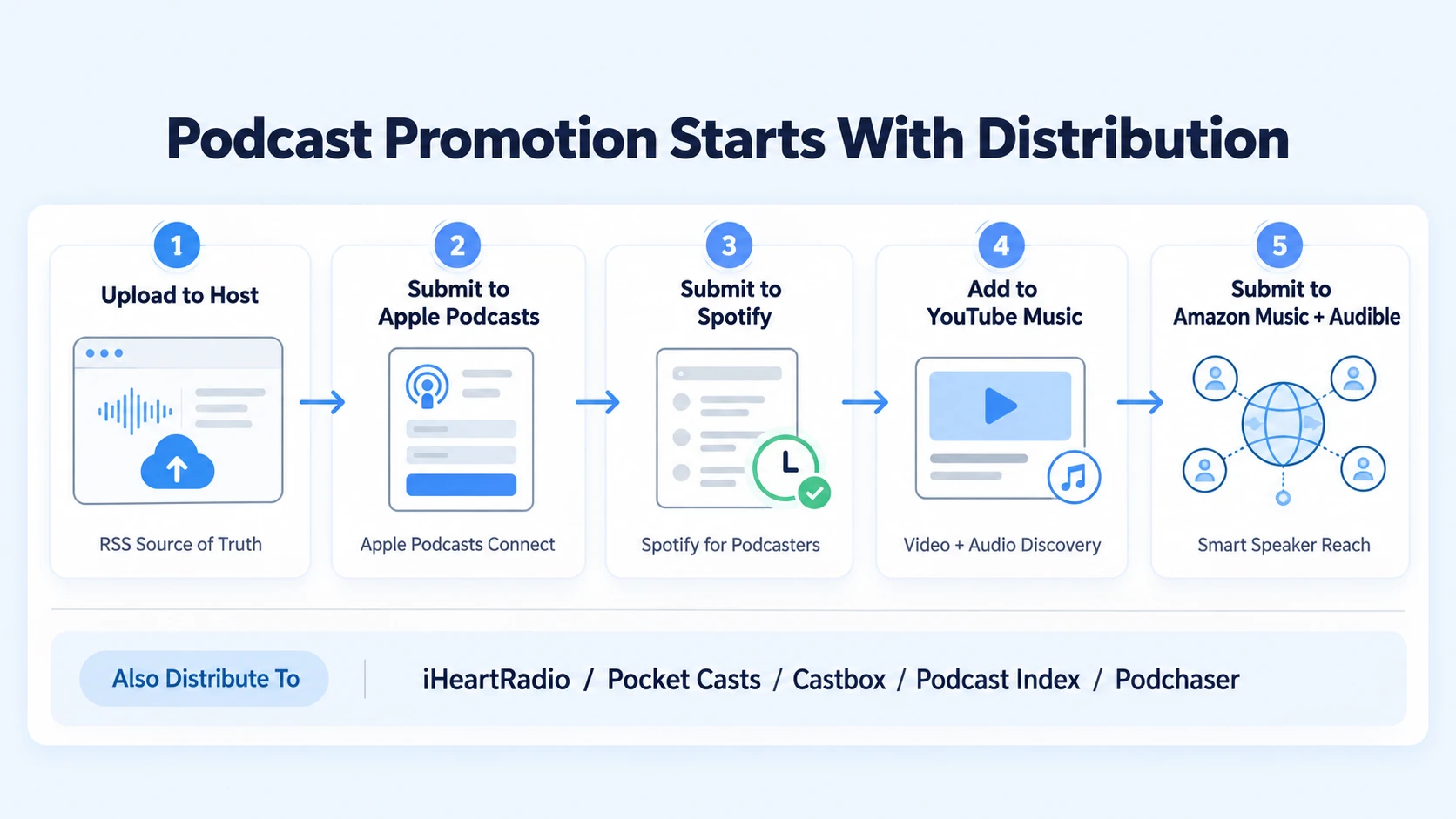
Here's the core submission sequence every new show needs to complete:
- Upload to a podcast host: Use a platform like Buzzsprout or a similar RSS-generating host. Your RSS feed is the single source of truth that every directory pulls from.
- Submit to Apple Podcasts via Apple Podcasts Connect: Your feed must be live before you can submit a feature request , but even standard listing requires going through Apple Podcasts Connect with your RSS URL.
- Submit to Spotify for Podcasters: Spotify has 760M+ users and accepts RSS submissions via Spotify for Creators.
- Add to YouTube Music: YouTube isn't a traditional podcast directory, but it's quickly becoming one of the go-to places for discovering podcasts, and now that Google Podcasts is deprecated, listing your show on YouTube is essentially a must.
- Submit to Amazon Music and Audible: Amazon Music for Podcasters provides comprehensive analytics and listener engagement insights. For podcasters looking to reach Alexa-enabled device users, submitting your RSS feed to Amazon Music and Audible is a strategic move.
Beyond the top four, secondary directories compound your reach. At minimum, list on Apple Podcasts, Spotify, YouTube Music, and Amazon Music/Audible, which together reach the large majority of listeners, then submit to iHeartRadio, Pocket Casts, Castbox, and Podcast Index. Also submit to Podchaser, which is best for building social proof through ratings and reviews.
The rule: every directory you skip is an audience segment you never reach. Distribution is free. There's no reason to be partial. Apple Podcasts drives 37% of all downloads, approximately 33 million listens. Submit there first because it can take the longest to be approved.
Podcast SEO and Show Notes Optimisation: How to Get Found on Google
Most podcasters ignore text-based discoverability entirely. That's a structural mistake. Search engines can't directly index audio content, but they can index text-based content from your website. Podcast SEO works across two surfaces: your podcast host metadata and your episode website pages. Here's how to nail both.
Metadata (on-platform):
- Place your primary keyword in the podcast title, episode titles, and episode descriptions.
- Use keywords naturally in episode titles, show notes, podcast description, and social media captions.
- Write episode titles that answer real questions, not just "Episode 47 with Guest Name."
Show notes optimisation: Comprehensive show notes are your secret weapon for conquering text-based search engines. Think of your show notes not as a simple summary, but as a standalone blog post for each episode. The ideal structure for SEO-optimised show notes includes:
- A keyword-rich episode summary (primary keyword in the first two paragraphs)
- Key takeaways as bullets
- Timestamps to improve listener navigation
- Internal and external links plus a strong call to action.
Episode transcription: Podcasts with comprehensive transcripts see an average of 15% more organic traffic compared to those without, primarily due to improved search engine indexing of spoken content. Every episode should have a full transcript published as searchable text on the episode page.
Schema markup: Schema markup is structured data that helps Google understand your content. Adding podcast schema makes your episodes eligible to appear in rich results like audio snippets and voice search playback results.
Best Ways to Grow a Podcast Audience Fast: Social Media and Short-Form Video
Around 58% of Americans aged 12 and older consumed a podcast in the past month, up from 55% in 2025, representing an estimated 167 million monthly U.S. podcast consumers. That audience is on social media every day. The fastest-growing shows meet them there with clipped, repurposed content.
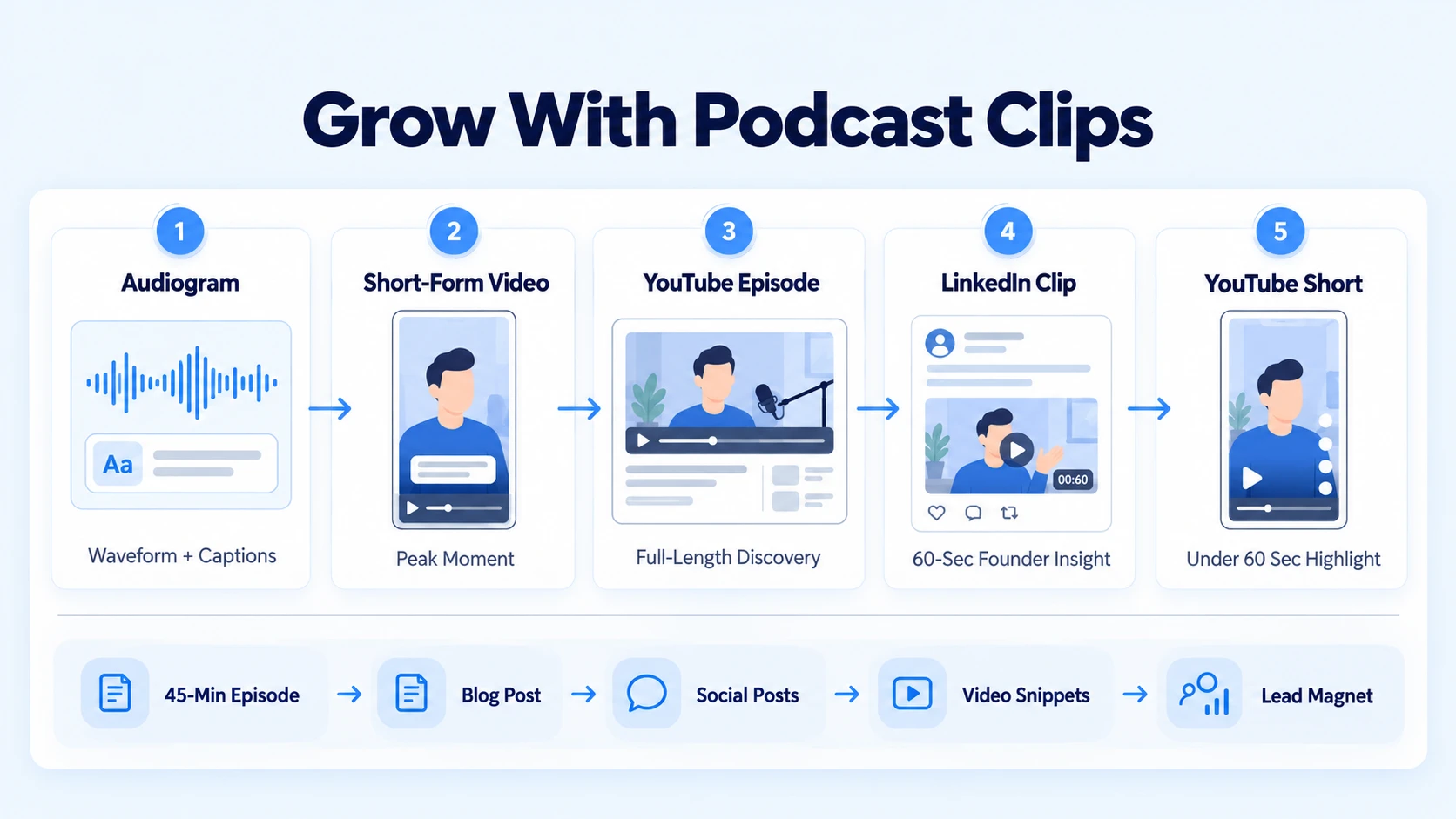
Here's how to use social media to promote a podcast effectively:
Audiogram creation: An audiogram is a short clip combining audio waveform, captions, and a still or motion background. It's the lowest-friction way to surface a compelling moment from a full episode. To make your social media stand out, leverage carousels, reels, audiograms, and other engaging forms of content beyond static images.
Short-form video repurposing: After publishing your podcast, repurpose it into a blog post, a LinkedIn article, an email newsletter, or short clips for YouTube or TikTok with captions. A 45-minute podcast can become one blog post, three social media posts, five video snippets, and one lead magnet.
For B2B SaaS and tech teams, LinkedIn is the primary platform. Clip the founder insight, the sharp counterintuitive take, the product analogy that landed. That's your LinkedIn short-form video. At Komet Media, we build this repurposing system into every podcast production engagement so nothing from a recorded session goes unused.
YouTube podcasting: YouTube has emerged as a leading podcast platform, outperforming Spotify and Apple Podcasts in the United States, with over 1 billion monthly podcast listeners. Publishing full-length video episodes and short clips on YouTube builds a parallel discovery channel indexed by Google search.
Platform-specific tactics:
- LinkedIn: 60-second insight clips with native captions
- Instagram Reels: audiograms and quote graphics with bold typography
- X (Twitter): episode threads that expand on the core argument
- YouTube Shorts: tight clips under 60 seconds from the episode's peak moment
Podcast Marketing Tips That Actually Work: Email, Guests, and Cross-Promotion
Audience growth strategy that compounds fastest combines three channels: your email list, guest-driven reach, and cross-promotion with aligned shows.
Email newsletter integration: Your existing email list is the most direct path to consistent downloads. Every episode should trigger an email with a summary, the three key takeaways, a direct listen link, and a single call to action. Embed the audiogram directly in the email. Keep it under 200 words. Treat it as a weekly touchpoint, not a broadcast.
Guest collaboration: Guests bring their own audiences. A well-chosen guest in your category can add hundreds of net-new listeners in a single episode. More importantly, when a guest shares their episode with their email list or LinkedIn following, it's an implicit endorsement. Structure guest invitations around people your target buyer already follows.
Cross-promotion: As the podcast space gets more crowded, smart producers are leaning on cross-promotion and podcast swaps to reach new ears. Swaps, where shows trade promo spots, guest appearances, or even full-episode exchanges, are becoming one of the most effective tactics.
Branded podcast impact: Branded podcasts drive 89% higher awareness, 57% higher brand consideration, and 14% higher purchase intent. These aren't vanity metrics for B2B teams. They translate directly to warmer sales conversations, shorter sales cycles, and buyers who arrive already educated on your positioning.
For podcast marketing to compound, consistency matters. Platforms and algorithms reward shows that publish on a regular cadence.
How to Promote a Podcast with No Budget: Free Tools and Zero-Cost Strategies
Zero budget doesn't mean zero traction. These are the highest-leverage free moves available in 2026.
Zero-budget tactics:
- Reply to comments: Every comment on a social post is an engagement signal. Reply to all of them in the first hour of posting.
- Repurpose episode transcripts: Always include transcripts or detailed show notes so search engines can "read" your episodes. A transcript becomes a blog post, a LinkedIn article, and an email with no additional production cost.
- Podchaser profile optimisation: Claim your show, add a complete description, and actively solicit listener reviews. Ask listeners to rate and review your show to improve visibility in podcast apps.
- Content syndication via RSS: Submitting to Podcast Index means your show automatically surfaces in dozens of third-party Podcasting 2.0 apps with zero ongoing effort.
- LinkedIn personal posting: Founders and executives posting clips and episode takeaways from personal profiles consistently outperform brand page posts in reach and engagement.
How to Get Your Podcast Featured on Apple Podcasts or Spotify
An editorial feature from Apple Podcasts or Spotify can spike downloads significantly. Both platforms have formal mechanisms, and most podcasters never use them.
Apple Podcasts: Apple's global team of editors reviews the ever-growing catalog regularly and hand-curates content to help your episodes, shows, and channels get in front of the right listeners at the right times. Here's how to submit:
- Use the official Podcast Promotion Request form: The best way to pitch Apple's editorial team is via their Podcast Promotion Request form.
- Submit at least two weeks in advance: Requests must be submitted two weeks in advance of the desired featured date.
- Pitch timely, topical content: Focus on timely content. The Apple team is looking for episodes and shows that talk about specific trends people are discussing in any given week.
- Prepare Showcase Hero artwork: Apple's feature request form states that submissions without Showcase Hero art will not be considered for Showcase featuring in the US.
- Pitch what makes your show genuinely different: Apple looks for fresh perspectives, unforgettable stories, stimulating conversations, and insights on niche or topical issues.
- Resubmit if not selected: Apple recommends submitting a new pitch no more than once every six to eight weeks.
Spotify: Spotify's editorial team curates playlists and featured placements using in-house metrics and trend data. The highest-leverage move is ensuring your Spotify for Podcasters profile is fully complete, your episode descriptions are keyword-rich, and your show has consistent listener engagement signals (saves, follows, shares). For both platforms, listener engagement metrics are the strongest editorial signal. Before pitching, make sure your existing audience is converting: subscribing, leaving reviews, and sharing episodes.
Conclusion
Knowing how to promote a podcast isn't complicated, but it is systematic. Execution across all these levers simultaneously is what creates compounding reach.
Core takeaways:
- Submit your RSS feed to every major directory before any other promotion starts.
- Podcast SEO through optimised show notes, episode transcription, and schema markup is your long-game organic engine.
- Short-form video repurposing from every episode is how you promote a podcast on social without creating it from scratch every week.
- Guest collaboration, cross-promotion, and email newsletter integration drive the fastest audience growth spikes.
- Use Apple's Podcast Promotion Request form with Showcase Hero art and a timely pitch angle to chase editorial features.
If you want this entire system built and run for your B2B team, Komet Media handles podcast editing, repurposing, and growth from strategy through execution. Komet Media also builds video advertising and content programs entirely from scratch—handling buyer research, ad concept scripting, remote recording guidance, editing, and platform formatting.
Frequently Asked Questions
Q1: How long does it take to grow a podcast audience?
Growth timelines vary by niche and promotion investment. The median podcast show grew from 428 downloads per episode to 516 downloads per episode over the course of a year, a growth rate of 21%. Consistent publishing plus active promotion compounds faster than publishing alone.
Q2: What is the best platform to promote a podcast in 2026?
There's no single answer. The most-used platform for weekly U.S. podcast listeners is YouTube at 33%, making it the strongest single channel for discoverability. Combine it with LinkedIn for B2B audiences specifically.
Q3: Do podcast transcripts actually help with SEO?
Yes, materially. Embedding full, searchable transcripts directly on podcast episode pages can increase average session duration by 20% to 30%, signalling higher engagement to search engines. Google indexes the text, not the audio.
Q4: How often should I submit new episodes to stay visible on directories?
Consistency beats volume. Spotify, Apple, and other directories reward shows that publish on a regular cadence. Weekly or bi-weekly is the standard for algorithmic favour. Irregular schedules suppress discoverability scores regardless of quality.
Q5: Is guest collaboration worth it for a small podcast?
Absolutely. Every guest brings a warm audience segment that has never heard your show. Even a guest with a modest following of 2,000 engaged LinkedIn connections can meaningfully move your download numbers and subscriber count in a single episode.
Q6: Can I promote my podcast entirely for free?
Yes, especially in the early stages. Free tools including Spotify for Podcasters, Apple Podcasts Connect, Podchaser, Canva, and Descript cover distribution, analytics, social graphics, and transcription. The biggest free lever is consistent content repurposing combined with personal social posting from the founder or host.

