
How to Find a Podcast Name: Step-by-Step Guide
Most teams that struggle with a podcast name do not have a shortage of ideas. They have a shortage of structure. Learning how to find a podcast name means using prompts and patterns that turn a vague topic into fifty candidates, then filtering them against real constraints. This guide covers ten idea-generation methods, a prompt bank for B2B shows, and the filters that remove weak names before anyone gets attached to them.
Quick answer
Define your audience and topic, run several naming methods to build a long list, then filter by clarity, spelling, and availability. Do not fall in love with an idea until it passes search and trademark checks.
Find the name from the audience, not from the studio
The most common naming mistake I see is starting in the wrong place. Teams sit down with the host, the studio, or the brand guide and ask what sounds good. Buyers do not experience the show that way. They see a name in an app list, a LinkedIn clip, or a YouTube thumbnail and decide in a few seconds whether the show is for them.
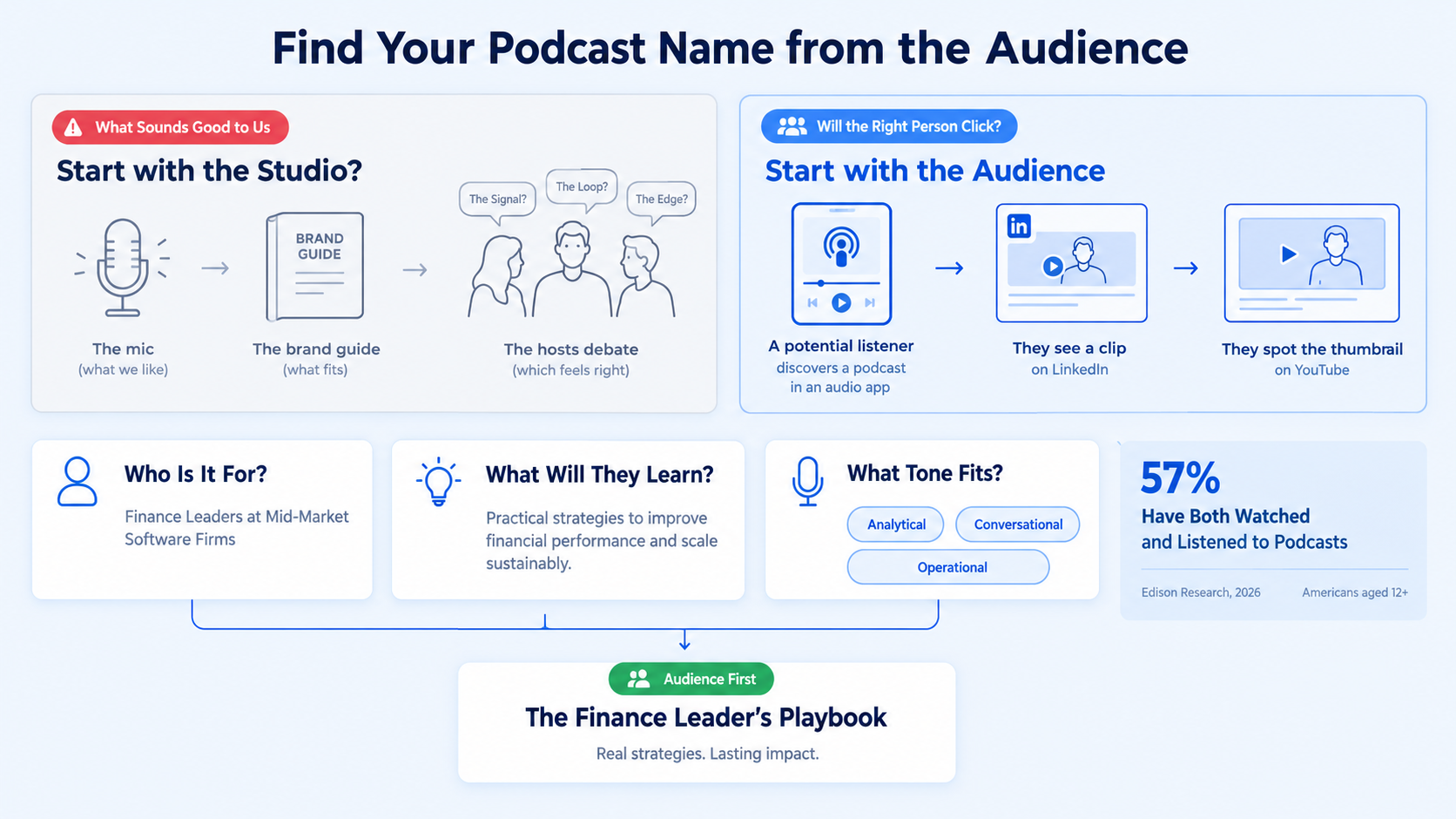
The context is also bigger than audio. Edison Research's 2026 Infinite Dial, as reported by Tubefilter, found that 57% of respondents had both listened to and watched a podcast, which is the first time more than half did both. The survey covers Americans aged 12 and older. A name has to work in a thumbnail as well as in an audio app.
Before you start any method below, write these three lines:
- Who is the show for? A role and a situation, such as "heads of finance at mid-market software companies."
- What will they learn or decide? One sentence, specific enough to disagree with.
- What tone fits? Analytical, conversational, or operational. Tone helps you reject names that sound wrong.
Ten methods for how to find a podcast name
Use at least four methods on every project, because how to find a podcast name depends on the kind of show you are building. Different methods surface different kinds of names, and the strongest candidate often comes from the method you expected to try last.
Spotify for Creators' list of podcast name approaches covers several of these, including naming the audience, using insider language, defining a niche, and choosing a broader genre so the name still fits years later. It also suggests dropping the word "podcast" from the title, since listeners can already tell what the show is.
Method details
Here is how I run the methods in a working session:
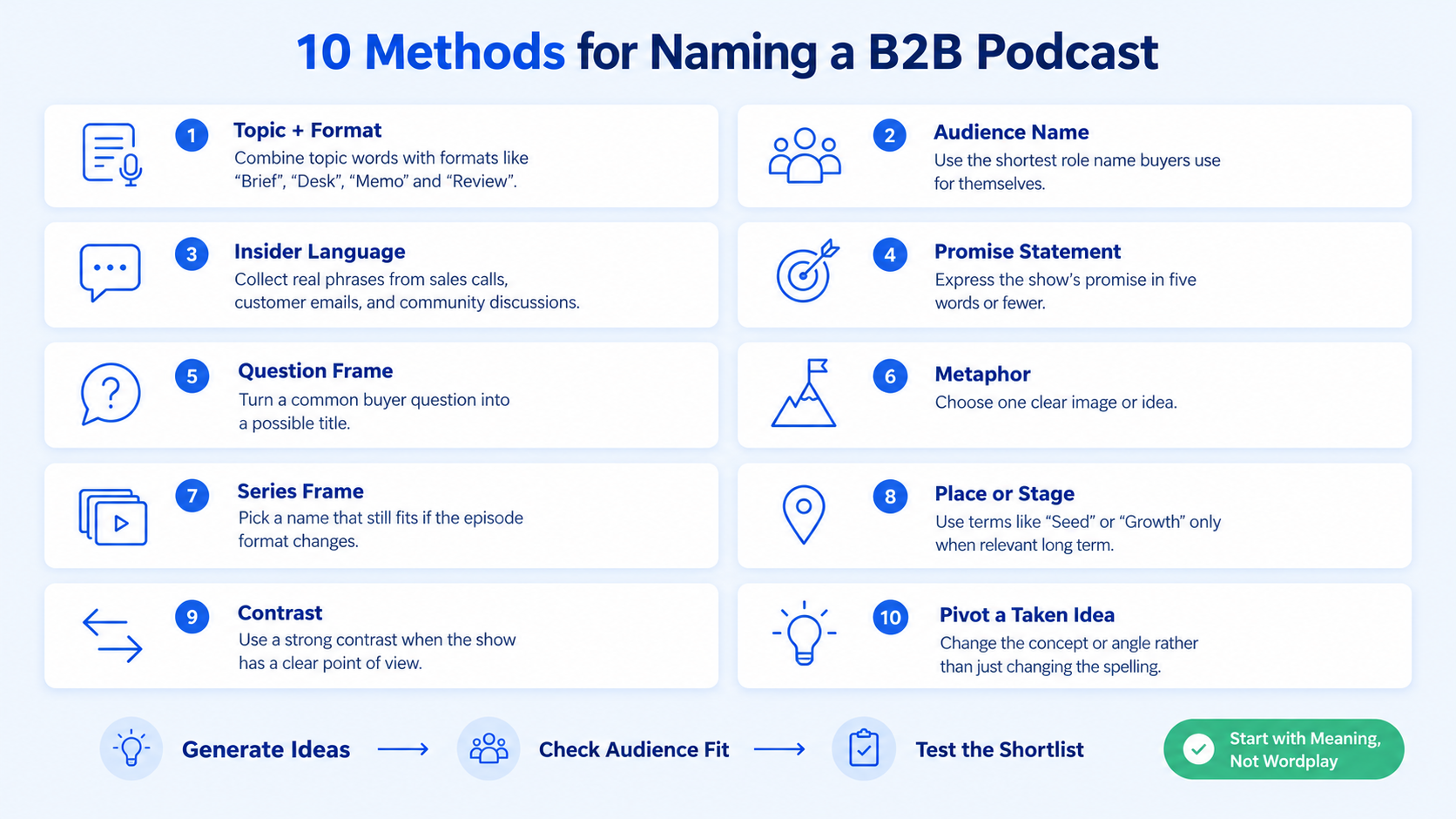
- Topic plus format. List 10 topic words and 10 format words. Combine them and keep the combinations that read like a real show. Format words I use often include notes, brief, desk, memo, and review.
- Audience name. Write the role in plain language, then cut it to the shortest form buyers use for themselves.
- Insider language. Pull phrases from sales calls, community threads, and customer emails. Words buyers use unprompted are better than words a marketing team invents.
- Promise statement. Rewrite your one-sentence promise in five words or fewer.
- Question frame. List the five questions your buyers ask most often. A short question can become a name, but it ages badly if the answer changes.
- Metaphor. Pick one image, not three. A name that mixes images sounds confused.
- Series frame. Ask whether the name still works if the format changes from interviews to solo episodes.
- Place or stage. Use a stage such as seed or growth only if the show will stay in that lane.
- Contrast. Contrast names work when you hold a strong view. They fail when the show is neutral.
- Pivot a taken idea. If the best name is taken, change the angle, not just the spelling.
A prompt bank you can use today
Use these prompts in a brainstorm with your marketing lead, a partner, and one person who represents the buyer.
- What is the one phrase our buyers use when they describe this problem?
- What do we want buyers to say about the show after the third episode?
- What would a skeptical buyer call this show if they were being critical?
- Which words would a competitor never use?
- What name would still make sense if the host left?
- What name would still make sense if the format changed?
- What would this name look like in a LinkedIn caption?
- What would we call the show if we were not allowed to use the company name?
I usually ask for at least six answers to each prompt before moving on. The first answers tend to be obvious. The fourth or fifth answer often contains the useful angle.
How to find a podcast name for different B2B audiences
Different audiences need different naming logic. The examples are illustrative only. I have not checked their availability.
A few additional notes:
- Funds should think about whether the name can hold outside guests. A name tied tightly to the firm limits that.
- SaaS and AI teams should avoid names that require the product to make sense.
- Executives should consider whether the show will outlast their current role.
A 60-minute naming session you can run this week
Many teams ask how to find a podcast name without booking three meetings. This agenda works in one hour with three to five people.
Two rules make the session work:
- Writing ideas individually before sharing prevents the loudest voice from setting the direction.
- Voting privately before discussion keeps seniority from deciding the result.
I have seen this format work well for funds and executive teams because it respects limited calendar time. A hypothetical example: a partner group wants a show about seed-stage founder mistakes. The group runs the audience-name, stage, and contrast methods, then cuts any name that needs the fund's name to make sense. That is a practical answer to how to find a podcast name when the people in the room have strong and different tastes.
Filters that remove weak names fast
After the list exists, apply these filters in order. They are quick, and they remove most weak candidates before anyone argues for them.
- Spelling filter. Say the name once. Can someone type it correctly?
- Length filter. Spotify for Creators says names on its platform average three to four words and 15 to 20 characters. Use that as a guide for what is easy to display and remember.
- Character filter. Remove ampersands, symbols, and creative misspellings.
- Meaning filter. Would a stranger guess the topic?
- Stuffing filter. Apple's podcast guidance warns that keyword-stuffed titles can get a show removed from its directory, and that episode or season numbers do not belong in the show title.
- Longevity filter. Would the name still fit in five years?
Availability checks before you commit
A name is not a candidate until it is available. Run these checks in order, and stop at the first conflict.
- Search the name in Apple Podcasts, Spotify, and YouTube.
- Search the name in a general web search, and read the first page of results.
- Check the matching domain and social handles.
- Search the USPTO trademark database for close marks in related categories.
- Record the date and result of each check in a shared document.
The trademark step is not legal advice. If the name will become central to a firm or product brand, ask an attorney to review it.
Mistakes that show up again and again
- Stopping at the first good idea. Spotify's own naming guidance recommends against settling on the first idea, even if it seems strong.
- Using the company name as the whole idea. A company name tells buyers nothing about the show until they trust the company.
- Making the name too narrow. A name tied to one guest type or one funding stage can trap the show.
- Ignoring how the name looks on cover art. The title becomes the logo, so mock it up early.
- Testing only with the team. Insiders know the story behind the name. Buyers do not.
What to do once you have a name
Naming is one early decision in a launch. The next ones are cover art, feed setup, editing standards, and distribution.
- Mock up cover art and test it at thumbnail size.
- Draft the show description using the audience promise.
- Plan the first three episodes and the clips they will produce.
- Decide who edits, who publishes, and who distributes.
Komet Media supports this stage with podcast production, podcast editing, and podcast marketing. When the show is live, the guide to repurposing a podcast explains how to turn each episode into clips and posts. If you want a second view on the shortlist, you can start with the companion piece on how to choose a podcast name, which covers scoring and buyer testing in more depth.
Conclusion
Names come from process, not inspiration. If you want to know how to find a podcast name that holds up, use several methods, filter hard, and check availability before you celebrate. The best name is the one your buyer can find, say, and remember after hearing it once.
FAQ
1. What is the easiest way to find a podcast name for a business show?
The simplest approach to how to find a podcast name is to write a one-sentence audience promise, then combine your topic with a simple format word such as notes, brief, or desk. Generate dozens of options before you judge any of them.
2. How long should the name be?
Aim for two to four words. Spotify for Creators reports that names on its platform average three to four words. Shorter names are easier to say, spell, and fit into cover art.
3. How much does it cost to find a podcast name?
The idea work costs time rather than money. Trademark review may add a legal fee. When teams work with Komet Media on a launch, our typical retainers run from roughly $2,500 to $5,000, depending on scope, volume, and turnaround, and naming is part of that planning work whether you have existing content or are starting from scratch.
4. How long does it take to find a good name?
Plan for about a week: two sessions to generate and filter, then a few days for availability checks and buyer feedback. Trademark questions can extend that.
5. Should I use a name generator?
Generators can start a list, but they produce generic results. I use them for volume, then apply the filters above. A name still needs an audience promise behind it.
6. Should the show name include my company name?
Only if buyers already know the company. If they do not, a topic-led name does more work. You can still brand the show with the company in artwork and descriptions.
7. Is this something an agency should handle or an internal team?
Your internal team knows the buyer and the promise best, so it should own those. An agency adds the most value in testing names across clips, thumbnails, and cover art, and in building the production system after launch.
8. Does Komet Media help B2B teams name and launch podcasts from scratch?
Yes. We work with B2B SaaS, AI-Native, venture, and private equity teams on podcast production and distribution, whether you have existing footage/audio or are starting from scratch. If you want to talk through a launch, you can book a call.

