
How to Choose a Podcast Name: Step-by-Step Guide
Most business podcasts are named in one rushed meeting, and the name then follows the show for years. Knowing how to choose a podcast name is mostly a filtering exercise: you generate a long list, remove everything a listener cannot spell, search, or trust, and test what survives. This guide gives you a repeatable process, the platform rules that matter, and a scorecard you can use with your partners or marketing team.
Quick answer
Pick a short, specific, easy-to-spell name that tells the right buyer what the show covers. Check it against podcast apps, trademarks, domains, and social handles, then test it aloud before you lock artwork.
Why the name matters more for a B2B show
A consumer show can lean on personality. A B2B show usually starts with strangers who have no reason to trust it yet, so the name does early work. It has to say who the show is for and what it covers in the few words a listener sees in an app.
Three facts shape the decision:
- Podcasting is mainstream. Edison Research's 2026 Infinite Dial, as reported by Tubefilter, found that 80% of Americans surveyed have either listened to or watched a podcast. The survey covers Americans aged 12 and older.
- Discovery happens in video as well as audio. YouTube says its podcast content reaches one billion monthly active users, so your name will appear in thumbnails and search results, not only in audio apps.
- Apps reward clarity. Apple's podcast guidance warns that vague titles attract few subscribers and that keyword-stuffed titles can get a show removed from the directory.
In my experience, the name problem is rarely creativity. It is that nobody wrote down who the show is for before the brainstorm started.
Rules from the platforms you will publish on
Before you fall in love with a name, check it against the places where it will appear.
How to choose a podcast name in 8 steps
This is the process I use when a team asks me how to choose a podcast name without turning it into a six-week debate. Most teams can finish it in two working sessions.
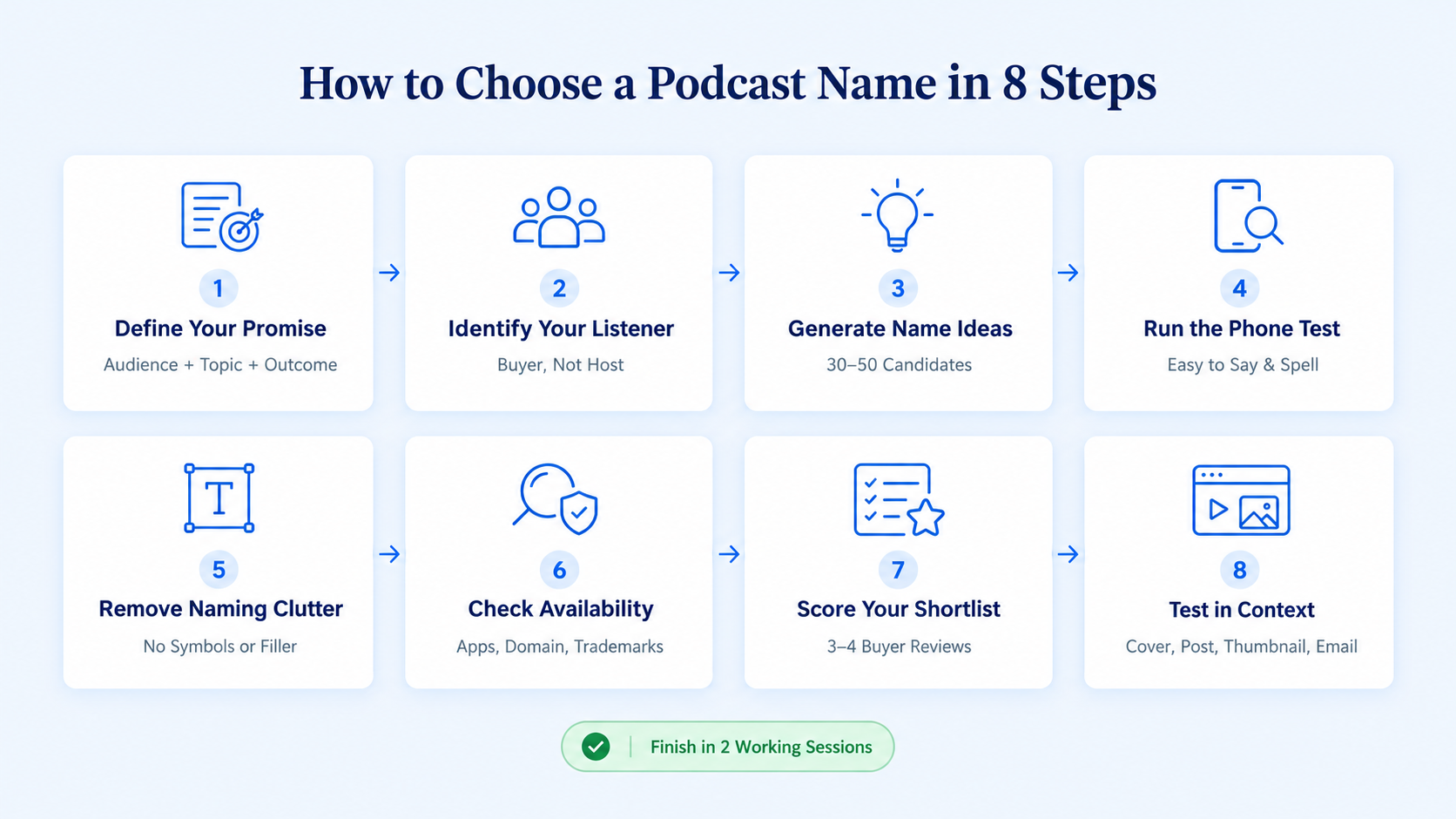
- Write the one-sentence promise. Complete this sentence: "This show helps [specific buyer] understand [specific topic] so they can [decision or outcome]." If you cannot finish it, the name will drift.
- Name the listener, not the host. A name built around the host works only if the host is already known to your buyers. For most funded startups and funds, it is safer to build around the topic or the audience.
- Generate 30 to 50 candidates. Do not edit while you generate. Use patterns such as topic plus format, audience plus topic, or a clear metaphor. The companion guide on how to find a podcast name covers idea generation in more detail.
- Cut anything that fails the phone test. Say the name to someone once. If they cannot spell it or search for it, remove it.
- Remove filler and risky characters. Drop "the" where it adds nothing. Avoid ampersands, symbols, and clever misspellings, which break search and voice commands.
- Check availability and conflicts. Search podcast apps and YouTube, then the domain and social handles. Run a USPTO trademark search for close matches.
- Score the shortlist. Use the scorecard below with three or four people who represent your buyers, not only your team.
- Test it in context. Mock up the cover art, a LinkedIn post, a YouTube thumbnail, and an email subject line. If the name looks weak in any of the four, go back to step 6 with your next candidate.
A scorecard for your shortlist
Score each criterion from 1 to 5. Treat anything under 3 on spelling or availability as a rejection, even if the total looks good.
How to run the shortlist test with real buyers
Internal opinion is a weak test when you are deciding how to choose a podcast name. People who built the show already know what the name means. A better test uses three to five people who match your buyer and have not heard the pitch.
Run it in this order:
- Show each person the name as text only, then ask: "What do you think this show is about?"
- Say the name aloud once, then ask them to type it into a search bar.
- Show the name inside draft cover art and a LinkedIn post preview.
- Ask: "Would you click this in a list of ten podcasts?"
- Record the answers in a simple table and compare the shortlist.
If two names score close together, choose the one that is easier to say. Spoken clarity carries more weight than visual polish, because most discovery happens through recommendations that are said aloud or typed from memory.
A worked example (hypothetical)
This example is hypothetical and does not describe a Komet Media client. Imagine a growth-stage SaaS company that sells compliance software to mid-market finance teams. Its marketing lead wants a show for finance leaders and has three candidate names.
- Candidate A is built around the company name. It scores well on brand fit and poorly on clarity, because tech startup finance leaders do not know the company yet.
- Candidate B is a clever metaphor about balance sheets. It scores well on memorability and poorly on spelling, because half the testers type a different word.
- Candidate C is a plain topic-and-format name about finance operations. It scores lower on creativity and highest on clarity, spelling, and searchability.
In this kind of case, I would pick Candidate C and let the episodes and clips build personality. A plain name that buyers can find beats a clever name that nobody can search. That is the practical answer to how to choose a podcast name when creativity and clarity pull in different directions.
How to choose a podcast name when several people share the show
Co-hosted shows, firm-wide shows, and shows run by a marketing team and an executive together create a specific problem: everyone has a favorite. Here is how I handle it.
- Agree on the scorecard criteria before anyone proposes names.
- Let one person own the final decision after scoring, so the process does not loop.
- Limit the shortlist to three names before the buyer test.
- Record why each name was cut. That record prevents the same name from returning in month four.
A realistic timeline
Here is how to choose a podcast name inside one week. The timeline assumes one decision-maker and no trademark complications. Add time if the show will carry a firm or product brand.
Teams that follow this schedule tend to spend their energy on the first episodes, not on reopening the naming debate. The same logic applies whether you are using this tutorial or the companion guide on how to find a podcast name for earlier-stage idea generation.
Naming patterns that work for business audiences
Different audiences need different naming logic. The examples below are illustrative only. I have not checked whether any of them is available.
A few notes on the table:
- A fund name in the title can help recognition, but it narrows the show if you later want outside guests.
- A product name in the title makes the show read as a promotional channel. I prefer topic-led names for SaaS and AI shows unless the product is already a category name.
- Founder-led shows can use the founder's name if buyers already know it. If they do not, the name does little work.
Mistakes I see repeatedly
- Naming before positioning. Teams brainstorm clever names before they agree on the audience.
- Putting "podcast" in the name by default. Spotify for Creators suggests the word is usually unnecessary unless it helps an established brand stand out.
- Choosing a name that needs explaining. If the host must explain the name in every outreach email, the name is working against the show.
- Ignoring the clip context. Short clips on LinkedIn and Instagram carry the show name in captions and lower thirds. Long names get cropped or ignored.
- Skipping the handle check. A great name with an unusable handle costs more later than a good name with a clean handle.
- Treating the name as final before artwork exists. Look at the name inside the artwork frame before you commit.
What to do after you choose a name
A name is only one asset in a launch. The sequence I recommend:
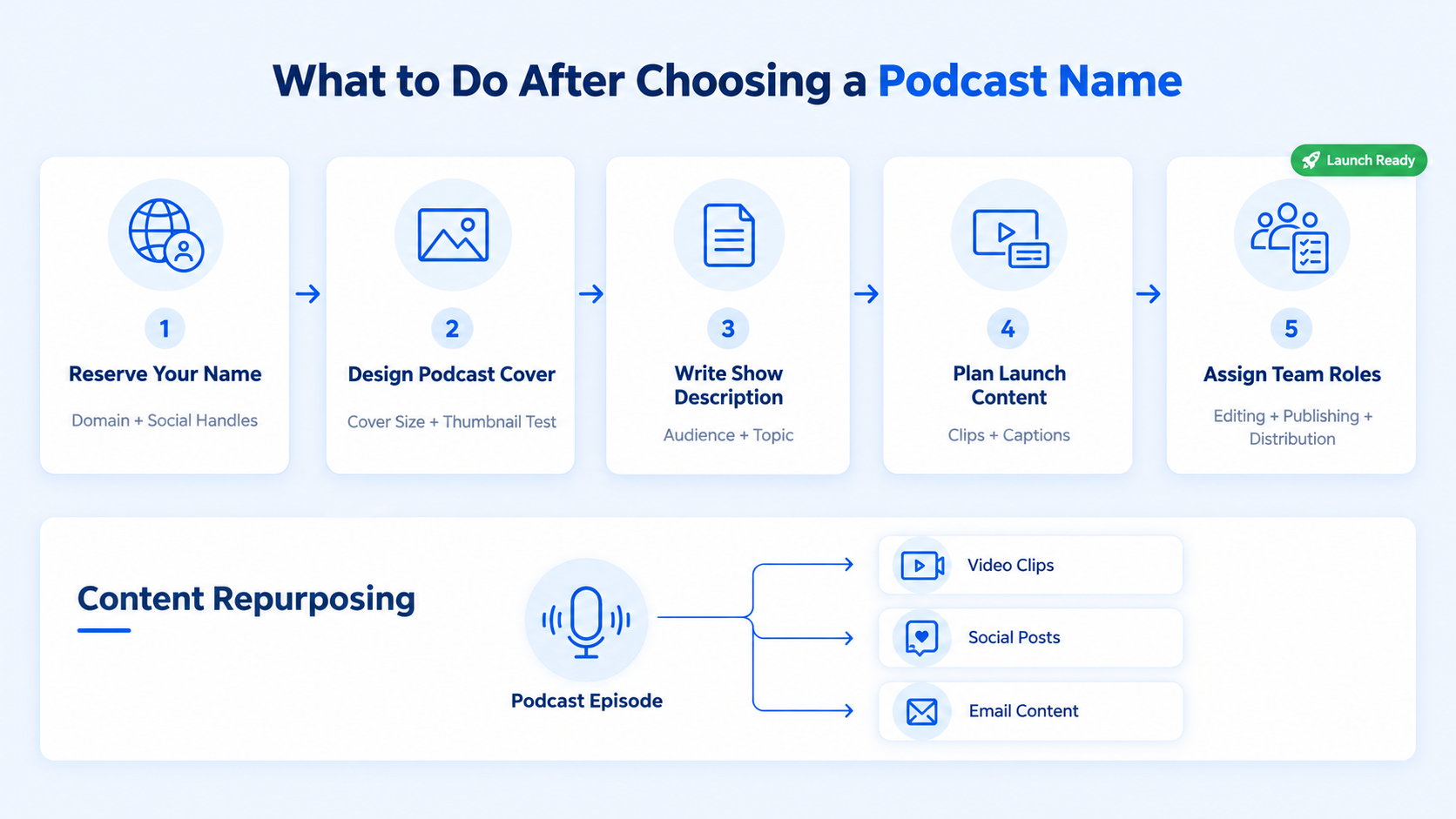
- Reserve the domain and handles on the same day you decide.
- Build the cover art to Apple's size rules and test it at thumbnail size.
- Write a plain description that says who the show is for and what it covers.
- Plan the first clips and captions before recording the first episode.
- Decide who owns editing, publishing, and distribution after launch.
For teams that want help with step 5 or starting from scratch, Komet Media handles podcast production, podcast editing, and podcast marketing. When a firm already has recordings, our B2B podcast repurposing work turns each episode into clips, posts, and email assets. If you are starting from zero, the guide on starting a business podcast covers the wider launch plan.
Conclusion
A good name does not need to be clever. It needs to be clear to the right buyer, easy to say aloud, and safe to build on for several years. If you remember one thing about how to choose a podcast name, make it this: write the audience promise first, then let the name serve it.
FAQ
1. What is the best way to choose a podcast name?
Start with a one-sentence audience promise, generate a long list, then cut names that fail spelling, search, and availability checks. Score the shortlist with people who match your buyer, then test it on cover art and social posts.
2. How long should a podcast name be?
Short names tend to work best. Spotify for Creators reports that names on its platform average three to four words, or 15 to 20 characters. That range is a guide, not a rule, but long names get cropped in apps and clips.
3. How much does it cost to choose a podcast name properly?
The name itself costs little. The real costs are time, a trademark search, and possibly attorney review. At Komet Media, our podcast work typically runs as a retainer of roughly $2,500 to $5,000, depending on scope, volume, and turnaround. Naming is usually part of a wider launch plan, not a separate fee.
4. How long does the process take?
Most teams can finish in two working sessions over about a week: one to generate and cut candidates, one to score and test the shortlist. Trademark review can add time if the name matters commercially.
5. Can I include keywords in the name?
You can include a topic word, but do not stuff keywords. Apple's guidance says keyword stuffing can lead to removal from its directory, and an overloaded name reads as generic.
6. Should a founder or fund put its own name in the show title?
Only if buyers already recognize it. A recognized name builds trust fast. An unknown name uses up title space without telling the listener what the show covers.
7. Should we hire an agency or decide internally?
Decide the audience, promise, and shortlist internally, because you know the buyer best. An outside partner helps most with testing the name in real formats, clip packaging, and the production system that follows launch.
8. Does Komet Media help with podcast naming and launch?
Yes, whether you are starting from scratch or scaling an existing show, Komet Media provides complete podcast production and distribution services for B2B SaaS, AI, and tech startups & teams. If you want to talk through a launch, you can book a call.

