
Content Atomization: One Asset, Many Formats: Step-by-Step Guide
Most B2B teams produce content once, publish it once, and move on. That is the most expensive mistake in modern content marketing. I'm Rajan Soni, Founder and Video Director at Komet Media, and in this guide I'll walk you through content atomization exactly as we apply it for SaaS founders, marketing heads, and growth teams, turning one strong asset into a full pipeline-driving content system.
TL;DR
- Content atomization means breaking one long-form asset into multiple format-specific pieces for different channels and audience segments.
- The process starts with pillar content (webinar, podcast, demo) and ends with short-form video, carousels, emails, blog posts, and more.
- Done right, it multiplies your content output without multiplying your production effort or budget.
- For B2B SaaS teams, this is the most efficient path to buyer education, founder-led visibility, and inbound pipeline.
What Is Content Atomization and Why Does It Matter for B2B Teams?
Content atomization is a content marketing strategy that involves breaking down a comprehensive piece of long-form content, like a blog post, whitepaper, or research report, into smaller, independently valuable units tailored for different platforms and audience segments.
Think of your best webinar or product demo as a raw material. Content atomization is the process of refining it into a dozen usable formats, short-form video clips, LinkedIn carousels, email sequences, podcast audio, quote graphics, each one designed to reach your buyer at a different touchpoint in the content marketing funnel.
The model is not new. Gary Vaynerchuk's content strategy is predicated on a "reverse pyramid" model that starts with a piece of pillar content, a keynote, vlog, or Q&A, and repurposes that one piece into dozens of smaller pieces contextual to the platforms they are distributed on. His team took one keynote, repurposed it into 30+ pieces of content, and distributed all of it across platforms, resulting in over 35,000,000 total views. That is the content atomization principle at scale.
For B2B SaaS teams specifically, the stakes are higher. 81% of B2B buyers pick a vendor before talking to sales. Your content has to build trust before any conversation starts. 71% of B2B SaaS buyers now say they rely on AI chatbots for software research, which means your atomized content also needs to live across the platforms these tools pull from, LinkedIn, YouTube, your blog, your podcast. The business case is straightforward.
Content repurposing strategies improve ROI by 32% on average. Repurposed content can increase organic traffic by 35% when brands systematically reuse top-performing assets. For a growth team with limited bandwidth, that is the most leverage you can get from content you have already paid to produce.
Content Atomization vs. Content Repurposing: What Is the Difference?
These terms get used interchangeably, but they are not the same thing, and the distinction matters operationally.
Content repurposing is taking one piece of content and adapting it to a different format. A blog post becomes an email. A webinar becomes a YouTube video. The goal is reuse with minimal transformation.
Content atomization is more systematic. It means extracting individual ideas, moments, and data points from a pillar asset and building each extract into a standalone, platform-native piece. Every atom is complete on its own. None of them just "point back" to the original, they each do independent work in your content distribution strategy.
For a B2B SaaS team, repurposing might mean uploading your webinar recording to YouTube. Atomization means that the same webinar becomes: five LinkedIn short-form video clips, a blog post, a podcast episode, three quote graphics, an email sequence, and a carousel, all built to work in the feed natively, not just as links back to a replay page.
The winning strategy is to create pillar content for SEO, then repurpose it into short videos and interactive elements for social distribution. That framing captures both disciplines working together, which is exactly how we build content systems at Komet Media's short-form video service.
Content Atomization Step by Step: The Full Workflow
This is the exact sequence I run for SaaS clients. It is repeatable, scalable, and produces consistent output without burning your team.
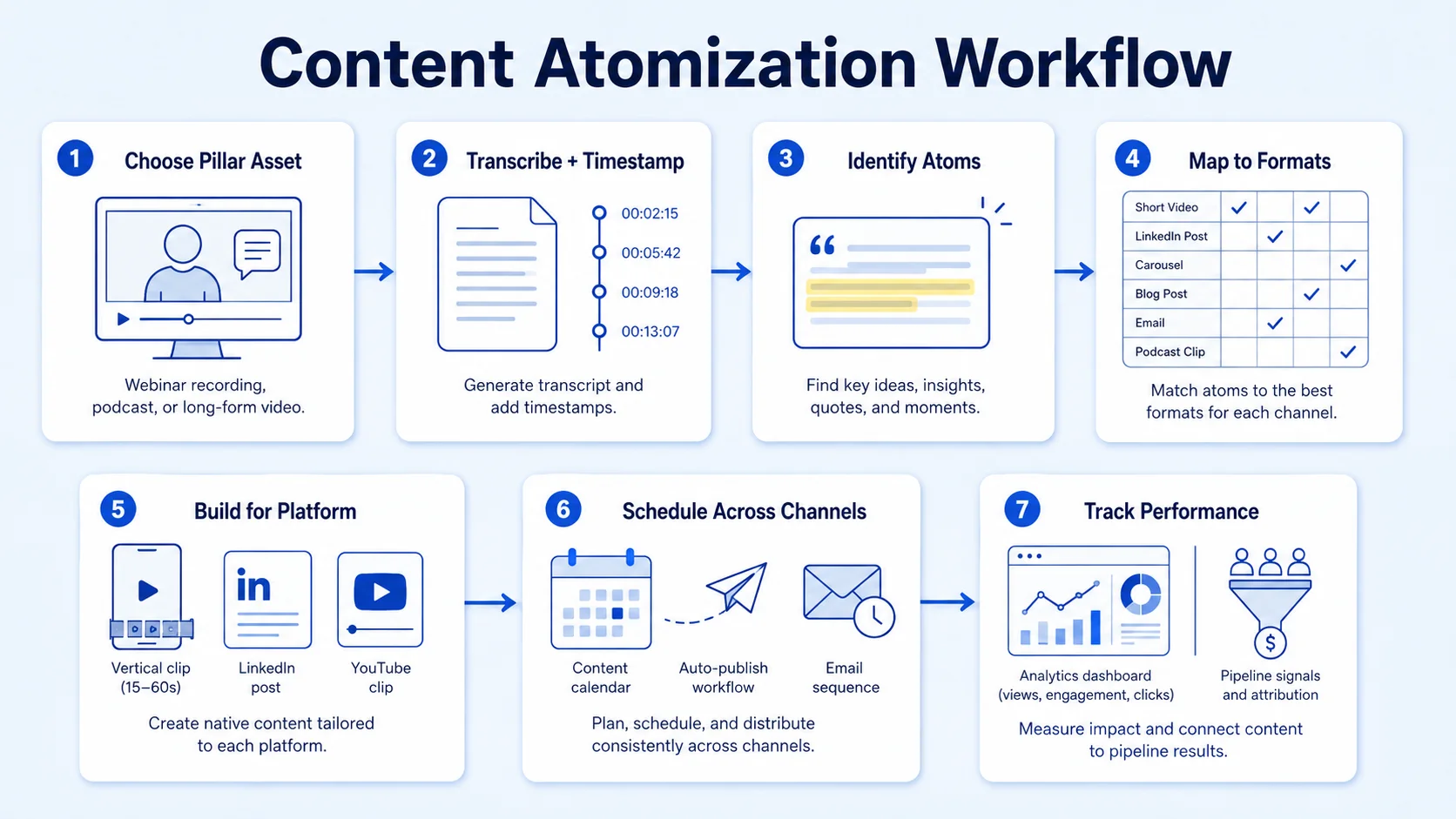
- Choose your pillar asset: Select a high-value long-form piece, a recorded webinar, a founder podcast episode, a demo walkthrough, or a customer case study call. It must contain substantive thinking, not just promotional messaging.
- Transcribe and timestamp: Use a transcription tool to get a full text document. Add timestamps for every major point, topic shift, or quotable moment.
- Identify your atoms: Go through the transcript and highlight 10–15 standalone moments: a compelling stat, a product insight, a counterintuitive take, a process explanation. Each one is a potential piece of micro-content.
- Map atoms to formats: Assign each atom to the format it fits best, a 60-second clip, a LinkedIn text post, a carousel slide, an email subject line, a short-form video hook. Refer to your content calendar and audience segmentation to prioritize.
- Build for the platform, not the asset: Rewrite, re-cut, or redesign each atom for its destination. Cross-platform content performance varies by up to 40% when properly adapted to each channel's specific requirements. A LinkedIn clip needs captions and a vertical frame. A YouTube clip needs a hook in the first three seconds.
- Schedule across channels: Load your content calendar with the atomized pieces spread over 3–6 weeks. One pillar asset should cover an entire distribution cycle.
- Track and feed back: Monitor which atoms perform. The highest-performing pieces become the brief for your next pillar content recording.
Short-form video is the fastest-growing ROI format in social and delivers the highest ROI of any social content type. Front-loading your atoms toward short-form video is where SaaS teams will see the fastest pipeline signal.
How to Turn One Webinar Into 10+ Content Pieces
The webinar is the single richest source asset for B2B SaaS content atomization. Webinars generate up to 73% higher-quality leads for SaaS brands than other channels. But most teams use the recording once and archive it. Here is what a full atomization looks like from a single 60-minute webinar, using Komet Media's webinar repurposing workflow:
- Short-form video clips (3–5 pieces): Pull 45–90 second moments with strong hooks. Captions on, vertical format for LinkedIn and Instagram Reels. Videos under 90 seconds retain 50% of viewers, making this the highest-priority atom.
- Long-form blog post: Use the transcript as a structural outline. Write around the key arguments from the session. Embed 1–2 clips directly in the post.
- Podcast episode: Strip the audio, clean it up, and publish to your podcast feed. Just clean up the audio, add intro/outro music, and share across your podcast platforms.
- LinkedIn carousel (5–8 slides): Take the top 5 insights and build a swipeable carousel with branded Canva slides. The last slide drives to the full recording or a demo.
- Email sequence (3–5 emails): Each email leads with one insight from the webinar and includes the corresponding short clip as the CTA.
- Quote graphic series: Pull 3–4 high-impact lines from the speaker. Pair with branded visuals for LinkedIn and Instagram.
- Highlight reel: Create a 60–90 second reel showcasing the most exciting moments, ideal for grabbing attention quickly and generating curiosity around your full-length webinar.
- Sales enablement one-pager: Distil the webinar's core arguments into a one-page PDF for your sales team to send during active deal cycles.
- FAQ page or blog addendum: Pull the Q&A segment, clean it up, and publish it as a standalone FAQ article that targets long-tail search queries.
- LinkedIn text post series: Write 3–5 standalone opinion posts that each expand on a single point from the webinar. No media required, just clean, direct thinking.
One webinar can become ten or more pieces of content without additional research, subject matter expert time, or recording sessions. This approach lets small teams maintain consistent output across multiple channels while focusing creative energy on fewer, higher-quality source materials.
Content Atomization Examples for B2B SaaS Teams
The best way to make this concrete is to show what it looks like in practice.
Example 1: SaaS Product Demo
A 20-minute product walkthrough recorded by the founder becomes: five 60-second feature-specific clips for LinkedIn, a "how it works" blog post anchored to a target keyword, three quote-style graphics with product claims, an email sequence for trial users, and a YouTube Shorts series. Each piece supports the pipeline at a different stage, awareness, consideration, decision.
Example 2: Founder Podcast Episode
A 45-minute podcast episode on a market insight becomes: a full YouTube video, three LinkedIn clips, a blog post, an audiogram for Twitter/X, five standalone LinkedIn text posts expanding on individual arguments, and a carousel summarising the key framework discussed.
Example 3: Customer Case Study Call
A recorded customer success conversation becomes: a written case study page, a 90-second video testimonial clip, a stat-forward LinkedIn post, and a slide for the sales deck. This is brand storytelling that functions as sales enablement simultaneously.
The clearest enterprise-scale proof: SAP's "Digital Chop Shop" atomized a single whitepaper into 650 derivative pieces across formats tailored for 25+ verticals, generating $23 million in new pipeline. Most SaaS teams will not hit 650 pieces, but the logic holds at any scale, more atoms from the same asset means more buyer touchpoints for the same investment. For teams with existing video editing services infrastructure, atomization is the multiplier on top of the original content investment.
The Benefits of Content Atomization for Content Teams
The case for content atomization is not just strategic, it is operational.
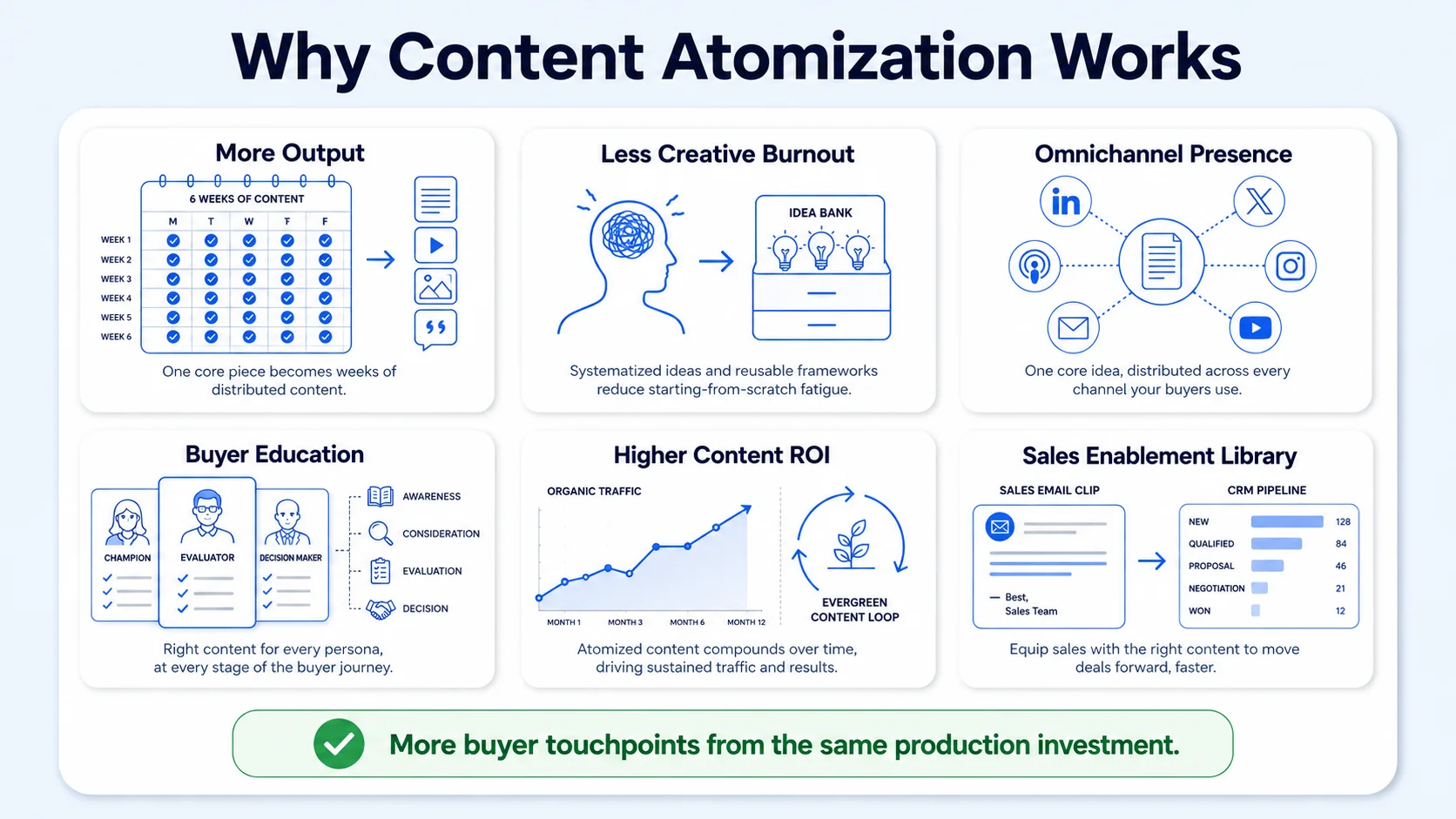
Output at scale without creative burnout: The hardest part of content marketing is not writing or filming, it is generating novel ideas fast enough to sustain a publishing cadence. Atomization solves this. One pillar asset produces enough atoms to fill 3–6 weeks of your content calendar across channels, without a single blank-page moment.
Omnichannel presence from one production event: Repurposing is cited by content marketing teams as the primary mechanism for maintaining consistent posting schedules across five or more social media platforms without triggering content gaps that penalize organic algorithm performance. For a lean SaaS marketing team, this is not a nice-to-have, it is how you stay visible without hiring a full content department.
Buyer education at every stage: Different buyers consume content differently. A VP of Sales wants a 60-second clip. A founder wants a 2,000-word breakdown. Your CTO wants the technical blog post. Atomization means every ICP variant gets a format that fits their behaviour, which directly supports pipeline and demo demand.
Compound content ROI: Repurposing amplifies your SEO footprint, each clip becomes a standalone asset you can optimize with keywords, hashtags, and platform-specific descriptions. Over time, this creates a library of searchable content that attracts organic traffic long after the live event ends.
Evergreen content extension: Each atom independently extends the content lifecycle of your pillar asset. A webinar from six months ago can generate a LinkedIn clip that performs well today. Content updates have delivered up to 70% more organic traffic and 32% higher engagement time on refreshed pages.
Sales enablement that scales: Atomized content gives your sales team a library of snackable, shareable assets to deploy in deals. A clip that explains a specific feature can replace a 20-minute discovery call explanation. This is where content atomization directly accelerates sales cycles, not just awareness.
Building a Repurposing Workflow That Your Team Actually Uses
The strategy is only as good as the system that executes it consistently. Most content atomization efforts fail not because the idea is wrong, but because the workflow breaks down after the first cycle. Here is how to build one that holds.
Define your pillar content sources first. For most SaaS teams this means: weekly or biweekly webinars, a podcast, recorded demos, and founder long-form video. These are your raw material supply chain. Everything else is downstream.
Create a content extraction template. A simple document that captures: the asset title, date, timestamp markers for each atom, the assigned format for each atom, the target platform, and the distribution date. This template is the backbone of your content calendar.
Assign ownership clearly. The most common failure point is unclear handoffs. Someone transcribes. Someone identifies atoms. Someone writes a LinkedIn post. Someone edits the clip. Define who does what, or work with an agency partner who handles the full chain.
Standardise your formats using templates. Use Canva for branded carousels and quote graphics. Build a clip template with consistent fonts, captions, and logo placement so every atom looks cohesive. Apply consistent brand elements so every piece looks cohesive regardless of where it's published, logos in a consistent corner, brand palette for text overlays, one or two brand fonts for on-screen text.
Batch, don't drip. After each pillar content recording, run a full atomization session. Extract all atoms, assign all formats, schedule all distributions. Do not atom-by-atom your way through the week, batch it once and schedule it forward.
Review performance at the cycle end. 60% of the most successful B2B marketers measure content ROI, versus just 28% of the least successful. Content marketers who measure ROI are 12x more likely to report stronger year-over-year returns. Track which atoms drive clicks, demo requests, and pipeline, then use that data to inform what your next pillar asset covers.
This is the full repurposing workflow we run at Komet Media. When it is systematised, a single recording session produces enough content to keep a B2B SaaS team consistently present on LinkedIn, YouTube, email, and organic search for weeks.
Conclusion
- Content atomization is the most efficient content strategy available to B2B SaaS teams, one asset, many formats, compounding returns.
- Start with a high-value pillar (webinar, podcast, demo), extract 10–15 atoms, build each for its platform natively, and distribute across a structured content calendar.
- The difference between teams that scale content and those that don't is not budget, it is the system behind the single asset.
- If your team is sitting on recorded webinars, podcasts, or demos and not atomizing them, you are leaving a pipeline on the table every week. Start with Komet Media's content services to build the system.
Frequently Asked Questions
Q1: What is content atomization in simple terms?
Content atomization is the process of taking one long-form asset, a webinar, podcast, demo, or blog post, and breaking it into multiple smaller, format-specific pieces designed for different platforms and audience segments. Each piece works independently and does not require the audience to have seen the original.
Q2: How many pieces of content can you get from one webinar?
A standard 45–60 minute webinar can realistically yield 10–15 distinct content pieces: short-form video clips, a blog post, a podcast episode, a LinkedIn carousel, an email sequence, quote graphics, a highlight reel, a FAQ page, a sales one-pager, and a series of standalone LinkedIn posts. One webinar can become ten or more pieces of content without additional research, subject matter expert time, or recording sessions.
Q3: What is the difference between content atomization and content repurposing?
Content repurposing adapts one asset into a different format (webinar to YouTube upload). Content atomization extracts individual ideas from one asset and builds each into a standalone, platform-native piece designed to perform independently, producing 10–30 outputs rather than 1–3.
Q4: Is content atomization effective for small B2B SaaS teams?
Yes, it is especially effective for small teams because it solves the output problem without increasing production volume. One recording session per week or fortnight, systematically atomized, can sustain an omnichannel presence across LinkedIn, email, YouTube, and your blog simultaneously.
Q5: What type of content works best as the pillar asset for atomization?
The best pillar assets are content-rich and idea-dense: recorded webinars, founder-led podcast episodes, live product demos, customer case study calls, or keynote presentations. The more substantive thinking the asset contains, the more atoms it produces. Promotional or shallow content atomizes poorly.
Q6: How does content atomization support the pipeline for SaaS companies?
Atomized content reaches buyers at multiple touchpoints before a sales conversation starts. 81% of B2B buyers pick a vendor before talking to sales, meaning your short-form video clips, LinkedIn posts, and blog atoms are often what close the gap between awareness and demo request, not a sales email.

