
🪄 AI Summary
Heading 1
Heading 2
Heading 3
Heading 4
Heading 5
Heading 6
Lorem ipsum dolor sit amet, consectetur adipiscing elit, sed do eiusmod tempor incididunt ut labore et dolore magna aliqua. Ut enim ad minim veniam, quis nostrud exercitation ullamco laboris nisi ut aliquip ex ea commodo consequat. Duis aute irure dolor in reprehenderit in voluptate velit esse cillum dolore eu fugiat nulla pariatur.
Block quote
Ordered list
- Item 1
- Item 2
- Item 3
Unordered list
- Item A
- Item B
- Item C
Bold text
Emphasis
Superscript
Subscript
If your team is sitting on webinars, demos, and founder interviews that nobody watches, you already have the raw material for your best-performing content. What is short-form video editing? It's the discipline of cutting that long-form footage into tight, platform-native clips that earn attention in under 90 seconds. This guide covers the definition, the mechanics, the tools, the platform rules, and why Komet Media's short-form video editing services exist specifically to turn B2B content into a pipeline.
TL;DR
- Short-form video editing is the craft of shaping raw footage into punchy, mobile-first clips optimized for TikTok, Instagram Reels, and YouTube Shorts.
- Hooks, pacing, captions, and aspect ratio are the four variables that determine whether a clip performs or dies.
- B2B teams use it to educate buyers, support sales, and compound visibility from content they already own.
- The right editing workflow turns one long-form asset into a full month of distribution.
What Is Short-Form Video Editing and Why Does It Matter for B2B?
What is short-form video editing at its core? It is the process of selecting, trimming, sequencing, and formatting footage into clips typically between 15 and 90 seconds that are built for vertical viewing on mobile devices. The discipline combines technical execution with editorial judgment: you're not just cutting video, you're engineering attention.
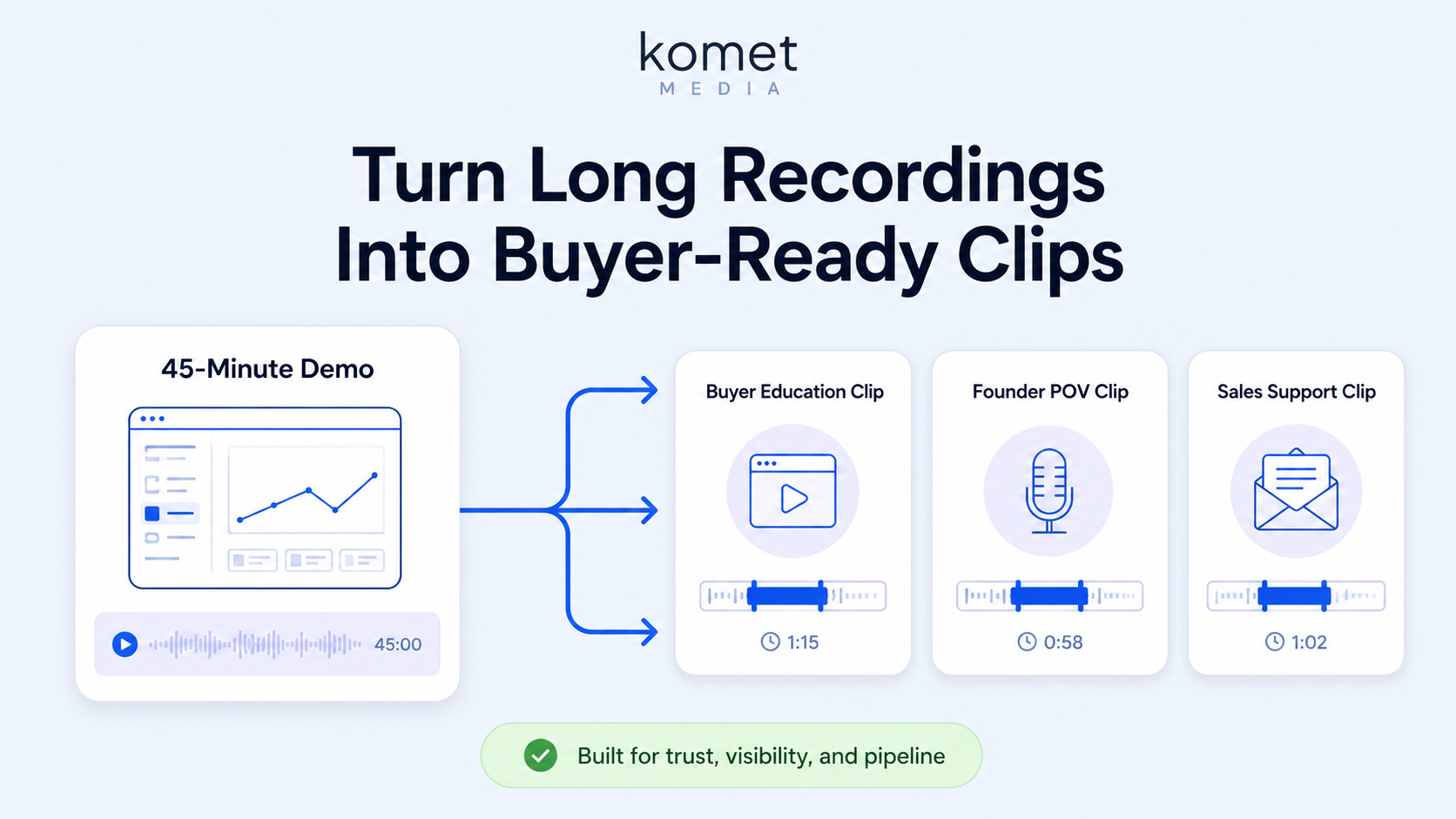
For a B2B SaaS team, that distinction matters. A 45-minute product demo has five moments of genuine buyer insight buried inside it. Short-form video editing is the skill of finding those five moments, framing them with a hook that earns the first three seconds, adding captions so they land without sound, and exporting at the right aspect ratio for each platform.
The vertical video format (9:16) is the default for TikTok, Instagram Reels, and YouTube Shorts. Each platform's social media algorithm rewards native-feeling content over repurposed horizontal footage with black bars. That means editing is not just aesthetic. It is strategic. A clip formatted wrong gets suppressed before a single buyer sees it.
Short-form is not a shortened version of your long-form content. It is a different editorial product built for a different context, attention state, and platform contract.
For B2B teams specifically, the use case goes beyond brand awareness. Short-form clips can educate buyers on a specific feature, surface a founder's point of view, or compress a customer story into something a sales rep can send before a discovery call. At Komet Media, I work with funded SaaS teams and growth-stage firms who already have the source material. The bottleneck is never content. It is about editing capacity and editorial strategy.
The three outputs that matter for B2B short-form:
- Buyer education clips: Feature walkthroughs, objection handling, or comparison breakdowns
- Founder-led content: Perspective clips that build trust with decision-makers before the first sales touchpoint
- Pipeline support assets: Short videos a sales team can drop into sequences, LinkedIn DMs, or pre-demo emails
What separates short-form video editing from general video editing is the compression of intent. Every second costs attention. That scarcity forces better editorial decisions.
How Does Short-Form Video Editing Work for Social Media?
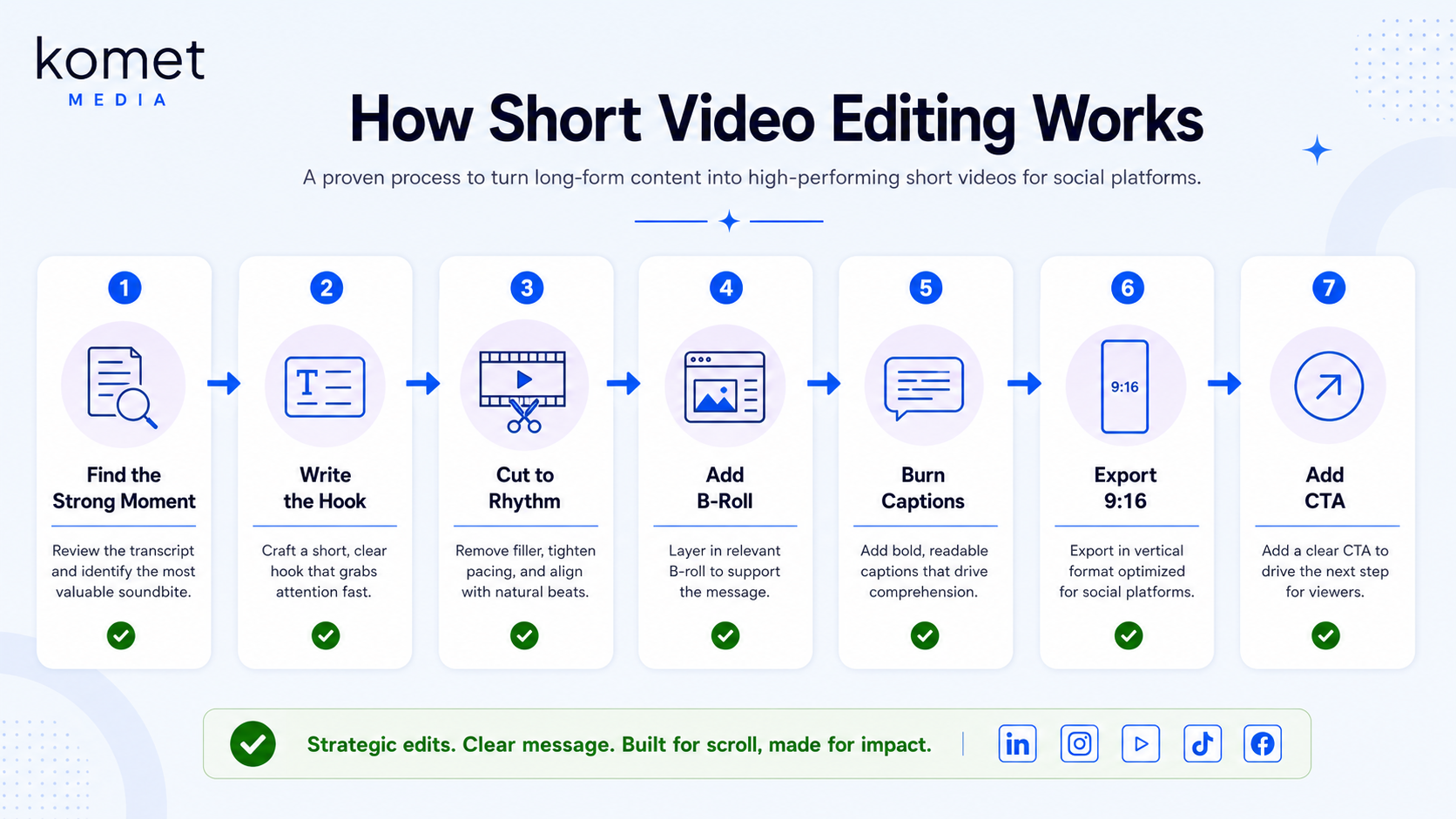
The editing process for social media follows a repeatable sequence regardless of the source material.
- Identify the strongest 60 to 90 seconds: Review the transcript or footage for moments of tension, clarity, or insight. A sharp opinion, a counterintuitive claim, or a direct answer to a buyer objection are ideal entry points.
- Write or select the hook: The first three seconds carry the entire weight of retention. A hook is a spoken line, a visual pattern interrupt, or an on-screen text frame that creates enough curiosity to prevent the scroll.
- Cut to rhythm: Pacing and rhythm in short-form video editing means removing every pause, filler word, and dead moment. Jump cuts are intentional, not sloppy. The edit should feel faster than a normal conversation.
- Add B-roll footage: Cutaway visuals that reinforce the spoken content without repeating it. For SaaS, this means product UI, motion graphics, or contextual screen recordings.
- Burn in subtitles and captions: A significant share of social video is watched without sound. Captions are not optional for reach. They are load-bearing.
- Format and export: 9:16 aspect ratio at the appropriate resolution for each platform. Video compression settings vary by destination. TikTok, Instagram Reels, and YouTube Shorts each have specific bitrate and codec preferences.
- Add a call to action: Even a 45-second clip needs an exit ramp. A CTA can be spoken, on-screen text, or both.
Tools used across professional workflows:
- Adobe Premiere Pro: Industry standard for complex multi-layer edits and color grading
- CapCut: Fast, mobile-native editing with AI caption generation
- DaVinci Resolve: Preferred for color work and audio cleanup on source footage recorded in variable conditions
For teams publishing consistently, the workflow above should produce three to five clips per long-form source asset. One webinar, properly edited, can fill an entire month of social distribution across LinkedIn, Instagram Reels, and YouTube Shorts.
Short-Form Video Editing Definition and Best Practices for B2B SaaS Teams
The working definition used at Komet Media's video editing services: short-form video editing is the craft of reshaping existing footage into platform-native, attention-efficient clips that serve a specific audience intent within 90 seconds or less.
Best practices for B2B specifically diverge from consumer short-form in important ways. Viral content mechanics built around entertainment do not translate directly to pipeline. The goal for a SaaS team is not shared. It is qualified for attention from the right buyer profile.
Hook structure for B2B:
- Lead with the problem, not the product
- Use the buyer's language, not internal jargon
- State a specific outcome in the first five words where possible
Engagement rate and retention:
Retention is the metric that feeds the social media algorithm. A clip that holds 70% of viewers through the full run time will outperform a clip with high initial impressions and fast drop-off. B2B content with educational depth tends to hold retention better than entertainment-only clips, which is an advantage for SaaS teams willing to publish substantive video.
Content repurposing as a system:
The highest ROI short-form editing workflow treats repurposing as a production pipeline, not a one-off task. The input is existing long-form: a podcast, a webinar, a demo recording, a founder interview. The output is a scheduled library of clips mapped to buyer journey stages.
Comparison of source asset types by clip yield:
Mobile-first content is not a design preference. It is a distribution requirement. Any clip that requires landscape viewing or small on-screen text is disqualified from the primary feed placements where most impressions happen.
What Makes Short-Form Video Different from Long-Form Editing?
The difference is not duration. It is editorial logic.
Long-form editing builds toward a conclusion. It earns trust over time, rewards patience, and assumes a viewer who opted in and is willing to stay. A documentary, a webinar recording, or a YouTube deep-dive operates on that contract.
Short-form video editing assumes the opposite: a viewer who is mid-scroll, in a low-attention state, with zero prior commitment to staying. Every editorial decision is made against that constraint.
Key structural differences:
Attention span is not a moral failing of the viewer. It is a rational response to infinite feed competition. Short-form editing is the discipline that makes content worth stopping for.
For B2B teams, the practical implication is that your product demo cannot simply be trimmed down. It needs to be re-sequenced. The insight that appears at minute 22 of a webinar belongs at second five of the clip. That re-sequencing is editorial work, not just cutting.
One more structural distinction: long-form content typically supports a single asset. Short-form video editing multiplied across a repurposing system creates compounding inventory. Forty clips published over a quarter accumulate engagement data, improve algorithm standing, and build buyer familiarity in a way no single long-form asset can replicate.
How Platforms Like TikTok, Instagram Reels, and YouTube Shorts Define Short-Form Video Editing
Each platform applies its own constraints, and those constraints should drive editing decisions.
TikTok: The originating platform for the modern short-form format. The algorithm is interest-graph-driven, which means new accounts with zero followers can reach large audiences on clip one if the content holds retention. For B2B, TikTok is increasingly relevant for reaching millennial and Gen Z buyers in software and tech roles. Clips under 60 seconds receive preferential distribution. Captions and strong audio are weighted signals.
Instagram Reels: Feed placement and the Explore page both amplify Reels. For B2B SaaS teams already active on Instagram, Reels are the highest-reach format available. The aspect ratio is 9:16. Clips between 15 and 60 seconds consistently outperform longer formats in engagement rate on this platform. Komet Media's Instagram marketing services are built around this distribution mechanic.
YouTube Shorts: The platform with the deepest integration into purchase-intent search behavior. A buyer who watches a 60-second Short about a SaaS product is often already in-market. YouTube Shorts also surface in standard YouTube search results, giving B2B teams search visibility that TikTok and Instagram Reels cannot provide.
Platform editing requirements compared:
The production consequence: a single well-edited 60-second clip can publish natively across all three platforms with minor format adjustments, tripling distribution from one editing effort.
What Metrics Matter When Evaluating Short-Form Video Editing Performance?
Output quality in short-form video is measurable. These are the metrics that indicate whether the editing is working, not just whether the content exists.
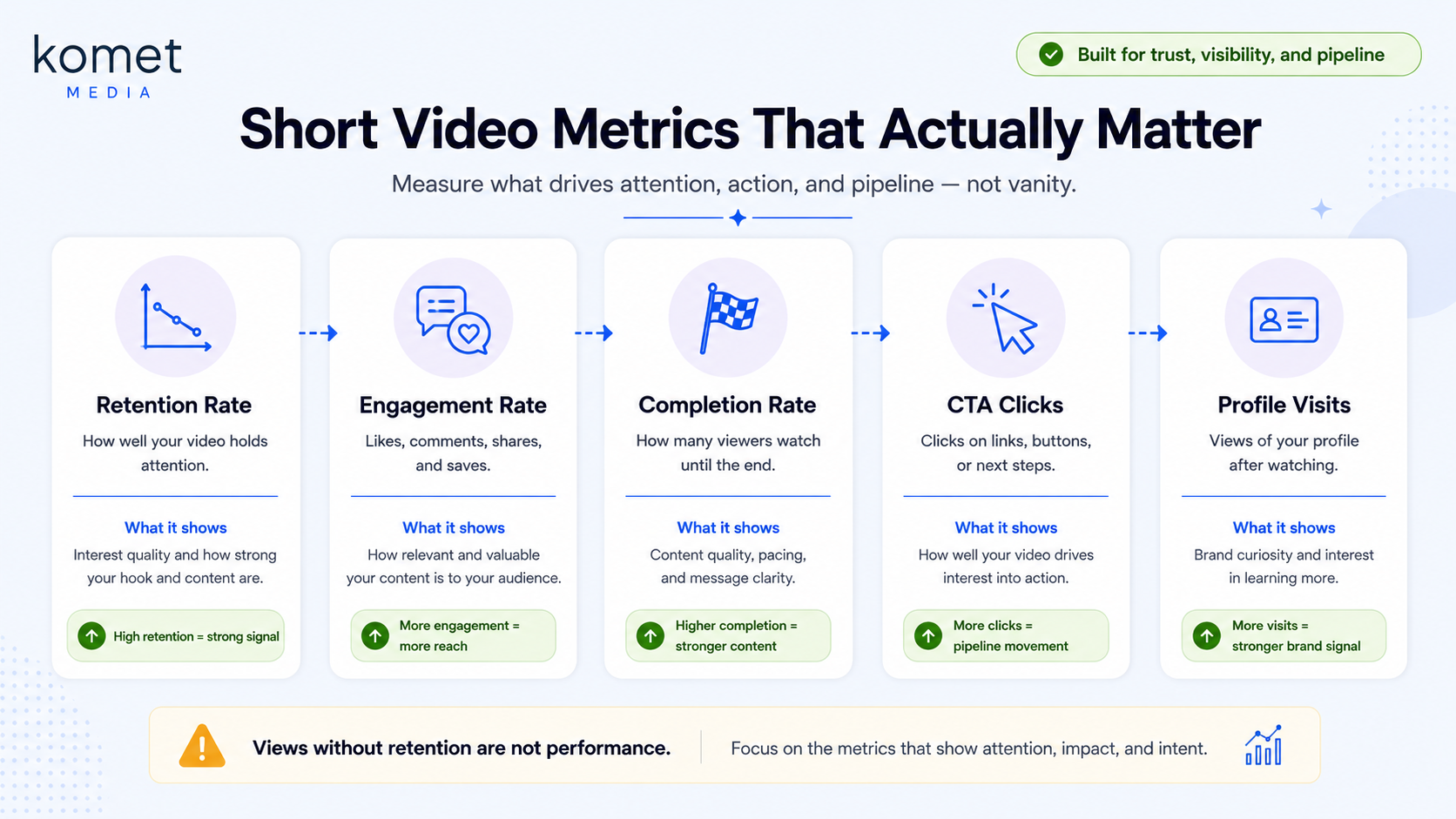
- Retention rate: The percentage of viewers who watch the full clip. Retention above 60% signals that the hook and pacing are working. Below 40% usually means the hook failed or the pacing collapsed in the first 10 seconds.
- Engagement rate: Likes, comments, shares, and saves as a percentage of views. For B2B content, saves and shares carry more weight than likes, because they indicate the viewer found the clip useful enough to act on.
- Completion rate: The share of viewers who watch the final frame. Critical for algorithm distribution. Platforms read high completion as a signal to push the clip to more feeds.
- Click-through on CTA: For clips with a link in bio or swipe-up prompt, the percentage of viewers who follow through. This is the metric that connects social video to the pipeline, and it is the one most B2B teams ignore.
- Profile visits and follows: Downstream of a strong clip, these indicate that the content built enough trust to earn ongoing attention. For founder-led growth strategies, profile growth from video is a leading indicator of inbound pipeline.
For teams evaluating a short-form video editing partner or internal workflow, these five metrics form the performance baseline. The volume of clips published is not a metric. Distribution of clips that retain viewers and prompt action is.
A high view count on a clip with 20% retention means the algorithm showed it and viewers left. That is not performance. That is a waste.
Tracking these metrics per clip, per source asset type, and per platform creates a feedback loop that improves the editorial brief over time.
Short-Form Video Editing Trends and the Market Opportunity in 2026
The short-form video editing software and services market continues to grow as platforms deepen their investment in vertical video. The competitive dynamics have shifted from "should B2B teams use short-form" to "how fast can they build the system."
Several trends define where this space is heading in 2026:
- AI-assisted editing: Tools like CapCut and emerging competitors now offer automated clip detection, caption generation, and hook scoring. For teams with large content libraries, AI reduces the time-to-clip significantly without replacing editorial judgment on what to cut.
- Founder-led content at scale: Funded startups and VC-backed SaaS companies are investing in founder video as a distribution channel. A founder who publishes consistently on LinkedIn Shorts and YouTube Shorts builds buyer trust in a way no paid ad campaign can replicate.
- Sales enablement video: Short clips are entering the sales stack, used in outbound sequences, pre-demo prep, and post-call follow-up. The edit requirements for a sales asset are tighter than a social clip. Precision, not virality, is the standard.
- Content repurposing as a growth function: Teams that treat content repurposing as a systematic growth function, rather than an occasional marketing task, are compounding visibility at lower cost per impression than paid acquisition.
The competitive differentiation among short-form video editing providers is shifting toward strategic output, not just editing speed. Services like Motionvillee and Vidpros compete on production throughput. The gap that matters for serious B2B teams is whether the editing partner understands buyer psychology, B2B messaging, and pipeline goals, not just frame rates and export settings. That is the positioning where Komet Media operates.
For SaaS growth teams evaluating the build-versus-buy decision: the combination of editorial strategy, B2B-specific formatting, and systematic repurposing is difficult to replicate with a generalist editor or an internal hire without a dedicated video background.
Conclusion
- What is short-form video editing? It's the discipline of engineering attention inside 90 seconds, built for mobile-first, algorithm-driven platforms.
- For B2B SaaS teams, it is the highest-leverage conversion of content you already own into buyer-facing assets that support pipeline, trust, and inbound demand.
- Retention, completion rate, and CTA conversion are the metrics that matter. View counts without depth are noise.
- The teams compounding fastest in 2026 are treating short-form video as a system, not a campaign. If your team is ready to build that system, Komet Media's services are built for exactly that.
Frequently Asked Questions
Q1: What is short-form video editing in simple terms?
Short-form video editing is the process of cutting raw footage into tight, vertical clips under 90 seconds that are formatted for platforms like TikTok, Instagram Reels, and YouTube Shorts. The goal is to hold attention, deliver one clear idea, and prompt a viewer action.
Q2: How long should a short-form video be for B2B content?
For B2B SaaS, 45 to 75 seconds is the practical sweet spot. Long enough to deliver a complete thought or buyer education point. Short enough to hold retention above 60% on the platform. Sales enablement clips can run shorter at 20 to 30 seconds.
Q3: What tools are used for short-form video editing?
The most common professional tools are Adobe Premiere Pro for complex edits, CapCut for fast turnaround and AI-assisted captions, and DaVinci Resolve for color grading and audio cleanup. Platform-native editors exist but rarely produce export-quality results for B2B content.
Q4: What is the difference between content repurposing and short-form video editing?
Content repurposing is the strategy: extracting value from existing long-form assets. Short-form video editing is the execution: the technical and editorial work that transforms those assets into platform-ready clips. Repurposing without skilled editing produces low-performing content.
Q5: Do B2B companies actually get pipeline from short-form video?
Yes, when the content is built around buyer education and paired with a distribution strategy. Clips that answer specific objections, demonstrate product value, or build founder credibility with a target ICP generate inbound interest and support sales conversations directly.
Q6: How many clips can one long-form asset produce?
A 60-minute webinar typically yields 6 to 10 clips. A 30-minute podcast produces 4 to 6. A 5-minute product demo yields 2 to 4. The ceiling depends on the density of insight in the source material and the editorial skill applied to extracting it.