
🪄 AI Summary
Heading 1
Heading 2
Heading 3
Heading 4
Heading 5
Heading 6
Lorem ipsum dolor sit amet, consectetur adipiscing elit, sed do eiusmod tempor incididunt ut labore et dolore magna aliqua. Ut enim ad minim veniam, quis nostrud exercitation ullamco laboris nisi ut aliquip ex ea commodo consequat. Duis aute irure dolor in reprehenderit in voluptate velit esse cillum dolore eu fugiat nulla pariatur.
Block quote
Ordered list
- Item 1
- Item 2
- Item 3
Unordered list
- Item A
- Item B
- Item C
Bold text
Emphasis
Superscript
Subscript
If you run a B2B SaaS company or a funded tech startup, the question of Instagram growth service vs in-house social team is genuinely consequential right now. Get it wrong and you're either burning $10K+ per month on overhead with mediocre results, or handing your brand voice to a service that uses bots and tanks your reach. This guide breaks down both models across cost, risk, scalability, and content output, so you can make the right call for your stage of growth in 2026.
TL;DR
- An in-house Social Media Manager costs $105,000–$150,000/year fully loaded, before tools or ad spend.
- Growth services range from $39/month (bot-risk tier) to $250+/month for human-managed options.
- Bot-based services face real account risk after Instagram's May 2026 bot purge.
- For B2B SaaS teams, content quality and Reels strategy beat follower-chasing every time.
What Does an In-House Instagram Team Actually Cost Per Month?
The sticker price on an in-house social hire looks reasonable. The real number does not. The Rachel Karten 2025 Social Media Salary Report, which surveyed more than 2,500 social media professionals, found a U.S. median salary of $80,000 for social media managers. But base salary is only the beginning.
The fully loaded cost of an employee, including payroll taxes, health insurance, 401(k) matching, equipment, and office space, runs 1.4× to 2.0× base salary. A social media manager earning a $75,000 salary costs your business $105,000–$150,000/year ($8,750–$12,500/month). Add what that person can't do alone. A single hire won't cover short-form video editing, Reels strategy, performance analytics, community management, and content repurposing simultaneously.
A professional agency delivers a multi-disciplinary team that typically includes senior strategic oversight, dedicated community management, creative production (copy, design, video), platform optimization specialists, and analytics, all aligned to clear KPIs with accountability built in. There are also hidden time costs.
Mid-level social media roles take 30–45 days to fill, while senior and director positions run 60–90 days. During that gap, your content calendar stalls. And if the hire doesn't work out, you restart from zero. In-house teams offer full internal alignment and deep brand knowledge, but come with limited perspective, slow hiring cycles, skill gaps across platforms, and difficulty adapting quickly to algorithm changes.
For early-stage SaaS teams still finding product-market fit, locking $10K+/month into a single headcount before your Instagram strategy is proven is a significant bet.
How Do Instagram Growth Services Work in 2026?
The Instagram growth service vs in-house social team debate often stalls because founders assume "growth service" means bots. That's no longer the whole picture.
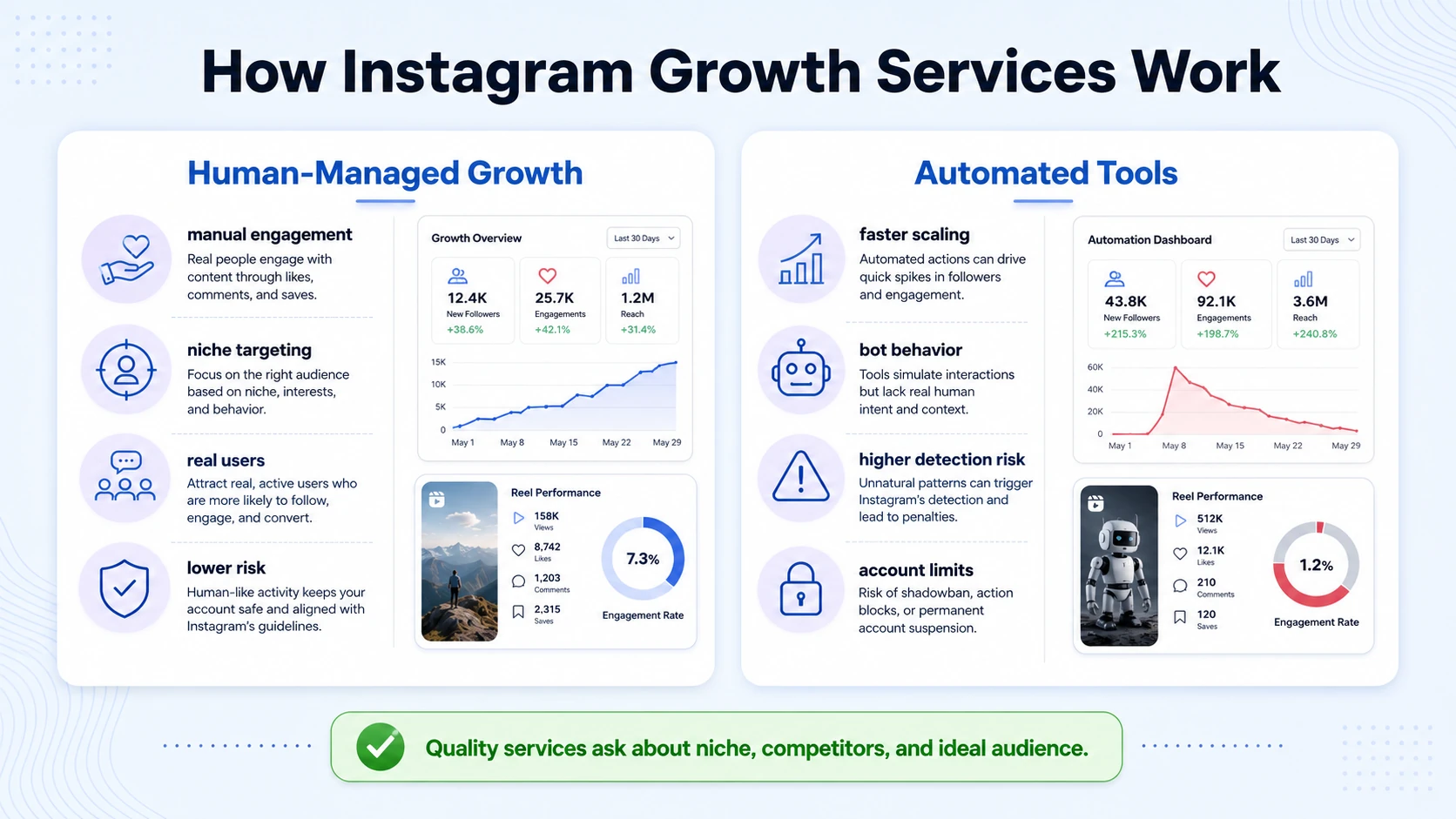
Modern services operate across two models:
- Human-managed growth: A team of real people manually engages with targeted profiles on your behalf, following, commenting, and interacting within niche communities. No automation, no bots.
- AI/automated tools: Software algorithms follow, like, and unfollow based on hashtag and competitor targeting. Faster to scale, higher risk of detection.
A trustworthy service is transparent about how it works, targets real users based on your interests, hashtags, and similar accounts, offers genuine customer support, and never promises overnight miracles. Steady, gradual real engagement is the goal, not a sudden spike that looks suspicious to the algorithm. Pricing reflects this range. Prices range from $39/month for low-end bot tools to $250+/month for premium human-managed services.
What do reputable services actually deliver? Audience targeting by niche, engagement rate monitoring, community management cadence, and in some cases a content calendar and Reels strategy layer. The better ones use tools like Meta Business Suite and third-party analytics platforms to track performance and report back. Tools like Hootsuite and Sprout Social are standard across both models for scheduling and performance analytics.
The key signal of a quality service: a manually operated service can and should offer precise targeting. If a service does not ask about your niche, competitors, and ideal audience, it is probably not doing personalized targeting.
For B2B SaaS teams, the best services also layer in content repurposing, turning webinar clips, founder talks, and demo footage into short-form video assets that support the pipeline. That's where the real leverage lives, and it's what separates a growth service from a follower vendor.
Instagram Growth Service vs In-House Social Team: The Real Cost Comparison
Here's how the two models stack up across the variables that actually matter for a B2B SaaS or funded startup team.
In-house teams typically cost between $4,000 and $8,000 per month in salary alone, excluding tools or ad spend. The advantage is full brand immersion and creative control, though the model requires ongoing training and multiple hires for content, design, and analytics. An agency at $12,000/month gives you a strategist, creative team, community manager, and analyst for less than the fully-loaded cost of one senior in-house hire.
For most SaaS teams under 50 people, the math almost always favors outsourcing, at least at the strategy and execution layer, while keeping a thin internal point of contact to manage brand voice and approvals.
Do Instagram Growth Services Still Work in 2026 or Are They Too Risky?
This is the right question to ask, and the answer depends entirely on the type of service. The Instagram bot purge of 2026 was an overnight cleanup, executed May 6–7, 2026, that removed millions of bot, spam, and inauthentic accounts using an AI moderation tool designed to detect coordinated inauthentic behavior and click-farm activity, following an expanded original-content policy Instagram rolled out on May 5.
Heavy bot-buyers were hit the hardest, with some accounts losing 30 to 60 percent of their entire follower base in a single purge. Bot-based Instagram growth is a genuine account risk in 2026. A single overnight purge can erase months of follower count gains.
Instagram has developed increasingly sophisticated detection systems that identify and penalize automated behavior. Temporary action blocks can last from hours to several weeks and recur with increasing frequency.
Beyond blocks, shadowbanning silently reduces content visibility: posts no longer appear in Explore, hashtags stop working, and organic reach drops dramatically, often going unnoticed for weeks. Human-managed services carry far lower risk. Services using manual, human interactions are safe because they respect Instagram's rate limits and don't use automation. AI-based or bot services carry real risks of shadowban or account restrictions. The rule: if a service doesn't use aggressive automation and respects Instagram's limits, the risk is minimal.
For B2B SaaS teams, the smarter play is combining a human-managed or content-first growth service with a disciplined Reels strategy. Businesses report an average 29% increase in ROI after integrating Reels into their marketing plans. That return comes from content quality, not follower manipulation.
What Are the Biggest Mistakes Companies Make Choosing an Instagram Growth Strategy?
Most mistakes in the Instagram growth service vs in-house social team decision come down to confusing vanity metrics with pipeline outcomes. Here's what consistently goes wrong:
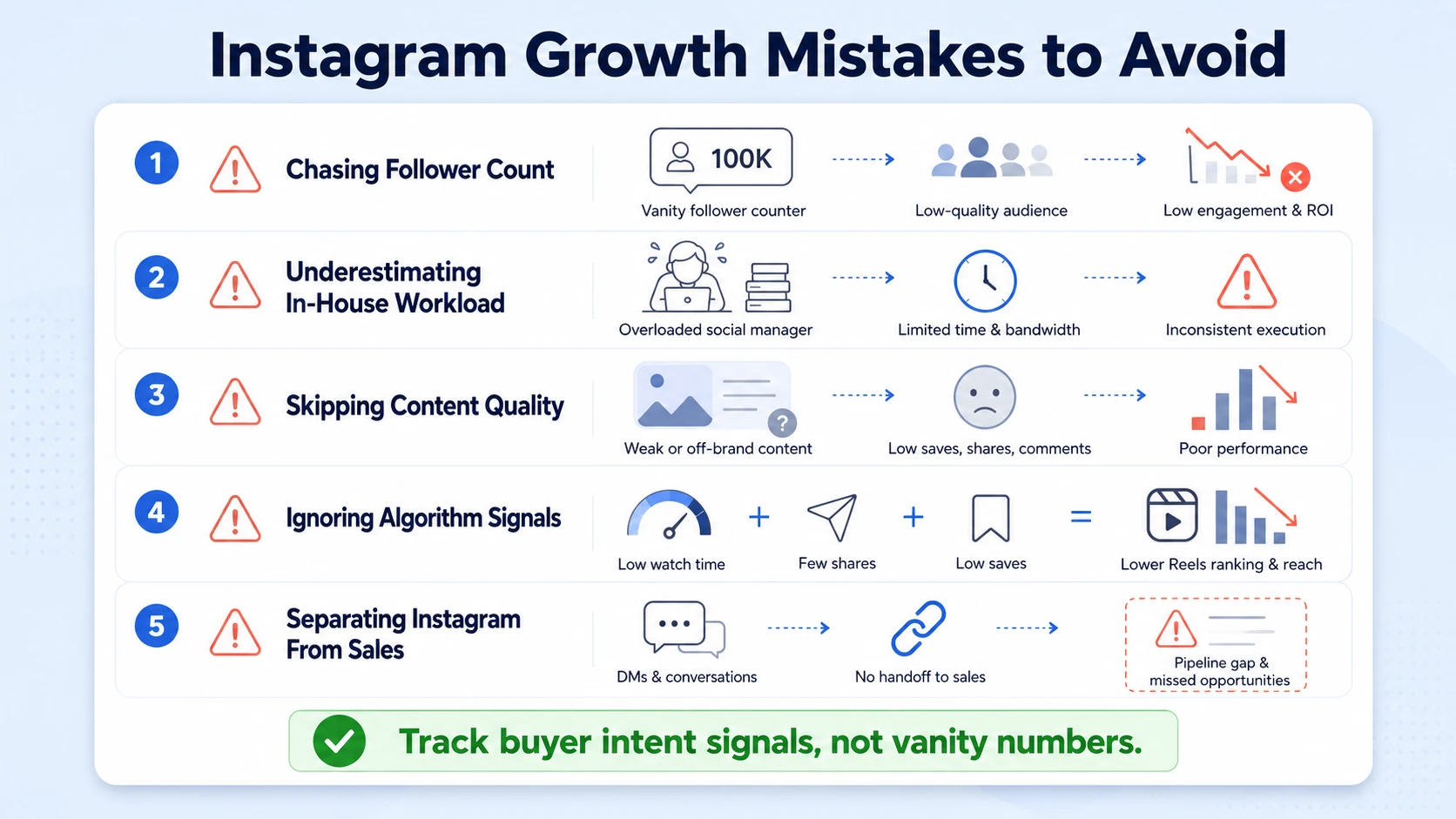
Choosing based on follower count, not engagement rate. If you start with 2,000 followers and average 80 likes per post, your engagement rate is 4%. If you buy 10,000 bot followers and your post still gets 80 likes, your engagement rate drops to under 0.7%. A deflated engagement rate tanks algorithmic distribution and destroys influencer marketing credibility.
Underestimating what "in-house" requires. One Social Media Manager stretched across strategy, Reels production, community management, and performance analytics will underdeliver on all of them. Many brands end up adopting a hybrid setup: one in-house manager plus freelancers or an agency for content creation and ads. That hybrid still costs more than a full-service arrangement from the start.
Skipping content quality to chase audience targeting. After watching a product video on Instagram, roughly 48% of users take a follow-up action, such as searching for more details or visiting a website. Audience targeting brings people to your page. Content quality converts them. ‘Bot’ services bring neither.
Ignoring algorithm signals. Instagram head Adam Mosseri confirmed that watch time, likes-per-reach, and DM shares are now the three most important Reels ranking factors. A growth service that doesn't optimize for these signals is optimizing for the wrong thing.
Treating Instagram as isolated from sales enablement. For B2B SaaS, the platform works best when Reels and short-form video directly support buyer education, product demos, and founder-led growth. Explore Komet Media's Instagram growth service and Instagram marketing services to see how we build this for B2B teams.
Should You Outsource Instagram Growth or Build an Internal Team?
The honest answer: it depends on one thing, whether Instagram is a primary growth channel or a supporting one. In-house makes sense when social is a secondary channel or when deep brand immersion matters most. If you're a 200-person SaaS company with a mature content team and consistent deal flow, bringing social management in-house gives you tighter brand control and faster creative iteration. If Instagram is meant to drive demo demand, buyer education, and inbound pipeline, the calculus flips.
In-house teams work well when social media is a secondary channel. They struggle when it becomes a primary growth driver. For most funded SaaS startups in 2026, the right answer is a strategic growth service or agency with a content-first approach, combined with a lean internal owner (usually a marketing lead or head of growth) who maintains brand voice and reviews output. That person doesn't execute; they direct.
Sprout's research shows around 70% of marketers plan to increase their investment in Instagram in 2026. That rising competition means getting more done per dollar matters more than ever. Services with built-in content repurposing, where your webinars, demos, and podcasts become Reels and short-form assets, deliver a compounding ROI that a single hire simply cannot match.
At Komet Media, I work specifically with B2B SaaS and tech teams to do exactly this. We take existing long-form content and founder thinking and turn it into short-form video that educates buyers and moves the pipeline. If that model fits your stage, explore our video marketing services or short-form video editing, or reach out directly.
Conclusion
The Instagram growth service vs in-house social team decision comes down to four variables: cost, content quality, risk tolerance, and growth stage. Here's the summary:
- An in-house Social Media Manager costs $105,000–$150,000/year fully loaded, with slow hiring cycles and skill gaps across video, analytics, and community management.
- Human-managed growth services ($250–$5,000/month) offer faster activation, specialist expertise, and lower overhead, but require strong brand onboarding to maintain voice.
- Bot-based services are a hard no in 2026 after Instagram's May purge, and carry account-level risk that no follower gain justifies.
- For B2B SaaS teams, the highest-ROI path combines a content-first growth service with a Reels strategy built around existing product and founder content.
Frequently Asked Questions
Q1: How much does a full in-house Instagram social media team cost per month in 2026?
A single Social Media Manager costs $8,750–$12,500/month when you factor in salary, benefits, payroll taxes, and equipment. A full team covering strategy, video production, and analytics will exceed $20,000/month before ad spend.
Q2: Are Instagram growth services safe to use in 2026?
Human-managed services that use real interactions and respect Instagram's rate limits carry minimal risk. Automated or bot-based services face real account penalties, including shadowbanning, action blocks, and follower losses, especially after Instagram's May 2026 bot purge.
Q3: What is the difference between an Instagram growth service and a social media agency?
A growth service typically focuses on audience targeting and follower acquisition. A social media agency or content-first growth service covers strategy, content creation, Reels production, community management, and performance analytics. B2B teams need the latter.
Q4: How do Instagram growth services work for B2B SaaS companies specifically?
The best setups for B2B SaaS repurpose existing content (webinars, demos, podcasts, founder talks) into short-form Reels that educate buyers and drive demo requests. Follower targeting is secondary to content quality and algorithm optimization in this model.
Q5: What metrics should B2B teams track instead of follower count?
Prioritize saves, shares, Reels watch time, DM replies, profile visits from non-followers, and link-in-bio clicks. These signals indicate buyer intent and algorithmic reach, and they directly correlate to pipeline outcomes better than follower count ever will.
Q6: When does building an in-house team make more sense than using a growth service?
When Instagram is a secondary channel, your team already has senior content talent on staff, and brand consistency requires tight internal control. For most early and growth-stage SaaS companies, outsourcing to a specialist and keeping a thin internal director layer is the smarter and cheaper model.