
🪄 AI Summary
Heading 1
Heading 2
Heading 3
Heading 4
Heading 5
Heading 6
Lorem ipsum dolor sit amet, consectetur adipiscing elit, sed do eiusmod tempor incididunt ut labore et dolore magna aliqua. Ut enim ad minim veniam, quis nostrud exercitation ullamco laboris nisi ut aliquip ex ea commodo consequat. Duis aute irure dolor in reprehenderit in voluptate velit esse cillum dolore eu fugiat nulla pariatur.
Block quote
Ordered list
- Item 1
- Item 2
- Item 3
Unordered list
- Item A
- Item B
- Item C
Bold text
Emphasis
Superscript
Subscript
Most SaaS marketing teams reach the same crossroads: the content calendar is backed up, the product demo is outdated, and someone just asked whether to hire a full-time editor or outsource. The wrong answer here costs you the pipeline, not just the budget. This guide breaks down the real tradeoffs on in-house vs outsourced video editing for SaaS in 2026, covering cost, speed, scale, and when each model actually makes sense for funded startups and growth-stage software teams.
TL;DR
- In-house video editing runs $60K–$100K+ per year in salary alone, before benefits, software, and equipment.
- Outsourced SaaS video agencies offer comparable output starting at $3,000–$8,000/month with no HR overhead.
- For most pre-Series C SaaS teams, outsourcing wins on cost, speed, and scalability.
- The in-house model only makes sense once you're producing daily video at enterprise scale.
Should You Hire an In-House Video Editor or Outsource for Your SaaS Company?
The honest answer depends on three factors: your current content volume, your internal bandwidth to manage a post-production pipeline, and whether your team already has a content library to repurpose.
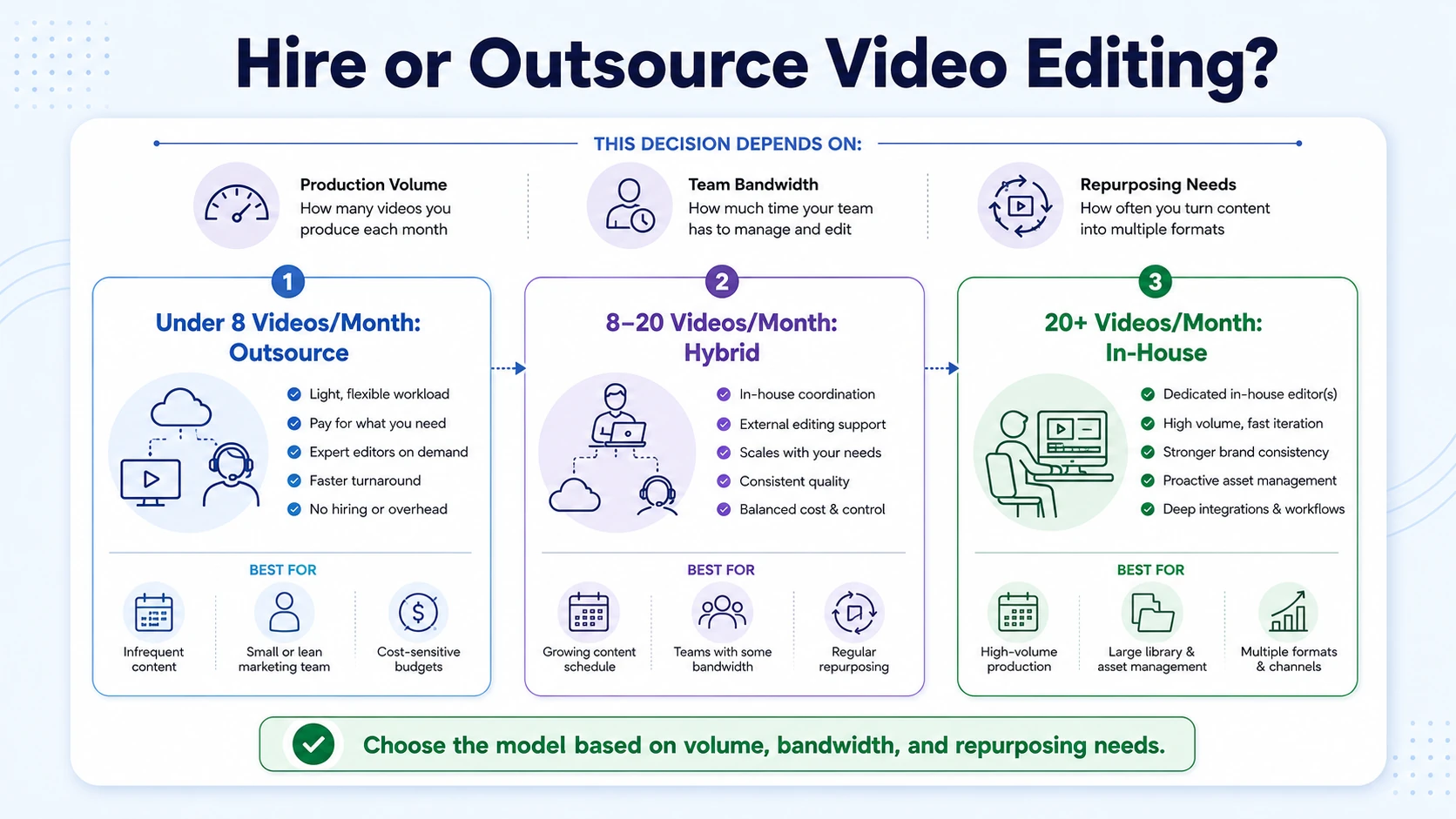
Here's how to think about it:
- Volume below 8 videos/month: Outsourcing is almost always more cost-efficient and faster to activate.
- Volume of 8–20 videos/month: A hybrid model works: an outsourced partner handles execution while a marketing lead manages strategy.
- Volume above 20 videos/month with daily publishing: At this scale, an embedded editor starts to justify the overhead.
The reason most early-stage SaaS teams default to in-house is false comfort. Hiring feels like owning the problem. But US in-house hiring typically runs 60–90 days before someone is seated and productive , while outsourced partners can onboard a content pipeline in two to three weeks.
The other factor most teams underestimate is the management cost. Managing an external freelance editor requires 10 to 15 hours of a marketing manager's time per week. If your Marketing Manager makes $90,000 a year, you're losing roughly $700 a week in internal payroll just to manage an "affordable" freelancer.
That math changes when you work with a B2B-specialist partner like Komet Media rather than a generalist freelancer. The embedded product knowledge eliminates brief-writing overhead and revision loops, which is where most SaaS teams bleed time.
In-House vs Outsourced Video Editing for SaaS: Full Pros and Cons Breakdown
The in-house model makes sense when you produce daily video content and need someone embedded in your team's daily standups, Slack channels, and product roadmap discussions. The recommendation for most SaaS teams: start with an agency to establish your video workflow, style guide, and content library.
The outsourced model wins at the early and growth stages because it gives you a full post-production pipeline without the fixed cost or operational drag of a full-time hire.
What Is the Average Salary for an In-House SaaS Video Editor in 2026?
Before deciding on the build-vs-buy question, you need the real cost picture. Salary is only one line item. The average salary for an in-house video editor is $78,934 per year in the United States, with the typical pay range falling between $60,657 (25th percentile) and $103,332 (75th percentile) annually.
But raw salary understates the true cost. Here's the full picture for a mid-level SaaS video editor in 2026:
One dedicated video editor in the US costs $80K–$100K. Add a motion designer, equipment, software, and benefits, and you're looking at $200K–$300K/year before they've shipped a single video. For a SaaS startup where headcount is constrained and marketing budgets are performance-measured, that is a significant bet on a single output function. And if that editor leaves, you're looking at another 60–90-day ramp cycle before you're back to full capacity.
How Much Does It Cost to Outsource Video Editing for a SaaS Startup?
Outsourced video editing for SaaS covers a wide pricing spectrum depending on the model you choose. For B2B SaaS companies scaling video in 2026, standard video editing rates fall into three main categories: experienced freelance editors ($75–$150 per hour), traditional video agencies ($4,000–$20,000+ per project), or Creative-as-a-Service models at a flat roughly $3,000 per month.
Here's how those models compare for SaaS-specific needs:
The critical differentiator for SaaS is not price, it's product context. The true cost of hiring a freelance video editor is what industry professionals call the "SaaS Revision Tax", the hidden internal cost of managing an editor who does not inherently understand B2B software mechanics. When you hire a generalist editor for $75 an hour, the invoice looks cheap, but the internal labor required to manage them destroys your marketing ROI.
For SaaS teams that need short-form video editing at speed, including clips from webinars, demos, and founder content, a specialist partner eliminates this friction from day one. That's the model at Komet Media: dedicated video systems built around your product, not a generic editing queue.
What Are the Biggest Mistakes SaaS Companies Make with Video Production?
Most SaaS video mistakes are structural, not creative. The content isn't bad. The system around it is broken.
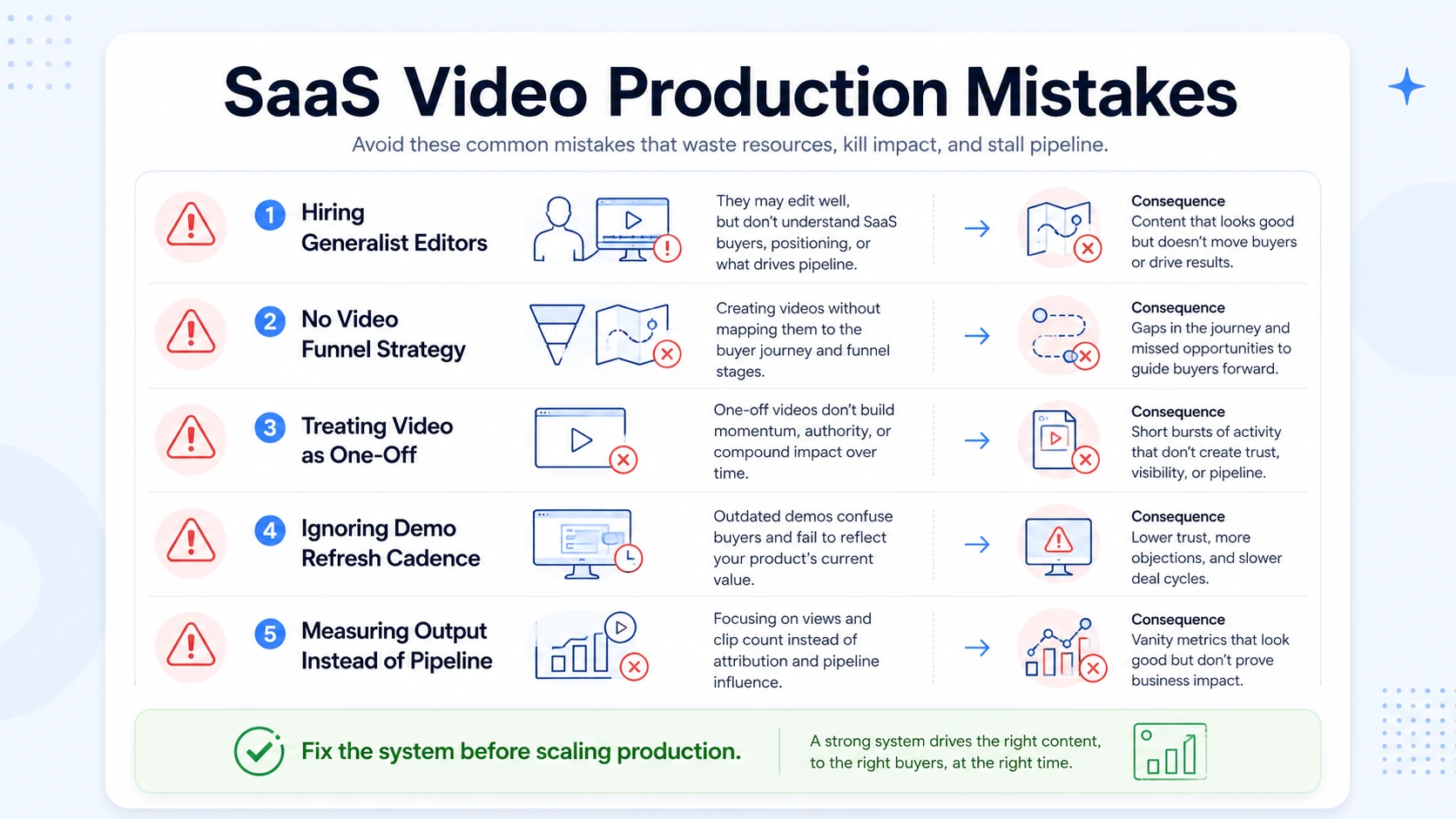
Mistake 1: Hiring a generalist editor for a specialist problem. Product demo videos, customer onboarding videos, and founder-led content require editors who understand SaaS user flows, activation moments, and B2B buyer psychology. A generalist cuts footage. A SaaS-specialist editor shapes a message. Generalist editors don't understand onboarding flows, activation metrics, or B2B video messaging.
Mistake 2: Building a post-production pipeline before establishing a content strategy. Many teams invest in Adobe Premiere Pro licenses, hardware, and a hire before they have a clear video marketing funnel mapped. The output is scattered assets that don't support pipelines.
Mistake 3: Treating video as a one-off project instead of a content repurposing strategy.
One recording session, edited properly, can generate 5–10 pieces of content. That's the leverage SaaS companies need to compete in content marketing without their executives spending all day on camera.
Mistake 4: Ignoring refresh cadence on product demo videos.
Product demos and onboarding videos should be refreshed every time a significant UI change ships, typically every 3–6 months for fast-moving SaaS products. Thought leadership and case studies have longer shelf lives of 6–12 months.
Mistake 5: Measuring output instead of pipeline impact. Video volume is a vanity metric. The question is whether your short-form video content is generating demo demand, reducing sales cycle length, and building founder trust with buyers.
At Komet Media, we structure every video engagement around those outcomes, not clip counts.
How to Build a Lean Video Production Workflow for a SaaS Marketing Team
Whether you're running in-house or outsourced, the workflow architecture determines your output quality and speed. Here's the system I recommend for lean SaaS teams:
- Audit your existing long-form content: Webinar recordings, podcast episodes, demo calls, and founder interviews are your raw material. Most SaaS teams are sitting on 40–60 hours of repurposable footage. Start with what you have.
- Define your video marketing funnel by stage: Top-of-funnel (thought leadership clips), middle-of-funnel (product demo video, explainer), and bottom-of-funnel (customer onboarding video, case study). Map content type to buyer stage before you produce anything.
- Create a brand consistency framework: Establish your motion template, color system, caption style, and hook format. This is what allows an outsourced editor to match in-house brand quality without daily supervision.
- Set a video asset management system: Use a shared tool (Frame.io, Notion, or a dedicated DAM) to organize raw footage, approved assets, and publish-ready clips. Without this, your content operations collapse under volume.
- Establish a publishing and repurposing cadence: Decide how many times each long-form recording gets repurposed. A 45-minute webinar should yield a minimum of 6–10 short-form clips, distributed across LinkedIn, YouTube Shorts, and sales enablement decks.
- Measure marketing ROI by asset, not batch: Track view-to-demo conversion, engagement rate by video type, and pipeline influenced by video content. This is how you justify and scale video budgets.
While hourly rates suit smaller edits, project-based or retainer fees are ideal for ongoing partnerships , and that holds true for the workflow structure too. Retainer-based partnerships allow the video team to develop product context over time, compounding quality with every sprint.
When Should a SaaS Company Bring Video Editing In-House?
Bringing video editing in-house is the right call in specific, well-defined scenarios. Doing it too early is one of the most common and expensive mistakes in SaaS content operations.
Bring video editing in-house when:
- You're publishing video content daily across multiple channels and the brief-to-delivery cycle is a competitive advantage, not just a content function.
- You have a dedicated content operations lead who can fully absorb the management overhead of an in-house editor without pulling time from strategy.
- Your brand identity is mature enough that a single editor can maintain brand consistency without an agency's quality control layer.
- You have the budget for the full stack: salary, benefits, software (Adobe Premiere Pro, DaVinci Resolve), hardware, and stock licensing, realistically $90,000–$125,000+ fully loaded annually.
- Attrition risk is manageable, meaning you have documented brand consistency frameworks and video templates that survive an editor change.
Keep outsourcing when:
- Your content volume is under 15–20 videos per month.
- Your team doesn't have a full-time content operations role to manage the post-production pipeline.
- Your product UI changes frequently and you need editors who understand SaaS workflows at a contextual level, not just technically.
- You want scalable content production that flexes with product launches, campaign cycles, and funding milestones without adding headcount.
By leaving video production in the hands of experts, your in-house team can focus on their core responsibilities, maximizing productivity and efficiency. Instead of your marketing manager spending weeks learning complex video editing software, they can focus on marketing strategy and performance optimization.
For most funded SaaS teams under Series B, a specialist partner handling video marketing and short-form production is the better operating model. When you're ready to evaluate what that looks like for your team, start here.
Conclusion
The decision between in-house vs outsourced video editing for SaaS comes down to scale, speed, and whether your content system is mature enough to support either model. Key takeaways:
- In-house costs $90,000–$125,000+ fully loaded and takes 60–90 days to activate. It makes sense only at high daily publishing volume.
- Outsourced SaaS agencies give you product-aware editors, elastic capacity, and a live post-production pipeline in under two weeks, starting around $3,000–$8,000/month.
- The biggest video mistake in SaaS is treating production as the problem when the content strategy and repurposing system are the real gaps.
- Build the workflow and brand consistency framework first regardless of which model you choose. Without it, neither in-house nor outsourced editing scales cleanly.
Frequently Asked Questions
Q1: What does an in-house video editor cost a SaaS company in 2026?
The average salary for an in-house video editor is $78,934 per year, with the typical range falling between $60,657 and $103,332 annually. Add benefits, software, and hardware, and the fully loaded annual cost reaches $90,000–$125,000 or more for most SaaS teams.
Q2: Is outsourcing video editing worth it for an early-stage SaaS startup?
Yes, for most pre-Series B teams. SaaS startup packages from specialist agencies start at $2,500/month, and growth-stage dedicated team models run $5,000–$8,000/month, significantly less than a single in-house hire when you account for the breadth of skills covered.
Q3: How do I avoid low-quality results when outsourcing video editing?
Don't hire generalist freelancers for SaaS-specific work. Choose a partner who understands product demo video structure, B2B buyer psychology, and your platform's UI. Provide a brand consistency framework upfront: motion templates, caption style, hook format, and approved music. Structured briefs eliminate most revision cycles.
Q4: Can outsourced video editors handle product demo videos and customer onboarding videos?
Yes, if the partner specializes in SaaS. Product demo videos, SaaS explainer videos, thought leadership, and social clips all require editors who understand your product and your audience , not just how to operate Adobe Premiere Pro or DaVinci Resolve.
Q5: What is the biggest hidden cost of managing freelance video editors for a SaaS team?
The SaaS Revision Tax: the internal time your marketing team burns explaining product concepts, correcting UI pacing errors, and chasing brand guideline consistency. Managing an external freelance editor requires 10 to 15 hours of a marketing manager's time per week , which erases most of the cost advantage at mid-level marketing salaries.
Q6: When does the in-house vs outsourced video editing decision flip toward in-house?
The model flips when you're publishing daily, have a dedicated content operations lead, a mature brand system, and the full-stack budget. The in-house model makes sense when you produce daily video content and need someone embedded in your team's daily standups, Slack channels, and product roadmap discussions. Before that threshold, outsourcing consistently outperforms on speed, cost, and scalability.