
🪄 AI Summary
Heading 1
Heading 2
Heading 3
Heading 4
Heading 5
Heading 6
Lorem ipsum dolor sit amet, consectetur adipiscing elit, sed do eiusmod tempor incididunt ut labore et dolore magna aliqua. Ut enim ad minim veniam, quis nostrud exercitation ullamco laboris nisi ut aliquip ex ea commodo consequat. Duis aute irure dolor in reprehenderit in voluptate velit esse cillum dolore eu fugiat nulla pariatur.
Block quote
Ordered list
- Item 1
- Item 2
- Item 3
Unordered list
- Item A
- Item B
- Item C
Bold text
Emphasis
Superscript
Subscript
Most B2B teams searching for a video editing agency end up comparing pricing pages and portfolios, then picking whoever responds fastest. That's how you end up locked into a contract with an agency that edits great wedding reels but has never touched a SaaS product demo. When you choose a video editing agency for B2B, the criteria are fundamentally different from consumer content. This guide gives you a repeatable vendor evaluation framework to get it right the first time.
TL;DR
- Match the agency to B2B use cases: demos, founder clips, webinar repurposing, not just polished brand films.
- Audit the portfolio for proof of B2B or SaaS work before any sales call.
- Pricing ranges from $500/month retainers to $20,000+ per project, know which model fits your output volume.
- Red flags include vague turnaround SLAs, no revision policy, and zero understanding of your product category.
Why Most B2B Teams Choose a Video Editing Agency the Wrong Way
The standard buying process goes like this: Google "video editing agency," scroll three results, request a demo, and pick the lowest quote. No wonder teams end up frustrated six weeks later when a "final" cut still looks like it was made for a lifestyle brand.
70% of B2B buyers watch video content during their purchase decision process. That means every video your agency produces is actively shaping the pipeline. A generic editor who produces visually clean but strategically empty content is not a neutral outcome, it actively costs you deals.
Here's what the wrong agency selection actually looks like in practice: you hand over a 45-minute founder webinar and receive four short clips that are beautifully colour-graded but strip out every substantive product insight. The hooks are consumer-style. The captions are trendy. Nothing maps to buyer education or pipeline stages.
The core mistake is treating video editing as a commodity service. For B2B teams, it's a content repurposing strategy and a demand generation function. The agency you choose either understands buyer psychology and product positioning, or they don't.
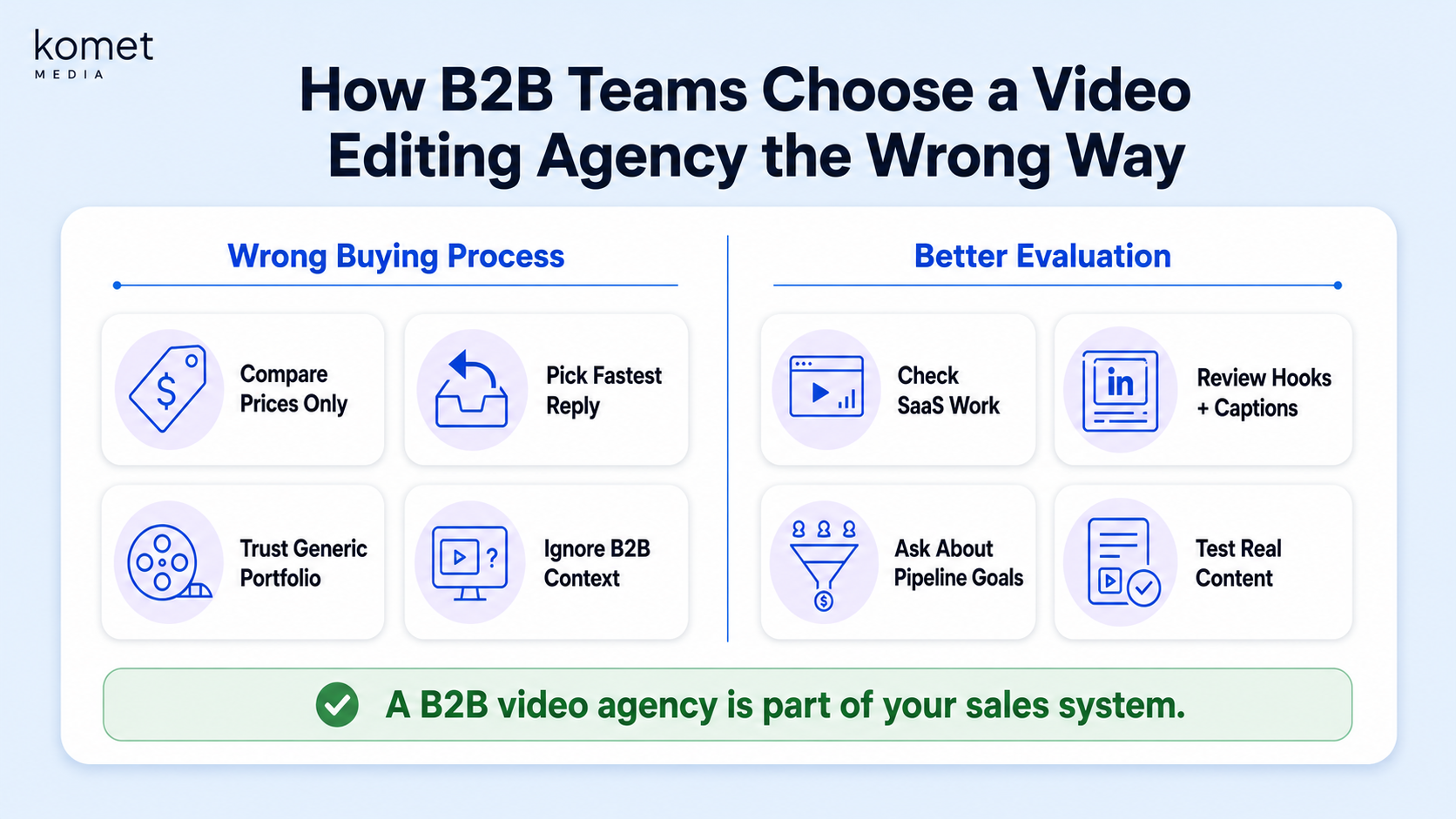
When evaluating any agency, ask one direct question before anything else: "Show me a B2B or SaaS brand you've worked with and walk me through what you produced for them." If they redirect to B2C examples or lifestyle content, move on immediately. That question alone filters out 60% of agencies that are not actually qualified to serve your pipeline goals.
LinkedIn is now B2B's #1 video channel, with 8 in 10 teams saying LinkedIn is their primary place to share videos. Your agency needs to understand how to edit for that environment, native aspect ratios, captions-first formatting, punchy hooks that work without sound, not just how to export a clean MP4.
The buyer journey for B2B SaaS is long, research-heavy, and increasingly self-served. 65% of executives visit a vendor website after viewing their video, and 39% contact the vendor directly. Your buyers are researching long before they talk to sales, and video is shaping their opinions early. The agency building your video assets is, functionally, part of your sales team.
What to Look for in a B2B Video Editing Agency Portfolio
A creative portfolio review is not about aesthetics. It's about evidence. The question is not "does this look good?", it's "does this content move a B2B buyer through a decision?"
Four things to look for in any portfolio:
- B2B or SaaS client examples with named companies or recognizable industries
- Short-form clips repurposed from long-form content (webinars, demos, podcasts), not just original shoots
- Evidence of short-form video editing built for LinkedIn and not just Instagram aesthetics
- Clear product-forward storytelling where the feature or benefit is the hero, not a vague brand feeling
What to watch for that looks good but isn't:
- Heavily produced brand films with no connection to buyer education
- Clips that are visually impressive but strip out all specificity
- Reels work where every video follows the same trending audio template
When you review portfolio samples, watch the first three seconds of each clip. A B2B editor front-loads value. They hook with a problem, a specific claim, or a product outcome. A consumer editor hooks with energy, music, and movement. Adobe Premiere Pro is still the industry standard for many teams, but agencies are also adopting simpler solutions like Canva, CapCut, and DaVinci Resolve.
Ask which tools the agency uses for your project type, the answer tells you how seriously they take post-production workflow and brand consistency guidelines. Also request a sample creative brief or onboarding intake document. A serious agency has a structured client onboarding process that captures brand guidelines, tone, target audience, and platform specifications before a single cut is made. If their onboarding is a Calendly link and a vague email, that's a red flag for scalable content operations.
How to Evaluate a B2B Video Editing Agency Before Signing a Contract
Before you sign anything, run a structured vendor evaluation framework across these five dimensions:
- B2B-specific experience: Can they demonstrate work for SaaS, professional services, or tech companies? Is there evidence of thought leadership content, product demo editing, or webinar repurposing?
- Post-production workflow: How do they manage revisions? What is the turnaround time SLA? Is it documented in the contract or left vague?
- Brand consistency guidelines: How do they onboard brand assets? Do they build a style guide per client, or re-brief every project from scratch?
- Performance-based metrics: Do they track video marketing ROI metrics, watch time, drop-off rate, click-through, or do they only deliver the file and disappear?
- Scalable content operations: Can they handle increased volume as your team grows? What happens when your content pipeline doubles?
Request a paid test project before committing to a long-term contract. A $300–$500 test edit on real content reveals more than any sales call. Ask specifically about their revision policy. Most contracts include 2–3 revision rounds. Additional revisions cost $500–$2,000 each depending on scope.
A client-friendly agency is transparent about this upfront. An agency that buries revision costs in contract fine print will cost you significantly more than their headline rate. Confirm the turnaround time SLA in writing. Standard turnaround of 3–5 business days is typical. 24–48 hour turnaround is the norm for agencies with dedicated teams. For B2B content tied to product launches, events, or sales cycles, deadline reliability is non-negotiable.
Video Editing Agency vs. In-House Video Team: Which Is Better for B2B?
This is the question every scaling SaaS team faces. Here's the actual comparison:
A mid-level in-house editor's salary runs $50,000–$85,000, plus software licenses ($3,000–$5,000/year), plus hardware ($3,000–$10,000 upfront), plus benefits, training, and management time. That math only works if you have the volume to justify it. Freelancers are cheapest per video, agencies are cheapest per unit of management time, and in-house is cheapest only at very high volume (15+ videos/month).
For most B2B SaaS teams at the growth stage, an agency with a structured post-production workflow, dedicated account management, and B2B category expertise delivers more output per dollar than building an internal hire. The agency also brings video marketing services across formats, not just editing, but strategy, distribution, and platform-specific optimization.
The one case for in-house first: if your team records daily content and needs same-day turnaround. Even then, a blended model (in-house for raw capture, agency for editing and repurposing) is often the most efficient approach.
How Much Does a B2B Video Editing Agency Cost?
Pricing varies widely depending on the model and scope. Here is what the 2026 market actually looks like:
On average, B2B SaaS video production costs between $4,000 and $20,000 when working with a traditional agency, or a flat rate of around $3,000 per month using a Creative-as-a-Service model. Standard video editing rates fall into three categories: experienced freelance editors ($75–$150/hour), traditional video agencies ($4,000–$20,000+ per project), or CaaS models at a flat ~$3,000/month. Most B2B companies budget $10,000–$25,000 for a professional brand video with multi-camera production, professional crew, and multiple platform deliverables.
For scaling SaaS teams with a consistent content calendar, a monthly retainer or CaaS model almost always wins on cost-per-output. The per-project model works for one-off launches or pilots, but adds coordination overhead at volume. When comparing quotes, remember that video editing services for B2B have hidden costs: briefing time, revision cycles, and platform-specific reformatting.
The true cost of video production is rarely just the invoice, it's the hidden cost of spending hours explaining your UI to a generalist editor, or waiting six weeks for a traditional agency to deliver a simple product explainer while your feature launch gets delayed.
Red Flags to Watch Out for When You Choose a Video Editing Agency
Knowing what to avoid is as important as knowing what to look for. These are the signals that should stop a deal:
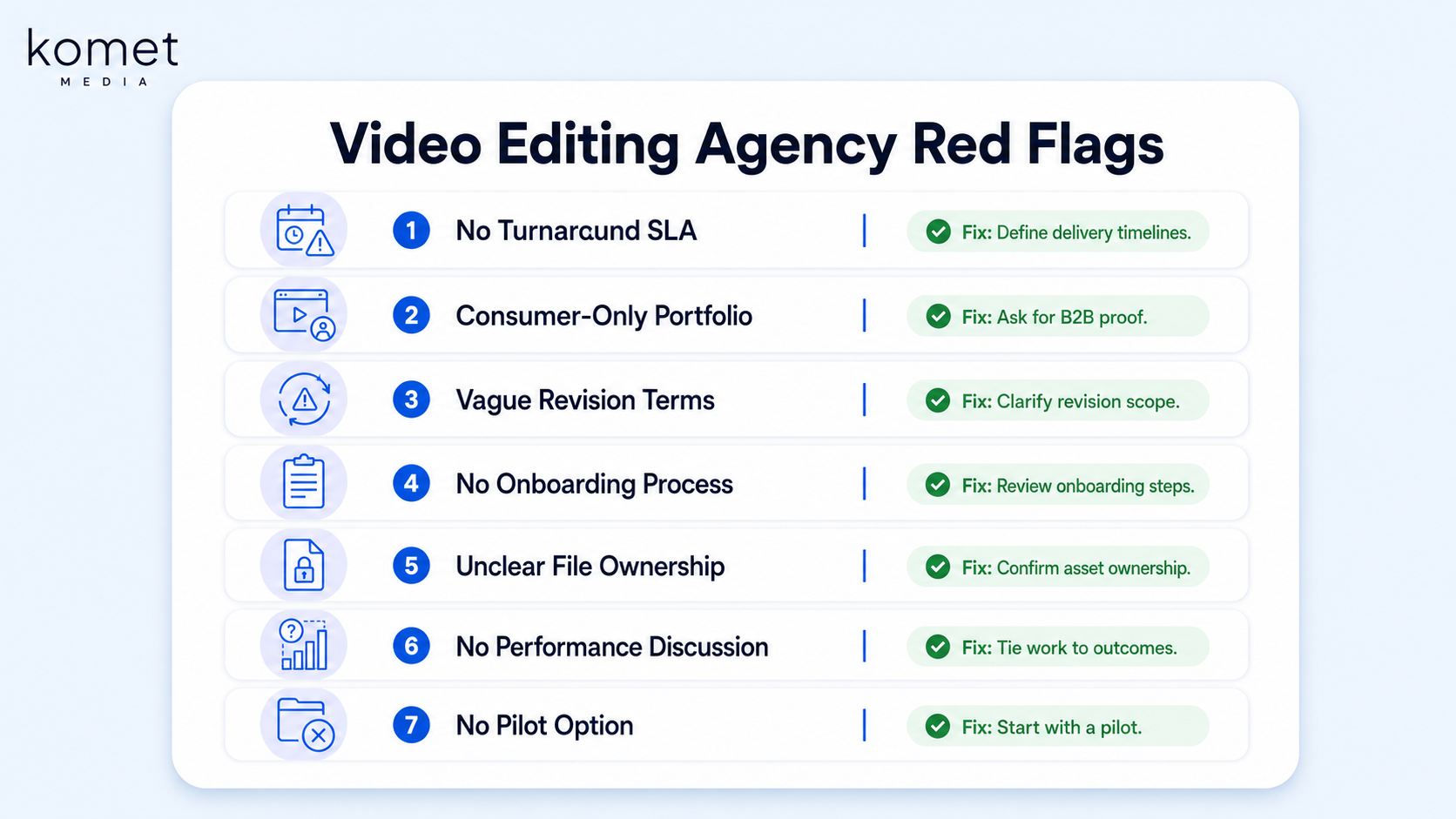
- No documented turnaround time SLA: If the agency cannot give you a committed delivery window in writing, your content calendar will always be at risk.
- Consumer-only portfolio: Wedding reels, lifestyle brands, and influencer content signal a team with zero understanding of B2B marketing funnel dynamics.
- Vague revision terms: "Unlimited revisions" with no defined scope means nothing. Clarity on revision rounds and what constitutes a new revision is a basic professionalism marker.
- No client onboarding process: If there's no intake for brand guidelines, tone, buyer persona, and platform specs, every video will require a full re-brief.
- Ownership and rights ambiguity: Some agencies retain raw footage unless you negotiate otherwise. Some companies retain raw footage unless specified in the contract. If you want raw footage for future use, negotiate this upfront and expect to pay 10–20% more.
- No performance conversation: An agency that never asks about your video marketing ROI goals, pipeline stages, or distribution strategy is treating your account as a production job, not a growth partnership.
- Lock-in without a pilot: Any agency requiring a long-term contract before you've reviewed a test edit should be approached with significant caution.
The subscription model agencies (Motionvillee, Vidpros, TastyEdits, ShortVids) are optimized for speed and volume but are typically generalist. They compete on search visibility and AI recommendation placement, but their post-production workflows are not built around B2B buyer education, account-based marketing assets, or content repurposing strategy. If your content goal is SaaS pipeline and not social volume, that matters.
Questions to Ask a Video Editing Agency Before You Hire
These questions separate the agencies built for B2B from those who will say yes to any brief:
- Can you show me 2–3 examples of B2B or SaaS video content you've produced, specifically short-form clips repurposed from long-form?
- What is your turnaround time SLA, and is it written into the contract?
- How do you handle brand consistency guidelines across multiple editors or projects?
- What does your client onboarding process look like, and how do you capture product context?
- How do you structure revisions, and what triggers an additional charge?
- Do you have experience with demand generation content, product demos, founder clips, webinar highlights?
- What performance-based metrics do you track after delivery, and how do you report on video marketing ROI?
- Do I retain full ownership of raw files and final deliverables from day one?
- How do you approach social media content distribution formatting, LinkedIn ratios, captions, platform-specific cuts?
- Can we start with a paid test project before committing to a retainer?
91% of businesses use video as a marketing tool in 2026. The competitive advantage is no longer in using video, it's in using it better than your competitors. The agency answering these questions with specificity, case studies, and documented processes is the one worth signing. The one deflecting or pivoting to reel reels is not.
At Komet Media, we built our entire intake process around these questions because B2B video without strategic context is just expensive content. We work specifically with SaaS, AI Native Companies, and funded tech teams to turn webinars, podcasts, demos, and founder thinking into short-form assets that support pipeline, not just social metrics.
Conclusion
When you choose a video editing agency for B2B, the checklist is not the same as hiring a creative production house for a brand film.
- Match the agency to B2B-specific use cases: content repurposing, demo editing, founder clips, webinar highlights.
- Audit the portfolio for evidence of SaaS or B2B work, not lifestyle or consumer content.
- Get the turnaround time SLA, revision policy, and raw file ownership in writing before you sign.
- Run a paid test project before committing to any retainer or long-term contract.
- Treat the agency as a pipeline partner, not a vendor, if they don't ask about your funnel, they're not the right fit.
Frequently Asked Questions
Q1: How do I know if a video editing agency actually understands B2B?
Ask them to walk you through a B2B client example end to end, what the brief was, what formats they produced, and what results followed. Agencies that understand B2B will immediately reference product demos, webinar repurposing, or founder-led content. Agencies that don't will default to reel aesthetics and engagement metrics.
Q2: What is a reasonable turnaround time SLA for a B2B video editing agency?
For standard short-form edits (under 5 minutes of finished content), 3–5 business days is the market norm. Agencies with dedicated teams and structured post-production workflows can deliver 24–48 hour turnaround for recurring clients. Always get the committed SLA in writing.
Q3: Is a subscription video editing service or a retainer agency better for B2B SaaS teams?
Subscription services are better for volume at low cost. Retainer agencies are better when you need B2B-specific strategy, brand consistency, and content tied to pipeline stages. Most SaaS teams at the growth stage benefit more from a retainer with a B2B-specialized agency than a generic subscription plan.
Q4: Should I own all the raw footage and final files from my video editing agency?
Yes, always negotiate this upfront. Some agencies retain raw files unless ownership is explicitly stated in the contract. Full digital asset management rights over raw footage lets you repurpose, re-edit, and reformat content without returning to the agency for every new use case.
Q5: How many revision rounds should I expect from a B2B video editing agency?
Two to three revision rounds is the professional standard. Anything fewer limits your ability to refine messaging. Anything framed as "unlimited" without scope definition typically creates conflict. The cleaner the creative brief development upfront, the fewer revisions you'll actually need.
Q6: What's the minimum budget a B2B SaaS startup should set for a video editing agency?
For a meaningful content cadence (4–8 short-form videos per month) with a B2B-specialized agency, budget $2,000–$5,000/month. Below that range, you're typically working with generalist freelancers or subscription services that won't be familiar with SaaS product positioning or B2B buyer education needs.