
🪄 AI Summary
Heading 1
Heading 2
Heading 3
Heading 4
Heading 5
Heading 6
Lorem ipsum dolor sit amet, consectetur adipiscing elit, sed do eiusmod tempor incididunt ut labore et dolore magna aliqua. Ut enim ad minim veniam, quis nostrud exercitation ullamco laboris nisi ut aliquip ex ea commodo consequat. Duis aute irure dolor in reprehenderit in voluptate velit esse cillum dolore eu fugiat nulla pariatur.
Block quote
Ordered list
- Item 1
- Item 2
- Item 3
Unordered list
- Item A
- Item B
- Item C
Bold text
Emphasis
Superscript
Subscript
Most SaaS founders spend months building a product, then weeks writing blog posts nobody reads. Meanwhile, 3,000 ideal buyers see a 60-second video of you explaining your core insight on LinkedIn before noon. That gap is the opportunity. Knowing how SaaS founders use short-form video to build pipelines is no longer a nice-to-have, it's a go-to-market decision. This guide breaks down the strategy, the platforms, the content types, and the mistakes costing you deals right now.
TL;DR
- Short-form video is the fastest path from founder credibility to inbound demo requests in 2026.
- LinkedIn is your primary B2B pipeline channel; TikTok and YouTube Shorts serve specific top-of-funnel roles.
- Repurposing existing webinars, podcasts, and demos into clips is the most efficient content motion.
- Most founders fail by posting too polished, too rarely, or without a clear buyer CTA.
Why Short-Form Video Is Now the Core of SaaS Pipeline Generation
The B2B buying journey has shifted entirely online. Research from 6sense, LinkedIn, and Gartner reveals that 80% of B2B sales now take place entirely online, and the vast majority of the buyer's journey is completed before a prospect ever speaks to a sales representative. That means your video content is doing sales work whether you've designed it to or not.
Prospects in 2026 are increasingly cynical of polished brand accounts. They want to buy from experts, founders, and engineers. That shift is the single biggest tailwind for founder-led short-form video. When you show up on camera, explaining a real problem, sharing a product insight, or breaking down a customer win, you compress the trust-building timeline that used to take a full sales cycle. The data backs this.
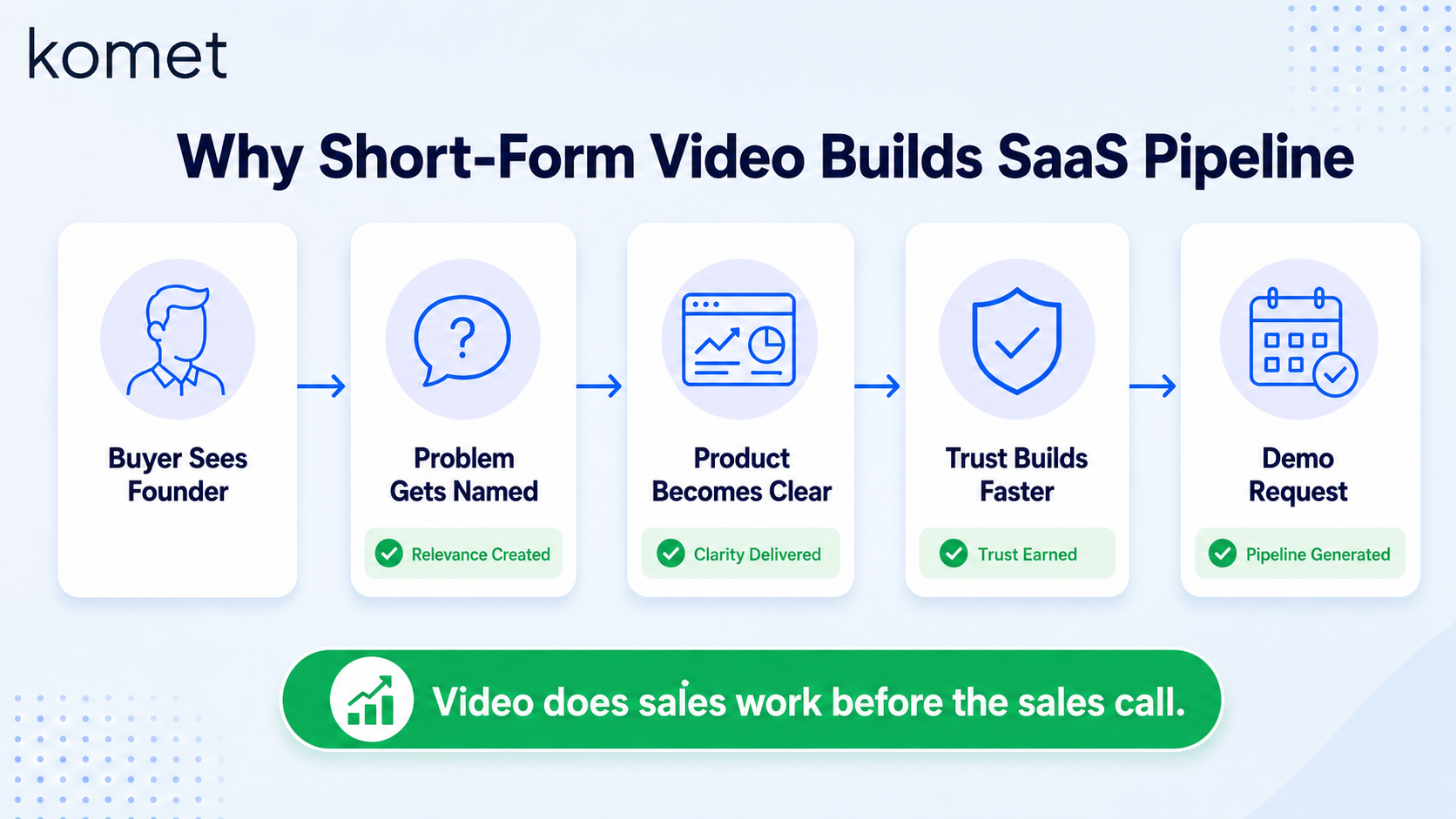
According to Wyzowl's 2026 Video Marketing Report, 91% of businesses now use video as a marketing tool, and 87% of buyers say a demo video convinced them to purchase a product. For SaaS specifically, the teams reporting the largest gains from video aren't measuring by view counts, they're measuring downstream pipeline impact: demo-call conversion rate, sales-cycle length, and trial-to-paid activation.
Short-form video accelerates how SaaS founders use short-form video to build pipeline across three specific motions:
- Top-of-funnel awareness: Clips that name the problem your ICP already feels, distributed on LinkedIn, YouTube Shorts, and TikTok.
- Mid-funnel education: Product walkthroughs, founder POV explainers, and feature spotlights that move prospects from curious to convinced.
- Bottom-of-funnel trust: Customer story clips, "before and after" workflow videos, and social proof moments that give a champion the ammunition to sell internally.
Most SaaS products don't lose leads or conversions because they lack great features, they lose because the prospects failed to understand the product in the first place. Short-form video solves that comprehension gap faster than any other format.
What Kind of Short-Form Video Content Actually Drives Demo Requests
Not all short-form video feeds the pipeline. Engagement is vanity. Demo requests are the metric. The content types that bridge the gap:
- Problem-framing clips (30–60 sec): Open with the specific pain your buyer feels. Every strong demo video opens with the pain point, not the product. The same rule applies to short clips on social media. When a VP of Sales watches your 45-second video and thinks "that's exactly my problem," they click through.
- Micro-demos: Instead of static screenshots, founders clip key product moments, "This is the feature our users love most." These clips act as visual micro-demos that drive curiosity.
- Add captions and close with a CTA pointing to a full demo.
- Founder POV takes: Your perspective on an industry shift, a product decision, or a customer insight. This is thought leadership content in video form, the format that earns the most DMs, connection requests, and unsolicited demo requests.
- Customer result clips: 30-second story arc: the problem, the switch, the outcome. 84% of buyers say watching a video convinced them to buy a product or service. Customer voice accelerates that conviction faster than founder voice alone.
- Webinar and podcast highlights: Webinars are full of viral soundbites, expert insights, founder tips, customer reactions. A single 45-minute webinar contains 8–12 standalone clips. Each one is a pipeline asset. This is the content repurposing workflow at its most efficient, one recording session, 10 distribution moments.
The format rules: vertical (9:16) for LinkedIn mobile and TikTok, captions always on (most people watch silently), hook in the first 3 seconds, CTA in the last 5.
LinkedIn vs. TikTok vs. YouTube Shorts: Which Platform Builds Pipeline Fastest
The honest answer: LinkedIn first, always. The others serve specific secondary roles.
LinkedIn dominates B2B with a 2.8% engagement rate for SaaS , and that engagement carries commercial intent. LinkedIn's visitor-to-lead conversion rate of 2.74% crushes Facebook (0.77%) and Twitter (0.69%). Personal profiles generate 8x more engagement than company pages, which means posting as a founder, not from the brand account, is non-negotiable.
On TikTok and Instagram Reels: TikTok and Instagram Reels are increasingly important for B2B campaigns targeting younger decision-makers and early adopters. But their role in how SaaS founders use short-form video to build pipeline is awareness, not conversion. TikTok is the stronger choice when you need top-of-funnel reach, trend discovery, creator-style content, or fast testing.
Instagram Reels are usually better for trust, retargeting, and conversion. YouTube Shorts earns its place because Shorts feed YouTube search. A video titled "how to [specific workflow your product solves]" compounds over time and surfaces to buyers actively researching solutions, a fundamentally different intent signal than a TikTok scroll.
The practical strategy for a lean SaaS team: publish natively on LinkedIn 3–4x per week, repurpose those same clips to YouTube Shorts and Reels for distribution reach, and test TikTok only if your ICP skews toward early adopters or product-led growth buyers.
Best Practices for SaaS Founders Posting Short-Form Video on LinkedIn
Short-form video delivers a 17% lift in completion rate versus longer formats on LinkedIn, and emotionally resonant video generates a 44% higher view-through rate and 2x the completion rate versus standard video.
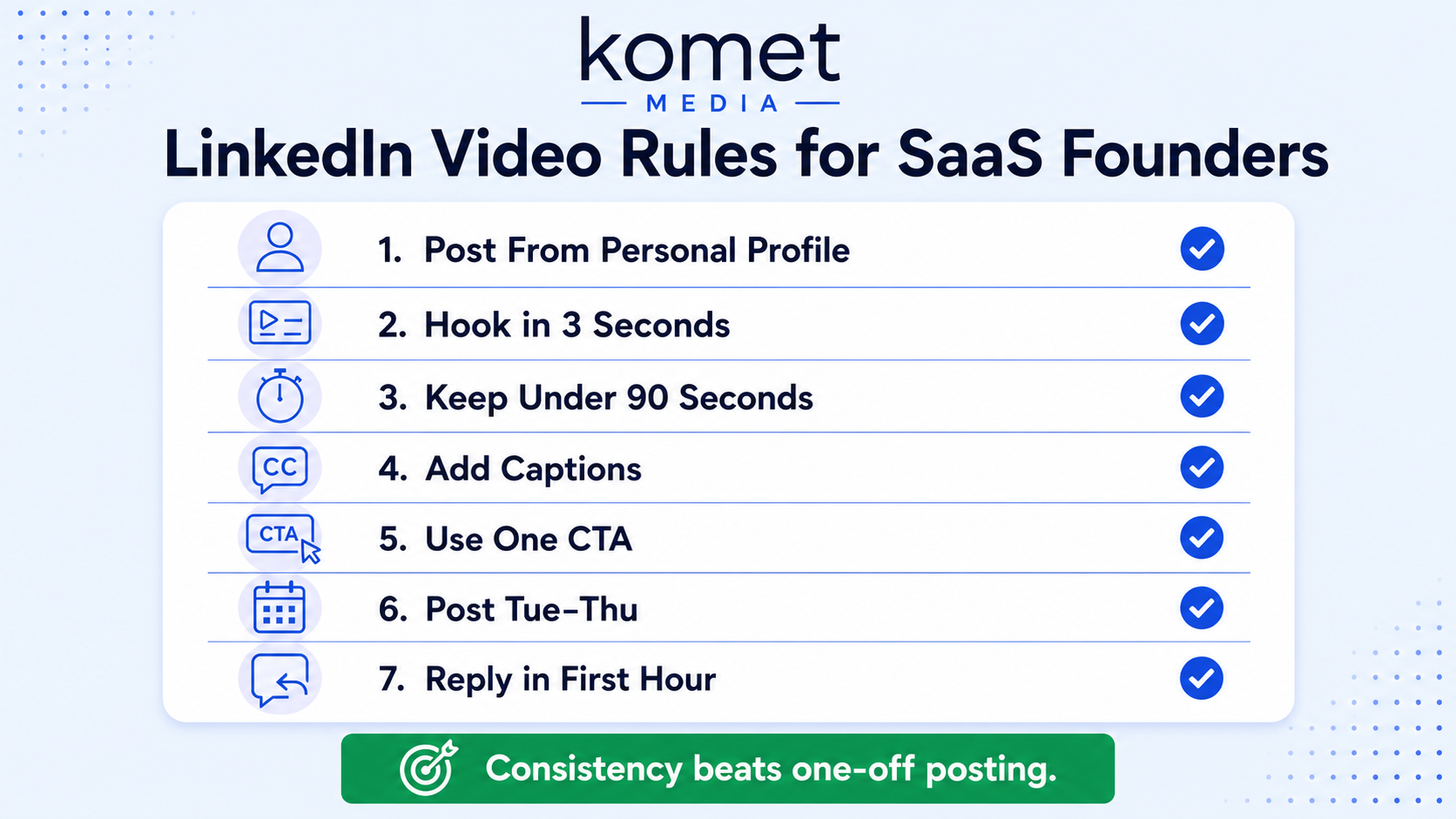
Here's what that looks like in practice:
- Post from your personal profile: Not the company page. Personal profiles generate 8x more engagement than company pages on LinkedIn.
- Hook in 3 seconds: Lead with a bold claim, a counterintuitive stat, or a direct call-out of your ICP's pain. "Most SaaS teams waste their best content" outperforms "Hi, today I want to talk about..."
- Keep it under 90 seconds: Short-form video delivers a 17% lift in completion rate versus longer formats. For pipeline video, under 60 seconds is the sweet spot.
- Always add captions: The majority of LinkedIn video is consumed on mute.
- One CTA per video: "Comment DEMO and I'll send you the link" or "Link in comments to book a call." Never two asks in one clip.
- Post Tuesday through Thursday: The middle of the working week (Tuesdays to Thursdays) sees the highest levels of engagement on LinkedIn.
- Engage within the first 60 minutes: Responding to every comment in the first hour signals the algorithm to extend reach.
The biggest mistake I see founders make: recording one video, getting 400 views, and declaring that "LinkedIn doesn't work." The algorithm rewards consistency, not one-off effort. A 90-day commit to 3 videos per week compounds, the 30th video performs better than the first because your existing audience amplifies it.
The Content Repurposing Workflow That Turns One Recording Into 10 Pipeline Assets
This is the lever that removes the "I don't have time to create content" objection permanently. One 45-minute webinar or podcast episode becomes:
- 6–8 short-form clips (30–90 sec each) for LinkedIn, Shorts, and Reels
- 1 highlight reel (2–3 min) for YouTube and the website
- 3–5 quote graphics for LinkedIn text posts
- 1 blog post built around the key argument
- 1 email nurture sequence using the clips as the lead-in
Webinars are full of viral soundbites, expert insights, founder tips, customer reactions. AI can pull these highlights automatically and format them as short, engaging clips.
At Komet Media, this is the core of what we build for SaaS teams: a repeatable system where your existing product knowledge, founder thinking, and customer conversations become short video assets that educate buyers and support the pipeline, without requiring you to create net-new content from scratch every week.
The workflow in practice:
- Record once: A 30-min founder Q&A, a webinar, a customer call (with permission), or a Loom product walkthrough.
- Clip by insight: Each distinct point, story, or demo moment becomes a standalone clip.
- Add captions and a hook card: The first frame and the caption do the distribution work.
- Publish natively per platform: No cross-posted watermarks. LinkedIn gets the native upload, YouTube Shorts gets the file, TikTok gets its own crop.
- Track which clips generate DMs, profile visits, or demo requests, those topics become your next recording agenda.
This system means a founder who records content once every two weeks can maintain a daily publishing cadence across three platforms. That's the kind of volume that shifts from invisible to top-of-mind with your ICP.
How Long Does Short-Form Video Take to Impact B2B Pipeline, and What Mistakes Slow It Down
The honest timeline: expect 60–90 days before short-form video produces consistent inbound pipeline signals. Payback windows for video assets are typically measurable within the first 30–90 days for landing-page placements. For organic social, the compounding typically kicks in at month 2, when your audience starts sharing content and algorithm signals accumulate.
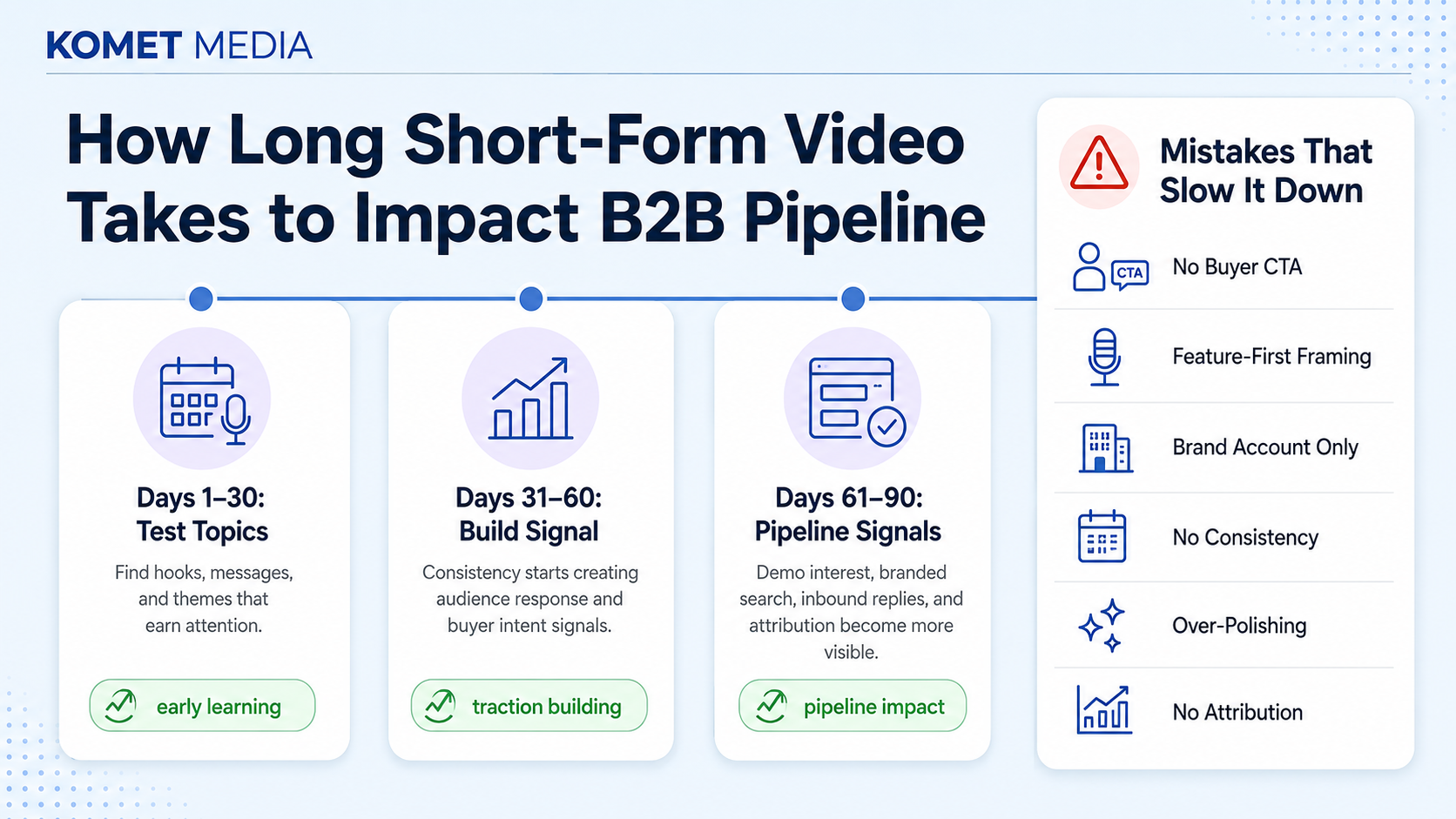
The mistakes that extend that timeline:
- No buyer CTA: Great engagement with no "book a demo" or "comment for access" mechanism doesn't convert. Every clip needs a next step.
- Feature-first framing: In 2026, SaaS buyers are more savvy and more skeptical than ever. They do not want feature lists. They want evidence that your product solves their specific problem faster, easier, and with less friction.
- Brand account only: Posting exclusively from the company page instead of the founder's profile kills organic reach.
- No consistency: Posting 3 videos in week one and then going silent for three weeks resets your algorithmic momentum.
- Over-polishing: Authenticity and first-hand experience are now core signals for short-form video performance. A well-lit iPhone video of a founder explaining something real outperforms a studio-produced commercial that says nothing specific.
- Ignoring attribution: Dark social often influences decisions invisibly. Qualitative data, like asking "How did you hear about us?" in forms, can help capture this hidden influence. Ask every inbound lead where they found you. The MQL-to-SQL bottleneck is real. The 2025 B2B SaaS funnel data shows MQL to SQL as the key bottleneck, with an average 15–21% conversion rate.
Short-form video that pre-educates buyers before they fill out your demo form directly improves that conversion, because an SQL who already understands your product takes half as long to close.
Conclusion
How SaaS founders use short-form video to build pipeline in 2026 comes down to a clear system, not a content grind:
- LinkedIn is your primary pipeline channel. Post as a founder, 3–4x per week, under 90 seconds, with a buyer CTA on every clip.
- Repurpose first. Your webinars, podcasts, demos, and Loom recordings already contain 10 clips each, extract them before creating anything net-new.
- Platform-match your goals. LinkedIn for pipeline, YouTube Shorts for compounding search, TikTok and Reels for top-of-funnel reach.
- Give it 90 days. Consistent execution over 12 weeks beats a burst of 20 videos in one week.
If you want to build this system without doing it yourself, Komet Media's short-form video services are built for exactly this motion.
Frequently Asked Questions
Q1: How many short-form videos should a SaaS founder post per week?
Three to four videos per week on LinkedIn is the baseline for building algorithmic momentum and pipeline impact. Quality matters more than volume, one specific, buyer-focused clip outperforms five generic ones. Start with two per week if you're repurposing existing content and scale from there.
Q2: Does TikTok actually generate pipelines for B2B SaaS companies?
Rarely as a direct pipeline driver. TikTok works for top-of-funnel reach and brand awareness, especially if your ICP includes younger decision-makers or product-led growth buyers. It works best paired with a LinkedIn retargeting strategy, not as a standalone pipeline channel.
Q3: What's the best length for a SaaS founder video on LinkedIn?
Under 90 seconds for pipeline-oriented content. The 45–75 second range consistently performs best, long enough to make a substantive point, short enough to hold attention through the CTA. Anything over two minutes needs a very strong hook and a well-known face to hold completion rates.
Q4: Should a SaaS founder appear on camera or use screen recordings?
Both work, but founder-on-camera video builds trust faster. Screen recordings (Loom-style walkthroughs) are excellent for mid-funnel product education. Use screen recordings to show the "what," and on-camera clips to deliver the "why," that combination covers the full buyer education job.
Q5: How do I measure whether short-form video is actually generating pipeline?
Track these signals: inbound DMs mentioning your content, demo request source attribution, LinkedIn profile visits after posts, and self-reported "how did you find us?" form responses. View count is a vanity metric. Pipeline-linked video performance shows up in demo volume, not impressions.
Q6: What's the fastest way to start without hiring a full video team?
Start with a content repurposing workflow. Take your last webinar or podcast episode and extract 5 clips using a clipping tool. Add captions, write a hook for each, and publish natively to LinkedIn over two weeks. That's your proof of concept. Once you see which clip types drive DMs and demo requests, you have the blueprint for your ongoing video marketing system.