
🪄 AI Summary
Heading 1
Heading 2
Heading 3
Heading 4
Heading 5
Heading 6
Lorem ipsum dolor sit amet, consectetur adipiscing elit, sed do eiusmod tempor incididunt ut labore et dolore magna aliqua. Ut enim ad minim veniam, quis nostrud exercitation ullamco laboris nisi ut aliquip ex ea commodo consequat. Duis aute irure dolor in reprehenderit in voluptate velit esse cillum dolore eu fugiat nulla pariatur.
Block quote
Ordered list
- Item 1
- Item 2
- Item 3
Unordered list
- Item A
- Item B
- Item C
Bold text
Emphasis
Superscript
Subscript
Most SaaS companies are producing more content than ever and closing fewer inbound deals from it. That's not a coincidence - it's a format problem. The same webinar that took your team three weeks to produce is sitting unwatched on a landing page. The same thought leadership that your CEO is genuinely brilliant at communicating is locked inside a 45-minute recording that prospects won't sit through. Meanwhile, a 90-second clip - pulled from that exact content - could have been in front of 50,000 buyers this week. SaaS marketing isn't dying. The version of it that ignores video distribution is.
What Is SaaS Marketing?
SaaS marketing is the ongoing process of attracting, educating, converting, and retaining buyers for a software product delivered via subscription - not a one-time purchase. That distinction changes everything about how you market.
When someone buys a SaaS product, they're not buying a thing. They're buying a continuous relationship - ongoing access, updates, support, outcomes. Which means the marketing job doesn't end at the sale. It runs through onboarding, activation, retention, and expansion. You're not closing a transaction. You're starting a long-term commercial relationship. And every touchpoint - pre-sale and post-sale - either compounds trust or erodes it.
How SaaS Marketing differs from traditional B2B marketing?
Traditional B2B marketing is largely campaign-based: launch a product, run a promotion, close the deal. SaaS marketing is always-on. Your pipeline depends on a steady, compounding stream of awareness and credibility - not episodic bursts.
Traditional marketing can survive on brand alone. SaaS marketing demands demonstrated expertise. Buyers need to believe you understand their specific problem, their workflows, and their business outcomes before they'll commit to a subscription - let alone an annual contract.
Traditional marketing closes on features. SaaS marketing closes on trust. And trust is built over time, through repeated exposure to content that proves you know what you're talking about.
The core components of a SaaS marketing strategy:
- Demand Generation - Creating awareness among buyers who don't know you exist yet. Thought leadership content, short-form video, organic social, and SEO all serve this function.
- Lead Generation - Converting that awareness into identifiable pipeline. Gated content, demos, free trials, and webinars are the primary mechanisms.
- Product Marketing - Positioning your product clearly against alternatives and communicating value to specific buyer personas. This includes messaging, competitive positioning, and sales enablement.
- Content Marketing - The sustained production and distribution of educational content that builds authority and keeps your brand top-of-mind across the buyer's journey.
- Customer Marketing - Retention and expansion plays targeting existing customers - upsells, case studies, community, and advocacy programs.
What's changed in 2026:
Three years ago, SaaS marketing was dominated by SEO-driven blog content and paid acquisition. Both still matter. But the center of gravity has shifted. Short-form video on LinkedIn, YouTube Shorts, and Instagram Reels now drives more brand awareness per dollar - and more qualified inbound - than almost any other channel for B2B SaaS companies.
The reason is simple: your buyers are consuming content differently. They're not sitting down to read a 2,500-word white paper. They're watching 60-second clips on their phones, between meetings, during their commute. The SaaS brands building pipeline in 2026 are the ones meeting buyers in those moments.
That's what the rest of this blog is about.
You're Creating Content Your Buyers Won't Consume
Here's the exact conversation happening inside B2B SaaS marketing teams right now:
The CMO wants pipeline. The content team is producing. Blog posts are published, webinars are recorded, the CEO did a conference talk. Analytics show decent traffic. And yet - inbound MQLs are flat. The sales team says prospects "don't know who we are." The content team is burned out and confused.
What's happening? The content exists. The expertise is there. The problem is that your buyers aren't consuming content the way your strategy assumes they are.
LinkedIn feed scroll time averages 15 seconds per post. Buyers are watching short-form video on their commute, between meetings, during lunch. They're forming opinions about vendors before a single discovery call - based on what they see in their feed, not what they find when they Google you.
The SaaS buying process in 2026 has moved further up-funnel than most marketing teams have adapted to. By the time a buyer fills out a demo form, they've usually already decided which two or three vendors are credible. That shortlist is being built on social proof, perceived expertise, and brand familiarity - and video is the format doing most of that work.
If your SaaS marketing strategy consists primarily of gated PDFs, SEO blogs, and monthly newsletters, you're playing catch-up in a game that has already moved on.
Why Generic SaaS Marketing Advice Is Failing You
Google "SaaS marketing strategy" and you'll get the same article written 40 different ways: product-led growth, freemium funnels, NPS scores, customer success loops. All fine in theory. None of it tells you what to do with the 12 webinars sitting in your Google Drive.
The conventional advice assumes you have two things: a massive content production budget and unlimited bandwidth. You don't. And neither does your team.
What the gurus won't tell you is this: the content you've already created is almost always enough - you're just distributing it wrong.
Most SaaS content teams are trapped in a one-to-one content model. One webinar produces one replay. One podcast episode produces one audio file. One keynote talk produces one YouTube upload. The content is created once and consumed a handful of times before it dies.
High-performing SaaS brands have figured out a one-to-many model. One piece of long-form content - a webinar, a podcast episode, a recorded panel - becomes 8 to 12 short-form video clips optimized for the platforms where your buyers actually spend time: LinkedIn, YouTube Shorts, and Instagram Reels.
This isn't a "nice to have" distribution tactic. It's the entire leverage point. The brands capturing pipeline through content in 2026 have industrialized this repurposing workflow. The ones still wondering why their content "isn't working" haven't.
The Content Multiplier System
At Komet, we don't just edit videos. We run a system we call the Content Multiplier - a repeatable workflow that turns one piece of long-form B2B content into a month's worth of short-form video assets that build authority, drive engagement, and generate inbound pipeline.
Here's how it works:
Step 1: Content Audit We review your existing long-form content - podcasts, webinars, recorded demos, keynote talks, panel discussions. Most SaaS companies have 6–18 months of usable raw material sitting untouched.
Step 2: Moment Identification This is where most agencies fail you. Generic editors clip whatever looks easy. Our team researches your product, your ICP, and your market before touching the timeline. We identify the moments that will resonate with the specific buyers you're trying to reach - a sharp insight, a counterintuitive take, a real customer outcome. iMocha, one of our clients, put it directly: "Most podcast editors don't take the time to understand the content. You basically have to hand hold them through the edit. That's exactly why we went with the Komet Media team."
Step 3: Platform-Native Editing LinkedIn clips aren't YouTube Shorts. A clip that works at 9:16 for Reels needs different pacing, different caption treatment, and different hooks than a square-format LinkedIn post. We produce platform-ready assets that are engineered for each algorithm.
Step 4: Distribution Strategy We give you a posting cadence, content angle recommendations, and performance guidance - not just files in a Dropbox folder.
The result: one 45-minute webinar becomes 10+ short-form clips deployed across 3–4 platforms over 4–6 weeks. Your team produces once. The content works continuously.
What This Looks Like in Practice (Step-by-Step)
Let's walk through an example. Imagine you're a B2B SaaS brand that ran a 50-minute customer success webinar with your Head of Product and two customer case study guests.
Here's what the Content Multiplier produces from that single session:
- LinkedIn Clips (3–5 videos, 60–90 seconds each) Pull the sharpest insights from your Head of Product - the moments where they're articulating a clear, contrarian POV on your market category. These position your brand as thought leaders, not vendors. Captions optimized for silent autoplay. Hook line in the first 3 seconds.
- Customer Story Clips (2–3 videos) Isolate the moments where your customers describe the before/after of using your product in their own words. These are your most powerful social proof assets - and most SaaS brands never extract them from the recording.
- YouTube Shorts (2–3 videos, 45–60 seconds) Educational cuts optimized for discoverability - clips where your expert answers a specific question your ICP is searching for. These drive organic reach and subscriber growth over time.
- Instagram Reels (1–2 videos) Founder-facing or human-interest clips - the moments where a speaker's energy, story, or personality comes through. These are top-of-funnel awareness plays.
Timeline: From raw recording to platform-ready delivery, this process runs in 5–7 business days with Komet.
What this replaces: A 4-person internal video team, a $3,000/month freelancer, and 40+ hours of editorial work per month.
The assets don't just sit in a content calendar. They're working while you're on customer calls. They're getting viewed by buyers you've never met. They're building the brand recognition that makes your outbound easier and your inbound warmer.
The Result - 750,000 Views. 600 Subscribers. Impressed Investors.
We don't work with companies that want vanity metrics. We work with brands that want their content to build actual pipeline.
Goliath.io came to Komet with a strong product and a marketing team that knew they had more to say than their current content output was showing. Here's what Ariana Faustini, Head of Global Marketing, said after working with us:
"We love the work. We have gone viral. With over 750,000+ views on one of the shorts. Before we would only have about a few hundred views if that. We have over 600 new subscribers, and this has impressed our investors and board."
Golaith.io - YouTube Channel
That's not a lucky clip. That's what happens when the right moment gets extracted, edited for platform performance, and distributed consistently.
Walden Catalyst Ventures saw a similar result - over 200,000 views on YouTube Shorts from content that was already recorded and sitting unused.
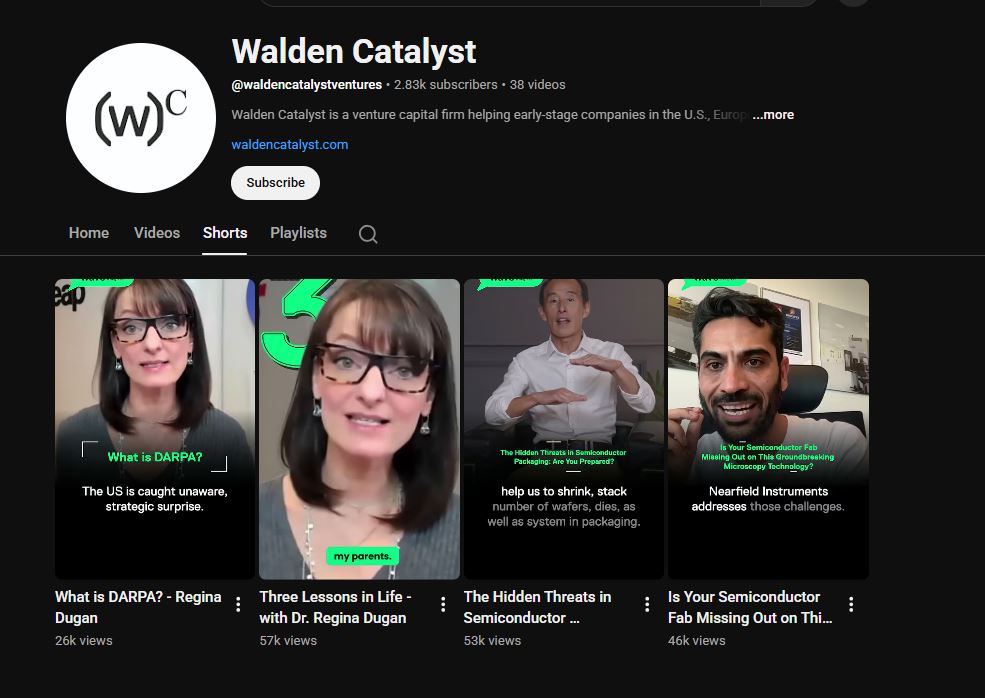
For Justin Simon at Distribution First, the transformation wasn't just the numbers. It was the system: "It's honestly the only way I can imagine doing this type of content… being able to create a web of content that comes off of that every single week."
That's the compounding effect of the Content Multiplier in action. You don't post once and hope. You build a content engine that generates pipeline on autopilot.
The SaaS Marketing Video Playbook: What You Need to Get Started
If you're reading this and thinking, "We have the content - we just need to start distributing it properly," here's your starting point:
1. Audit your existing long-form content. Webinars, podcasts, recorded demos, conference talks. List them. Estimate runtime. Identify which ones feature your most compelling insights, customer stories, or expert opinions.
2. Identify your highest-leverage platform. For most B2B SaaS companies, LinkedIn is where you should start - it's where your buyers and economic decision-makers spend professional time. YouTube Shorts adds organic discovery. Pick one primary, one secondary.
3. Set a cadence you can sustain. Consistency outperforms volume. Three clips per week, every week, beats twelve clips in one burst and then silence.
4. Build the repurposing workflow. Whether in-house or with a partner like Komet, establish the pipeline: raw recording in → clips out → scheduled and posted. This workflow is the asset.
Want to see exactly how to build this system?
Download Komet's Complete Podcast Repurposing Guide - it covers how to turn every long-form content session into a multi-platform content engine that works for your SaaS brand week after week.
Ready to Turn Your SaaS Content Into a Pipeline Engine?
Most SaaS companies are 90 days away from having a short-form video system that consistently puts them in front of qualified buyers - they just haven't built the workflow yet.
Komet works with B2B SaaS brands, founders, and marketing teams to turn existing content into a lead-generating video machine. We handle everything: moment identification, platform-native editing, distribution strategy, and performance optimization.
Book a Free 15-Minute Strategy Call with Komet - we'll review your existing content, show you exactly which assets are worth repurposing first, and tell you what kind of results to expect based on what we've done for brands like Goliath.io, Walden Catalyst, and iMocha.
No pitch decks. No fluff. Just a clear plan for your SaaS content.
Also worth reading:
- Complete Equipment Setup Guide for Podcast & Webinar Video Calls
- Complete Podcast Repurposing Guide: Turn Your Podcast Into a Content Engine