
🪄 AI Summary
Modern B2B buyers don’t move in a straight line anymore. They self-educate, compare options, validate internally, and only then speak to sales. That’s why your video strategy must align with how decisions are actually made.
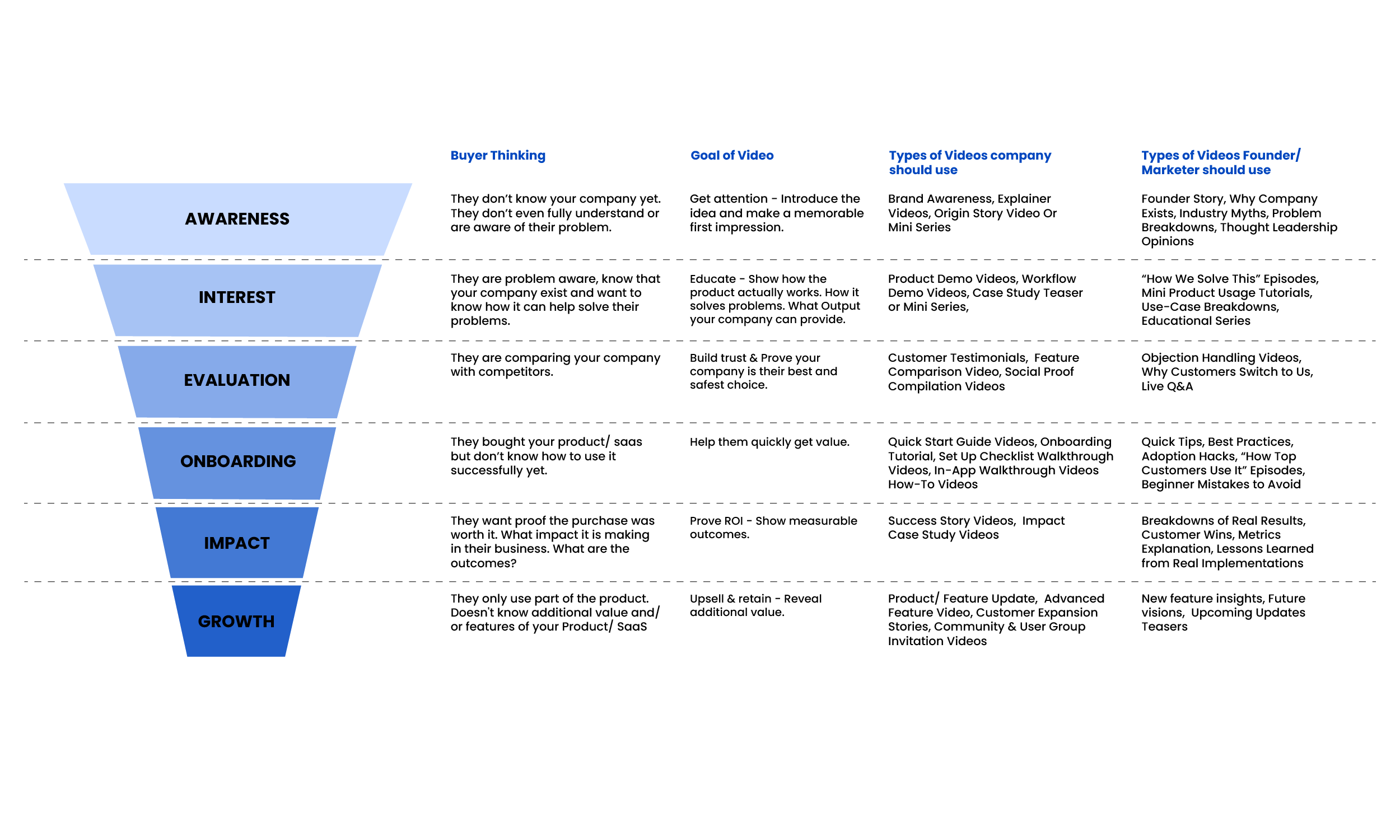
Here’s a simple breakdown of the six stages covered in this blog:
- Awareness – Buyers don’t fully understand their problem or know your company yet. Goal: capture attention and create problem awareness.
- Interest – Buyers know their problem and know you exist. Goal: educate clearly and show how your solution works.
- Evaluation – Buyers are comparing you with competitors. Goal: remove doubt, build trust, and prove ROI.
- Onboarding – Customers have purchased but haven’t achieved success yet. Goal: help them get value quickly.
- Impact – Customers are validating their decision internally. Goal: prove measurable results and reinforce confidence.
- Growth – Customers are underutilizing your product. Goal: drive adoption, upsell, and expansion.
The key takeaway: B2B video in 2026 is not about producing more content. It’s about building a structured video ecosystem that guides buyers from awareness to growth with clarity, proof, and confidence at every stage.
95% of B2B buyers say video influences their purchasing decisions. Yet most B2B companies are producing videos randomly without a structured strategy mapped to how buyers actually make decisions.
If you're a founder, CMO, VP of Marketing, or growth marketer at a B2B company, this blog is for you. We're breaking down exactly which types of videos to use at each stage of the B2B buyer's journey and why the companies that win in 2026 are the ones treating video as a system, not a campaign.
If you want deeper examples of how B2B SaaS brands are executing this in real life, you can explore these 9 Amazing Video Ideas for SaaS in 2026 (with Real Examples You Can Watch).
Why B2B Video Marketing Has Changed Everything in 2026
The old B2B marketing funnel is dead.
Old Funnel (2015):
Marketing educates → Sales persuades → Customer decides
New Journey (2026):
Content educates → Video proves → Sales confirms → Customer validates
Today, content educates, video proves, sales confirms, and customers validate through peer research and internal discussions. Buyers complete most of their decision-making before ever speaking to a salesperson. They watch demos, analyze case studies, compare vendors, and share videos internally with stakeholders. By the time sales enters the conversation, the preference is often already formed.
Video is no longer a supporting marketing asset sitting on a landing page. It has become the primary decision-making medium. It bridges the gap between information and trust. A blog post can explain a concept, but a well-structured video can demonstrate it in seconds. A brochure can describe features, but a product walkthrough shows real usability.
Modern buyers do not want polished claims or generic messaging. They want clarity. They want to see how something works in real scenarios. They want transparent comparisons, authentic customer experiences, and measurable results.
That’s why in 2026, video strategy cannot be random or campaign-based. It must be mapped intentionally across every stage of the buyer’s journey. The companies that win are the ones that structure their video ecosystem to guide buyers from awareness to growth with confidence and clarity.
Let’s walk through each of the six stages and the exact video types that move buyers forward at every step of the journey.
For each stage, we’ll cover two distinct tracks: one for your company’s brand channel and one for founders and marketers showing up personally.
Both matter. Both influence trust differently.
And when combined strategically, they accelerate pipeline movement far more effectively than either one alone.
1. AWARENESS STAGE
At the awareness stage, buyers don’t know your company and often don’t fully understand their problem. The goal of the video should be to capture attention, reframe the problem, and create curiosity. You’re selling problem awareness, not features.
Types of Videos Company should use:
Brand Awareness Videos
Explainer Videos
Origin Story Video Or Mini Series
For amazing explainer videos inspiration, explore these 8 Best SaaS Explainer Video Examples.
Types of Videos Founders/ Marketers should use:
Founder Story
Company Journey
Burst Industry Myths
Problem Solution Videos - Q&A Style
Thought Leadership or Opinion Videos
If you want a detailed breakdown specifically for founders, read 7 Types of Founder-Led Video Content for B2B.
At this stage, you’re not selling your product. You’re selling the problem awareness.
2. INTEREST STAGE
At the interest stage, buyers know they have a problem and know you exist. Now they want clarity on how you help. The goal is to educate clearly and show how your solution works in real scenarios. They want to understand your product without booking a call.
Types of Videos Company should use:
Product Demo Videos
Workflow Demo Videos
Case Study Teaser or Mini Series
If you’re structuring demo video content, study these 10 Best SaaS Product Demo Video Examples for 2026.
Types of Videos Founders/ Marketers should use:
“How we Solve This” Episodes
Mini Product Usage Tutorials
Use-Case Breakdowns
Educational Content
At this stage if your demo video still needs a salesperson to explain it, it’s incomplete.
3. EVALUATION STAGE
At the evaluation stage, buyers are comparing you with two or three competitors. They are thinking about adoption, ROI, and potential failure. Your job is to remove doubt and prove you are the best in the market and can help solve their problems.
Types of Videos Company should use:
Feature Comparison Videos
Customer Testimonials
Social Proof Compilation Videos
Types of Videos Founders/ Marketers should use:
Objection-Handling Videos
“Why Customers Switched to Us” Stories
Authentic testimonial videos that show real metrics, real challenges, and real results perform far better than scripted praise.
At this stage, the trust you build should accelerate sales pipeline velocity.
4. ONBOARDING STAGE
At onboarding, the buyer has purchased but hasn’t yet experienced success. They’re asking, “Now what?”. Your goal should be to help them achieve value quickly.
Types of Videos Company should use:
Quick Start Guide Videos
Onboarding Tutorial Videos
Set Up Checklist Walkthrough Videos
In-App Walkthrough Videos
How-To Videos
Types of Videos Founders/ Marketers should use:
Quick-Start Walkthroughs
Best Practice Videos
Beginner Mistakes to Avoid While Using this (XYZ Product)
“How Top Customers Use This”
In 2026, onboarding is not customer support. It's a growth strategy. The faster customers see value, the longer they stay.
5. IMPACT STAGE
At this stage, buyers are internally validating their decision. They’re asking, “Was this worth it?” This determines renewals. Your goal should be to provide measurable ROI and reinforce confidence.
Types of Videos Company should use:
Success Stories
Impact Case Study Stories
Types of Videos Founders/ Marketers should use:
Breakdowns of results
Share Customer wins
Videos with metrics explanation
Lessons learned from real implementations
If you want to build an Impact-stage video strategy that increases renewals and drives expansion revenue, start documenting your customer wins today.
6. GROWTH STAGE
At the growth stage, customers are using only part of your product. They may not fully understand the additional value available. Your goal should be to drive expansion and increase product adoption.
Types of Videos Company should use:
Product/ Feature Update
Advanced Feature Videos
Customer Expansion Stories
Community & User Group Invitation Videos
Types of Videos Founders/ Marketers should use:
New Feature Insights
Future Visions
Upcoming Updates
In 2026, product update emails are not enough. If customers don’t see the value visually, they won’t upgrade.
The Bottom Line: B2B Video Is No Longer a Tactic. It's Your Pre-Sales Engine.
Video is no longer just a marketing tactic sitting on a landing page or supporting a campaign. In 2026, it functions as your pre-sales engine, answering objections before the first call even happens. It acts as your trust builder, showing proof instead of making claims. It becomes your onboarding guide, helping customers achieve value faster. And it serves as your retention strategy, reinforcing ROI and revealing expansion opportunities long after the deal is closed.
The companies that win in 2026 will not be the ones producing the most content. They will be the ones designing the most structured video journey intentionally guiding buyers from awareness to growth with clarity, proof, and confidence at every stage.
Ready to Build Your Complete B2B Video Strategy?
We help US based B2B companies, founders, CMOs, and marketing leaders build structured, full-funnel video ecosystems that drive pipeline, shorten sales cycles, and increase renewals.
Not random content. Not one-off campaigns. A complete, intentional video journey mapped to your buyer's decision-making process.
Book a demo call today and let’s map your complete 6-stage B2B video strategy together.
Author:
Rajan Soni
Rajan is passionate about marketing & business. He believes in process & preparation over everything else.

