
🪄 AI Summary
Heading 1
Heading 2
Heading 3
Heading 4
Heading 5
Heading 6
Lorem ipsum dolor sit amet, consectetur adipiscing elit, sed do eiusmod tempor incididunt ut labore et dolore magna aliqua. Ut enim ad minim veniam, quis nostrud exercitation ullamco laboris nisi ut aliquip ex ea commodo consequat. Duis aute irure dolor in reprehenderit in voluptate velit esse cillum dolore eu fugiat nulla pariatur.
Block quote
Ordered list
- Item 1
- Item 2
- Item 3
Unordered list
- Item A
- Item B
- Item C
Bold text
Emphasis
Superscript
Subscript
In 2026, the barrier to producing video content is essentially zero. Anyone with a phone and a free AI tool can record, edit, and publish. That's the problem.
The supply of video has exploded. The quality of thinking behind it has not.
B2B founders and marketers are publishing more testimonial content than ever. Most of it sounds the same. "We were struggling with X. We found this company. Now everything is better." The viewer nods, scrolls, and forgets.
The reason is not the production. The reason is the script. Or the lack of one.
Customer testimonial videos are the highest-converting asset a B2B company can own. Research consistently shows that peer validation moves buyers faster than any ad or cold outreach. But that conversion only happens when the story is structured, specific, and believable. A poorly framed testimonial does not just underperform. It actively damages trust, because sophisticated buyers can feel when something has been coached into a corporate talking point.
This is where Claude, used correctly, changes things. Not as a replacement for the customer's voice, but as a system for extracting and structuring it.
Why Does This Matters for B2B?
Buyers trust peers over brands by a factor of three to one. A single well-scripted testimonial video, repurposed across LinkedIn, YouTube, and your website, can drive pipeline for 12 to 24 months. The script is the asset. Everything else is execution.
Why Most Testimonial Scripts Fail
Before the tutorial, understand the problem you are actually solving. Most testimonial scripts fail for one of three reasons.
First, they are too vague. "It saved us so much time" is not a testimonial. It is a placeholder for one. Buyers want specifics. Which team? How much time? Compared to what?
Second, they bury the transformation. The viewer needs to see a clear before and after. Not implied. Stated. The gap between where the customer was and where they are now is the entire point of the video.
Third, they are written for the vendor, not the viewer. When you ask a customer to talk about your product, they instinctively want to help you. So they say what they think you want to hear. It sounds polished, and it sounds fake.
Claude, with the right prompts, solves all three. It helps you build a structured question set that pulls out specificity, surface the transformation arc, and write a script that sounds like the customer, not the company.
What You Need Before You Start
This is a system. Like any system, the output quality depends on what you put in. Before opening Claude, gather the following.
1/ Raw interview notes or transcript
This can be a rough call recording transcript, written notes from a conversation, or even a bullet list of things the customer said. You need source material. Claude cannot invent specifics. You provide the truth; it provides the structure.
2/ The customer's role and company context
Claude needs to understand who is speaking. A VP of Sales at a 200-person SaaS company sounds different from a solo founder at a 10-person agency. This context shapes the tone, the vocabulary, and the credibility of the script.
3/ The primary viewer persona
Who is watching this video? What decision are they making? The script is not for your customer. It is written by your customer, for your next customer. Define that person clearly before you write a single word.
4/ The platform and format
A 90-second LinkedIn video has a different script structure than a three-minute website case study video. Claude handles both, but you need to specify the destination upfront. Format is not a styling decision. It is a strategic one.
5/ A Claude account (free or Pro)
Claude.ai works for this workflow. No API access required. The Pro plan gives you longer context windows, which matters when you are feeding in full interview transcripts.
The Four-Part Story Framework Claude Will Follow
Every testimonial script, regardless of length, needs four components. Think of it as a framework, not a template. Templates produce generic output. Frameworks produce structured thinking that you adapt to each customer's specific story.
When you prompt Claude, you are asking it to organize your raw interview material into this arc. You are not asking it to fabricate. You are giving it a structure and asking it to find the right material for each part.
Step-by-Step: Using Claude to Write the Script
Step 1: Set the context with a system-level prompt
Before you paste any interview notes, tell Claude exactly what it is working on. Context first. This is not a search query. Claude performs significantly better when it understands the goal, the audience, and the constraints before seeing the raw material.

Step 2: Paste the raw interview material
After the context prompt, paste your interview notes or transcript directly into the conversation. No need to clean it up. Claude handles messy, unstructured input well. What matters is that the real material is there.
Pro Tip
If you recorded the interview, run it through a free transcription tool like Otter.ai or Descript first, then paste the transcript. Even an imperfect transcript gives Claude far more to work with than summary notes alone.
Step 3: Request the first draft
Once the context and the raw material are both in the conversation, give Claude a clear instruction for the output.

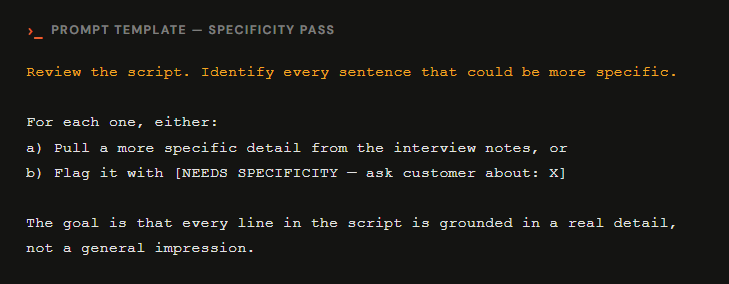
Step 4: Refine with a specificity pass
Read the first draft. Flag every line that is vague or generic. Then ask Claude to strengthen those specific lines.
Step 5: Create repurposing variations
A 90-second LinkedIn script becomes three different assets with one more prompt.

Common Mistake
Do not send the Claude-generated script directly to your customer and ask them to memorize it. Share it as a guide, not a script. Tell them: "Here are the four things we want to make sure come through. Say them in your own words." The structure is yours. The words should be theirs.
Troubleshooting Common Issues
Even with good prompts, you will hit friction. Here is what to do when Claude's output misses.
- The script sounds too polished: Add this to your context prompt: "Write at a 7th-grade reading level. Short sentences. Natural pauses. Avoid formal language."
- The Before section is too vague: Go back to your interview notes and look for a specific moment, a specific cost, or a specific frustration. Paste that section to Claude and ask it to rebuild only the Before using that material.
- Claude is inventing claims not in the interview: Add this line to your prompt: "Only use information explicitly stated in the interview notes. If a section cannot be completed without additional information, write [MISSING: ask customer about X] instead."
- The endorsement line feels weak: Ask Claude: "Rewrite the endorsement section. The viewer is a [specific role] at a [specific company type] dealing with [specific problem]. Write the endorsement so it speaks directly to that person."
- The 90-second script runs too long: Paste the script back and say: "Tighten this to 220 words. Remove qualifiers and filler. Keep every specific detail."
What This System Produces Over Time
One testimonial script, done correctly, creates six to eight distinct assets. The full script. The 30-second cut. The 15-second cut. The LinkedIn post. The quote pull for a case study. The slide for a sales deck. The email snippet for outbound sequences.
That is not a video project. That is a content system built around a single customer conversation.
The companies that consistently win at B2B content are not producing more. They are producing smarter. They are building systems that generate multiple assets from single inputs, and they are doing it in a way that the content feels human because it is grounded in real conversations, real specifics, and real customer language.
The script is the asset. Production is just delivery.
Claude is not replacing the thinking here. It is removing the friction between the raw material you already have and the polished asset your audience needs to see.
Most B2B video fails not because of budget or production. It fails because no one built a system for the thinking that comes before the camera turns on.
The framework above is one piece of a larger content operating system. The goal is not to produce more. The goal is to build infrastructure that makes every customer conversation compound over time, across platforms, without burning out the team behind it.
Consistency does not come from motivation. It comes from systems. This is one of them.
Done-For-You Video Content Systems
Want us to build this system for your company?
At Komet Media, we build done-for-you video content systems for US-based B2B companies. From customer testimonials to thought leadership clips, we handle scripting, production coordination, and repurposing across platforms, so your team can focus on what they do best.
Book a Demo Call | Get a Free Sample Clip in 48h