
🪄 AI Summary
Heading 1
Heading 2
Heading 3
Heading 4
Heading 5
Heading 6
Lorem ipsum dolor sit amet, consectetur adipiscing elit, sed do eiusmod tempor incididunt ut labore et dolore magna aliqua. Ut enim ad minim veniam, quis nostrud exercitation ullamco laboris nisi ut aliquip ex ea commodo consequat. Duis aute irure dolor in reprehenderit in voluptate velit esse cillum dolore eu fugiat nulla pariatur.
Block quote
Ordered list
- Item 1
- Item 2
- Item 3
Unordered list
- Item A
- Item B
- Item C
Bold text
Emphasis
Superscript
Subscript
Most B2B SaaS teams are making video content. Very few are making the right video content at the right moment. A customer-journey content map for video fixes that by pairing specific video types to each stage of how your buyers actually move from "I have a problem" to "I'm renewing." Here's exactly how to build one.
TL;DR
- A customer-journey content map for video assigns specific video types to TOFU, MOFU, BOFU, and Post-Purchase stages.
- Each stage has a distinct audience mindset, video format, content focus, and distribution channel.
- Wrong video at the wrong stage kills trust; right video at the right touchpoint accelerates pipeline.
- Start with your existing content, webinars, podcasts, demos, and atomize outward.
What Is a Customer-Journey Content Map for Video?
A customer-journey content map for video is a structured framework that assigns specific video types, content focuses, and distribution channels to each stage of your buyer's journey. It answers one critical question: which video should this buyer see right now, based on where they are mentally?
The average B2B buyer consumes 13 pieces of content before making a vendor decision, typically eight pieces of vendor-created content and five pieces of third-party content. Without a map, your team produces videos randomly, dumping demos on cold audiences and publishing explainer videos to prospects who are ready to buy. This is where most companies fall flat. They have great content, but it's not aligned with where the buyer is mentally. A video content map solves that alignment problem by design, not by accident.

The framework I use at Komet Media follows four stages:
- Top of Funnel (TOFU): Awareness
- Middle of Funnel (MOFU): Consideration
- Bottom of Funnel (BOFU): Decision
- Post-Purchase: Delight and Retention
Each stage has a distinct audience mindset. Each stage of the journey demands different types of messaging: awareness calls for educational, pain-aware content. The same logic applies to video. A testimonial video shown to someone who has never heard of you is a wasted asset. An explainer video shown to someone ready to buy is a conversion killer.
Research from Google and Vidico indicates that 70% of B2B buyers watch video content during their purchase decision process. The question is no longer whether buyers watch video. It's whether your video meets them at the right moment.
The Four-Stage Video Framework: What Goes Where
Here is the complete stage-by-stage breakdown. Every row reflects verified, practical data you can act on immediately.
This is your customer-journey content map for video in its most actionable form. Every production decision your team makes should trace back to one of these four rows.
How to Build a Customer-Journey Content Map for Video (Step-by-Step)
- Audit your existing content: List every webinar, podcast episode, demo recording, founder interview, and product walkthrough you already have. Most B2B SaaS teams are sitting on 6–12 months of repurposable video assets they've never atomized.
- Map each asset to a buyer mindset: Ask: "Who watches this, and what are they trying to decide?" A 45-minute product webinar is MOFU, your audience knows their problem and wants to see solutions. A 90-second founder story is TOFU.
- Identify your gaps: Use the four-stage table above. If you have no BOFU testimonials or no Post-Purchase onboarding series, that's where deals are leaking.
- Assign production priorities: Fill BOFU and MOFU gaps first. Product demos and customer testimonials work well mid-funnel to build trust and confidence in your offerings. These are the formats closest to revenue.
- Choose your distribution channels per stage: Don't spray every video everywhere. TOFU content belongs on YouTube, TikTok, Instagram Reels, and Meta video ads. MOFU lives on LinkedIn, your website's video marketing hub, and email sequences. BOFU assets belong on landing pages and Vimeo Showcase.
- Set stage-specific metrics: Measure Early Phase (Awareness) by reach and organic visibility for problem-oriented keywords; Middle Phase (Consideration) by content engagement, return visits, and downloads; Late Phase (Decision) by attribution of content touchpoints to opportunities and closing rates.
- Build a repurposing workflow: One long-form piece, a podcast episode or webinar, should yield 3–5 short-form clips mapped to different funnel stages.
Video Content Mapping by Customer Journey Stage: Deep Dive
TOFU, Awareness: The content focus here is them, not your product. Answer the "why" and "how" behind their daily challenges. Educational TikToks, short Reels, and documentary-style LinkedIn videos that frame the problem your buyer faces. Explainer videos are ideal for top-of-funnel engagement, simplifying complex ideas to attract potential customers. Publish on YouTube, TikTok, Instagram Reels, and Facebook Ads targeting broad interests. Do not pitch. Not once.
MOFU, Consideration: The content focus shifts to solutions and authority. Show how your specific offering removes their friction. Video types that work: product tutorials, webinars, behind-the-scenes glimpses, and thought leadership interviews. 70% of video marketers use LinkedIn, making it the most widely used platform for video marketing in 2025, suggesting increased B2B adoption and professional content strategies. Your short-form video editing workflow should be churning MOFU clips from every webinar and podcast you record.
BOFU, Decision: The content focus is proof. Let your satisfied customers do the selling. Customer testimonials, case studies, product demos, and personalized onboarding messages. These live on dedicated landing pages, targeted email sequences, and Vimeo Showcase. 89% of people say watching a video has convinced them to buy a product or service, highlighting the persuasive power of video content in the purchasing decision process.
Post-Purchase, Delight: The content focus is success. Help buyers win with their new purchase so they keep coming back. Onboarding series, advanced feature tutorials, and VIP community spotlights, delivered via Loom or Bonjoro for personalized outreach, or housed in a private knowledge base. This is the most underinvested stage in B2B SaaS video, and it's where retention and upsell live.
How to Align Video Content with Awareness, Consideration, and Decision Stages
The biggest mistake B2B teams make is treating video as a single-stage asset. They make a product demo and push it to cold ad audiences. It tanks. They assume video doesn't work for them. The real problem is stage misalignment. Wistia data shows that long-form videos have a higher conversion rate, with videos running between 30–60 minutes having the highest conversion rate of all lengths.
That's a MOFU and BOFU insight. Long-form content (webinars, demos) converts. But it only converts buyers who are already considering you. Running a 45-minute webinar replay as a cold awareness ad is a budget drain, not a strategy.
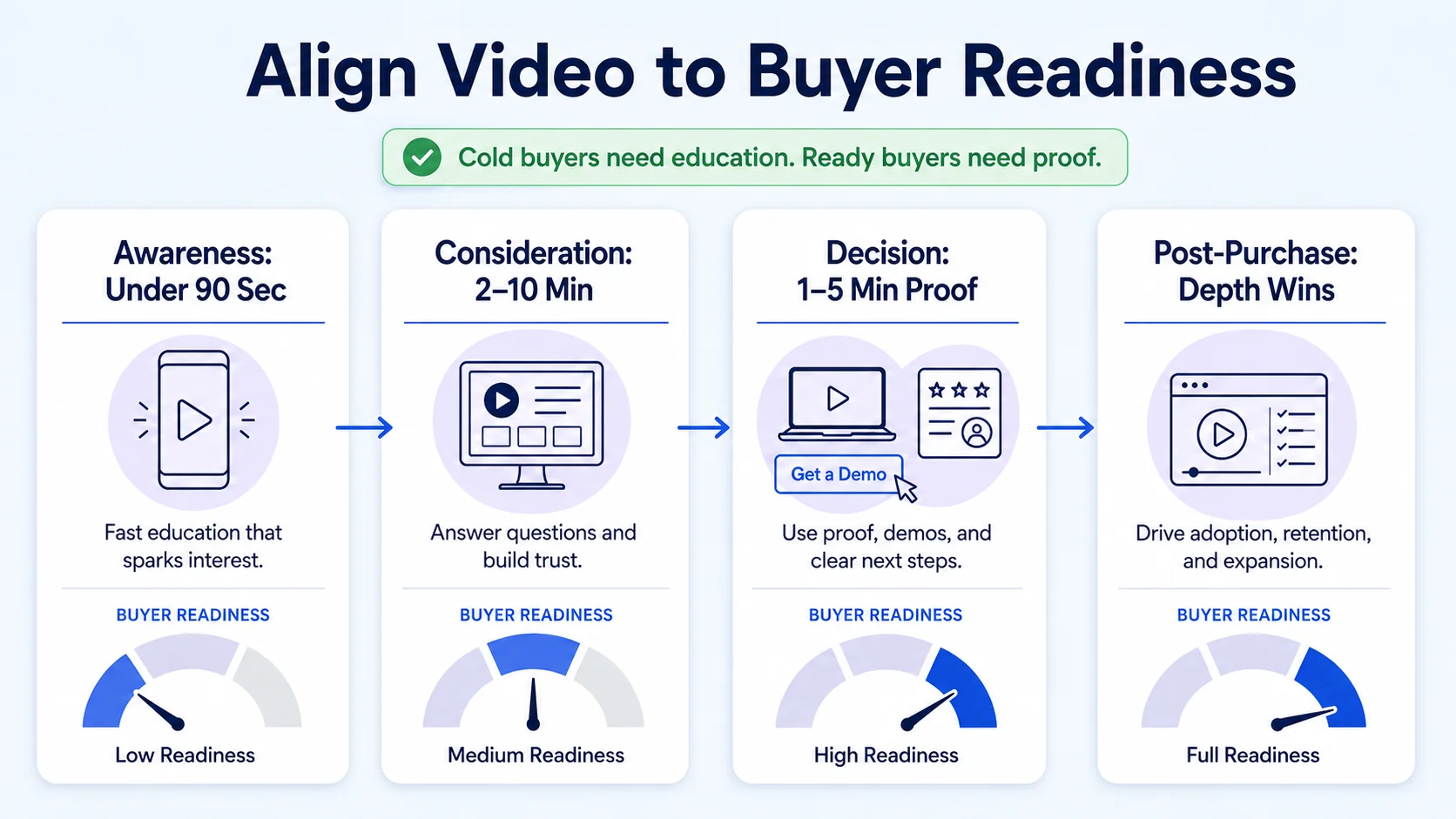
Alignment rules by stage:
- Awareness videos should be under 90 seconds, problem-focused, and emotionally resonant. No product names. No pricing. No CTAs to "book a demo."
- Consideration videos can run 2–10 minutes. They explain mechanisms, show workflows, and position your approach as the clearest path to the outcome the buyer wants. Donald Miller's StoryBrand framework applies here: put the buyer as the hero, your product as the guide.
- Decision videos are proof documents. Testimonials, case studies, and demos should be 1–5 minutes and end with a direct CTA, a demo booking link, a free trial, and a proposal.
- Post-Purchase videos can be as long as they need to be. The buyer is already committed. Depth beats brevity here.
Landing pages with videos convert 86% better than those without. That statistic applies most powerfully to BOFU landing pages where your testimonial and demo videos do the heavy lifting.
Best Practices for Mapping Video Content to Customer Touchpoints
A customer-journey content map for video only works if it's operationalized, not just planned.
- Start with content atomization. Every long-form asset, a webinar, a podcast episode, a recorded sales call, contains video segments mapped to multiple stages. A 45-minute webinar typically yields: one 90-second TOFU hook clip, two or three 3-minute MOFU explainer clips, and one BOFU clip featuring a customer question and your answer. That's 4–5 video assets from one recording session.
- Caption everything. With over 85% of social video viewed with the sound off, silent autoplay captions are critical for engagement and completion rates.
- Match platform format to stage. Vertical 9:16 for TOFU TikTok and Reels. Landscape 16:9 for MOFU LinkedIn and YouTube. Square 1:1 for email thumbnails.
- Use Vidyard or Wistia for MOFU and BOFU tracking. Both platforms let you see which prospects watched which videos and for how long. Integrating video performance analytics with CRM and marketing automation platforms provides a powerful feedback loop, allowing teams to track individual prospect engagement and use video watch data for lead scoring and personalizing follow-up communications.
- That data feeds your HubSpot lead scoring model directly.
- Gate MOFU assets behind a form, keep TOFU open. Your explainer videos and educational shorts should be ungated and distributed widely. Your webinar replays and detailed product tutorials earn an email address.
- Personalize BOFU outreach. Tools like Bonjoro and Loom let your sales team send personalized 60-second video messages after a demo request. This one practice lifts reply rates significantly and fits directly into the Post-Purchase delight stage for onboarding too.
A well-built customer-journey content map for video turns your content library into a pipeline machine. Every video has a job. Every job maps to a stage. Every stage maps to revenue.
Conclusion
A customer-journey content map for video is not a nice-to-have for B2B SaaS teams in 2026. It's the operational foundation that determines whether your video budget generates pipeline or just views.
Key takeaways:
- TOFU videos educate without pitching; MOFU builds authority; BOFU converts with proof; Post-Purchase drives retention.
- Each stage has a defined audience mindset, video format, content focus, and distribution channel, following the framework exactly.
- Content atomization turns one webinar or podcast into 4–5 stage-mapped assets.
- Measure stage-specific metrics: reach for awareness, engagement for consideration, attribution for decision.
Ready to map your existing content to every buyer stage? Start with Komet Media's services.
Frequently Asked Questions
Q1: What is a customer-journey content map for video?
A customer-journey content map for video is a strategic framework that assigns specific video types, content focuses, and distribution channels to each stage of the buyer's journey, Awareness, Consideration, Decision, and Post-Purchase, so every video serves a defined role in moving prospects toward purchase.
Q2: What types of videos work best at the top of the funnel?
TOFU video types are explainer videos, educational TikToks and Reels, entertaining short-form videos, and high-level industry documentaries. The content focus is on the buyer's problem, not your product. Publish on YouTube, TikTok, Instagram Reels, and Facebook Ads targeting broad interests.
Q3: What videos should I use at the bottom of the funnel?
BOFU video types are customer testimonials, case studies, product demos, and personalized onboarding messages. The content focus is proof. Publish on dedicated landing pages, targeted email sequences, and Vimeo Showcase to minimize purchase hesitation among prospects who are ready to buy.
Q4: How does content atomization fit into a video content map?
Content atomization takes one long-form asset, a webinar, podcast, or demo recording, and breaks it into multiple short clips, each mapped to a different funnel stage. One 45-minute webinar typically yields TOFU hook clips, MOFU tutorial clips, and a BOFU testimonial or Q&A excerpt.
Q5: Which platforms should I use for each stage of the video funnel?
Use YouTube, TikTok, Instagram Reels, and Meta video ads for TOFU. Use LinkedIn, your website resource center, and email autoresponders for MOFU. Use dedicated landing pages, targeted email sequences, and Vimeo Showcase for BOFU. Use Loom or Bonjoro for personalized Post-Purchase outreach.
Q6: How do I measure whether my video content map is working?
Measure TOFU by reach and organic visibility. Measure MOFU by content engagement, return visits, and content downloads. Measure BOFU by deal attribution, which video touchpoints are appearing in closed-won deals. Tools like Vidyard, Wistia, and HubSpot connect video watch data to CRM pipeline for accurate multi-touch attribution.