
TikTok for B2B Posting Cadence and Scheduling: Step-by-Step Guide
Most B2B teams dismiss TikTok as a consumer play. That's a mistake. The buyers you're trying to reach, VPs, founders, heads of growth, are already on the platform, scrolling between meetings. The question isn't whether TikTok for B2B posting works. It's whether you show up with a system or keep winging it. This guide breaks down exactly how often to post, when to post, how to build a content calendar, which tools to use, and how to repurpose what you already have.
TL;DR
- Post 3–4 times per week as a B2B baseline, quality over volume
- Tuesday through Thursday, 2–5 PM local time is your primary targeting window
- Build a content calendar around 3 content types: educate, position, proof
- Repurpose every long-form asset, demos, webinars, podcasts, into short-form clips
Does TikTok Actually Work for B2B Companies?
The demographic objection falls apart when you look at the data. Men aged 25–34 make up 19% of TikTok's global audience, and the 25–34 female demographic adds another 16.3%, meaning over one-third of users are in prime decision-making years. TikTok's demographic profile is shifting. The platform is no longer the exclusively Gen Z domain it was in 2022. The 35–44 age group is now the fastest-growing segment, and users over 45 represent a meaningful share of the audience.
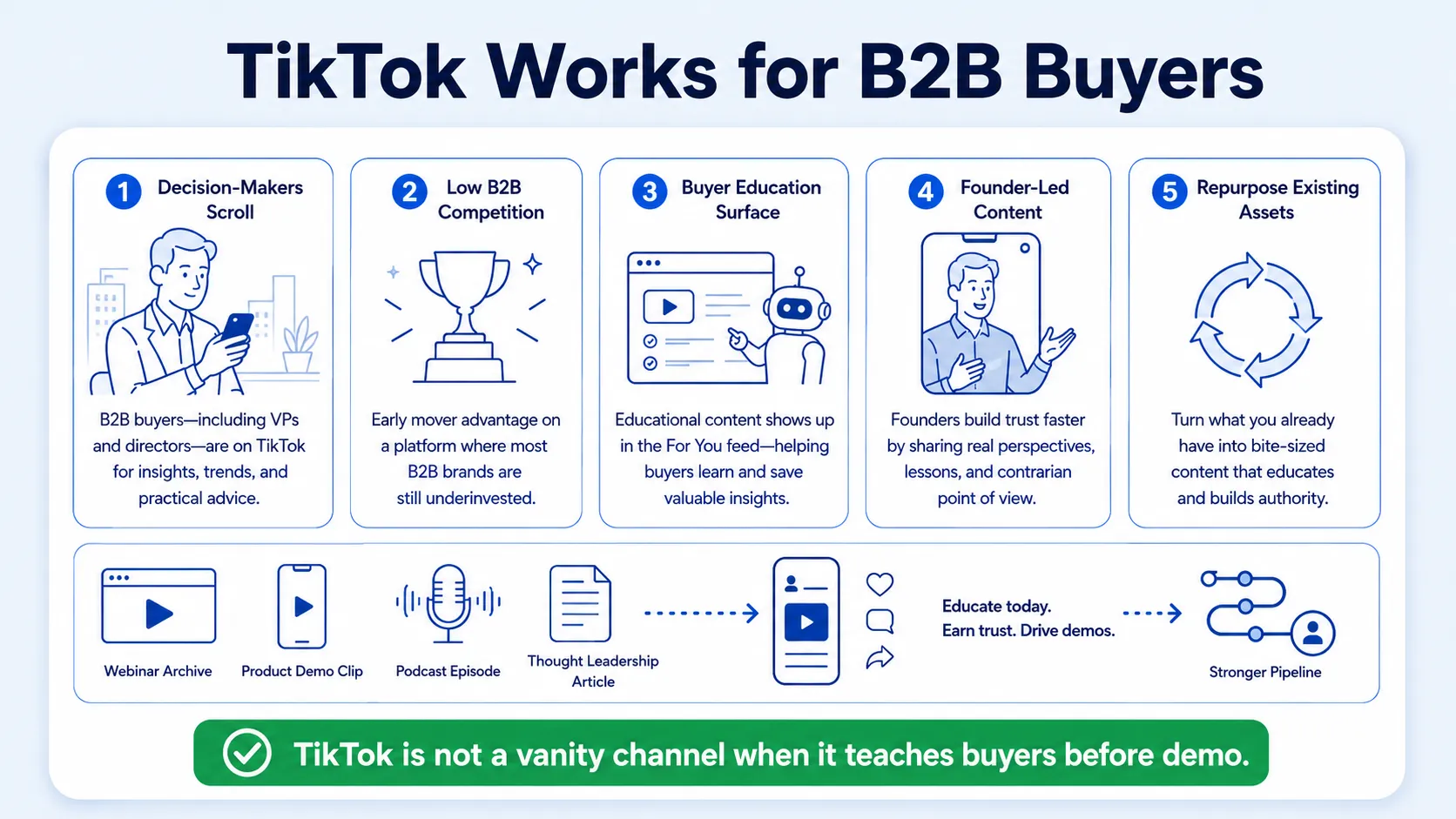
The decision-makers who authorize six-figure software contracts are on TikTok with their guard down, consuming content they chose from people they like. Audiences on TikTok are not in defensive scroll mode the way they often are on a platform full of job alerts and vendor pitches. The adoption gap makes this the right time to move.
According to HubSpot's State of Marketing 2025, only 8% of B2B marketers planned to invest in TikTok in 2025. That low competition means your content has more room to distribute, especially in niche B2B verticals like SaaS, AI tools, and funded tech. With 71% of marketers increasing their TikTok investments in 2026, the highest of any platform, the competition for attention is intensifying. The window to build early organic reach before it narrows further is right now.
For a SaaS founder or growth team, TikTok isn't a brand-awareness vanity channel. It's a buyer education and thought leadership surface that runs parallel to your B2B marketing funnel. When a prospect watches three of your product explainers before booking a demo, TikTok did pipeline work. At Komet Media, I see teams with webinar recordings, demo videos, and podcast episodes sitting untouched. Every one of those is a TikTok content repurposing workflow waiting to happen. The platform rewards specific, useful, founder-led content, which B2B teams are already producing in long form.
How Often Should B2B Companies Post on TikTok?
The short answer: 3–4 times per week. B2B content often performs best with 3–4 weekly high-value posts, while research indicates that TikTok Analytics reveals precise windows of opportunity for maximum content visibility. Buffer's analysis of data from over 11 million TikTok posts confirms: aim for 2–5 posts per week. Going from posting just once to 2–5 times per week offers the most meaningful lift in views. Specifically, creators posting 2–5 times per week saw up to 17% more views per post.
The key principle: frequency helps only when watch-time and completion stay strong, posting more weak videos can hurt. Here's how cadence should scale based on team capacity:
TikTok Business studies show that consistent publishers retain 45% more followers than irregular posters. Consistency beats sprints. A team that disappears for three weeks after a burst of posting signals low trust to both the algorithm and to buyers who found them.
Rule of thumb: Never post a video just to hit a quota. One strong educational clip that earns a 70%+ audience retention rate does more pipeline work than five mediocre posts. Posting 10 mediocre posts per week hurts more than posting 3 strong ones. For B2B SaaS teams, three polished, insight-dense videos per week is a sustainable, high-performance cadence to start.
Best Time to Post on TikTok for a B2B Audience
Timing matters at the launch window. When you post, TikTok decides who sees your video first. Your content gets distributed to a small group immediately. If those viewers watch longer, the algorithm shows it to more people. This initial 3-hour window is critical for success.
Sprout Social's 2025 dataset found that B2B audiences engage most mid-week afternoons (2–5 p.m.). Tuesday is the best day to post TikTok content in a business context. Wednesday and Thursday are the days when decision-makers are most mentally available and open to insights, tools, or frameworks. Post 30–60 minutes before peak windows so the video is indexed and climbing as your audience arrives. Here's a practical B2B posting window reference:
Posting in the afternoon captures professional "mental breaks," when users are likely to scroll without switching fully into personal mode. Weekends should be avoided entirely for B2B content due to sharply reduced business-focused intent. Use your own TikTok Analytics Dashboard: TikTok's creator and business dashboards show when your followers are actually active. Generic benchmarks are a starting point. After 30–60 posts, your own data is more reliable than any published chart.
How to Create a TikTok Content Calendar for B2B Marketing
A content calendar for TikTok for B2B posting is not a spreadsheet full of random ideas. It's a system that maps content types to funnel stages and repurposes what your team already produces. Build the calendar in three layers:
Layer 1: Content types (what you post)
- Teach: Product explainers, "how we built X," workflow teardowns, founder takes
- Position: Industry POVs, contrarian opinions, competitor comparisons, trend reactions
- Proof: Customer wins (anonymised), before/after use cases, team expertise clips
Layer 2: Source assets (where content comes from)
- Webinar recordings (clip to 45–90 second insights)
- Podcast episodes (pull founder soundbites)
- Sales demos (trim to feature highlights)
- Long-form LinkedIn posts (turn the argument into a talking-head video)
Layer 3: Publish rhythm (when it goes live)
- Map 3–4 weekly slots to your peak windows (Tue–Thu, 9 AM–4 PM local).
- Assign one content type per slot: two "Teach" videos, one "Position," one "Proof."
- Batch-produce every Monday for the following week.
- Use the TikTok Analytics Dashboard to review watch-time on Friday and adjust the next week's mix.
This is the content repurposing workflow we run at Komet Media for SaaS and AI teams. Every piece of long-form content, webinars, podcasts, feeds the short-form machine instead of sitting in a Drive folder. There is no one-size-fits-all TikTok posting frequency. To build the best content calendar for your business, you need to consider your niche, team size, and target audience behaviour.
TikTok Posting Schedule for B2B Brands in 2026: The Proven Framework
Here's how a mature B2B TikTok schedule actually runs week-to-week. This is a sustainable video publishing cadence that accounts for production lead time:
Week structure (4 posts/week):
- Monday (production day): Film and edit the week's four videos in one session. Batch production eliminates daily decision fatigue.
- Tuesday, 10 AM: Post Video 1, a "Teach" clip (product explainer, how-to, framework).
- Wednesday, 9 AM: Post Video 2, a "Position" clip (founder POV, industry take, contrarian angle).
- Thursday, 2 PM: Post Video 3, another "Teach" clip targeting a different pain point.
- Friday, 1 PM: Post Video 4, "Proof" or "Repurposed" clip (event highlight, podcast soundbite, customer outcome).
High-quality content with meaningful interaction is prioritized by 2026 algorithms over sheer volume, a "frequency floor" ensures relevance without triggering follower fatigue. Cross-publishing amplifies reach without extra production. Every TikTok video should simultaneously post to Instagram Reels and be logged for LinkedIn Cross-Publishing within 24–48 hours. This turns one video into three placements across the B2B marketing funnel without adding a single extra shoot.
Short-form video strategy principle: TikTok is the testing ground. What earns a 70%+ completion rate on TikTok becomes a LinkedIn video ad. What earns comments becomes a blog post. The algorithm gives you real-time buyer signals for free. 41% of B2B marketers say that, of all video formats, short-form drives the highest ROI, and TikTok is the highest-volume short-form testing environment available. Use it as your content R&D channel.
TikTok Scheduling Tools for B2B Marketers
Manual posting at exactly 10 AM Tuesday is not a content operation. It's a distraction. These tools handle the video publishing cadence so your team focuses on content quality.
Sprout Social offers an all-in-one solution for social media management, encompassing scheduling, engagement, analytics, and listening, its advanced reporting features and CRM integrations make it particularly valuable for businesses focused on customer relationships and detailed performance tracking. Later excels at visual content planning and scheduling for Instagram and TikTok, with a drag-and-drop calendar, media library, and link-in-bio tools.
The 2026 versions of Hootsuite, Buffer, and Sprout Social now layer AI-assisted timing recommendations, sentiment analysis, and content performance prediction on top of their core scheduling functions. For most B2B SaaS teams starting out: Buffer or Later for lean operations, Sprout Social once you need cross-channel reporting tied to pipeline data. TikTok's native scheduler inside the TikTok Business Account is also worth using as a fallback for quick single-video pushes.
How to Build a Content Repurposing Workflow for TikTok B2B Posting
The most sustainable short-form video strategy for B2B teams is not creating new content daily. It's systematically extracting short clips from long-form assets you already have. Here's the exact repurposing pipeline:
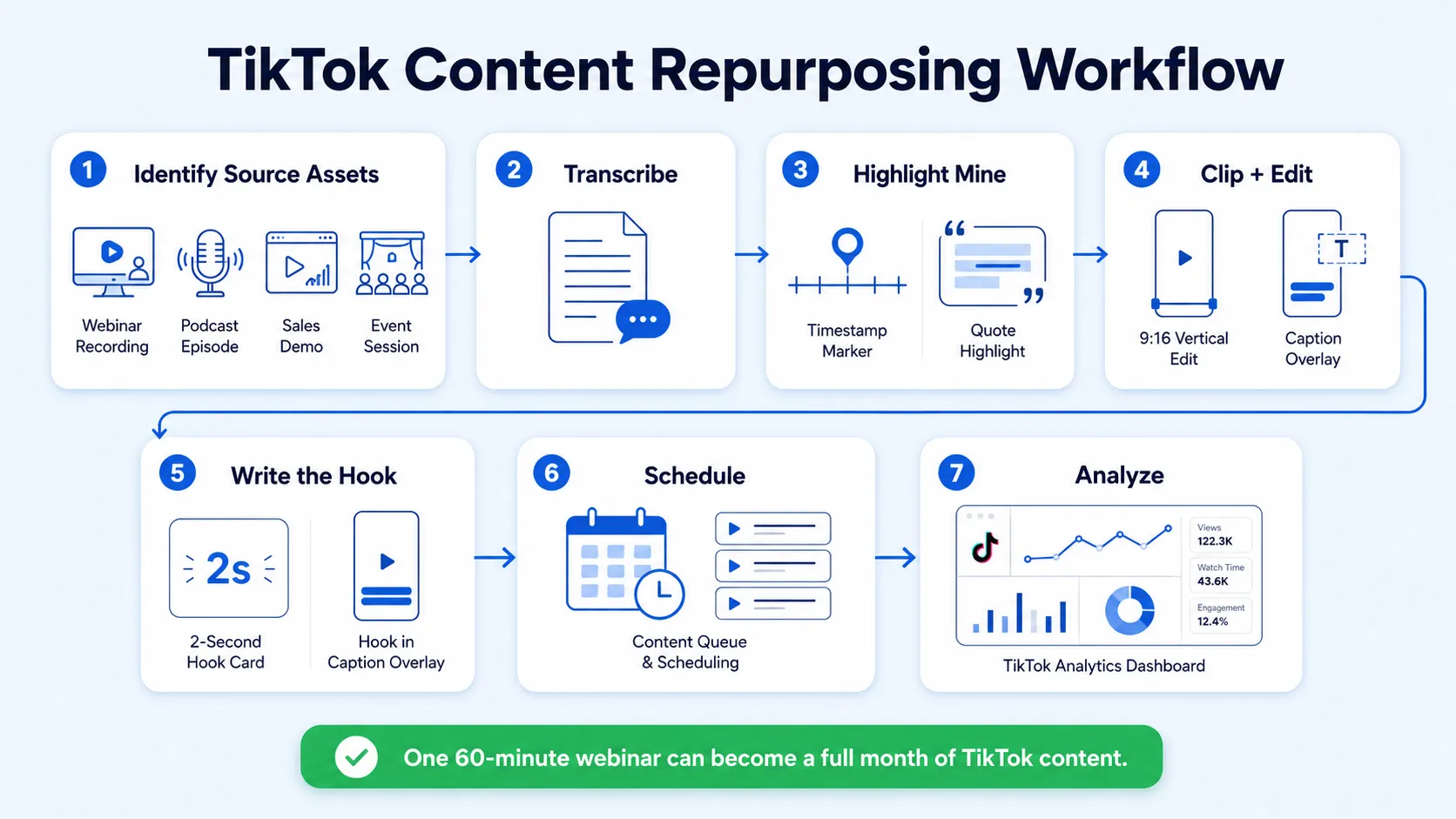
- Identify source assets: Webinar recordings, podcast episodes, sales demos, internal talks, and event sessions.
- Transcribe: Use automatic transcription to get a full text of each asset.
- Highlight mine: Mark every insight, quote, stat, or contrarian claim that stands alone in 30–90 seconds.
- Clip and edit: Cut each highlight into a vertical 9:16 video with captions, b-roll, or a talking-head frame.
- Write the hook: The first 2 seconds determine watch-time. Write a specific hook for each clip ("Why your SaaS demo is losing deals in the first 60 seconds").
- Schedule: Load clips into your scheduler (Later, Buffer, Sprout Social) with the correct posting window.
- Analyse: Check the TikTok Analytics Dashboard each Friday, watch-time, audience retention rate, and shares are your primary signals.
The top social media marketing channels for B2B in 2025 are short-form videos on YouTube, Instagram, and TikTok, and 78% of B2B marketers now use video, with more than half planning to increase investment.
At Komet Media's video marketing services, we run this exact pipeline for SaaS and funded AI teams. A single 60-minute webinar routinely yields 8–12 standalone TikTok clips, each targeting a different pain point in the B2B marketing funnel. That's a month of consistent TikTok content from one asset.
The TikTok Creator Marketplace is worth exploring for distribution amplification once your organic library is established. Partnering with niche B2B creators in your vertical accelerates brand awareness metrics faster than organic reach alone, especially for new accounts building their first 90 days of content.
Conclusion
TikTok for B2B posting works, when it's treated as a system, not a side project.
- Cadence: 3–4 posts per week is the proven B2B baseline. Consistency over volume.
- Timing: Tuesday through Thursday, 9 AM to 5 PM local time, with a 30–60 minute pre-peak upload buffer.
- Calendar: Map three content types (Teach, Position, Proof) to weekly slots. Batch produce on Mondays.
- Repurpose: Every webinar, podcast, and demo is already TikTok content, it just needs to be clipped, captioned, and published.
The team that starts now builds an organic reach advantage that compounds. Start building your video system with Komet Media.
Frequently Asked Questions
Q1: How many TikToks should a B2B company post per week?
Three to four posts per week is the recommended baseline for most B2B brands. This cadence balances algorithm consistency with the production quality needed to hold a decision-maker's attention. Scaling to five posts per week is viable with agency or in-house editing support.
Q2: What is the ideal TikTok cadence for a B2B brand just starting out?
Start at two to three posts per week for the first four weeks. Focus on educational "Teach" content, product explainers, founder POVs, workflow tips. Once watch-time data accumulates in your TikTok Analytics Dashboard, adjust cadence and timing based on your audience's actual behaviour.
Q3: Can B2B brands actually get results from TikTok?
Yes. The 25–34 demographic represents over one-third of TikTok's global audience, and these users hold purchasing authority. B2B brands running consistent educational content use TikTok as a buyer education and thought leadership channel that feeds the pipeline alongside LinkedIn.
Q4: What is the best time to post on TikTok for a B2B audience?
Sprout Social's 2025 data identifies Tuesday through Thursday, 2–5 PM local time, as the primary peak for B2B engagement. For most North American SaaS teams, posting at 9–10 AM ET Tuesday and Wednesday captures the morning professional scroll window as well.
Q5: Which scheduling tool should a B2B team use for TikTok?
Lean teams and startups should start with Buffer or the Later App, both support TikTok natively and offer free entry tiers. Growth-stage teams with multi-platform reporting needs should evaluate Sprout Social, which integrates analytics with CRM-level data for pipeline attribution.
Q6: How do I build a TikTok content calendar without producing content from scratch every week?
Use a content repurposing workflow: transcribe your webinars, podcasts, and demos, extract 30–90 second insight clips, edit to vertical format with captions, and schedule using a publishing tool. One 60-minute webinar typically yields 8–12 standalone TikTok clips, that's a full month of TikTok content from a single session.

