
Repurposing Long-Form Video Content Into TikTok for B2B & AI/Tech Startups: Step-by-Step Guide
I'm Rajan Soni, Founder and Video Director at Komet Media. Every week, B2B SaaS founders and AI startup teams sit on hours of recorded webinars, product demos, and podcasts that almost nobody ever watches again. Repurposing long-form video content into TikTok is the fastest way to unlock that trapped value, reach buyers earlier in the funnel, and build the kind of trust that moves the pipeline. This guide gives you the exact framework we use.
TL;DR
- A single 60-minute webinar or demo can generate 20 to 30 short TikTok clips that educate buyers at every funnel stage.
- 67% of B2B buyers now prefer a rep-free, self-serve buying experience , which means your clips need to show up before a sales conversation starts.
- Bite-sized vertical videos are still the dominant format across social media, and short-form video delivers the highest ROI versus other formats.
- The right video repurposing workflow turns one recording into weeks of demand-generation content, with no new shoots required.
Does TikTok Actually Work for B2B, or Is It Just B2C?
This is the most common objection I hear from SaaS founders. The honest answer: TikTok works for B2B, but only if you treat it as an education and trust channel, not a viral stunt machine. TikTok is no longer just for consumer brands, it is a growing platform for B2B SaaS companies to connect with professionals, and its algorithm lets you target decision-makers like IT managers and startup founders with tailored, short-form video content.
The key mechanism is intent-based discovery. TikTok's algorithm surfaces content by interest, not just by who you follow. That means a clip explaining "how to reduce churn in your SaaS product" can reach a VP of Product who has never heard of your brand. TikTok's algorithm prioritizes user interests, making it possible to reach professionals during their downtime. It is less saturated with B2B ads than LinkedIn, offering better reach and lower costs.
For funded AI startups and SaaS teams with tight CAC targets, that gap matters. Household names in SaaS like Salesforce, ClickUp, and Zapier are actively posting on TikTok. They are not there for brand vanity, they are there because their buyers are spending time on the platform between Zoom calls. Busy decision-makers have "pockets of downtime", waiting for a meeting to start or grabbing a coffee, and short videos fit perfectly into those pockets. A 30-second clip respects their time and delivers what marketers call "snackable" value.
17% of B2B marketers plan on investing the most on LinkedIn this year, followed by TikTok and Instagram at 13% each, a meaningful shift for a platform that most B2B teams had written off two years ago. The early movers in B2B TikTok are winning discovery before the competition even shows up. The content angle for B2B is also different from B2C. You are not chasing trends or dances. You are publishing buyer education: product explanations, founder thinking, category insights, and customer proof. That content builds real pipeline trust.
What Parts of a Long Webinar Work Best as TikTok Clips?
Not all moments in a 60-minute webinar are equal. Knowing which segments to extract saves hours of editing and produces clips that actually hold attention. The best short-form videos for SaaS companies usually include product micro-demos, founder insights, webinar highlights, customer success stories, onboarding tips, and educational clips that explain one useful idea quickly. Here is how I categorize clips from any long-form recording:
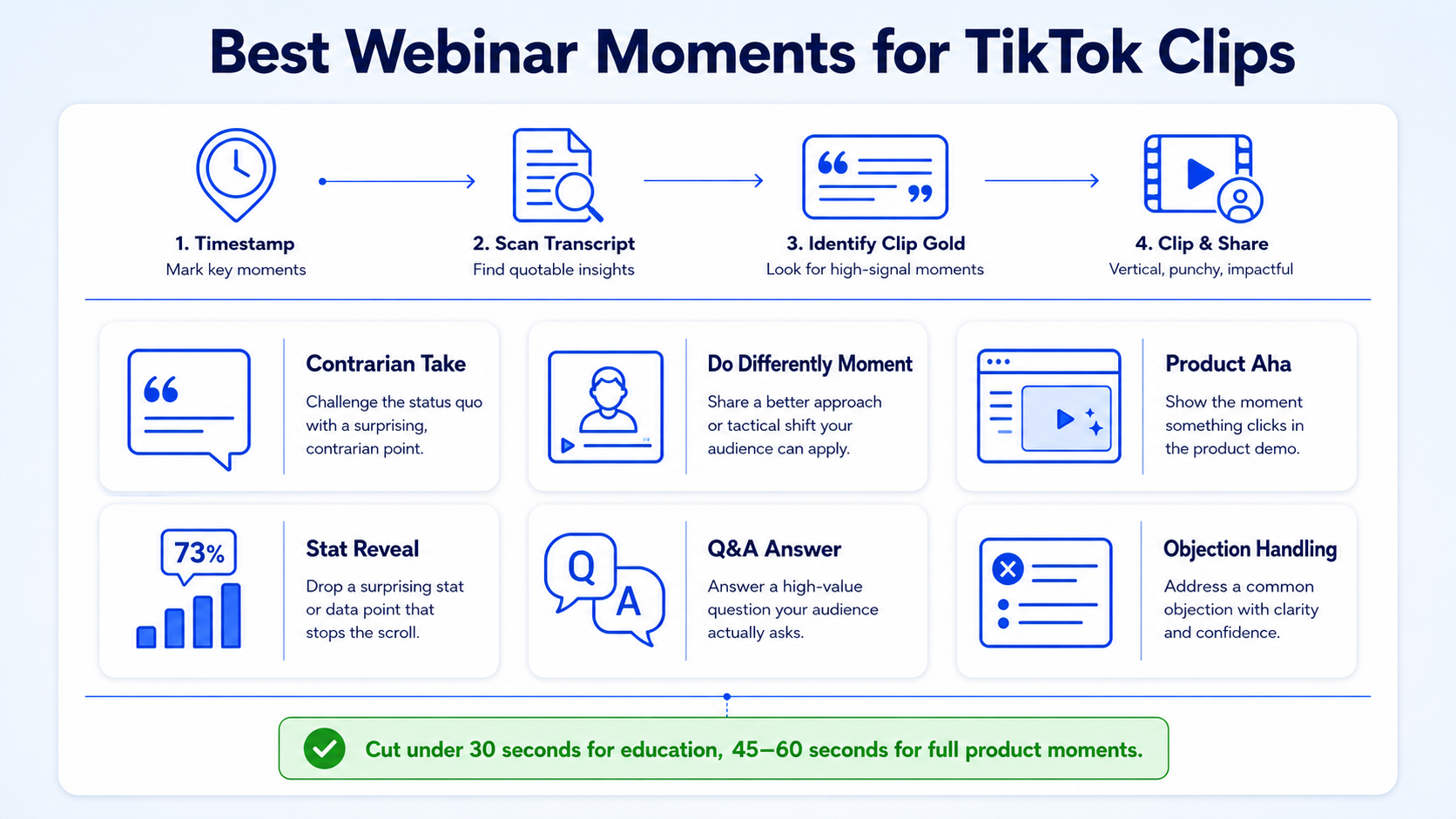
High-yield clip types for B2B TikTok:
- Strong opinion or contrarian take: A speaker disagreeing with a common industry belief is an instant hook. These clips spark comments, shares, and saves.
- "One thing I'd do differently" moments: Retrospective insights from founders or executives feel authentic and get replayed.
- Product "aha" moments: The instant a demo reveals something unexpected. These function as visual micro-demos that build product curiosity.
- Stat or data reveals: A striking number delivered on camera creates a screenshot-worthy clip that educates without requiring the viewer to watch the whole session.
- Q&A answers: Live Q&A segments produce naturally conversational clips. The question-to-answer format maps perfectly to TikTok's educational style.
- Objection handling moments: When a speaker addresses a real buyer objection out loud, that clip does sales enablement work on its own.
The compounding move is repurposing: a single 45-minute webinar becomes a dozen short clips, a highlight reel, and gated on-demand content. At Komet Media, we routinely pull 20 to 30 usable clips from a single session when we approach it with a structured clipping framework. TikTok videos under 30 seconds have an average completion rate of 72%, while those between 30 and 60 seconds have a rate of 54%. That completion data tells you exactly where to cut: under 30 seconds for pure education, 45 to 60 seconds when you need to show a full product moment or argument. Anything longer needs a very strong hook in the first three seconds to survive.
How to Repurpose Long-Form Video Content Into TikTok: Step-by-Step
This is the exact workflow we run at Komet Media for B2B SaaS and AI startup clients. Follow these steps in order.
- Audit your existing recording library: Pull every webinar, podcast episode, demo recording, founder interview, and sales call with consent. Most teams have six to twelve months of content already recorded and doing nothing.
- Transcribe the full recording: Use Descript or any transcription tool. Working from text is 3x faster than scrubbing through a timeline. It also makes keyword and topic identification trivial.
- Tag clip candidates by type: Mark timestamps for opinion moments, data reveals, product demonstrations, and Q&A answers. Aim for 15 to 25 candidate clips per hour of footage.
- Write a one-sentence hook for each clip: The hook is the first three seconds. If you cannot write a hook that would stop a scrolling thumb, the clip is probably not strong enough to publish.
- Edit for vertical format (9:16 at 1080x1920): Vertical video in the 9:16 aspect ratio is the dominant format, perfect for mobile viewing and creating concise SaaS product demos.
- Add captions: Captions are non-negotiable. A large percentage of TikTok views happen with sound off, especially on mobile during work hours.
- Apply a consistent brand style: Logo placement, text overlays, and color consistency help B2B buyers recognize your content across repeat exposures.
- Schedule and distribute: Push clips to TikTok, LinkedIn video, and Instagram Reels. One clip, three placements, no extra production cost.
- Review analytics weekly: Double down on clip formats that drive profile visits, link clicks, and saves, those signals indicate buyer-intent behavior, not just entertainment.
Tools for Automatically Clipping Long Videos Into TikToks for Startups
You do not need a large production team to build a repurposing workflow. The right tool stack reduces a full-day editing job to under two hours. Here is what we recommend based on where your team sits today.
Opus Clip is the leading AI tool for converting long-form video, podcasts, YouTube videos, livestreams, interviews, into short TikTok-ready clips. It uses AI to identify the most engaging moments, extract clips at optimal length, add captions, and reframe the video to vertical format.
Opus Clip differentiates itself with its ClipAnything AI model that analyzes visual, audio, and sentiment cues to identify viral-worthy moments, plus automatic captions in 25+ languages and AI reframing. Pricing starts free (60 credits/month with watermarks), with paid plans at $15/month (Starter) and $29/month (Pro).
Many serious creators use both: OpusClip surfaces clip candidates, CapCut handles the polish. That is the hybrid workflow I recommend for most SaaS teams: AI does the heavy lifting on clip identification, a human editor applies brand standards and refines the hook. For teams using our short-form video editing and content creation services, we layer our editorial judgment on top of these tools, whether we are repurposing existing footage or filming new content from scratch, because AI clipping scores for virality, not necessarily for B2B buyer intent.
How AI Startups Use TikTok to Build Audience and Pipeline
AI and tech startups have a structural advantage on TikTok that most founders are not using: the product itself is interesting. When you build in a space that has genuine curiosity around it, AI, automation, data, educational content about your category naturally attracts your buyers.
A B2B SaaS TikTok strategy is a framework for using educational, native-style video to capture high-intent buyers who now use social media as their primary search engine. By shifting from viral trends to informational TikTok content, startups can generate qualified leads with lower customer acquisition costs than traditional search ads.
The most effective content categories for AI startups on TikTok are:
- Category education: "What is [your AI category] and why does it matter for [ICP role]?" These clips build awareness before intent exists.
- Founder POV clips: A founder explaining a product decision or market insight builds trust faster than any ad. A founder speaking directly into a phone camera creates more trust than a generic corporate motion graphics video.
- Feature reveal clips: Short, specific walkthroughs of one feature. Not a full demo, one moment, one benefit, one CTA.
- Contrarian takes on your category: "Why [common belief in your space] is wrong" drives comments and positions your brand as a thought leader.
AI-driven video campaigns now enable SaaS companies to create tailored content for different audience segments, significantly improving video ROI for B2B through effective customer segmentation. For AI startups, that means creating separate clip tracks for technical users (developers, data teams) and business buyers (heads of ops, marketing leads, founders), same recording, different clip angles, different hooks.
Content atomization is the discipline here: one webinar or podcast episode becomes founder clips, product clips, category-education clips, and customer story clips, all from the same 60 minutes. Distribute them through a structured content calendar and you have daily TikTok presence without daily production overhead.
TikTok Strategy for B2B SaaS: Building a Content System, Not Just Clips
Repurposing long-form video content into TikTok is not a one-time tactic. It works when it becomes a repeatable system connected to your broader B2B content strategy and demand generation motion. The most efficient strategy involves repurposing one piece of long-form content like a webinar into multiple short video assets for different channels. That efficiency only compounds when you build a consistent cadence around it.
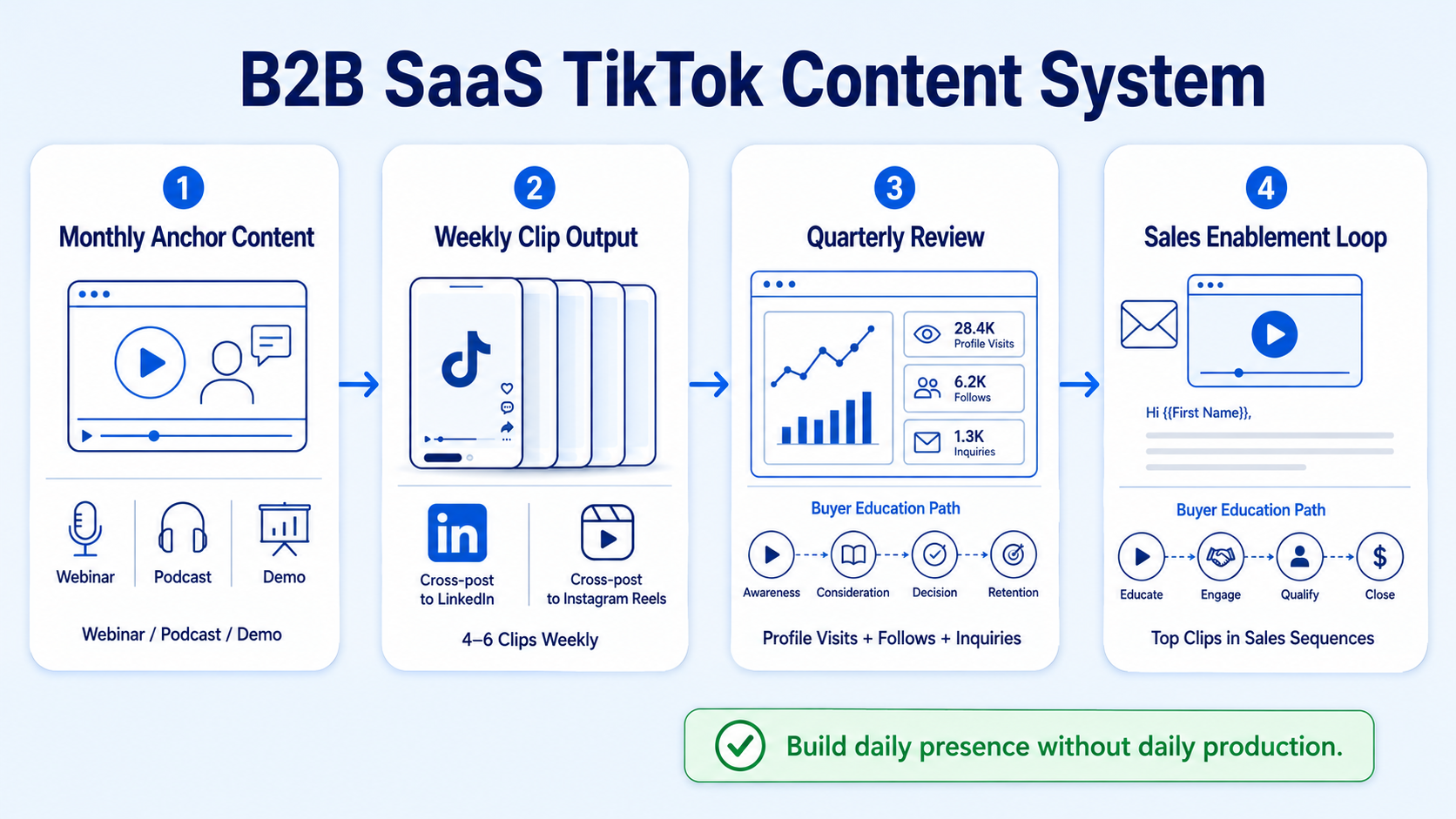
Here is how a sustainable TikTok system looks for a SaaS or AI startup team:
- Monthly anchor content: One webinar, podcast episode, or product demo serves as the raw material. Our webinar repurposing services are built exactly around this model.
- Weekly clip output: 4 to 6 clips per week, drawn from that anchor content, published on a rotating schedule across TikTok, LinkedIn video, and Instagram Reels.
- Quarterly content review: Identify which clip types generated the most profile visits, follows, and inbound inquiries. Shift the content mix accordingly.
- Sales enablement loop: Your top-performing clips go into your sales team's outreach sequences. A clip that educates a buyer organically is twice as effective when a rep sends it in a follow-up.
The 2025 Edelman x LinkedIn Thought Leadership Impact Report revealed that 55% of decision-makers use thought leadership as part of their vetting process. Short-form video on TikTok and LinkedIn video is now the fastest distribution channel for thought leadership, not a replacement for depth, but the top-of-funnel entry point that earns the right to go deeper.
Video SEO also matters at this stage. Use your primary keyword and buyer-relevant language in your TikTok caption, on-screen text, and spoken hook. TikTok's search function is increasingly used as a discovery engine, particularly among younger B2B decision-makers who grew up on the platform.
How to Measure ROI From TikTok for B2B SaaS Teams
ROI from repurposing long-form video content into TikTok is real, but the metrics are different from paid search or email. Measuring the wrong things leads teams to abandon the channel before it compounds. A Statista survey reports that Facebook leads in perceived B2B ROI, with 22% of respondents saying it is the highest; Instagram, TikTok, and YouTube each came in second, mentioned by 16% of respondents.
The perception gap exists because most B2B teams measure TikTok against direct-response benchmarks. The correct frame is demand generation and brand awareness, the same lens you use for content marketing. Metrics that actually signal B2B ROI from TikTok:
- Profile visits per clip: A buyer clicking through to your profile is intent behavior. High profile-visit rates indicate the clip is reaching the right audience.
- Saves: When a B2B buyer saves a clip, they intend to reference it later. This is a high-intent signal in a professional context.
- Link-in-bio clicks: Track clicks to your website, demo booking page, or contact page from TikTok directly.
- Branded search lift: As TikTok awareness grows, monitor whether direct and branded search traffic increases in parallel. This is the clearest signal of top-of-funnel impact converting to mid-funnel intent.
- Inbound attribution: Ask every inbound lead "where did you first hear about us?" and track TikTok mentions explicitly.
Video is central to B2B buyers' research behavior: 98% of B2B decision makers have watched explainer videos, and 87% of B2B buyers say video influenced their purchase decisions. Those numbers confirm that video is already in the buying process, TikTok just extends your reach into the awareness phase, before a buyer knows they need what you sell. Short-form video on TikTok is not a brand awareness experiment. For B2B SaaS, it is a buyer education channel that warms pipeline before your sales team ever makes contact.
Conclusion
Repurposing long-form video content into TikTok is the highest-leverage content move available to B2B SaaS and AI startup teams in 2026. You already have the raw material.
Key takeaways:
- One webinar or demo recording yields 20 to 30 publishable TikTok clips with a structured clipping workflow.
- The best B2B clip formats are opinion moments, product "aha" reveals, data-driven insights, and founder-to-camera commentary.
- Opus Clip and CapCut together cover the core of your editing stack; Descript handles transcript-led workflows.
- Measure TikTok ROI through saves, profile visits, branded search lift, and inbound attribution, not just views.
If your team is sitting on recorded webinars and demos, you are sitting on a content library. Let's put it to work. Explore Komet Media's video repurposing and short-form video services or get in touch to start building your pipeline video system.
Frequently Asked Questions
Q1: How many TikTok clips can I realistically get from one 60-minute webinar?
A structured clipping approach pulls 20 to 30 distinct clips from a single 60-minute session. That covers opinion moments, data reveals, Q&A answers, and product demonstrations. Most teams underestimate how many strong moments exist in a single recording until they audit it with a clip-first lens.
Q2: What is the ideal TikTok clip length for B2B content?
TikTok videos under 30 seconds have an average completion rate of 72%, while those between 30 and 60 seconds drop to 54%. For B2B buyer education, aim for 30 to 45 seconds per clip. Reserve 60-second clips for product moments that require context to land properly.
Q3: Do I need a separate TikTok content strategy from my LinkedIn strategy?
Not entirely. Repurposing long-form video content into TikTok clips typically works cross-platform, the same 9:16 clips publish to LinkedIn video and Instagram Reels. Adjust the caption tone slightly for each platform, but the core clip and hook remain consistent.
Q4: What hook formula works best for B2B TikTok clips?
The most reliable B2B hooks are problem-forward: "Here's why most [ICP role] get [topic] wrong..." or "One change that reduced our [pain point] by [result]." Specificity in the first three seconds is the single biggest driver of completion rate and saves for professional audiences.
Q5: Should a founder appear on camera for TikTok, or can we use screen recordings?
Both work, but founder-to-camera clips consistently outperform screen recordings for trust-building. A founder speaking directly into a phone camera creates more trust than a generic corporate motion graphics video. Use screen recordings for product walkthroughs, but lead with a human face on the hook frame.
Q6: How long before TikTok produces measurable B2B results?
Most B2B SaaS teams see measurable signals, profile visits, inbound attribution mentions, branded search lift, within 60 to 90 days of consistent posting (four to six clips per week). Consistency is the key to leveraging TikTok for brand growth; even with the right tools and strategies, irregular posting prevents compounding results. The teams that quit at 30 days never see the compounding effect.

