
How to Start a Podcast with No Audience: Step-by-Step Guide
Most people overthink how to start a podcast with no audience. They wait for the perfect mic, a big following, or a fully formed content strategy. I've seen founders, SaaS teams, and executives stall for months because of this. The reality? You have the knowledge. You have the perspective. The medium rewards specificity, consistency, and patience, not pedigree. This guide gives you the exact process, from gear to growth, so you can stop planning and start publishing.
TL;DR
- You don't need an audience to launch, you need a niche, a dynamic microphone, a hosting platform, and a consistent publishing schedule.
- Spotify for Creators is the best podcast hosting platform for beginners because it's free and easy to use.
- The typical timeline from launch to a meaningful, engaged audience is 6 to 18 months of consistent effort.
- Your fastest growth lever is content repurposing—or partnering with an end-to-end production agency like Komet Media to handle show creation from scratch, clips, show notes, and social assets.
Starting a Podcast from Scratch with Zero Listeners: What Actually Matters
Around 58% of Americans aged 12 and older consumed a podcast in the past month, representing an estimated 167 million monthly U.S. podcast consumers. The market is not saturated for good, specific shows. Niche communities are getting stronger, and smaller shows can grow faster when the audience is tightly defined.
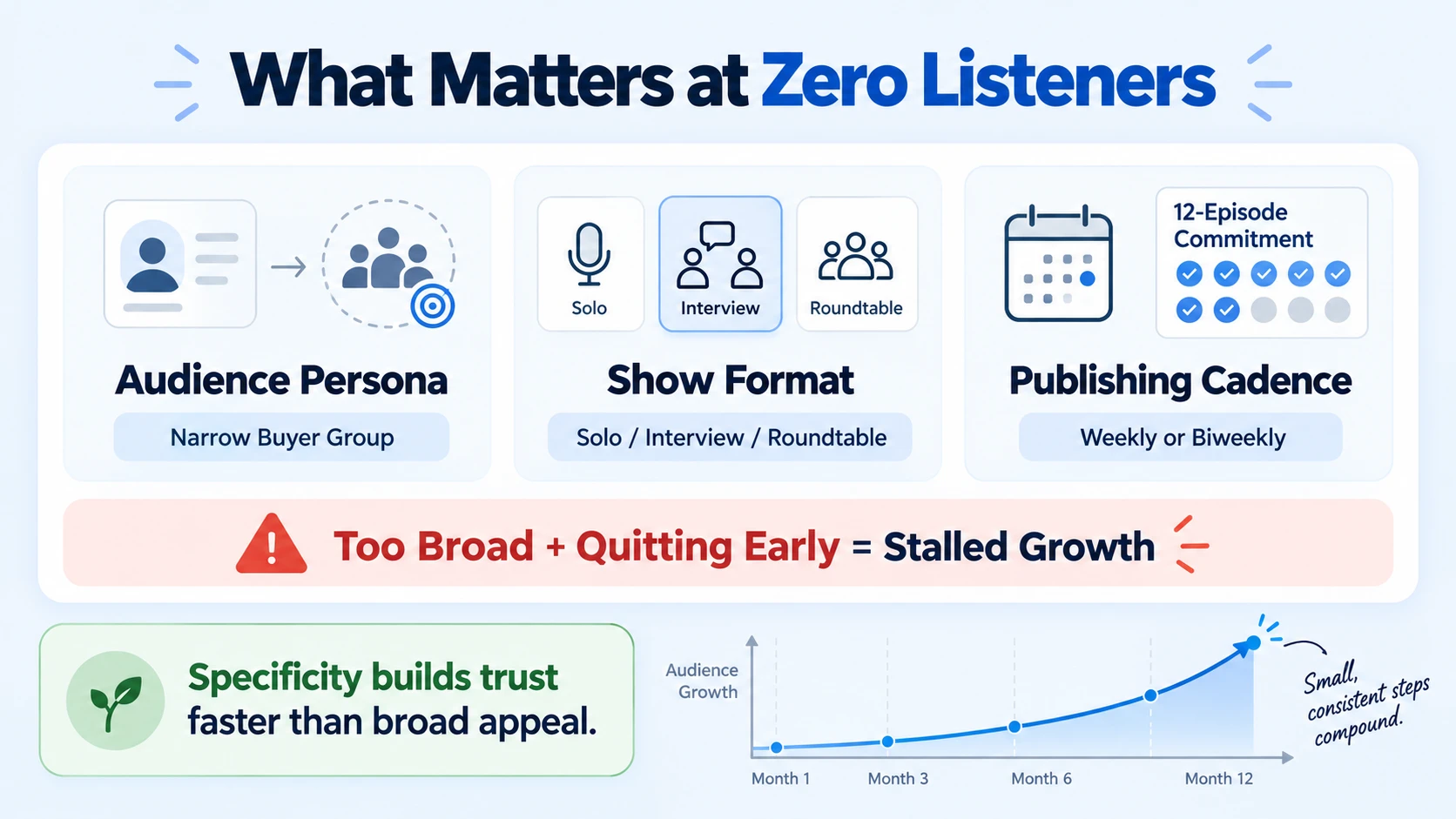
When you start with zero listeners, three decisions determine everything else:
- Define your audience persona first: Not "business professionals" but "Series A SaaS founders dealing with churn." The narrower the definition, the faster trust compounds.
- Pick a format and commit to it: Solo commentary, guest interviews, or co-hosted roundtables each demand different prep. Choose one and stay consistent for at least 12 episodes before reassessing.
- Establish your publishing cadence: Most podcasts publish weekly or biweekly, and consistent cadence is one of the strongest predictors of steady growth. New shows often need 8 to 16 weeks of consistent publishing before audience growth becomes predictable.
Two things derail new podcasters before they ever find an audience: they go too broad, and they quit too early. Broad topics appeal to no one specifically, and quitting in month three means stopping just before the compound growth curve kicks in.
For B2B founders and SaaS teams, the show topic is not the product, it's the problem your buyers are actively thinking about. An AI startup founder should be talking about go-to-market strategy, not just their product's features. That positioning creates inbound trust, not just downloads.
What Equipment Do You Need to Start a Podcast as a Beginner?
You do not need a professional studio. Starting a podcast requires a laptop, a microphone, and headphones. A USB dynamic microphone like the Samson Q2U ($70) and any pair of wired headphones connected to your existing computer gets you recording for under $150. Here's a practical gear breakdown by budget:
A dynamic mic is the best entry point because it's less sensitive to background noise. This matters enormously when you record at home with no acoustic treatment. A condenser mic (like those used in studios) picks up every keyboard click and air conditioner hum.
For editing software, Audacity is free and capable for beginners. Adobe Audition offers more precise control over audio bitrate settings, noise reduction, and EQ, making it the better DAW software choice once you're producing consistently. Set your export to 128 kbps stereo or 64 kbps mono, the standard audio bitrate for most podcast hosting platforms. Before uploading, embed correct ID3 tags (title, episode number, author, artwork) in your files so podcast directories display your metadata correctly.
Acoustic treatment doesn't require money. Record in a walk-in closet, drape a heavy blanket over your desk setup, or sit in your car. The room you record in shapes audio quality more than the microphone you use.
Best Podcast Hosting Platforms for Beginners with No Following
Your podcast hosting platform generates the RSS feed that syndicates your show to every podcast directory. Choosing the right one matters because switching later is a hassle.
Spotify for Creators (previously Spotify for Podcasters and Anchor FM) is the best option if you're just getting started. It's completely free and beginner-friendly with a straightforward workflow. Buzzsprout has been one of the most beginner-friendly hosts in podcasting since 2009. The dashboard is clean, the onboarding is guided, and getting your first episode live is genuinely straightforward.
It's the go-to choice if you want strong analytics and a beginner-friendly interface. Libsyn is one of the oldest podcast hosting services, having been around since 2004, long before podcasting broke into the mainstream. It suits teams running high-volume, enterprise-grade shows where unlimited bandwidth and advanced distribution matter more than low cost.
Once your RSS feed is live, submit it manually to Apple Podcasts Connect and Spotify for Podcasters. Both directories review and approve within 24–72 hours. Getting into Apple Podcasts and Spotify covers the majority of global listener reach, YouTube leads with 31% of weekly listeners, followed by Spotify at 27% and Apple Podcasts at 15%.
Step-by-Step Guide to Launching a Podcast for the First Time
Here's the exact sequence I recommend to anyone starting from zero:
- Define your audience persona and show concept: One sentence: "This podcast helps [specific audience] do [specific outcome] by [your unique angle]."
- Record a pilot episode: 15–20 minutes, solo. Don't publish it. Just listen back and adjust your pacing and mic distance.
- Record episodes 1–3 as a batch: Launching with multiple episodes gives new listeners immediate back-catalogue content and signals commitment.
- Produce professional podcast cover art: Your artwork appears at 3000 x 3000 pixels in podcast directories. It is the single first impression before anyone presses play. Use high-contrast, readable text, it will render at thumbnail size.
- Set up your hosting platform and generate your RSS feed: Upload episodes, complete metadata (title, description, categories), and embed correct ID3 tags.
- Submit to Apple Podcasts Connect and Spotify for Podcasters: These two directories alone cover the majority of your addressable audience.
- Publish episode 1 and promote it specifically: Not a generic "new podcast" post, share the specific insight or story from that episode.
- Create show notes and episode transcriptions for every episode: These are your podcast SEO assets. Every transcript is a page Google can index and rank.
How to Get Your First Podcast Listeners When Starting from Nothing
Getting your first 100 listeners is the hardest part. The tactics that work at zero followers are different from the ones that work at 1,000.
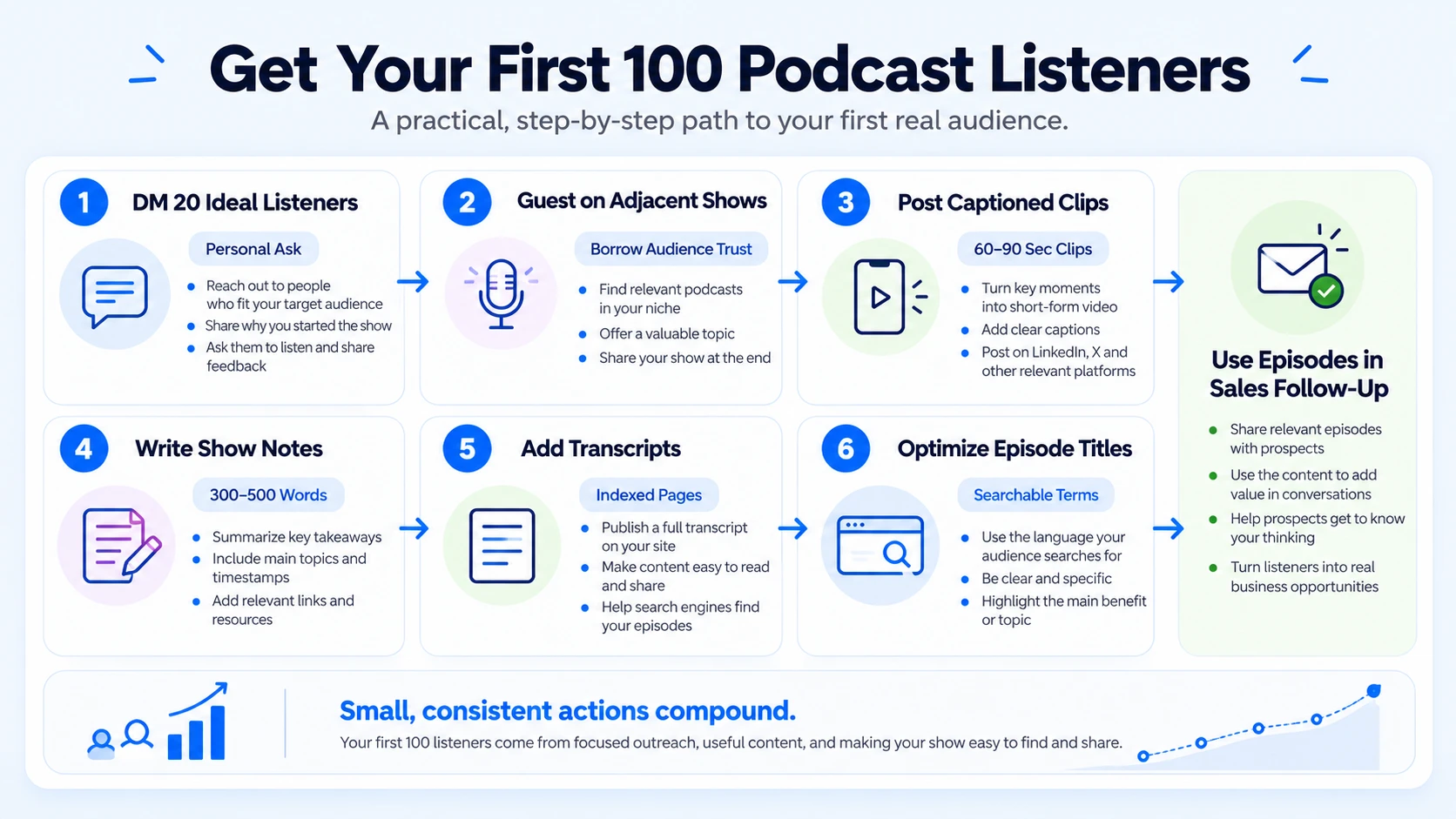
For the first 30 days:
- Share the show personally, not just publicly. DM 20 people who fit your audience persona and ask them directly to listen to episode one.
- Appear as a guest on 2–3 podcasts in adjacent niches. Borrow their audience for 40 minutes and point people back to your show.
- Post episode clips (60–90 seconds, captioned) to LinkedIn and short-form video channels. Cross-format shows that mix audio with video, newsletters, and social clips often grow 2x to 5x faster than audio-only launches.
For podcast SEO that compounds over time:
- Write detailed show notes for every episode, 300–500 words with your primary topic keywords embedded naturally.
- Add episode transcriptions (our podcast transcription service handles this at scale). Every episode page on your website, every show notes post, every transcript, these are all pages that Google can index and rank for specific search terms. Over a year, a weekly podcast produces 50+ indexed pages.
- Optimize your episode titles for searchable terms, not clever wordplay.
For SaaS and AI startup teams, the most underused channel is your existing sales and marketing motion. If your team is already sending outbound, the podcast episode becomes a high-value touchpoint that replaces generic follow-ups and accelerates trust before the demo call. At Komet Media, we help teams launch and build podcasts from scratch as well as convert every episode into a full content repurposing system, clips, highlights, and short-form assets built for pipeline and inbound demand.
How Long Does It Take to Grow a Podcast Audience from Zero?
Realistic expectations prevent the #1 growth killer: quitting in month two. Most podcasters move through a real growth timeline: 0–3 months is the early stage with low downloads and format testing; 3–6 months is the momentum stage where the audience begins returning; 6–12 months is the growth stage with consistent listeners and shareability; and 12+ months unlocks authority and monetization potential. Podcast growth is exponential, not linear. Your first 100 listeners take the longest. Getting from 100 to 500 happens faster. Growing from 500 to 2,000 happens faster still.
Can you start a successful podcast with no social media following? Yes, and a B2B show built around a specific niche is actually better positioned than a general entertainment show with a bigger social presence. Cross-format shows that mix audio with video, newsletters, and social clips often grow 2x to 5x faster than audio-only launches , which is why content repurposing is a growth strategy, not just a distribution tactic.
The biggest differentiator between shows that grow and shows that stall is what happens after publish. Most podcasters publish and wait. The ones who grow turn each episode into a content system: short-form video clips for social, podcast marketing touchpoints for email, and SEO-optimized show notes for search.
What Are the Biggest Mistakes New Podcasters Make?
Most mistakes are not technical, they're strategic.
- Going too broad: A show for "entrepreneurs" competes with every business podcast. A show for "B2B SaaS founders navigating their first sales hire" owns a lane. Broad = invisible.
- Inconsistent publishing: Podcasts that release episodes regularly tend to build trust and retain listeners. Posting on a consistent schedule helps grow your audience faster. Missing two consecutive weeks sends listeners to a competitor's back catalogue.
- Skipping podcast SEO: Most new podcasters rely only on social media to promote episodes. Every episode without show notes and a transcript is a missed organic discovery opportunity.
- Ignoring audio quality at launch: Poor audio quality is the single fastest reason a new listener doesn't return. A 70–100 dynamic microphone eliminates 90% of the problem before you add a single edit.
- Not repurposing episodes: Every 30–45 minute episode contains 5–10 short-form video clips, 2–3 LinkedIn posts, and a full email. Not extracting that content means leaving compounding reach on the table. Our complete podcast creation and production, short-form video editing, and podcast editing services handle this system end-to-end.
- Measuring downloads too early: Downloads in months one and two are not signal. Episode completion rate, return listeners, and direct feedback are better early indicators of show health.
Conclusion
How to start a podcast with no audience comes down to six things:
- Pick a specific niche and audience persona before you record anything.
- Gear matters less than consistency, a $70 dynamic microphone and a quiet room are enough to launch.
- Choose the right podcast hosting platform (Buzzsprout for analytics, Spotify for Creators for free), generate your RSS feed, and submit to Apple Podcasts Connect and Spotify for Podcasters on day one.
- Treat every episode as a content system, not just an audio file: show notes, transcripts, and short-form clips compound your reach over time.
- Growth takes 6 to 18 months of consistent publishing, the shows that win are the ones still publishing in month 12.
- For B2B teams: the podcast is a pipeline asset, not a hobby. Build it like one.
Frequently Asked Questions
Q1: Do I need social media followers to start a podcast?
No. A social following helps amplify episodes, but it's not a prerequisite for starting or growing a show. Consistent publishing, podcast SEO (show notes, transcripts, optimized episode titles), and guest appearances on other podcasts drive discovery for shows starting from absolute zero.
Q2: What is an RSS feed and why does every podcast need one?
An RSS feed is the file your podcast hosting platform generates that syndicates your episodes to every podcast directory, including Apple Podcasts, Spotify, and others. When you update your feed by publishing a new episode, every subscribed directory automatically pulls the new content. Without an RSS feed, your show cannot be listed in podcast directories.
Q3: Should I use a USB or XLR microphone as a beginner?
A dynamic mic is the best entry point because it's less sensitive to background noise. The Samson Q2U is particularly valuable because it lets you move from a simple USB setup to an XLR setup later without buying a new microphone.
Q4: How many episodes should I record before launching?
Record a minimum of three episodes before your public launch. This gives new listeners immediate back-catalogue content, signals commitment to the show, and gives you enough material to identify format and pacing issues before they're compounding in public.
Q5: What is podcast SEO and how does it help a show with no audience?
Podcast SEO refers to optimizing your episode titles, descriptions, show notes, and transcripts so that Google and podcast directories surface your show in search results. Search engine optimization is the most underutilized growth channel in podcasting. While most podcasters focus on social media, the real compounding advantage comes from Google.
Q6: Can I start a podcast and use it to generate a B2B pipeline?
Yes, it's one of the highest-ROI content formats for B2B teams. A podcast positions founders and subject matter experts as trusted voices in their category. Episodes can replace cold outreach touchpoints, warm up prospects before demos, and fuel short-form content that keeps your brand visible across the buyer journey. The podcast is the asset; the clips, show notes, and transcripts are the distribution system.

