
Repurposing Long-Form Content Into YouTube Shorts for B2B SaaS: Step-by-Step Guide
I've spent years working with B2B SaaS founders and growth teams on video strategy, and the single biggest content mistake I see is burying product knowledge inside 60-minute recordings that no one re-watches. Repurposing long-form content into YouTube Shorts for B2B SaaS solves that directly. It turns webinars, demos, and founder thinking into short-form assets that educate buyers before a single sales call happens, and it does it without filming anything new.
TL;DR
- YouTube Shorts now generates 200 billion daily views globally , making it a serious B2B discovery channel, not just a consumer format.
- One 60-minute webinar yields 8 to 12 standalone Shorts when you clip methodically.
- Shorts prime buyers before the demo, shortening sales cycles and improving SQL quality.
- The workflow is: audit, select, clip, optimise, distribute, and measure.
Why Repurposing Long-Form Content Into YouTube Shorts for B2B SaaS Is a Pipeline Move, Not a Vanity Play
Most SaaS marketing teams treat YouTube Shorts as a brand awareness experiment. That framing is wrong. The platform is now a buyer research channel. Research from 6sense, LinkedIn, and Gartner reveals that 80% of B2B sales now take place entirely online, with the vast majority of the buying journey completed before a prospect ever speaks to a sales rep. Your Shorts are doing sales work whether you design them to or not.
The MQL-to-SQL conversion rate sits at 15 to 21% on average. Short-form video that pre-educates buyers before they fill out your demo form directly improves that number, because an SQL who already understands your product takes half as long to close. 70% of B2B buyers now use video in purchase decisions , and the YouTube Shorts algorithm actively surfaces your content to audiences who have already shown interest in adjacent topics.
YouTube's December 2025 algorithm overhaul reduced long-form video recommendations from six per row to approximately two, with Shorts slots increasing substantially in response. That algorithmic shift makes short-form discovery unavoidable for any SaaS team that wants organic reach. A 45-minute webinar might engage a prospect, but only after a 30-second Short gave them a reason to click through. Shorts have become the pre-roll to deeper engagement.
Think of each Short as a micro-chapter of your product story, one that earns attention and routes warm buyers toward longer content, demo bookings, and trials. Channels that use YouTube Shorts alongside long-form content grow 41% faster , confirming this is a compounding content motion, not a distraction from it. Content atomisation is the operating principle here. Gary Vaynerchuk popularised it with the "Document, Don't Create" model. For B2B SaaS, it means your webinars, podcasts, demos, and founder interviews are the raw material. You don't need a studio. You need a clip strategy.
What Parts of a Webinar Should You Turn Into YouTube Shorts?
A webinar is a content goldmine. A single 60-minute session can fuel a multi-channel strategy for weeks. The key is knowing which moments convert into strong Shorts versus which moments only work inside the full recording.
Clip types that consistently perform for B2B SaaS audiences:
- The sharp opinion: A speaker makes a counterintuitive claim about the category. These drive comments and shares, boosting the YouTube Shorts algorithm.
- The stat reveals: A data point that reframes how the buyer thinks about a problem. Keep it at the natural pause point in the webinar, don't splice in graphics.
- The "aha" feature moment: The instant where a demo shows something unexpected that solves a recognisable pain. These are your best demand-generation Shorts.
- The objection flip: When the speaker directly addresses a common sales objection. These pre-condition buyers before calls.
- The how-to sequence: A tight 3-step process the speaker walks through. Instructional content consistently retains viewers.
Moments to skip: introductions, sponsor reads, Q&A tangents, anything requiring context from the previous 20 minutes to land. Using AI tools to slice webinar clips is the most efficient way to scale short-form video content for B2B SaaS. Feed a 60-minute webinar into an AI platform and you instantly generate a month of content.
The rule I use at Komet Media: timestamp every "quotable" moment during the live session or first watch-through. A 60-minute webinar typically yields 8 to 12 quality timestamps. From those, I aim for 5 to 7 publishable Shorts after editing for hook strength, caption quality, and 9:16 reframing. Distribute the strongest clip in the first 48 hours while the webinar topic is still contextually relevant to your audience.
You can explore our webinar repurposing and video growth services if you want this done without adding to your team's workload.
Step-by-Step: How to Repurpose a Product Demo Into YouTube Shorts
Repurposing long-form content into YouTube Shorts for B2B SaaS is most reliable when you run a repeatable workflow rather than treating each video as a one-off project. Here is the exact process I use:
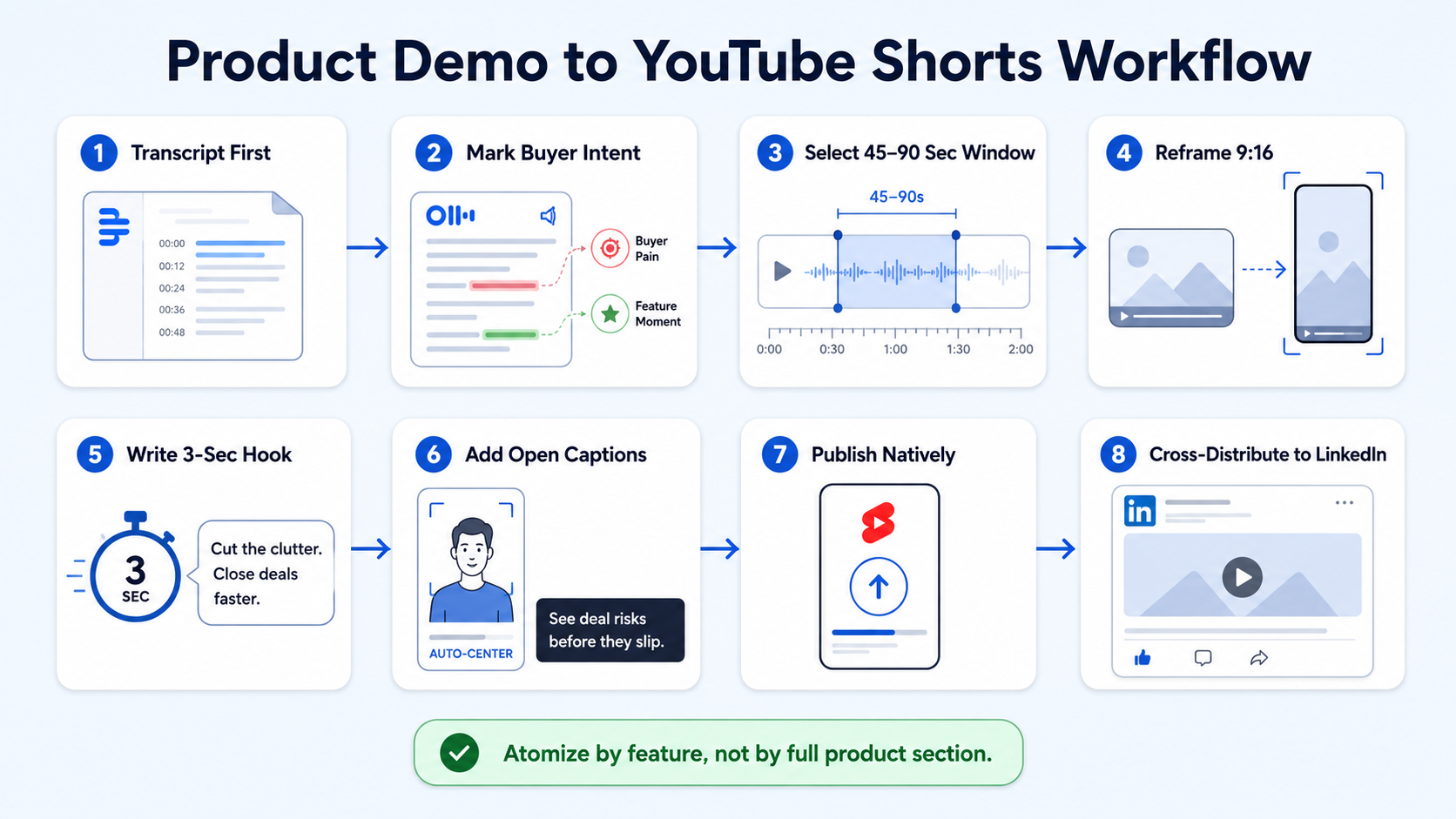
- Transcript first: Export a full transcript using Descript or Otter.ai before you touch the timeline. Editing from text is 3x faster than scrubbing video.
- Highlight for buyer intent: Mark every moment where the speaker solves a named pain point, reveals a product capability, or makes a claim a buyer would repeat to their team.
- Select 45 to 90 second windows: The YouTube Shorts algorithm moved from swipe rate to watch time per impression. Retention thresholds to get pushed wider are roughly 65% for sub-30-second Shorts and 50% for 30 to 60-second Shorts. Aim for clips that naturally close within that window.
- Reframe to 9:16: Use active speaker detection to keep the presenter centred. Automatically keeping the speaker in the centre of the frame is crucial for converting horizontal Zoom calls to vertical mobile video.
- Write a hook for the first 3 seconds: 71% of viewers decide within the first few seconds whether a video is worth continuing. The hook must name the specific pain or claim, not the company.
- Add open-captions: 50% of silent video viewers rely on captions to understand content , so caption-free Shorts lose half their potential reach before the algorithm can assess retention.
- Publish natively to YouTube Shorts: Never upload a TikTok-watermarked clip. The algorithm suppresses cross-posted content with competitor platform watermarks.
- Cross-distribute to LinkedIn video using the same clip with a revised caption written for a professional feed context, not a Shorts feed.
For demo-specific repurposing, atomise by feature, not by product section. Each Short covers one workflow, one outcome. The key is to atomize a long demo into a library of bite-sized, feature-specific micro-demos, ideal for feature pages, paid ads, and how-to blog posts.
Check out our short-form video editing service for done-for-you production across this workflow.
Best Tools for Converting Long Videos Into YouTube Shorts for SaaS Teams
HubSpot's 2025 State of Marketing Report found that 71% of companies repurpose long-form video content into short-form clips, making it the most common content repurposing tactic across all formats. The tooling ecosystem has matured to match that demand.
OpusClip automatically identifies the most engaging moments from long-form content, clips them into vertical short-form videos, adds retention-optimised captions, and scores each clip for viral potential. For most B2B SaaS teams running 2 to 4 webinars per month, OpusClip handles the bulk pass and Descript handles the precision edits that protect brand quality.
Wistia and Vidyard sit at the distribution end of the stack. They provide video engagement metrics, viewer drop-off data, and integration with HubSpot and Salesforce so your sales team knows which prospects watched which Short before a call.
Stack principle: Use AI tools to generate candidate clips at volume, then apply human editorial judgment to select the 20% that protect your brand and move your buyer.
For teams that want a complete repurposing workflow without stitching tools together, our video marketing service covers production, editing, and distribution in one system.
YouTube Shorts vs Long-Form Video for B2B SaaS: Which Works Better?
This is the wrong question framed as a binary. The right answer is that they serve different stages of the SaaS buyer journey and work best together.
Short-form videos get 2.5x more engagement than long-form on social platforms , but engagement is a distribution metric, not a pipeline metric. Long-form earns the trust that moves a buyer from curious to committed. The winning motion is using Shorts as the entry point that routes buyers into deeper content.
One of the unique strengths of YouTube is how Shorts and long-form content work together. If a user discovers your channel through a Short, they may explore your long-form videos or subscribe, contributing to deeper engagement across the whole channel.
For B2B SaaS specifically, the product-led growth and thought leadership use cases map cleanly to this structure. Shorts seed awareness of a specific pain point or capability. Long-form webinars and podcast content deliver the depth that earns consideration. The combination is what builds the inbound demand flywheel that outperforms paid acquisition at scale.
Common Mistakes When Repurposing B2B Content Into Short-Form Video
Most repurposing efforts fail not because the source content is weak, but because the editing decisions strip out what made the content valuable in the first place.
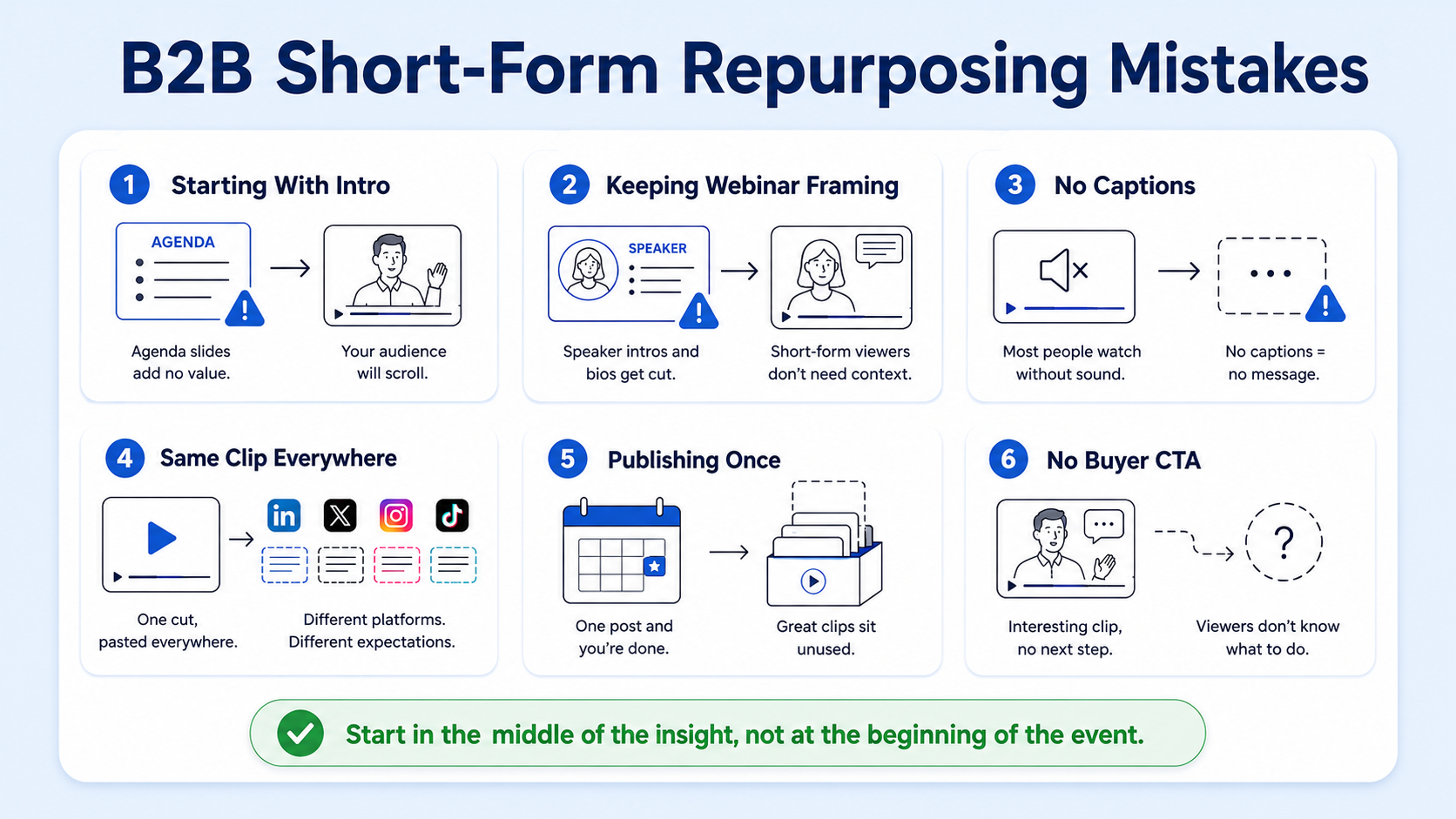
Mistake 1: Starting with the wrong moment. Clipping the intro, agenda slide, or speaker bio. Buyers don't care who you are until they care what you know. Start every Short in the middle of an insight.
Mistake 2: Keeping the webinar framing intact. "As I mentioned earlier" and "so moving on to slide 12" are death sentences for Shorts retention. The YouTube Shorts algorithm considers video completion rates over click-based merit , and contextual references from a longer session destroy completion on a standalone clip.
Mistake 3: No caption layer. Already covered in tools, but it bears repeating as a mistake because teams skip it when in a rush. Half your impressions play silently.
Mistake 4: Treating all clips identically across platforms. A YouTube Short and a LinkedIn video serving the same clip need different captions, different CTAs, and sometimes different opening frames. The buyer context differs between platforms.
Mistake 5: Publishing once and moving on. Your webinars, podcasts, demos, and Loom recordings already contain 10 clips each. Extract them before creating anything net-new. Most teams use 1 of those 10 and move on. The highest-leverage behaviour is treating each long-form asset as a multi-month content system, not a single event.
Mistake 6: No buyer CTA. Shorts without direction are brand content at best. Every clip should direct the viewer toward the next action: watch the full demo, book a call, visit a feature page. Even a soft CTA in the caption works. 67% of B2B buyers now prefer a rep-free buying experience , so your CTA needs to route them to self-serve resources, not straight to a sales call.
Our YouTube video editing service and podcast editing service exist precisely to prevent these mistakes from eating your production investment.
Conclusion
Repurposing long-form content into YouTube Shorts for B2B SaaS is the highest-leverage content motion available to funded startups and scaling SaaS teams right now. Key takeaways:
- YouTube Shorts has 2 billion monthly users and leads all short-form platforms with a 5.91% engagement rate , making it a real buyer channel, not a side experiment.
- One 60-minute webinar, clipped methodically, yields a full month of short-form demand generation.
- Shorts and long-form work together: Shorts earn the click, long-form earns the trust.
- The workflow scales without adding headcount when you pair AI clip tools with human editorial judgment, or a dedicated video growth partner.
Work with Komet Media to build a repurposing system that consistently converts your existing content into pipeline.
Frequently Asked Questions
Q1: How long should YouTube Shorts be for a SaaS audience?
Aim for sub-30-second clips if your retention target is 65%, or 30 to 60-second clips targeting 50% retention, as these are the thresholds YouTube uses to decide whether to push a Short wider. For complex SaaS topics, 45 to 75 seconds tends to be the practical sweet spot that allows enough context without losing the viewer.
Q2: How do B2B SaaS companies use YouTube Shorts for lead generation?
They use Shorts as top-of-funnel buyer education assets that route interested viewers to demo bookings, gated content, or feature pages. SaaS marketing videos simplify complex products and validate buyer decisions before the first sales conversation makes it onto a calendar. The CTA in your caption and description does the conversion work.
Q3: How many Shorts can I realistically get from one webinar?
By feeding a 60-minute webinar into an AI clip platform, you can instantly generate a month of content. In practice, I recommend targeting 5 to 8 high-quality publishable Shorts per session after editorial filtering, rather than maximising raw clip volume at the expense of brand quality.
Q4: Should I repurpose blog posts into YouTube Shorts for B2B SaaS?
Yes, but the direction is more effective in reverse: produce short-form video first, then transcribe it into blog content. If you're working from an existing blog post, pull the 3 most counterintuitive points and script a talking-head Short for each. Tools like Lumen5 can assist with turning blog posts and text into video, using AI to match visuals to your script, which works well for SaaS brands.
Q5: Does repurposing content hurt YouTube SEO or video engagement metrics?
No. Channels using YouTube Shorts alongside long-form grow 41% faster. The documented risk is not repurposing itself, but generic AI output that sounds disconnected from your channel voice. Maintain your authentic tone and the algorithm rewards the distribution, not punishes it.
Q6: What is content atomisation and how does it apply to SaaS video?
Content atomisation means breaking one large content asset into many smaller, platform-specific pieces. For B2B SaaS, a single webinar becomes Shorts, a LinkedIn video, a podcast clip, blog post sections, and email snippets. This requires editing for clarity, restructuring for readability, and optimising for specific channels. For B2B firms, it directly supports SEO, thought leadership, and lead generation by turning spoken expertise into discoverable, shareable assets.

