
Repurpose a Podcast Episode into YouTube Shorts: Step-by-Step Guide
Most founders sit on a goldmine of recorded conversations, interviews, and panel appearances, and publish exactly zero clips from them. When you repurpose a podcast episode into YouTube Shorts, you stop creating from scratch and start multiplying what already exists. One strong conversation becomes eight weeks of trust-building content for buyers, investors, and future hires. This guide gives you the full system: which moments to clip, which tools to use, and how to turn a single episode into a repeatable authority engine.
TL;DR
- One podcast episode yields 8–15 Shorts using AI tools like Opus Clip, without manual scrubbing.
- 15–60 seconds is the proven sweet spot; the algorithm rewards high completion rates over raw length.
- Target moments that deliver a sharp opinion, a counterintuitive insight, or a concrete result, not summaries.
- Consistency beats volume: two Shorts per week for six months outperforms an occasional burst.
Why Founders and CEOs Should Repurpose a Podcast Episode into YouTube Shorts Right Now
YouTube Shorts now has 2 billion monthly users, ahead of TikTok (1.59 billion) and Instagram Reels (1.8 billion). For B2B founders, that reach is not theoretical. It is the same platform where buyers, hiring candidates, and investors already spend time, and where your competitors are largely absent from as executives. 74% of Shorts views come from non-subscribers, making it YouTube's primary discovery format.
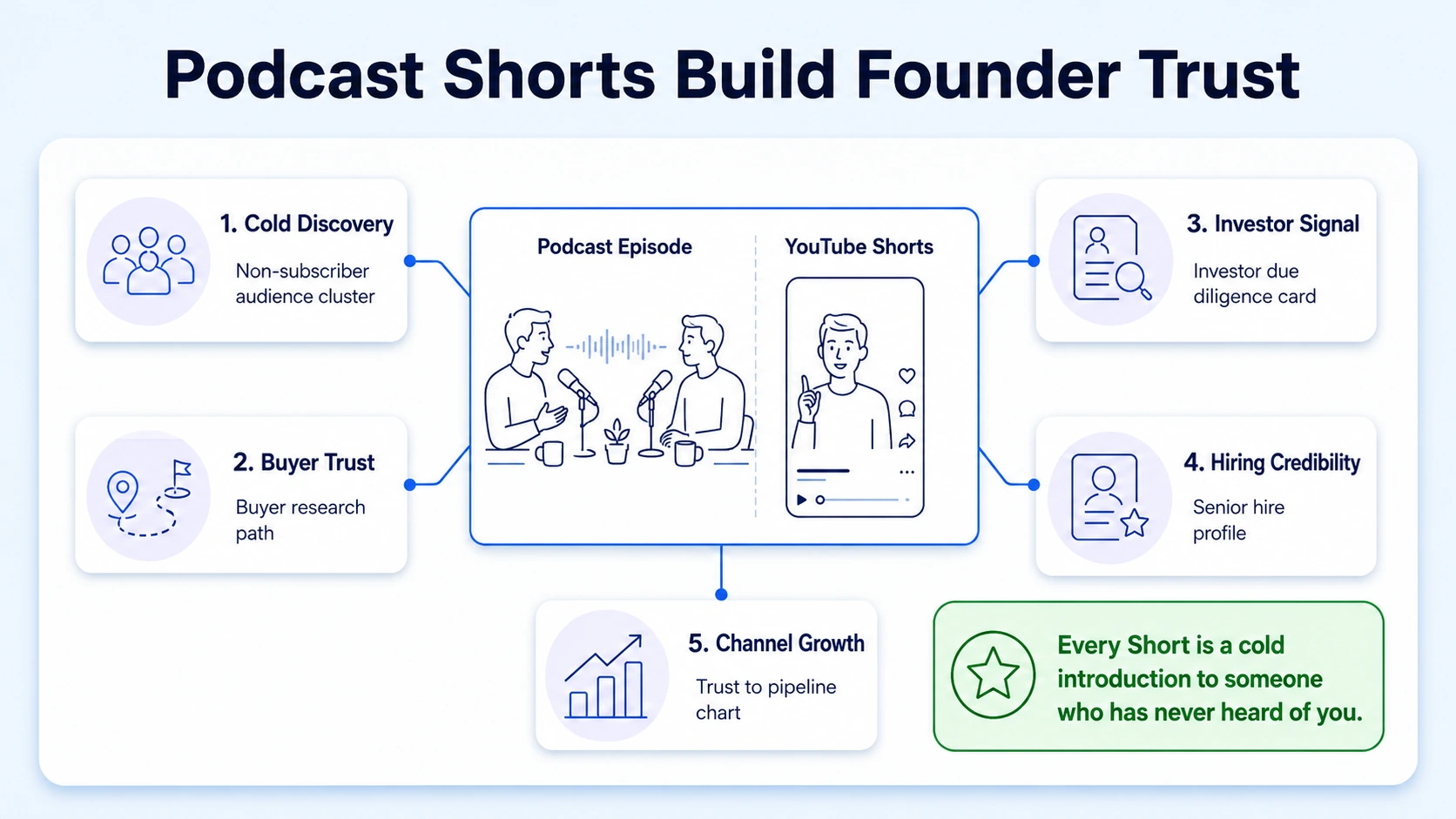
That single stat rewires how you should think about distribution. Every Short is a cold introduction to someone who has never heard of you. When that Short carries your actual thinking, a sharp take from a real conversation, it builds more trust in 30 seconds than a LinkedIn post ever could. Major platforms like YouTube and Spotify have doubled down on video podcast integration, and YouTube reported 1 billion monthly podcast viewers in early 2025. Your podcast audience is already there. The question is whether you are serving them clips they can share.
The business case for executives is specific. When a procurement lead, a Series A investor, or a senior hire searches your name, they want a signal: What does this person think? Do they know what they are talking about? A YouTube Shorts library built from your podcast conversations answers that question before a single sales call happens. Channels that post Shorts consistently for six months see a 44% increase in overall channel growth, and for B2B founders, growth translates directly into inbound pipeline, not just vanity metrics.
Edison's Infinite Dial data shows 33% of US weekly podcast listeners use YouTube as their primary podcast destination, more than Spotify or Apple Podcasts. If you are not clipping your episodes for Shorts, you are leaving distribution on the table on the single platform that dominates podcast consumption.
At Komet Media, the executives I work with are not content creators by trade. They are operators, dealmakers, and builders. The system below is designed around that reality, minimum input, maximum output, no content-bro theatrics required.
What Parts of a Podcast Episode Work Best for YouTube Shorts
Not every minute of your podcast is clip-worthy, and knowing the difference is the highest-leverage skill in this entire workflow. The goal is to find moments that are self-contained, opinionated, and immediately useful to a specific person, not moments that summarize the episode.
The five moment types that consistently produce strong Shorts from B2B podcast episodes:
- The sharp opinion: You disagree with conventional wisdom in your industry. State it plainly. These clips stop the scroll because they create mild friction, the viewer either agrees loudly or wants to push back. Either response signals trust.
- The counterintuitive result: You did something that "shouldn't" have worked and it did. Or the opposite. Numbers make this format concrete, "we cut our sales cycle by 40% by removing a demo step."
- The hard-won lesson: A specific mistake with a specific cost and a specific fix. Founders have these. Most are too reluctant to say them plainly. The ones who do build outsized authority fast.
- The quotable definition: You define a concept in your own words in a way that makes people think, "I've never heard it put that way." These become the clips that get screenshotted and shared on LinkedIn.
- The moment of tension or surprise: Your guest says something you didn't expect, and your reaction is visible and genuine. Reaction moments read as authentic in a way that scripted content rarely does.
Upload your podcast video to Opus Clip, and the AI scans for high-engagement moments, strong opinions, emotional peaks, or actionable tips. That scan is useful as a first pass, but your editorial judgment on which moments carry real authority for your specific audience is irreplaceable.
What does not work as a Short: lengthy context-setting ("So what we were talking about earlier was..."), segments where you are asking questions rather than delivering insight, and any moment that requires three prior minutes to understand. When you repurpose a podcast episode into YouTube Shorts, you are editing for standalone clarity, not episode continuity.
The Step-by-Step Podcast to YouTube Shorts Workflow for 2026
This is the production system I run at Komet Media for founders who publish one podcast episode per week and want 6–10 Shorts from it without burning a team on manual editing.
- Record or receive the episode file. Use Riverside.fm if you are recording new content, it captures dual-track audio and video locally, which protects quality regardless of either participant's connection. For existing episodes, pull the MP4 or audio file directly.
- Generate a transcript. Run the file through Descript for an accurate podcast transcription. Descript's word-level transcript lets you read the episode like a document, making clip identification 10x faster than scrubbing audio.
- Identify 10–15 candidate moments. Use the criteria in the previous section. Flag timestamps in your transcript for every sharp opinion, result, or definition.
- Upload to Opus Clip for AI clip extraction. A single 30-minute podcast episode can yield 10 to 15 short clips using Opus Clip. Paste the link or upload the file. Opus Clip automatically centers the active speaker using computer vision, even in multi-person landscape videos, converting them seamlessly to 9:16 vertical format.
- Review clips against your AI Virality Score. Opus Clip scores each clip 0–99 for predicted performance, auto-reframes to vertical, and burns in captions. The workflow that pays off: sort clips by virality score, edit only the top 3–5, and batch-schedule the rest.
- Add captions and brand elements. Captions and subtitles are non-negotiable, a large share of mobile viewers watch without sound. Adjust font size, color, and position in Descript or within Opus Clip's editor.
- Export in aspect ratio 9:16 at 1080x1920 resolution. Verify the framing before export, faces should not be cut off by the caption bar.
- Schedule via Repurpose.io or Hootsuite. Repurpose.io automates cross-posting from a single upload to YouTube Shorts, Instagram Reels, and LinkedIn simultaneously. Hootsuite gives you a visual calendar if you prefer manual control over scheduling timing.
- Monitor in YouTube Studio and Google Podcast Manager. Track average percentage viewed, not raw views. That is the signal that tells you which clip formats actually hold attention.
Our short-form video editing service handles steps 4–8 for executive teams who want the output without managing the stack.
Best Tools to Repurpose Podcast Episodes into YouTube Shorts in 2026
The right stack depends on whether you have a video recording of the episode or audio only. Here is how the tools map to each scenario:
Opus Clip has over 10 million users who have collectively generated more than 172 million clips, making it the most battle-tested AI video editing tool in this category. For audio-only podcasts without a video recording, Descript's audiogram feature creates a waveform-animated vertical video that still functions as a Short.
For founders who have a backlog of episodes, Opus Clip is purpose-built for people who produce long-form video regularly and don't have time to scrub through it manually, including podcasters with a backlog of hour-long episodes.
One tool not on this list by choice: fully automated AI video editing services that skip human review entirely. For executive thought leadership content, a human checkpoint before anything goes live protects your positioning. A clip that misrepresents your argument damages trust faster than no clip at all.
Our podcast editing and podcast transcription services integrate directly with this stack for teams that want done-for-you production.
How Long Should YouTube Shorts from Podcast Clips Be
Length is one of the most misunderstood variables in short-form video strategy. The platform has expanded the technical ceiling, but the data points in one direction: shorter wins on retention. YouTube Shorts can now be up to 3 minutes long as of 2025, a significant expansion from the original 60-second limit. For podcast clip repurposing, treat 3 minutes as an emergency exit, not a target. Shorts between 15 and 30 seconds consistently achieve the highest retention rates, often exceeding 80%. This sweet spot gives enough time to deliver a complete idea without testing viewer patience.
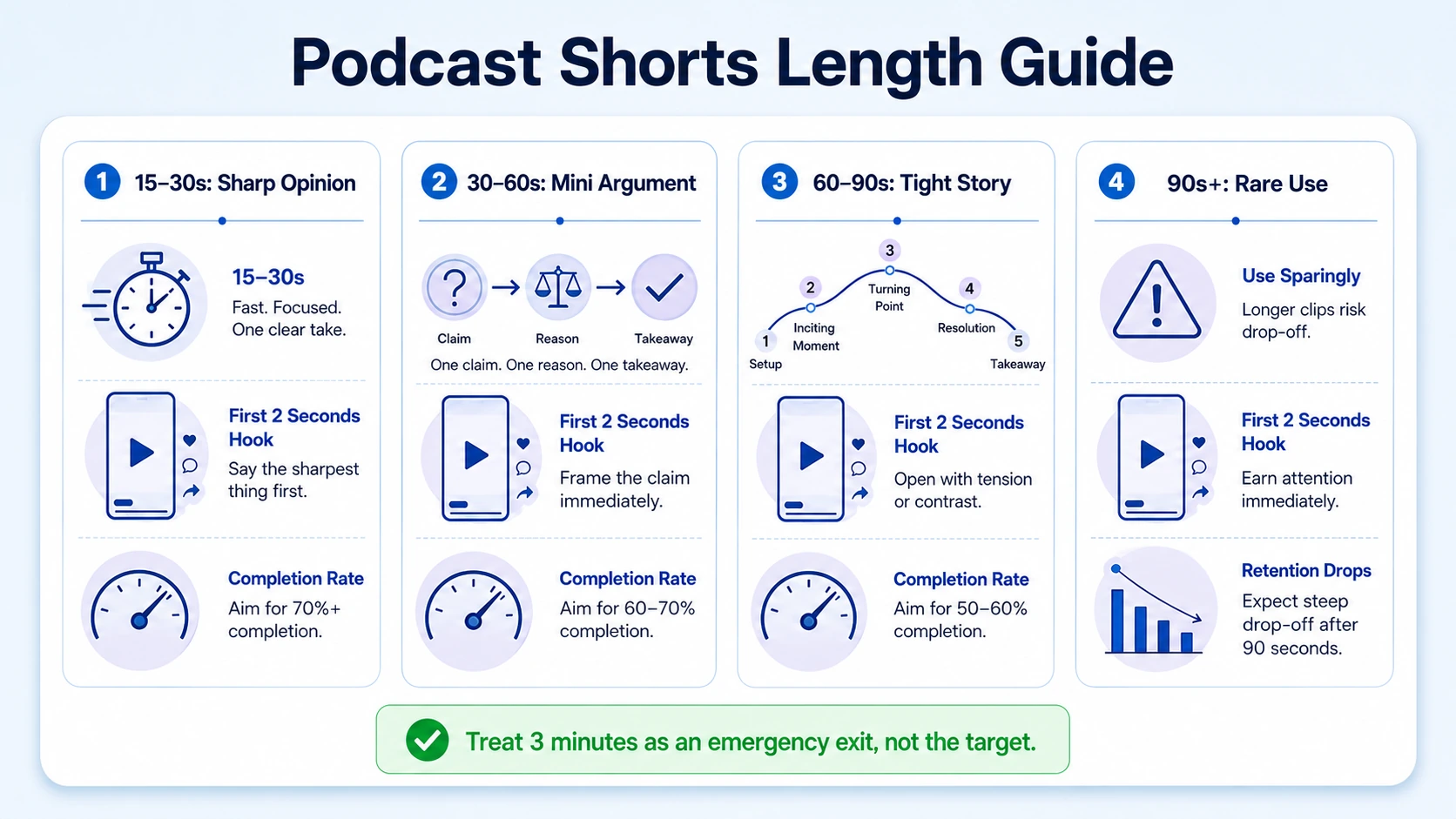
For B2B executive content specifically, these length guidelines apply:
- 15–30 seconds: Single sharp opinion or one-sentence insight with immediate context. Highest completion rates. Best for building topical authority fast.
- 30–60 seconds: A mini-argument, claim, one data point or example, conclusion. The sweet spot for short-form video in 2026 is 30–60 seconds: long enough to deliver value, short enough to retain attention. TikTok and YouTube Shorts favor clips under 60 seconds for algorithmic boosts.
- 60–90 seconds: A tight story arc, setup, tension, resolution. Use only when the narrative genuinely requires it.
- 90 seconds+: Rarely justified for podcast clips. Reserve for exceptional storytelling moments where cutting would destroy the point.
Shorts with an immediate hook in the first 2 seconds retain 19% more viewers than those with a slow start. The opening line of your clip is not an introduction, it is the entire argument in one sentence. "The reason most enterprise sales cycles drag for 9 months isn't the deal, it's the demo." That is a hook. "So today we're going to talk about..." is a death sentence. The average retention rate for Shorts is 73%, compared to 52% for long-form YouTube videos. When you repurpose a podcast episode into YouTube Shorts and maintain that retention rate, YouTube Studio surfaces your clips to non-subscribers at a compounding rate.
Podcast Repurposing Strategy for C-Suite Thought Leadership on YouTube
Most executives who try YouTube Shorts make the same error: they treat it as a broadcast channel. Clips go up, then nothing. No topic consistency, no narrative arc, no connection between Shorts and the full episode or the broader body of work. That approach produces views with no business outcome. The content repurposing framework that works for C-suite thought leadership is built on three pillars:
Topical authority: Every clip should map to one of 3–5 core themes your channel owns, pricing strategy, hiring philosophy, go-to-market approach, category creation, or whatever defines your expertise. This is how Semantic Search and YouTube's Knowledge Graph begin to associate your name with a specific domain.
E-E-A-T signals: Google and YouTube's Quality Rater Guidelines weight Experience, Expertise, Authoritativeness, and Trustworthiness. Podcast clips score naturally on all four, you are speaking from lived experience, not scripted copy. This is a structural advantage over polished brand content.
Cross-format continuity: Creators are embracing multi-format workflows: full-length episodes are posted to audio platforms and YouTube, while short clips on YouTube Shorts function as samples. Repurposing a single episode into a series of clips, blog posts, and social posts is now standard practice. Each Short should link back to the full episode in the description, driving watch time on your main channel while the Short drives discovery.
In business channels, mixing Shorts correlates with measurably more subscribers, business channels that use Shorts show 39% more subscribers than long-form-only channels. For investor-facing and hiring-focused executives, the secondary function of a Shorts library is a living due diligence trail. A candidate evaluating your company will watch three of your Shorts before deciding whether to take the first call. An LP or Series B lead will do the same. The clips are not content marketing, they are trust infrastructure. Visit our podcast marketing page to see how we build this system for executive teams.
Do YouTube Shorts from Podcasts Actually Grow an Audience for Executives?
The honest answer: Shorts grow the right audience when the content signals expertise, and they grow the wrong audience when the content chases trends. For B2B founders, this distinction is everything. Three-quarters of YouTube Shorts views come from people who are not subscribed to the channel, making Shorts YouTube's primary discovery format. For growth-focused creators, this means Shorts serve as a top-of-funnel acquisition tool: capture attention with short content, then convert viewers into subscribers who watch long-form videos.
Channels integrating Shorts see 14% higher subscription growth compared to those not utilizing this format. For executive channels, that compounding subscriber base is what turns a podcast into a business asset, not just a media project. The audience quality caveat: a Short that goes viral because of a provocative headline attracts viewers who will never buy, hire, or invest. The Shorts that convert for B2B executives are those that attract people who have the exact problem your business solves. That specificity is intentional, not accidental.
When you repurpose a podcast episode into YouTube Shorts consistently over 6–12 months, three measurable outcomes follow for most executive channels I have worked with:
- Inbound messages from buyers who reference a specific clip as the reason they reached out.
- Recruiting candidates who arrive knowing your management philosophy before the first interview.
- Investor or partner introductions where the introduction already includes "I've been following your content."
Nearly 60% of new YouTube channels that experience rapid growth rely on Shorts, leveraging its potential for viral reach. For established executives who already have a podcast, the barrier to entry is even lower, the content already exists.
Our video marketing services are built specifically for B2B teams who want measurable pipeline outcomes, not just view counts. If you are ready to build this system, start here.
Conclusion
- Repurpose a podcast episode into YouTube Shorts by targeting sharp opinions, counterintuitive results, and quotable definitions, not summaries or context-setting segments.
- Use Opus Clip for AI clip extraction to 9:16 vertical format, Descript for transcript-based editing, and Repurpose.io for automated multi-platform scheduling.
- Target 15–60 seconds per clip, open with a hook in the first 2 seconds, and post 2 Shorts per week minimum for 6 months.
- For B2B executives, the real ROI is not views, it is the trust infrastructure that converts buyers, candidates, and investors before the first conversation happens.
Frequently Asked Questions
Q1: Do I need a video recording of my podcast, or can I use audio only?
Video is significantly stronger for YouTube Shorts, it allows AI tools like Opus Clip to auto-reframe to 9:16 and track the speaker's face. For audio-only episodes, Descript can generate animated audiograms in vertical format. Going forward, record with Riverside.fm for clean dual-track video.
Q2: How many Shorts should I produce from one podcast episode?
A single 30-minute podcast episode can yield 10 to 15 short clips using Opus Clip. For a 45–60 minute episode, expect 8–15 usable clips after editorial review. Publish 2–4 per week rather than dropping them all at once, spacing builds channel consistency.
Q3: Should I use captions on every Short?
Yes, without exception. A significant portion of mobile viewers watch with sound off, and captions improve retention for all viewers. Opus Clip burns captions automatically. Review them before publishing, AI caption accuracy on technical B2B vocabulary is imperfect and a terminology error in a clip undermines credibility.
Q4: Will YouTube Shorts from my podcast hurt my main channel's algorithm?
No. Shorts and long-form content run on separate algorithms, and weak Shorts no longer drag down your main channel. They operate in separate feeds and are measured by different signals. The risk of Shorts cannibalizing long-form performance is not supported by current platform data.
Q5: How long until I see meaningful results from podcast Shorts?
Channels that post Shorts consistently for six months see a 44% increase in overall channel growth. For B2B executives, inbound signals, DMs, referrals mentioning a clip, recruiting inquiries, typically appear within 60–90 days of consistent posting. Track average view duration in YouTube Studio, not raw views.
Q6: What is the single biggest mistake executives make when repurposing podcast content into Shorts?
Clipping the wrong moments. Most founders clip episode introductions, guest bios, and topic overviews, all of which require context to land. The clips that build authority are the ones that deliver a complete, surprising, or opinionated idea in under 45 seconds with no setup required. Start mid-sentence if that is where the insight lives.

