
Repurpose a Case Study into a Video Story: Step-by-Step Guide
Your best-performing case study is sitting in a PDF nobody reads past page two. Meanwhile, 53% of B2B buyers prefer video case studies over written testimonials. The gap between what you have and what buyers actually want is a production decision, not a content problem. When you repurpose a case study into a video story, you take proof that already exists and put it in the format buyers trust most. This guide shows you exactly how to do it, from script structure to distribution, without a bloated production budget or a film crew.
TL;DR
- 53% of B2B buyers prefer video case studies over written testimonials , making this the single highest-leverage content conversion you can make.
- The proven structure for a case study video is: Problem, Stakes, Solution, Proof, CTA.
- The sweet spot for B2B case study video length is 45 to 90 seconds, with a 74% completion rate compared to 49% for videos over two minutes.
- Distribute across LinkedIn, your website, sales sequences, and post-demo follow-up, not just social.
Why B2B Buyers Respond to Video Case Studies (and Not PDFs)
Most SaaS and AI startup teams have at least a handful of strong case studies. The problem is format. A written case study asks a buyer to invest 10 minutes of uninterrupted reading. A video asks for 90 seconds of attention while they scroll LinkedIn between meetings. 73% of B2B decision-makers now prefer to watch product demo videos over reading whitepapers, and 96% of individuals use video to learn about products and services.
When a buyer is at the decision stage, they are not going deeper into documentation. They are looking for fast, credible confirmation that your product has worked for someone who looks like them. 66% of B2B buyers say they are more likely to consider a product after watching a relevant video, compared to 40% who prefer reading text-based content. That 26-point gap is where your written case study is leaving a pipeline on the table every single week. The trust mechanism is also different.
In a crowded SaaS market where trust and clarity are hard to earn, customer-led videos give prospects a way to see value, not just read about it. While most SaaS brands agree video is "engaging," few are tapping into its deeper advantages, like simplifying complex features or building credibility for abstract products. Static PDFs can't show tone, context, or real-world usage. When you repurpose a case study into a video story, you are not just changing the container. You are moving the message from passive reading into a medium that activates social proof at an emotional level.
Case studies and customer logos influence 78% of enterprise purchase decisions, and video amplifies every element that makes a case study persuasive: the customer's voice, the specific outcome, and the moment of recognition a prospect feels when they see their own problem named on screen. Research shows that 81% of B2B buyers had already decided on a preferred vendor before engaging a sales rep. Your video case study does not just support the sales team. It is the mechanism by which buyers qualify themselves before they ever book a demo.
The Right Narrative Structure for a B2B Case Study Video
Structure is where most SaaS teams get this wrong. They open with their company name, spend 30 seconds on their product features, and bury the customer outcome in the final 10 seconds. That is a product demo, not a customer story. When you repurpose a case study into a video story, the customer must be the protagonist, not your software.
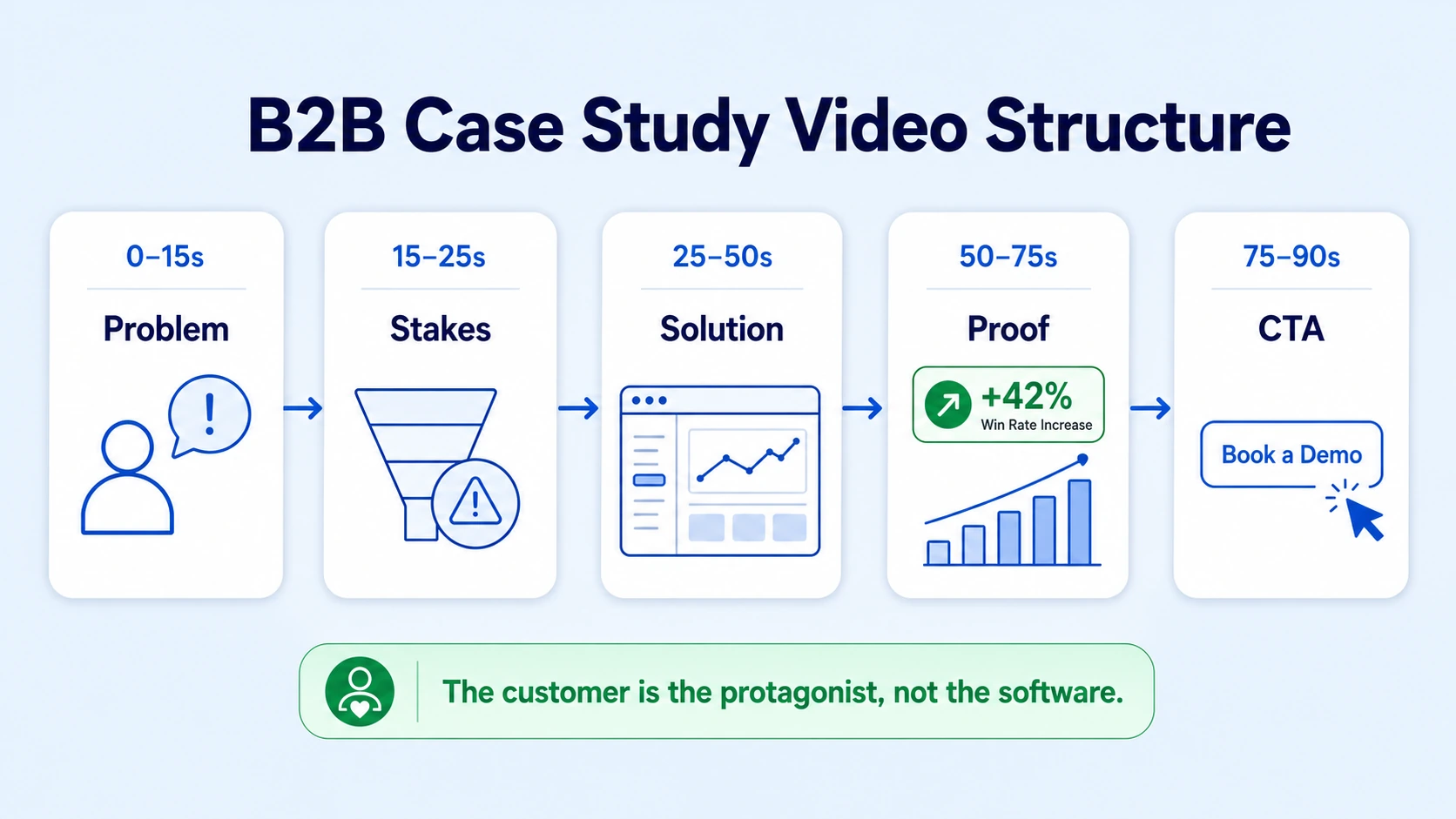
The five-part framework that works consistently for B2B SaaS video case studies:
- Problem (0–15s): Name the exact pain the customer had. Specific beats generic. "Our sales team spent three hours per rep per week building follow-up content" outperforms "we had a productivity challenge."
- Stakes (15–25s): What happened because of that problem? Pipeline slowed, deals stalled, marketing budget was wasted. Stakes give the problem weight.
- Solution (25–50s): How did they find your product and what did they actually do with it? Keep this outcome-oriented, not feature-oriented.
- Proof (50–75s): The metric. One clear, named result. Revenue recovered, time saved, conversion rate lifted. A case study that says "we helped Company X increase qualified pipeline by 127% in four months" is conversion gold. The difference is outcome specificity.
- CTA (75–90s): One instruction. Book a demo, watch more stories, or visit the product page. Not three options. One.
B2B case study videos come in several distinct formats, each suited to a different moment in the buyer journey: a testimonial (a single customer speaking directly to camera, short and highly persuasive at the top of the funnel); a customer success story (a narrative-driven video combining interview footage with screen recordings); and an ROI or data story (a metrics-forward video quantifying business impact built to address finance and procurement stakeholders). Match format to funnel stage. A 30-second testimonial clip goes in cold outreach and paid social. A 90-second success story goes on the pricing page. A 3-minute ROI story goes into a late-stage proposal sequence.
How to Turn a Written Case Study into a Video Script (Step by Step)
You do not need to start from scratch. Your existing case study contains every element you need. The job is extraction, not creation.
- Identify the one result: Pull the single strongest metric from your written case study. If there are five results, choose the one most relevant to the ICP you are targeting with this video.
- Find the customer's voice: Pull direct quotes from your case study. These become the core of your script or interview guide. Real language from real customers outperforms copywritten narration every time.
- Write a three-sentence synopsis: Problem in one sentence, solution in one sentence, result in one sentence. This becomes your video script backbone and your caption copy simultaneously.
- Build a question list, not a script: If you are recording a customer interview using Loom or a Zoom call, send four focused questions, not a script. "What were you dealing with before?" and "What changed after?" generate the most usable footage.
- Layer in screen recordings or motion graphics: Use Canva or a tool like Komet Media's short-form video editing service to add product UI overlays, animated stats, or branded lower-thirds that reinforce the spoken proof points.
- Write the caption before you edit: The caption frames what viewers expect. Write it first and it will clarify which moments in the footage actually matter.
- Edit to the proof point: Cut everything before the problem and everything after the CTA. Every second that exists between those two anchors must earn its place.
A successful case study strategy in 2025 is no longer limited to a single format. B2B buyers consume an average of 5–7 different content formats before making a purchasing decision. One case study produces a 90-second LinkedIn video, a 30-second paid social cut, a 15-second testimonial pull, and a written companion post. That is a content system, not a one-off production.
How Long Should a B2B Case Study Video Be?
Length is one of the most practical questions SaaS marketing teams ask, and the answer depends on where the video lives in the buyer journey.
The sweet spot for B2B testimonial video length is 45 to 90 seconds, with a 74% completion rate compared to 49% for videos over two minutes. Completion rate matters because an unconsumed video generates zero trust. A 90-second video that gets watched to the end beats a 4-minute video that gets abandoned at the 45-second mark. Three minutes is the ceiling for most B2B buyers; 90 seconds is ideal for anything going into cold outreach.
For AI startups specifically, shorter is more important. Your buyers are technical decision-makers and founders who are time-poor and skeptical of marketing polish. A tight, specific, 60-second story from a peer carries more weight than a cinematic 3-minute production with no named metric. Longer videos, like case studies, can go up to 3–5 minutes when they require more detail to showcase success stories and results , but reserve that length for late-stage assets, not for organic distribution. The format and platform should dictate length first. The story fills in from there.
Where and How to Distribute Your Case Study Video
Producing the video is 40% of the job. Distribution is the other 60%, and most teams stop at uploading to YouTube and posting once on LinkedIn.
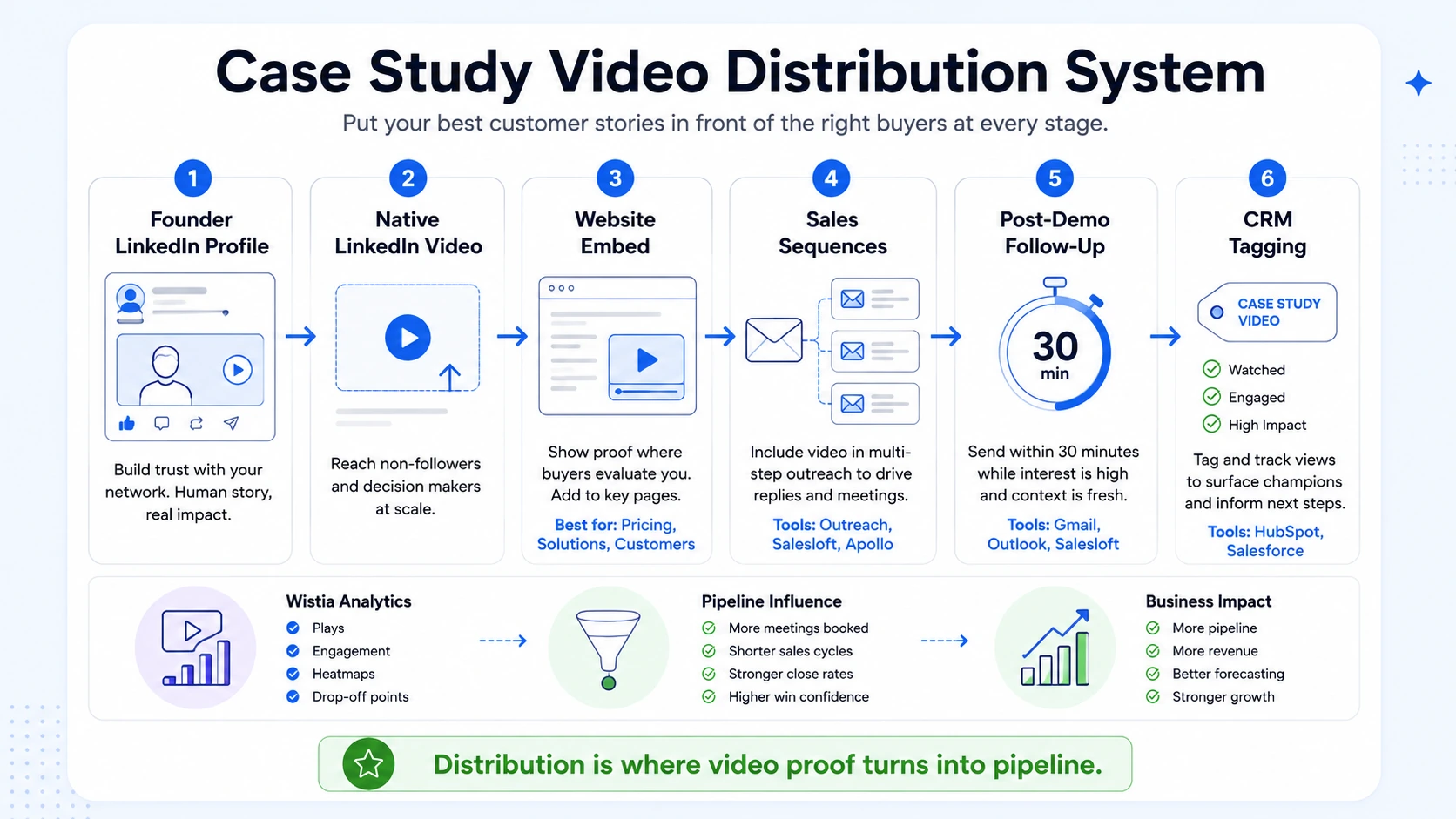
A complete distribution system for a repurposed case study video looks like this:
- LinkedIn (founder or executive profile): Personal profiles generate 8x more engagement than company pages, with posts from individual profiles receiving 8x the engagement of identical content from company pages. Post from your founder's or sales leader's profile, not the company page.
- LinkedIn native video: Native LinkedIn videos average 5.60% engagement rate in 2025. Upload the file directly to LinkedIn rather than sharing a YouTube link. Native video gets prioritized in the algorithm.
- Website embed (pricing, solutions, or case study page): Videos on your own website generate 48% engagement compared to 32% on social media. Embed using a platform like Wistia to retain SEO value and capture analytics. This also signals video SEO signals to search engines.
- Sales sequences: Drop the 90-second version into step 3 or 4 of your outbound sequence. Personalize the accompanying message by matching the customer's industry to the prospect's.
- Post-demo follow-up: Send the relevant case study video within 30 minutes of a discovery or demo call. It reinforces the solution discussed while the conversation is still fresh.
- HubSpot or CRM tagging: Tag which contacts watched the video and for how long. Use that engagement data to trigger follow-up sequences or score leads in your pipeline.
If you run webinars or record founder content, treat those as additional source material. Every webinar or podcast episode contains customer language and proof points you can pull into future case study video scripts.
Turning Case Studies into Video Without a Production Team
The most common blocker I hear from SaaS founders is: "We don't have a videographer." In 2026, you do not need one to produce a credible case study video.
The no-production-team workflow:
- Customer recording: Ask your customer to record a 3–5 minute Loom answering four questions. This is raw footage and it is often more believable than a polished studio recording.
- Screen capture: Use Loom or any screen recording tool to capture product UI, dashboards, or workflow moments that illustrate the outcome named in the case study.
- Static assets: Export the key metric from the written case study as a branded graphic using Canva. Animated text overlays on a short video clip perform particularly well on LinkedIn.
- AI-assisted transcription: Transcribe the customer's Loom recording and use it as a basis for caption copy, short written posts, and companion content.
- Editing: This is where most teams lose time. A skilled short-form video editor will cut a 4-minute raw Loom into a 75-second case study video that lands the proof point and holds attention. This is not a DIY task if pipeline is the goal.
A sharp, 20-second video clip can extend the half-life of your best ideas, pulling a key takeaway out of your latest report, giving it visual and emotional context, and sending it rippling through executive feeds within hours. It can turn depth into reach, and thought leadership into momentum.
The tools exist. The missing ingredient for most SaaS teams is a repeatable system for extraction, editing, and distribution. At Komet Media, that is the exact workflow we build for B2B and SaaS teams. We take your existing content, whether it is a written case study, a recorded webinar, or a founder interview, and turn it into short-form video assets built for the pipeline.
How to Measure Whether Your Case Study Video Is Working
Producing the video is not the end of the process. If you are not measuring, you are not optimizing, and you are not building a repeatable content system.
Track these metrics by placement:
Videos featuring customer testimonials have a 44% higher conversion rate in the decision stage than videos without testimonials. Use that as your benchmark. If your case study video is not lifting decision-stage conversion, the problem is usually one of three things: wrong audience targeting, a weak proof point, or a missing CTA.
For video SEO, embed your case study videos on dedicated landing pages using Wistia or a platform that generates a video sitemap. Include a transcript below each embedded video to give search engines indexable content. This turns each video asset into an inbound demand generation page, not just a social post with a short shelf life. B2B SaaS buyers read an average of 7 reviews before requesting a demo.
Your case study video is one of those touchpoints. Make it count by ensuring the result stated in the video matches the result on the page, in the testimonial, and in any related sales collateral. Consistency across formats is what builds cumulative brand authority with your target buyer.
If you are ready to build a video marketing system around your existing case studies, the Komet Media is the right next step.
Conclusion
When you repurpose a case study into a video story, you are not recycling content. You are upgrading social proof into the format your buyers actually consume. Here is what matters most:
- Start with the single strongest result, build the script around it, not around your product features.
- Keep LinkedIn and cold outreach videos at 45–90 seconds; reserve longer formats for late-stage sales assets.
- Distribute from personal profiles, embed on high-intent pages, and drop into sales sequences immediately after demos.
- Measure completion rate, downstream demo bookings, and deal velocity, not just views.
One well-executed case study video, distributed correctly, can influence more pipeline than 10 blog posts. Build the system, then scale it.
Frequently Asked Questions
Q1: What is the best structure for a B2B case study video?
The proven five-part structure is: Problem, Stakes, Solution, Proof, CTA. Lead with the customer's pain, not your product. Close with one specific metric and one clear next action. Every second that does not serve those five elements should be cut.
Q2: How long should a B2B case study video be for LinkedIn?
The sweet spot is 45 to 90 seconds, which produces a 74% completion rate compared to 49% for videos over two minutes. For cold outreach, stay under 90 seconds. For website embeds at the decision stage, you can extend to 2–3 minutes.
Q3: Can I repurpose a case study into a video without recording new footage?
Yes. A customer's Loom recording, product screen capture, and animated branded graphics are enough to produce a credible 75-second case study video. The key is a tight script and clean editing, not a production crew.
Q4: Where should I publish a case study video for maximum pipeline impact?
Publish natively on LinkedIn from a founder or executive profile, embed on your pricing or solutions page using Wistia, and include in your post-demo sales follow-up within 30 minutes. Your own website generates 48% engagement compared to 32% on social media, so treat the website embed as the primary asset.
Q5: How do I get my customer to participate in a video case study?
Send four focused questions via email or Loom, not a script. Ask: what problem did you have before, what did you try first, what changed after using our product, and what result can you put a number on? Brief them on length: 3–5 minutes of raw recording is all you need.
Q6: What makes a case study video different from a testimonial video?
A testimonial is a single positive statement. A case study video has a narrative arc: problem, solution, and named outcome. Case studies function as "proof of concept" for complex B2B products by detailing the specific problem, solution, and results of a past client, going beyond simple praise to demonstrate exactly how a product delivers value. A testimonial builds warmth. A case study video closes deals.

