
A Hook-Writing Framework for Short Video: Step-by-Step Guide
Most short-form videos die in silence. Not because the content is bad, but because the first three seconds never earned the watch. I've built video systems for B2B founders and executives at Komet Media, and the pattern is consistent: great insight, weak hook, invisible content. A proven Hook-Writing Framework fixes that. This guide gives you the exact structure, formulas, and psychology to stop the scroll and keep buyers, investors, and future hires watching until the end.
TL;DR
- The 3-second window is the critical threshold: if your video doesn't deliver a hook within those first moments, retention rates plummet.
- A Hook-Writing Framework is not creative writing. It's a repeatable system built on attention psychology.
- Every effective hook triggers at least one of three responses: curiosity, pattern interrupt, or self-relevance.
- Short-form video generates stronger returns than long-form videos, live streaming, and podcasts , making it the highest-leverage format for B2B visibility in 2026.
What Is a Hook-Writing Framework and Why Does It Matter for Short Video?
A Hook-Writing Framework is a structured system for engineering the first three seconds of a video so the audience chooses to keep watching. It is not a headline formula lifted from email copywriting. It is a discipline purpose-built for the scroll environment. A hook is the first one to three seconds of your video that compels someone to keep watching instead of scrolling away. Great hooks create an information gap, trigger curiosity, or deliver an immediate, unexpected value hit.
Why does it matter so much? Because the algorithm decides based on behavior, not intent. Research shows 71% of users decide whether to keep watching in the first 3 seconds, and the minimum viable threshold for algorithmic promotion is around 65 to 70% retention at that mark. Industry analysis puts watch time and completion at an estimated 40 to 50% of the entire ranking decision. That means the hook is not the opening of the video. It is the most important variable in your entire distribution strategy.
For B2B founders, the stakes are even higher. Decision-makers increasingly consume content through social platforms before engaging with vendors or entering formal buying processes. Your hook is the handshake that determines whether a potential buyer, investor, or future hire sees your message at all.
In 2026, B2B brands are empowering employees, founders, and executives to show up on camera and build their own followings, because audiences trust people more than logos. But trust cannot be built from a video nobody watches. The Hook-Writing Framework is how you earn that first watch. A framework also solves the consistency problem. Most founders produce content sporadically because each video feels like starting from scratch. A repeatable hook structure turns production into a workflow rather than a creative bet.
A great hook doesn't happen by accident. Every top short-form creator has a hook formula, a repeatable pattern they use to open clips in a way that makes scrolling feel impossible. At Komet Media, we apply this framework to content repurposing workflows, extracting the strongest insight moments from long-form recordings and rebuilding them around a hook that earns the watch. The content already exists. The Hook-Writing Framework makes it visible.
How to Grab Attention in the First 3 Seconds of a Video
The First Three Seconds Rule is not aspirational. It is algorithmic. Understand the mechanism and you will never open a video the same way again. TikTok videos that maintain 70 to 85% retention in the first 3 seconds receive 2.2 times more total views than videos with lower retention rates, according to 2025 industry data. Videos exceeding 85% retention in this window achieve viral potential, while content below 60% faces minimal algorithmic promotion.
TikTok's algorithm initially shows your video to a test audience of 200 to 500 users. If retention through the first 3 seconds is strong, TikTok expands distribution. If not, the video stalls. On Instagram Reels and YouTube Shorts, the same mechanic applies. Platforms like TikTok, Instagram Reels, YouTube Shorts, and Facebook Stories now prioritize videos with strong opening hooks, directly impacting engagement and reach.
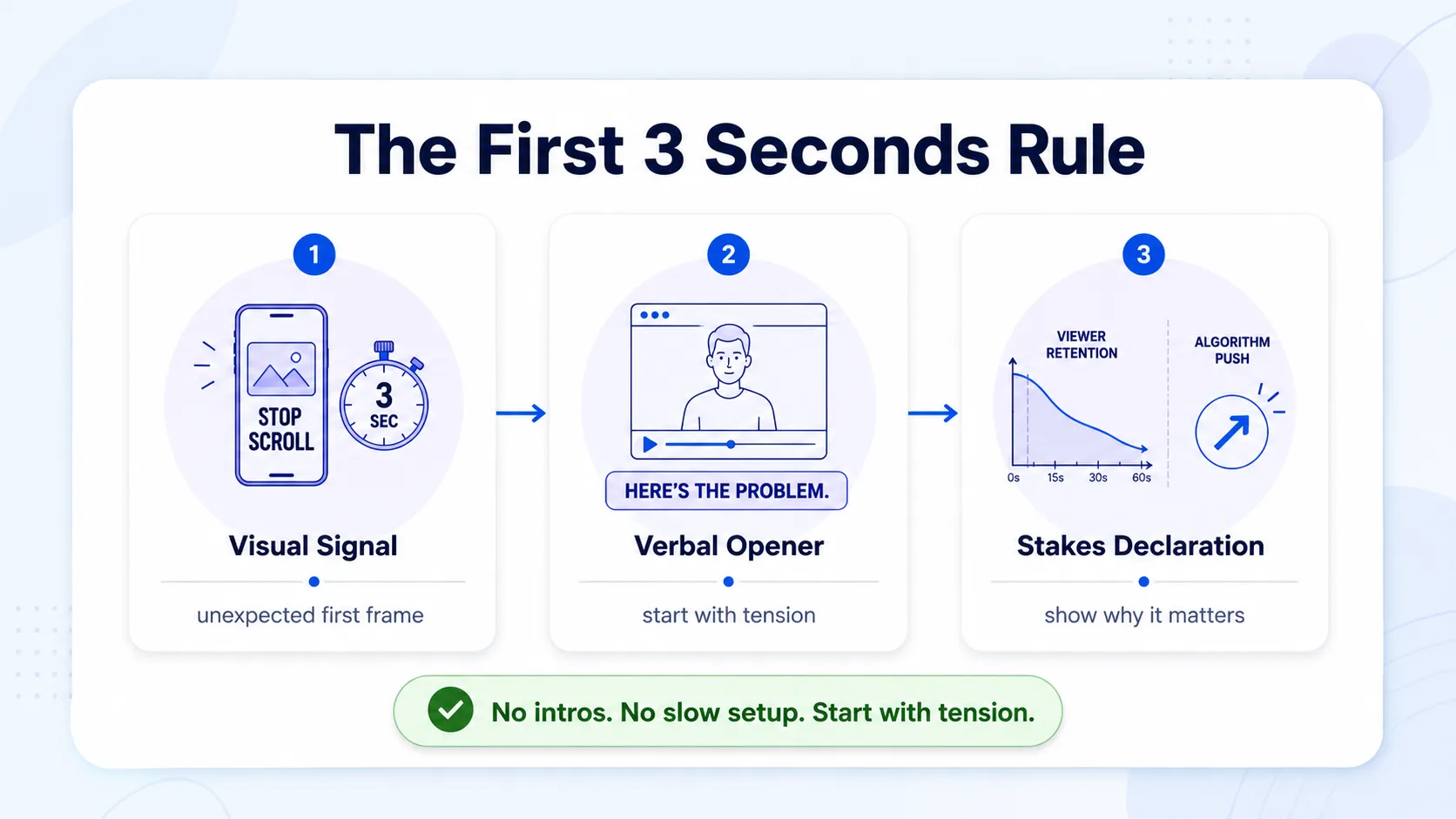
In 2026, the threshold shifted slightly. TikTok's algorithm now also looks for "Qualified Views" at 5 seconds, so your hook needs to be strong enough to keep viewers watching slightly longer than before to count as a quality view. Here is the operative sequence for the first three seconds using the Hook-Writing Framework:
- Visual signal: The very first frame must visually communicate something unexpected, specific, or emotionally charged. No slow zooms. No intros. No logos.
- Verbal opener: Your first spoken word or on-screen text carries the full weight of the hook. Start with the tension, not the topic.
- Stakes declaration: Within two seconds, the viewer should understand what they stand to gain or lose by watching. Make the cost of scrolling away feel real.
Silent-friendly formats matter: bold captions and visual storytelling cater to the 85% of users watching without sound, boosting completion rates by 40%. That means your on-screen text hook must carry the same tension as your spoken line. Neither can afford to be weak.
The single most common failure in B2B short-form video is the setup intro: "Hey everyone, today I want to talk about..." That construction loses the audience before the first idea lands. The Hook-Writing Framework eliminates it entirely.
What Makes a Good Hook for Short Videos: The 4 Psychological Triggers
Crafting a great hook is as much a psychology exercise as it is a creative one. In those first moments, several cognitive and emotional triggers determine whether someone continues watching.
Four triggers drive nearly all scroll-stopping hooks.
Curiosity Gap: Open loops are unresolved ideas that the brain wants closure on. Story scientists like George Loewenstein call this the curiosity gap, a proven driver of continued attention. A hook that withholds the answer forces the brain to stay. Formula: "The one thing holding your [role] back from [outcome] isn't [obvious answer]."
Pattern Interrupt: Effective hooks exploit pattern interruption because our brains are wired to notice anything that breaks the expected flow. In a B2B feed full of talking heads and slide decks, an unexpected visual or a provocative first sentence breaks the autopilot state.
Self-Relevance: People pay attention to content they believe is about them. Hooks that call out a specific audience, problem, or desire instantly feel personal, which triggers deeper engagement. "If you're a founder trying to close Series A..." qualifies the viewer immediately.
Emotional Stakes: Anger, surprise, awe, and fear all spike attention. Hooks that prime an emotion in the first second, through tone, music, or a charged phrase, get an immediate boost in retention. The strength of a hook multiplies when it combines two or more of these triggers.
Your first spoken sentence is your verbal hook; the first frame of footage and any on-screen text are your visual hook. A verbal curiosity gap paired with a visual pattern interrupt is one of the most effective combinations, as the audio and visual hooks compound each other.
Before publishing any video, score the hook against this checklist:
- Does it open an information gap the viewer wants to close?
- Does it break the visual or auditory pattern of the surrounding feed?
- Does it call out the exact person or problem you're targeting?
- Does it create emotional tension in under two seconds?
Two or more: publish. Zero or one: rewrite.
Hook-Writing Formulas That Actually Work on Social Media
A Hook-Writing Framework is only as useful as the formulas inside it. These are the structures with the strongest track record across TikTok, Instagram Reels, and YouTube Shorts.
The Controversial Take provokes curiosity and invites disagreement, which drives comments. The Number Hook creates clear expectations and is easy to consume. Both are reliable structures that produce strong three-second retention. Successful hooks often mirror tabloid headlines: dramatic, urgent, and curiosity-inducing. Lines like "Nobody talks about this side of freelancing" or "This one mistake cost me thousands" are prime examples.
For B2B founders specifically, the most effective hooks anchor to a specific business outcome, not a vague topic. "How to build a personal brand" is a topic. "Why your buyers Google you before your first call, and what they find" is a hook. Top creators test three different hooks for every video they publish.
Build this habit into your video editing workflow. Shoot the same hook three ways: one curiosity gap, one bold claim, one story start. Publish the one with the highest early retention. Over time, you learn which formula resonates with your specific audience.
How to Write a Pattern Interrupt Hook for Video
The pattern interrupt is the most technically specific hook type in the framework, combining verbal and visual elements simultaneously. A pattern interrupt is a deliberate break in what the viewer expects to see, hear, or read next. A hook is the reason to keep watching. A pattern interrupt is the moment that breaks autopilot long enough for the hook to land.
Writing a pattern interrupt hook requires decisions at two levels:
- Verbal pattern interrupt: Open mid-sentence, mid-argument, or mid-story. Begin mid-sentence, mid-action, or mid-emotion. The viewer arrives in the middle of something and must stay to understand what is happening.
- Visual pattern interrupt: Effective pattern interrupts include sudden camera movements, unexpected props, abrupt sound effects, or visual contrasts that stand out in the feed. Starting a video with a close-up of an unusual object and then zooming out to reveal context creates a micro-mystery that holds attention.
The key rule: make sure the interrupt is relevant to the content that follows. Random chaos might stop the scroll, but if it doesn't connect to your message, viewers will leave as soon as they realize the video isn't what they expected. For B2B video specifically, the verbal interrupt outperforms the visual one in most cases because decision-makers are drawn in by ideas, not spectacle. A strong verbal pattern interrupt sounds like this: "We were about to lose the account. One video changed it." No setup. No context. Drop into the tension.
Once the hook lands, you still have to keep disrupting expectations. Otherwise, viewers settle in and then you lose them during the middle of the video. The pattern interrupt must continue with pacing changes, caption beats, and cut points throughout the video, not just at the open.
The editing side of a pattern interrupt hook follows a tight structure:
- Open with the most unexpected or charged frame, not the most logical starting point.
- Use a jump cut within the first two seconds to break visual rhythm.
- Front-load the on-screen text with the key tension phrase, not the topic label.
- Hold back the resolution or payoff until at least 60% through the video.
This is where short-form video editing decisions matter as much as the writing itself. A brilliantly written hook fails if the edit opens on a static shot with a slow fade-in.
Open Loop Narrative: The Hook-Writing Framework That Keeps Viewers to the End
A pattern interrupt stops the scroll. An open loop keeps the viewer. Together they form the complete attention architecture of a high-retention short-form video. Open loops are based on the Zeigarnik Effect, a psychological phenomenon that explains our brain's tendency to remember unfinished tasks better than finished ones. In video terms, an open loop is a promise you make in the hook that you do not fully deliver until late in the video. By opening up an idea or starting a thought process in someone's head, you create a sort of tension that they need to close that loop. Your audience will want to know what happens next or how this story ends.
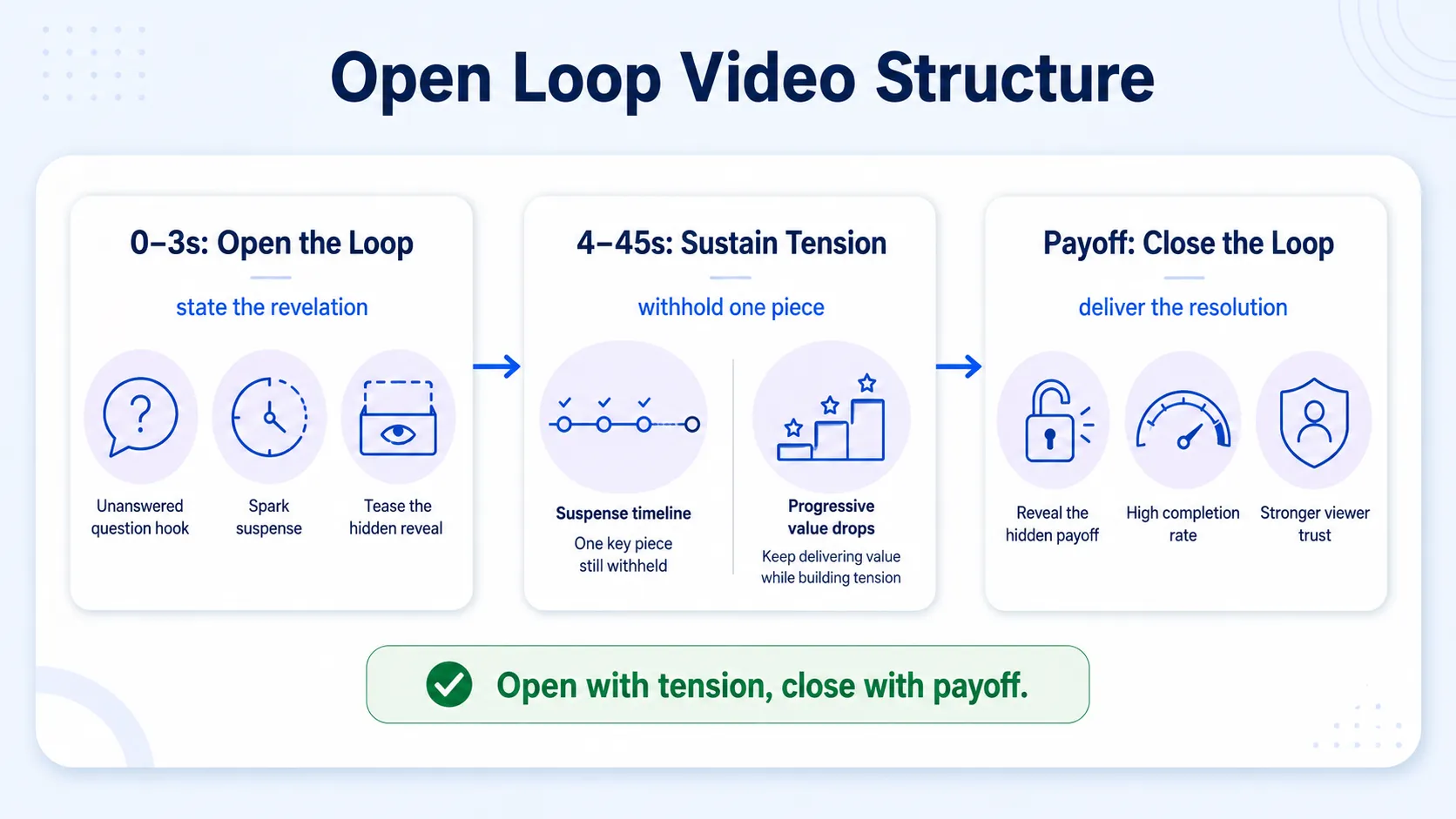
The open loop narrative works in three stages:
- Open the loop in the hook (0 to 3 seconds): State the outcome, result, or revelation without explaining how. "The conversation that changed how I think about hiring."
- Sustain the tension through the body (4 to 45 seconds): Deliver value progressively, but keep one key piece of the story withheld. Pacing controls viewer dopamine cycles. Rapid pacing early on helps secure engagement, while rhythmic pacing later sustains attention without fatigue. Editors often shift pacing every 3 to 6 seconds to maintain novelty.
- Close the loop at the payoff: Deliver the resolution fully. Close some open loops and give satisfaction to the viewer in the current video so the viewer maintains trust with you.
For content repurposing workflows, the open loop is already embedded in most long-form recordings. A podcast guest's most surprising admission, the moment a CEO corrects a common misconception, the turning point in a case study: these are natural open loops waiting to be extracted and rebuilt as hook-first short-form clips.
At Komet Media, this is the core of our video marketing process for founders and executives. We identify those high-tension moments inside existing conversations, then structure the short-form clip so the hook opens the loop and the payoff closes it, driving completion rates and platform distribution simultaneously.
These hooks rely on creating an "open loop": a psychological trigger that makes viewers crave closure. Questions, bold claims, or suspenseful teasers leave the brain wanting answers, encouraging people to keep watching.
Hook-Writing Framework vs Traditional Copywriting for Video
This is the question I get most often from founders who come from a written content background: can I just apply my copywriting skills to hooks? The short answer: partially. Traditional copywriting and video hook writing share psychological roots but diverge sharply in execution.
Traditional brand slogans and long introductions are ineffective in short-form video. Copywriting trains you to set up context before the payoff. A Hook-Writing Framework demands the opposite: drop the audience into maximum tension with zero setup, then earn context as trust is extended. The structural difference matters most. Traditional copywriting frameworks like AIDA (Attention, Interest, Desire, Action) move linearly through awareness and interest before desire.
A hook has one job: create tension. Tension is the feeling that something important is about to happen, a revelation, a payoff, a contradiction. When a viewer feels that tension in the first 2 seconds, their brain won't let them scroll away until it's resolved. Copywriting skills that transfer directly: specificity, emotional precision, benefit-oriented language, and audience targeting. These sharpen the verbal hook significantly. What does not transfer: buildup, qualification, and context-setting before the main idea.
For B2B founders with strong written content backgrounds, the adjustment is cognitive, not creative. You already know how to identify the most compelling claim in a piece of content. The hook-writing shift is simply moving that claim from paragraph three to second one, frame one, word one. That is the whole game.
Our video editing services team works directly at this intersection, turning existing written expertise and long-form content into short-form hooks that the algorithm rewards and buyers respond to. If you want to see what this looks like in practice for your own content, visit our services page or get in touch directly.
Conclusion
The Hook-Writing Framework is the highest-leverage skill in short-form video for B2B founders in 2026. Here is what to take into your next video:
- The 3-second window is the critical threshold where a viewer's decision to watch or scroll is made. Engineer it deliberately using the curiosity gap, pattern interrupt, or open loop formulas.
- Match your hook type to your audience's pain: self-relevance beats cleverness every time for decision-makers and buyers.
- Test three different hooks for every video you publish and let retention data, not instinct, select the winner.
- Content repurposing only compounds in value when the extracted clips open with a hook strong enough to earn the watch. Structure first. Distribution follows.
-
Frequently Asked Questions
Q1: What is a Hook-Writing Framework in simple terms?
A Hook-Writing Framework is a repeatable system for writing the first one to three seconds of a short video. It uses specific psychological triggers, such as curiosity gaps, pattern interrupts, and open loops, to stop the scroll and earn the watch before the viewer's thumb can swipe away.
Q2: How many hook types should I use across my content?
Start with two to three reliable formulas and rotate them. Most top creators use 2 to 3 hook patterns consistently. Testing multiple types builds data on what resonates with your specific audience so you can double down on what works.
Q3: Does the Hook-Writing Framework work differently on TikTok vs Instagram Reels vs YouTube Shorts?
The core framework applies across all three platforms, but distribution signals differ slightly. TikTok leads with approximately 78% average view completion, followed by YouTube Shorts at 73% and Instagram Reels at 65%. Tailor the hook's tone to each platform while keeping the tension-first structure intact.
Q4: How do I apply a Hook-Writing Framework to repurposed content?
Identify the single most surprising or high-stakes moment in your long-form recording. Rebuild the short clip around it using an open loop structure: open with the tension or revelation, sustain curiosity through the middle, and close the loop at the end. The hook is already in the conversation. A webinar, podcast episode, or leadership presentation can be converted into multiple short-form video assets once you know how to extract the tension moment first.
Q5: How long should a hook actually be?
Three seconds maximum for the verbal and visual hook combined. The best structure for short form videos follows a proven 4-step framework: Hook at 0 to 3 seconds, Value Drop at 4 to 15 seconds, Story or Payoff at 16 to 45 seconds, and a Call to Action in the final 5 seconds. Every word in the hook must earn its place. If it does not add tension, cut it.
Q6: Can a B2B founder build executive visibility using just a Hook-Writing Framework?
The framework is the starting point, not the complete system. Strong hooks drive watch time, which drives algorithmic distribution. Brands publishing 3 to 5 short-form videos per week see significantly higher engagement growth. For executives, 3 clips per week across 2 platforms is the sustainable floor. Consistent output with repeatable hooks compounds into authority, trust, and buyer confidence over time.

