
Instagram Reels Posting Cadence and Scheduling for B2B SaaS & AI/Tech Startups: Step-by-Step Guide
I'm Rajan Soni, Founder of Komet Media. At every team I advise, the first Instagram question is always about cadence: how often, when, and how to keep it running without burning out the marketing team. The honest answer is that Instagram Reels posting cadence and scheduling for B2B SaaS & AI/Tech Startups is not about posting the most. It is about posting the right amount, at the right time, from a system that never runs dry. This guide breaks that system down, section by section.
TL;DR
- For B2B and SaaS, 2–4 Reels per week is the target range, because educational content outperforms volume.
- B2B brands see peak engagement from 11 AM to 1 PM, with Tuesday, Wednesday, and Thursday consistently outperforming weekends.
- The social media algorithm rewards original content and watch time over raw posting frequency.
- Batch production plus a scheduling tool is the only way to sustain any cadence long-term.
How Often Should B2B SaaS Companies Post Instagram Reels?
Frequency is the first thing founders ask about and the last thing they should obsess over. Posting frequency matters, but consistency beats volume. That single line should be printed on every SaaS marketing deck. For B2B and SaaS specifically, 2–4 Reels per week is the proven range, because educational content performs better than sheer output.
Instagram rewards accounts that post Reels regularly, with 3–5 times per week as the current sweet spot for increased distribution across Explore and the Reels feed. For a lean B2B SaaS team that is also running product, sales, and support, I recommend landing at 3 Reels per week as your baseline.
Here is why: the social media algorithm categorizes your account into micro-niches based on your last 9–12 posts. If your cadence goes dark for two weeks and then spikes, the algorithm does not know what to do with you. Once you lose your rhythm, the algorithm moves on and your followers forget you exist. Consistency is the actual product.
What does sustainable look like in practice? One benchmarked B2B brand with nearly 29K followers averages around three posts per week including at least one Reel, plus 6–7 Stories per week. That steady, strategic approach grew their audience by approximately 5,000 followers over the past year. That is a real outcome from a sustainable cadence, not a viral spike.
At Komet Media, we build this consistency by turning one long-form asset (a webinar, podcast episode, or product demo) into 3–5 short Reels in a single production session. The raw material is already there inside your team's existing content. The cadence only feels hard when you are trying to create from scratch every week.
The practical frequency breakdown for B2B SaaS:
- Weeks 1–4 (launch): 2 Reels per week to establish baseline and gather Instagram Insights data
- Weeks 5–8 (build): Increase to 3 Reels per week once production rhythm is confirmed
- Weeks 9+ (scale): Test 4 Reels per week for 30 days and compare audience engagement rate trends before committing
Does Posting More Reels Actually Increase Reach for B2B Brands?
Short answer: volume alone does not. Signal quality does. Instagram's algorithm prioritizes watch time, DM shares (sends per reach), and engagement quality over follower count. The algorithm now rewards watch time, saves, shares, and DM sends above all other signals. Likes alone barely move the needle. The algorithm heavily prioritizes Reels in 2026, often delivering 3–5x the reach of static posts even for smaller B2B accounts.
But that reach multiplier is triggered by quality signals, not by pushing out more content. Specifically:
- Reels with strong 3-second hold rates above 60% outperform those with weak holds below 40% by 5–10x in total reach.
- Instagram now prioritizes "Shares per Reach" over likes and comments.
- Content creators producing longer-form educational content are finding increased reach and engagement, while those relying on quick, flashy content are watching their metrics drop.
For B2B SaaS, this is genuinely good news. Founder POVs, product walkthroughs, and buyer objection breakdowns are exactly the kind of educational, save-worthy content that the algorithm rewards. You are not competing with lifestyle brands on volume. You are winning on depth. A Reel that gets shared in a Slack channel by one VP of Marketing is worth more to your pipeline than 1,000 passive views from cold accounts. Instagram now prioritizes Reels in the algorithm, with shorter Reels under 90 seconds receiving additional promotion.
For B2B SaaS, the practical sweet spot is 45–90 seconds: long enough to land a clear idea, short enough to hold a decision-maker's attention during a commute or between meetings. Our short-form video editing process is built entirely around this window.
Best Time to Post Instagram Reels for a B2B SaaS Audience
Timing determines whether your Reel gets momentum in its first hour. When you publish a Reel, Instagram shows it to a small portion of your followers first. If those initial viewers engage quickly, the algorithm interprets that as a signal to push your content to more people, including the Explore page and Reels tab.
For B2B SaaS, your buyers are professionals. They check their phones between meetings, at lunch, and in the early afternoon, not at midnight. B2B brands see the best engagement during the 11 AM to 1 PM slot. The best times to post general B2B content are between 9 AM and 11 AM and between 1 PM and 3 PM, targeting the lunch break window.
The best times to post on Instagram are Mondays 2–4 PM, Tuesdays 1–7 PM, Wednesdays 12–9 PM, and Thursdays 12–2 PM, with midweek afternoons driving the highest consistent engagement, per Sprout Social's data from 30,000 customers.
One important caveat: post 30 minutes before the peak hour so your Reel lands inside the engagement window. If Insights shows your followers peak on Wednesday at 12 PM, post around 11:30 AM. Your own Instagram Insights data will always beat any benchmark. Use peak time data as a starting framework, then adjust based on Reels Analytics after 4–6 weeks.
Instagram Reels Strategy for AI/Tech Startups: What Content to Build
For B2B brands, the goal is rarely direct conversions from Instagram. Think of Reels as top-of-funnel awareness and mid-funnel engagement tools. Your strategy should map to specific business objectives: brand awareness among target accounts, thought leadership positioning, product education, or driving traffic to owned properties where actual conversion happens.
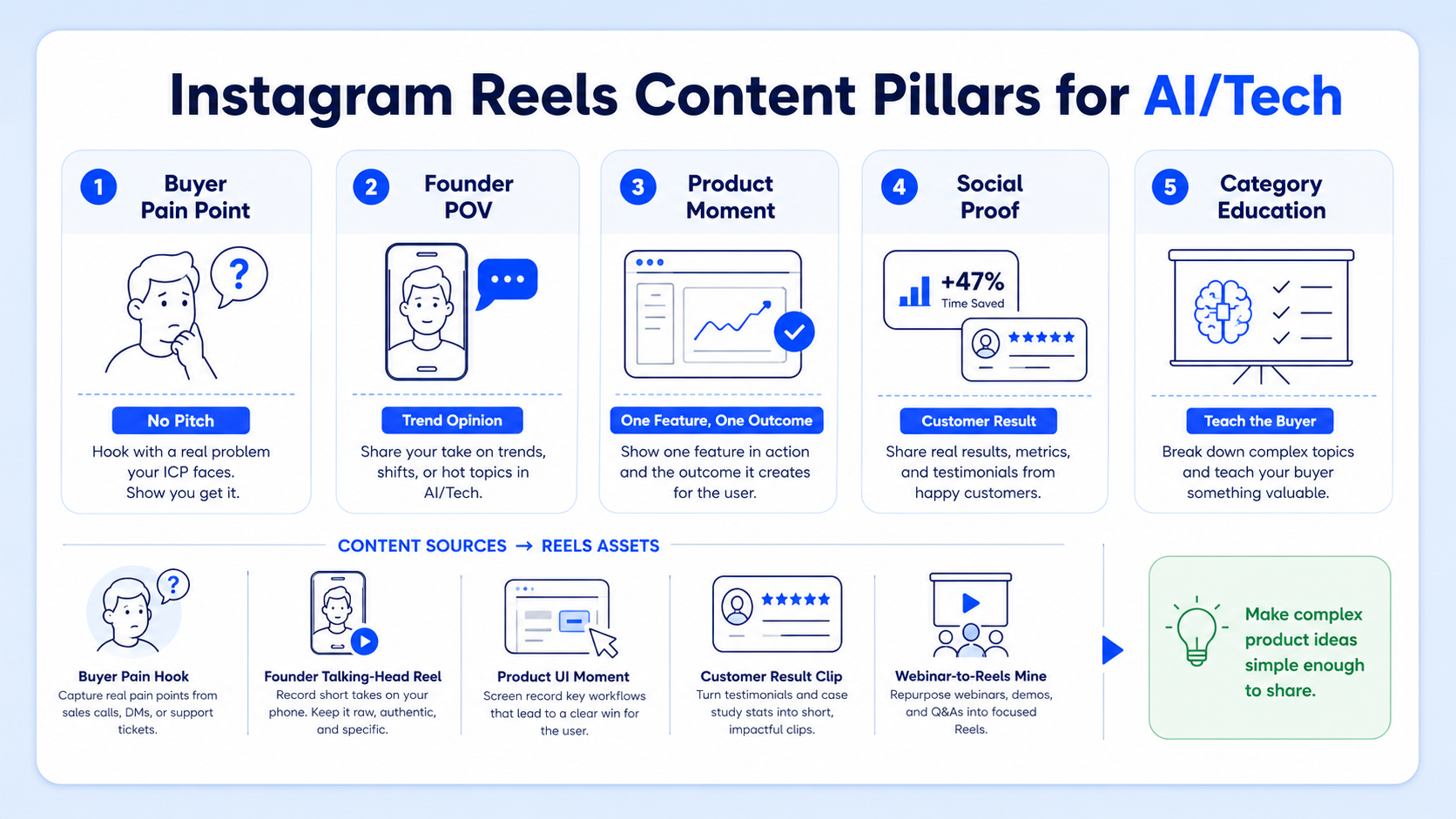
For AI and tech startups specifically, the challenge is translating complex product functionality into a 60-second video that a non-technical buyer can immediately understand and want to share. Here is the content system I recommend:
5 Reel content pillars for B2B SaaS and AI/Tech:
- Buyer pain point: Open with a problem your ICP feels daily, then show one clear way your product or thinking addresses it. No product demo. No pitch.
- Founder POV: A 45–60 second opinion take from the founder on a category trend. This drives thought leadership and DM conversations.
- Product moment: Show one feature doing one thing in under 60 seconds. Not a tour. One job. One outcome.
- Social proof: A customer result, a before/after metric, or a short testimonial clip pulled from a call recording or podcast episode.
- Category education: Teach something your buyer needs to know regardless of whether they buy from you. This builds trust and organic reach.
From July 2025, all public content from professional Instagram accounts became eligible to appear in search engine results by default. Your Reels, carousels, and photos can now surface directly in Google searches without users ever opening the app. Instagram went from a walled garden to a searchable content hub, with your posts competing alongside blog articles, landing pages, and YouTube videos in Google results. This means keyword-intentional captions and topic consistency in your content calendar now carry actual SEO value, not just social reach.
For teams that run webinars or podcasts, every long-form session is a Reels content mine. One 45-minute webinar can produce 6–8 standalone Reels without shooting a single new frame.
How to Build an Instagram Reels Content Calendar for a Tech Company
A content calendar is not a spreadsheet full of post ideas. It is a production system that makes output repeatable. Here is how to build one that holds up for a B2B SaaS team.
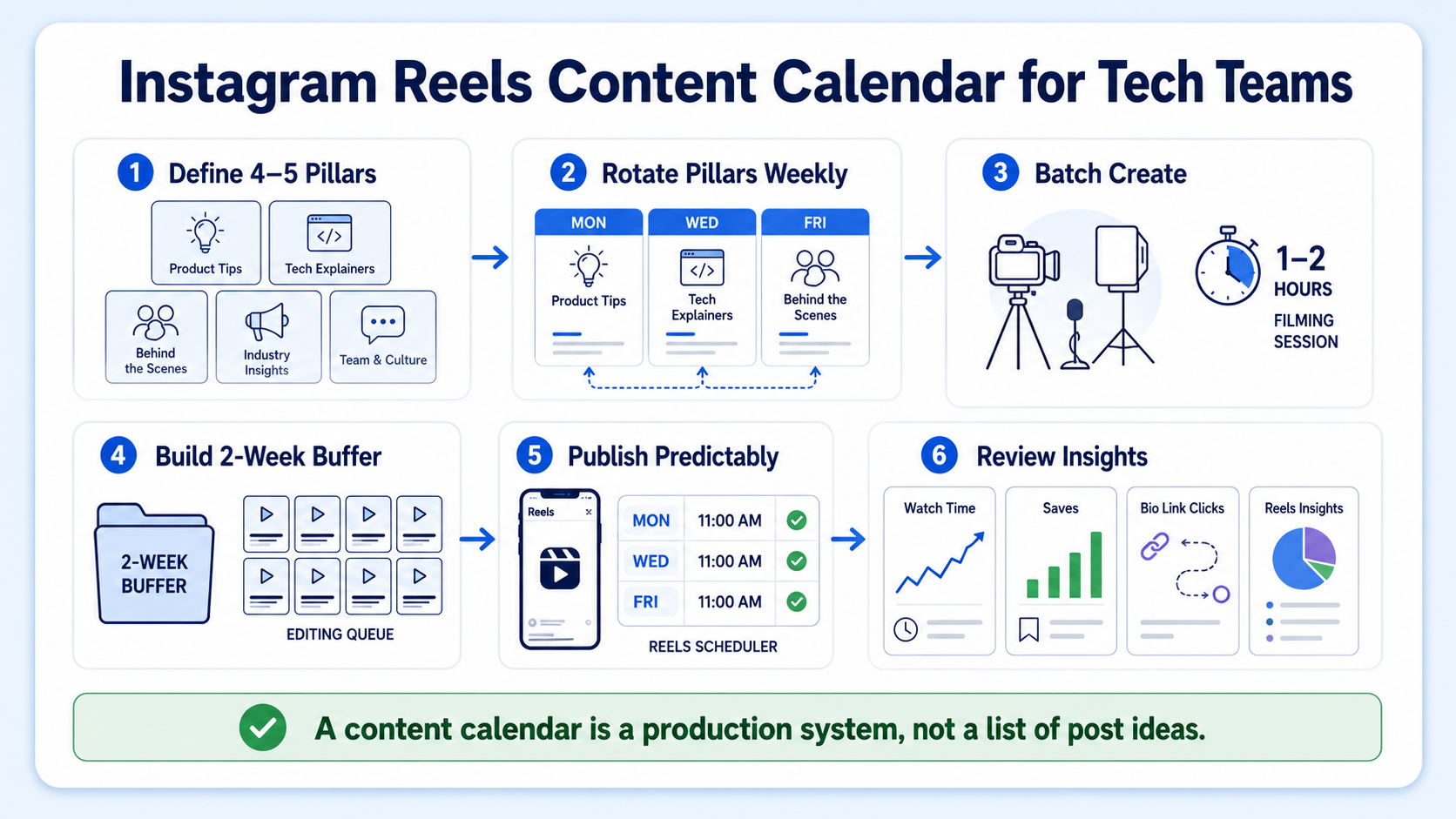
Step 1: Define your 4–5 content pillars (see the section above). Every Reel maps to one pillar. No exceptions.
Step 2: Assign pillar rotation across the week. A 3-Reels-per-week schedule might look like: Monday (pain point), Wednesday (founder POV), Friday (product moment).
Step 3: Batch content creation. Film all Reels and photos in one session on Tuesdays (1–2 hours), then edit and schedule everything on Wednesdays (30–60 minutes), leaving the rest of the week for engagement, DM responses, and Stories created in real time.
Step 4: Pre-build a 2-week content buffer. This removes the weekly panic and protects cadence during busy periods (product launches, fundraising, hiring surges).
Step 5: Plan a week or two ahead, batch content creation into focused sessions, and publish on a predictable schedule that trains both the algorithm and your audience to expect you.
Step 6: Review Reels Analytics and Instagram Insights every two weeks. Check watch time, saves, shares, and profile visits. Adjust pillar weighting based on what is actually driving traffic to your bio link.
Content pillars work exceptionally well for maintaining consistency while providing variety. Developing 4–5 core themes that align with your expertise and audience interests is a proven approach for B2B clients.
For distribution, cross-posting each Reel to LinkedIn (natively uploaded, not a link share) extends your content reach to your core buyer persona without additional production effort. That is your Content Distribution Framework in one sentence.
Instagram Reels Scheduling Tools for B2B SaaS Startups
Scheduling removes the single biggest reason B2B teams fall off cadence: manual posting at inconvenient times. Five scheduling methods exist in 2026: Instagram's native scheduler, Meta Business Suite, third-party tools like Buffer and Later, the Content Publishing API, and scheduling paired with DM automation.
Here is a practical comparison for B2B SaaS and AI/Tech teams:
If you post 2–3 times a week, Instagram's native scheduling (available since 2023) handles this fine. Teams posting 4+ times per week across multiple platforms should step up to Later, SocialPilot, or Metricool. SocialPilot offers multi-account scheduling for posts, Reels, carousels, and Stories, with best-time-to-post suggestions, approval workflows, and bulk scheduling capabilities.
For a growth team managing content approvals across a marketing head and a founder, that approval workflow alone saves hours per week. Instagram's native scheduler supports up to 25 posts per day, scheduled up to 75 days in advance, across single images, carousels, and Reels. For most B2B teams at 3 Reels per week, that is more than enough runway to build a meaningful content buffer.
Our Instagram growth and video marketing services include scheduling setup as part of the production system, so the tool is never the bottleneck. The content is.
Conclusion
Here is what actually moves the needle for Instagram Reels posting cadence and scheduling for B2B SaaS & AI/Tech Startups:
- Post 3 Reels per week as your baseline. Scale to 4 only once production is systemized.
- Schedule for Tuesday to Thursday, 11 AM to 1 PM in your buyer's time zone. Use Instagram Insights to refine from there.
- Optimize for watch time, saves, and DM shares, not likes. Those are the signals the algorithm acts on.
- Batch production around existing content (webinars, demos, podcasts) so cadence never depends on starting from scratch.
Consistency, system, and content quality. That is the full equation. Reach out to Komet Media if you want a production system built around your existing content library.
Frequently Asked Questions
Q1: How many Reels per week should a B2B SaaS company post?
For B2B and SaaS, 2–4 Reels per week is the proven range. Start at 2–3 to establish a sustainable rhythm, then test 4 only once your production pipeline is batched and consistent. Volume without a system leads to burnout and inconsistency, which the algorithm penalizes.
Q2: Does posting more Instagram Reels increase reach for B2B brands?
Not automatically. The algorithm prioritizes watch time, DM shares, and engagement quality over follower count. A single highly-shared educational Reel will outperform five mediocre ones. Optimize for depth of engagement, not posting volume.
Q3: What is the best time to post Instagram Reels for a B2B SaaS audience?
B2B brands see best engagement at 11 AM to 1 PM, with Tuesday, Wednesday, and Thursday consistently outperforming weekends. Always cross-reference with your own Instagram Insights to confirm when your specific audience is most active.
Q4: What scheduling tool should an AI/Tech startup use for Instagram Reels?
For teams posting 2–3 times per week, Instagram's native scheduler is sufficient. Teams posting more frequently or needing approval workflows should use Later ($25/month) for visual calendar planning or SocialPilot for bulk scheduling and best-time suggestions.
Q5: How do I build a Reels content calendar without a large marketing team?
Map 4–5 content pillars, assign each to a day slot, and batch-produce in one weekly session. Film all Reels in one 1–2 hour session, then edit and schedule everything in a 30–60 minute session the next day. Repurpose webinars, podcast clips, and demos to avoid creating from scratch every week.
Q6: Should B2B SaaS brands cross-post Reels to LinkedIn?
Yes, with one condition: upload natively to LinkedIn, never share an Instagram link. Native video on LinkedIn gets significantly more organic reach than an external link. Each Reel built for Instagram can be repurposed as a LinkedIn video post with a slightly longer caption tailored to a professional audience, doubling your content distribution without doubling production time. Explore Komet Media's Instagram marketing services for a full cross-platform strategy.

