
How to Find Podcast Sponsors: Step-by-Step Guide
Podcast monetisation is no longer a numbers game reserved for shows with massive audiences. If you know how to find podcast sponsors the right way, a tightly focused show with a few hundred engaged listeners can land real brand partnerships. U.S. podcast advertising revenue hit $2.9 billion in 2025, a 17.6% year-over-year increase,
and brands are actively hunting for niche shows that put them in front of the right buyers. This guide covers every step: from building your pitch infrastructure to closing your first deal.
TL;DR
- Download volume matters less than audience quality; niche targeting wins deals at any size.
- A polished sponsorship deck and CPM pricing knowledge are non-negotiable before you pitch.
- Marketplaces like Podcorn work with zero download minimums; ad networks require 5,000–10,000+.
- Host-read midroll placements command the highest CPMs and the strongest listener action rates.
How Many Listeners Do You Need to Get Podcast Sponsors?
This is the question that stops most podcasters from even trying. The honest answer: it depends on the model you use. Most brands want 5,000 to 10,000 downloads before they will talk rates, and that threshold applies to traditional CPM-based sponsorships with consistent publishing schedules and clear audience demographics. That said, these numbers are not a hard gate.
Traditional ad networks typically require 10,000–20,000 downloads per episode, but alternatives exist for smaller shows: ad marketplaces like Podcorn work with any size, and direct sponsors may engage with niche shows as small as 500 downloads if the audience fit is strong.
For B2B shows specifically, the bar drops further. B2B shows should aim for at least 300 to 1,000 downloads per episode within 30 days to start attracting paid sponsorships. Why? Because the listener demographics do the heavy lifting. A show where your audience is made up of CTOs or procurement heads is worth far more per listener than a general interest show. The cleaner way to think about this:
Most brands want a baseline of 300–1,000 downloads per episode within 30 days, but brand partnerships often hinge more on audience quality than volume. If your audience includes niche decision-makers, your sponsorship proposal can stand out even with smaller numbers.
What Is a Podcast Media Kit and Do You Need One?
Yes. You need one before you send a single outreach email. A sponsorship deck (also called a media kit) is the document that answers every question a brand has before they decide to reply. It answers a sponsor's first questions, who listens, how many, and what a placement costs, before they have to ask, which speeds up yes or no decisions and signals that you run the show professionally. A podcast media kit is a one-pager or downloadable PDF that introduces your show, including your description, audience metrics, past guests, and sponsorship opportunities.
Here is exactly what to include: A complete media kit covers show positioning (a one-line promise naming the exact audience), an audience profile (who listens and what they do for work), reach and engagement metrics (downloads per episode, growth, completion rate), host bio and credentials, proof (reviews, testimonials, notable guests, past sponsors), sponsorship packages and rates (so buyers can self-qualify), assets (cover art, host photo, logo, sample clip), and a contact or booking link.
Pay close attention to your engagement data. Completion rate measures what percentage of listeners finish each episode. A rate above 70% belongs at the top of your numbers page, not buried below the download count. On pricing, a common starting point for host-read midroll ads is $18–25 per 1,000 downloads. Package deals (midroll + newsletter + social post) give sponsors more value and you a higher total rate.
If you want to produce a podcast from scratch or turn your existing assets into a professional video kit or sizzle reel, Komet Media's podcast production services can help you launch from scratch or build the kind of clip reel that makes sponsors take your pitch seriously.
Podcast Sponsorship Rates: How Much Should You Charge Advertisers?
Charge based on the CPM pricing model: cost per thousand downloads. CPM represents the cost per 1,000 downloads or listens of an episode. Here is the 2026 rate landscape by placement:
Host-read ads accounted for the largest market share at 62.4% in 2025, and with good reason: the host's endorsement is the product. Host-read ads are the default unit in direct deals because the endorsement carries trust that a pre-produced spot cannot borrow, and buyers pay for it. For niche B2B and tech podcasts, the ceiling is higher. Technology shows hit 45–65 CPM because tech companies have large advertising budgets and compete for listener attention.
If you run a small show, don't default to CPM. Flat-rate sponsorship is a fixed fee per episode or per campaign, regardless of download numbers, and is common with smaller or newer podcasts without established download metrics or highly niche shows with valuable but small audiences. A show with 10,000 downloads per episode at a $25 CPM mid-roll earns $250 per episode. At $45 CPM for a tech niche, that same show earns $450 per episode from a single placement. The midroll ad placement is where you make your money. Protect it, price it right, and lead with it in every pitch.
How to Find Podcast Sponsors: Step-by-Step
Here is the process that actually converts, whether you are pitching directly or using a marketplace.
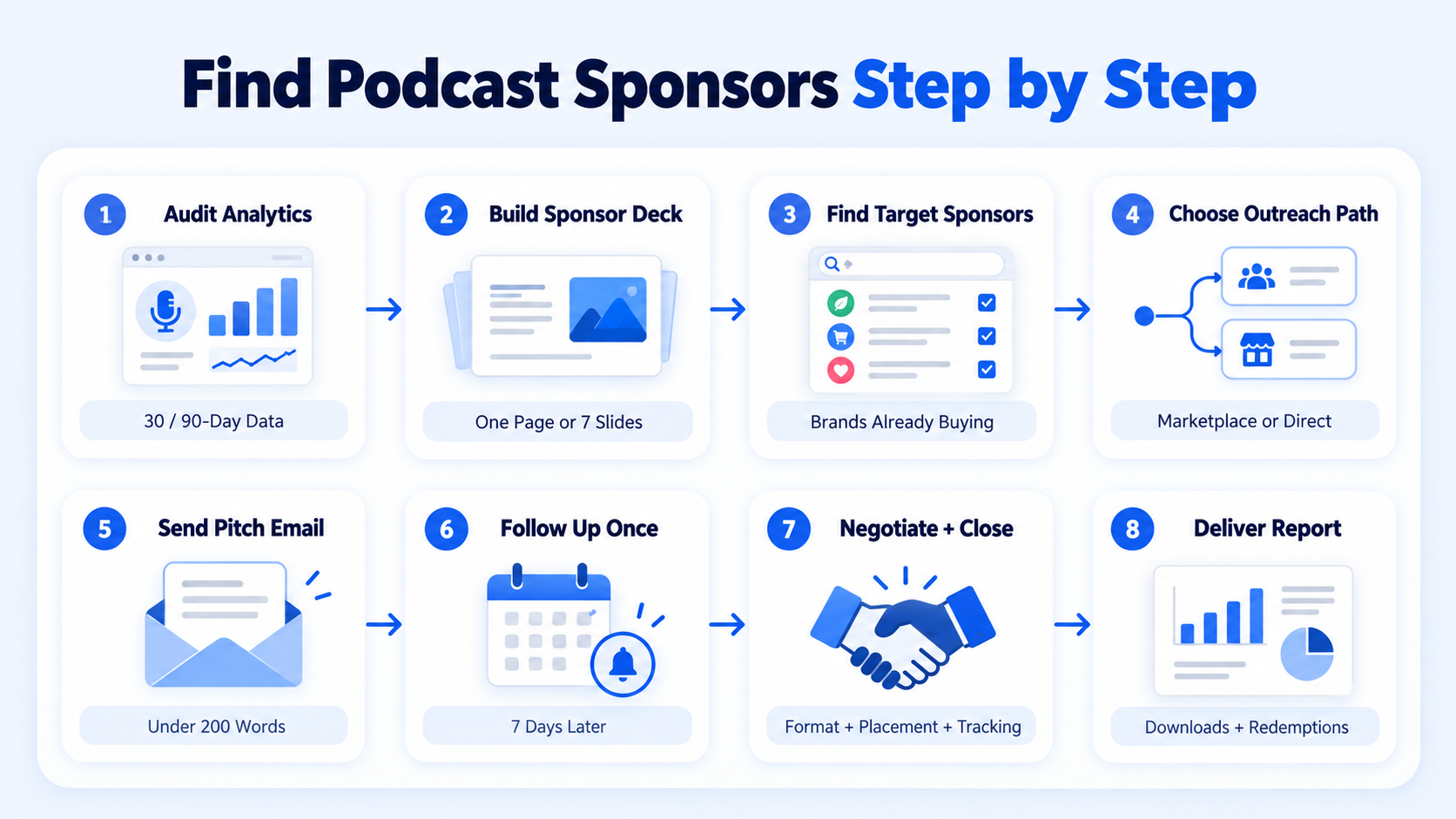
- Audit your podcast analytics: Pull 30-day and 90-day download data from Spotify for Podcasters or your hosting dashboard. Know your completion rate, top listener locations, and listener demographics before you approach anyone.
- Build your sponsorship deck: Use the media kit structure above. Keep it to one page or a tight 7-slide PDF.
- Identify target sponsors: Look at which brands already advertise on shows in your niche. Podchaser's database lets you search sponsorship activity by category. Brands already spending money in your niche are far easier to close than brands new to podcast advertising.
- Choose your outreach path: Podcorn is a self-serve marketplace where brands post campaigns, podcasters of any size browse and pitch, and deals are struck directly at flat rates the two sides negotiate. For larger shows, AdvertiseCast was acquired by Libsyn, and the AdvertiseCast brand now redirects to Libsyn Ads, running as a managed podcast advertising marketplace where brands place campaigns across many shows.
- Send your pitch email: Keep it under 200 words. Lead with who your audience is, what your numbers are, and what placement you are offering. Attach the deck.
- Follow up once: Wait seven days, send one follow-up. More than that damages the relationship before it starts.
- Negotiate and close: Agree on format (host-read vs. dynamic ad insertion), placement (pre-roll, midroll, post-roll), duration, and tracking method (promo code or vanity URL).
- Deliver and report: After the campaign, send the brand a short performance report with download data for the sponsored episodes and any promo code redemptions.
For podcast teams that want to launch and produce shows from scratch or extend sponsorship value into short-form video clips, Komet Media's short-form video editing services can create fresh content or turn episode highlights into LinkedIn and Instagram assets that give sponsors additional organic touchpoints.
What Companies Sponsor Podcasts and How Do I Contact Them?
The categories that consistently invest in podcast sponsorships are technology/SaaS, financial services, direct-to-consumer products, and professional services. Brands in financial institutions, consumer brands, and direct-to-consumer retail are actively seeking targeted customer acquisition channels through podcast advertising.
To find specific companies and contact them:
- Search Podchaser: Filter shows in your niche and look at their listed sponsors. Those brands are already buyers.
- Use Podcorn: Podcorn is the most accessible way for small and mid-size podcasts to land real sponsorships, no download minimums, self-serve proposals, and flat-fee deals that pay regardless of audience size.
- Use Libsyn Ads (formerly AdvertiseCast): AdvertiseCast is a podcast network with over 1,500 shows in its inventory, but to join their marketplace you have to be part of the network itself, which has some influence requirements.
- Try Spotify for Podcasters: Spotify for Creators requires 1,000 listeners and 3 episodes as a baseline.
- Go direct: Find the brand's marketing or partnerships team on LinkedIn. Reference the specific podcast they already sponsor to show you have done your research.
Research shows that 88% of podcast listeners have taken action, like visiting a website, signing up, or hitting 'buy', after hearing an ad on a podcast, making this a straightforward ROI argument for any brand you are pitching. When contacting brands directly, address the marketing or brand partnerships team. Use a subject line that names your show, your audience size, and the format you are offering. Specificity signals professionalism.
How to Get Podcast Sponsors Without a Big Audience
Small audience does not mean no sponsors. It means you need a different strategy. Here is what actually works at under 1,000 downloads per episode:
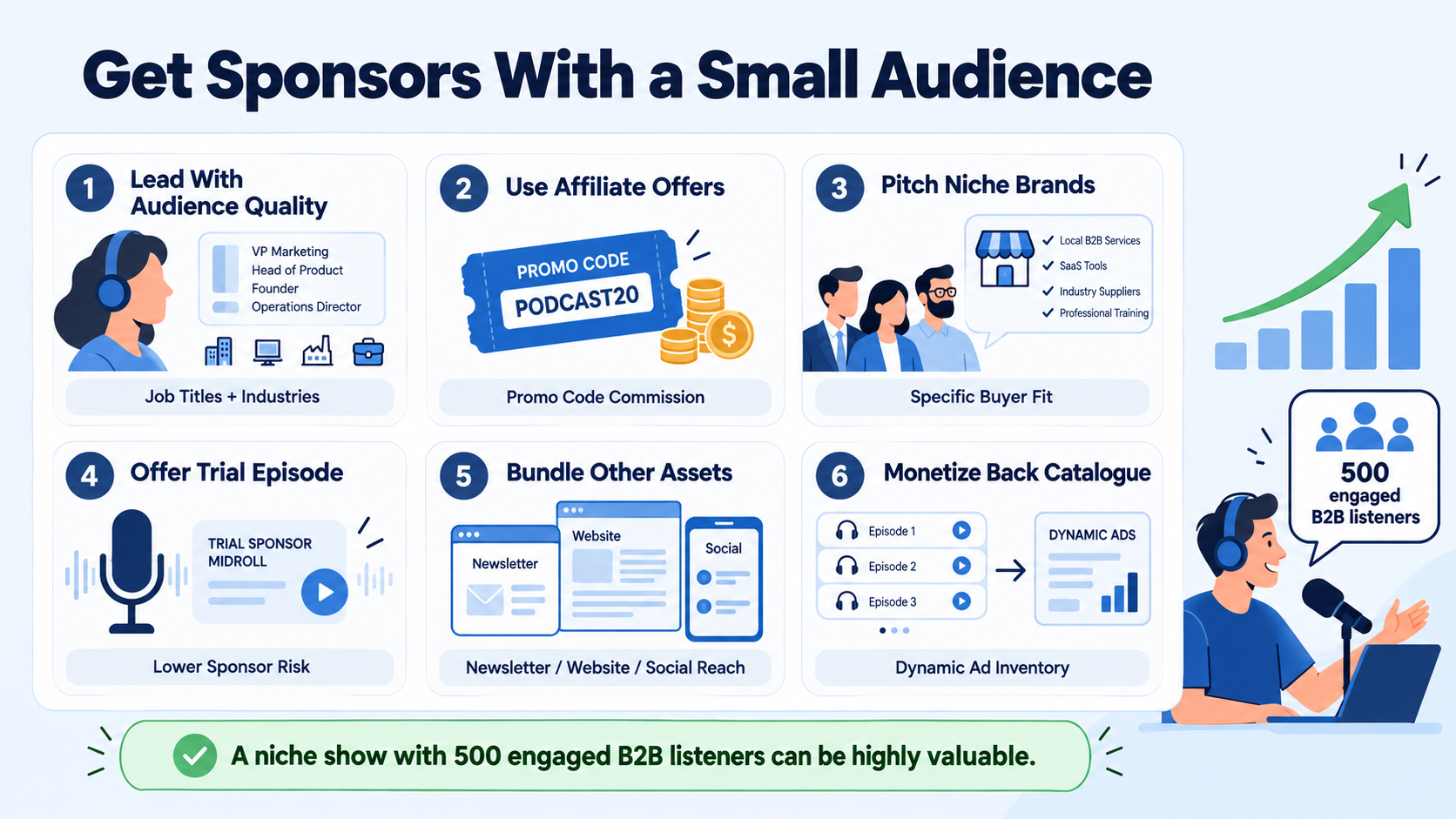
Lead with audience quality, not quantity. A 300-download B2B show where every listener is a VP of Sales is more valuable to a SaaS vendor than a 5,000-download general business show. Build that case in your deck using listener job titles and industries pulled from your Spotify for Podcasters analytics.
Use affiliate marketing as the entry point. Affiliate marketing lets you earn commission on sales driven through your unique promo code. Podcorn is an ad marketplace that uses the affiliate model, making it a great option for all podcasters regardless of the number of downloads, and is a strong way to start monetizing in the early stages of your podcast.
Pitch local or niche-specific brands. A regional accountancy firm or niche SaaS tool has a smaller budget and a very specific target buyer. Your focused audience is exactly what they need, and they are not expecting to pay for 50,000 downloads.
Offer a trial episode at a reduced rate. Let a brand test a single midroll before committing to a multi-episode package. Reduce the financial risk for them; the relationship builds from there.
Bundle your podcast with other content assets. Pair smaller podcast numbers with bigger website, newsletter, or social reach. Together, they tell a bigger story. If you are already repurposing episodes into short-form video or social clips via Komet Media's podcast marketing services, include those distribution numbers in your pitch.
A niche podcast with 500 engaged B2B listeners can command a higher effective CPM than a general show with 20,000 passive ones. Dynamic ad insertion also helps smaller shows monetize catalogue episodes, brands can buy inventory across your back catalogue, not just new releases, giving you revenue from episodes that were published months ago.
Conclusion
Learning how to find podcast sponsors is a system, not a single email. Your core takeaways:
- Build your sponsorship deck and know your CPM before you approach any brand.
- Use Podcorn or affiliate marketing if you are under 1,000 downloads; move to direct outreach and Libsyn Ads as you scale.
- Lead every pitch with audience quality and listener demographics, not just raw download numbers.
- Midroll host-read placements are your highest-value inventory, price them accordingly and protect them for the right brand partners.
If you want to build a podcast from the ground up, maximise the value of each episode, and give sponsors additional content touchpoints, Komet Media's podcast advertising services are built for exactly that.
Frequently Asked Questions
Q1: How do I find podcast sponsors as a brand new podcaster?
Start with affiliate marketplaces like Podcorn, which have no download minimums. Build a tight media kit focused on your listener profile, and pitch local or niche brands directly. Audience quality and a professional presentation outweigh low episode counts at this stage.
Q2: What is the CPM pricing model for podcasts?
CPM stands for cost per mille, meaning cost per 1,000 downloads. If your show charges $25 CPM and gets 4,000 downloads per episode, a single midroll placement earns you $100. Host-read midrolls average 15–30 CPM across the industry in 2026.
Q3: Do I need a media kit to get podcast sponsors?
Yes. A sponsorship deck tells a brand who listens, how many do, and what a placement costs without any back-and-forth. It signals professionalism and speeds up decisions. Keep it to one page or a tight 7-slide PDF with your key metrics and package options.
Q4: What is the best podcast sponsorship marketplace in 2026?
Podcorn is the most accessible for small shows with no download minimums and a flat-fee model. Libsyn Ads (formerly AdvertiseCast) suits mid-to-large shows. For complete fee control, platforms with 0% commission structures let you keep the full deal value.
Q5: What placement should I offer sponsors first?
Always lead with the midroll ad placement. It commands the highest CPM (15–30 average), sits at the point of peak listener engagement, and delivers the strongest action rates for host-read advertisements. Pre-roll is a secondary upsell, not your anchor offer.
Q6: How do I approach a brand for a podcast sponsorship deal?
Find the brand's marketing or partnerships contact on LinkedIn. Send a short email (under 200 words) naming your show, your audience profile, your download metrics, and the specific placement you are offering. Attach your media kit. Follow up once after seven days. Specificity and professionalism close these deals.

