
How to Find Podcast Influencers: Step-by-Step Guide
If your B2B pipeline depends on reaching buyers who actually listen, knowing how to find podcast influencers is one of the highest-leverage moves you can make right now. In a Spotify report, 63% of podcast listeners said they trust their favorite podcast host even more than their favorite social media influencers. For SaaS founders and growth teams trying to build genuine buyer trust, that is the channel worth owning. This guide walks you through the exact process: from defining your criteria to vetting, outreach, and turning podcast partnerships into repurposed content assets.
TL;DR
- Podcast influencers combine niche authority with deep listener trust, making them ideal for B2B buyer education.
- Use discovery tools like Podchaser, Rephonic, and Listen Notes to find aligned shows at scale.
- Vet on audience demographics and listener engagement rate, not just download numbers.
- Outreach and content repurposing together multiply the ROI of every partnership.
What Are Podcast Influencers and How Do They Work for B2B?
Podcast influencers (sometimes called podfluencers) are hosts or recurring guests who have built a loyal, niche audience around a specific topic. In B2B, they are not chasing virality. They are building trust with the exact buyers you want in your pipeline: operators, directors, and founders who listen while commuting, exercising, or working.
How the model works in practice:
- Sponsorship placement: Your brand is read by the host mid-episode, natively woven into the conversation.
- Guest appearance: A founder or executive from your team joins the show as a subject-matter expert.
- Co-produced content: You create an episode together, which both parties distribute.
- Content repurposing: The interview or mention gets clipped into short-form video and distributed on LinkedIn and Instagram through a podcast marketing workflow.
Brand mentions inside long-form podcasts drive 2.3 times higher recall than 15-second video pre-roll spots. For SaaS teams focused on product trust and founder-led growth, that recall advantage matters far more than raw impression volume. 72% of listeners prefer ads that align with the content and theme of the podcast, which means sponsorship alignment and brand affinity are not nice-to-haves. They determine whether your placement lands or gets ignored. This is why matching your solution to the right podcast influencer by niche, not just audience size, is the foundation of the entire strategy. U.S. monthly podcast listeners in 2026 sit at 183 million, meaning the audience is already there. The opportunity is matching your brand to the right slice of it.
How to Find Podcast Influencers for Your Brand: Start with Criteria
Before opening any tool, lock in your criteria. Searching without them wastes hours and surfaces irrelevant shows.
Define these five parameters before you search:
- Buyer persona match: Which job titles, industries, and company stages listen to this show? A SaaS podcast for growth-stage founders is different from a DevOps podcast for engineers.
- Niche authority: Is the host consistently recognized as a subject-matter expert in your category? Look for consistency across episodes, not one viral moment.
- Listener engagement rate: High download numbers mean nothing if the audience skips ads and never acts. Look for shows with active communities, listener reviews, and social amplification.
- Content alignment: Does the show already discuss adjacent problems your product solves? A show on revenue operations is naturally aligned for a sales enablement SaaS.
- Sponsorship history: Has this host worked with B2B brands before? Hosts with a track record of brand deals understand the expectations.
Once these are defined, you have a targeting brief. Every podcast you evaluate gets scored against it. This prevents scope creep where you end up pitching 50 shows with no shared audience logic. For B2B SaaS specifically, podcast influencers who host shows covering go-to-market, product-led growth, sales strategy, or founder journey tend to pull the most qualified buyers. The tighter the niche, the shorter the sales cycle for inbound leads that come from it. Audience demographics and sponsorship alignment beat download numbers every time. A 3,000-listener niche show where 80% of the audience are your exact buyer type outperforms a 50,000-listener show with diffuse demographics.
Best Tools to Find Podcast Influencers in Your Niche
These four platforms cover discovery through intelligence. Use them in combination.
Podchaser Pro includes 20+ first-party audience demographic datapoints per show, listenership estimates, a Power Score (a 0–100 popularity ranking), and transcript monitoring across 150,000+ podcasts. For B2B teams doing serious podcast influencer prospecting, it is the most complete single tool available. Rephonic is best known for free public widgets that estimate listener counts across a published database of around 3 million shows, surfacing email contacts and topic-level audience information per show.
It suits smaller teams doing focused outreach without enterprise-level budgets. Listen Notes indexes 3M+ shows and 180M+ episodes and remains the fastest, broadest podcast search engine available, with a free tier covering real research use. Use it for keyword-based discovery, then move to Rephonic or Podchaser for audience validation.
For podcast advertising campaigns specifically, pairing Listen Notes for discovery with Podchaser for vetting is the most cost-efficient two-tool stack for most B2B teams.
How to Vet Podcast Influencers Before Partnering with Them
Finding a show is step one. Qualifying it before you invest budget or time is where most teams skip ahead and pay for it later. Run every shortlisted podcast through this vetting checklist:
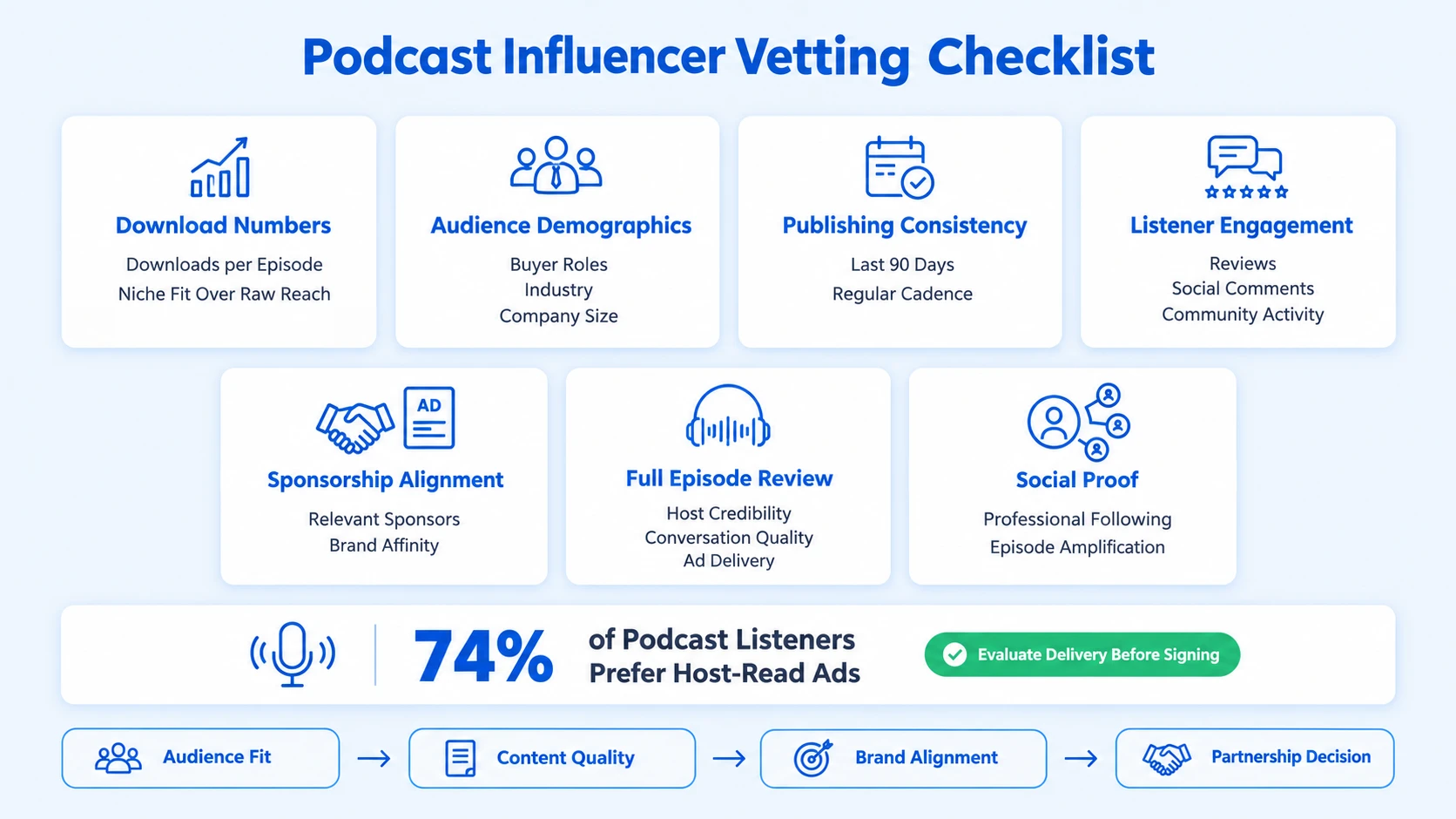
- Check download numbers in context: A show with 2,000 downloads per episode in a tight B2B niche can outperform a 20,000-download lifestyle show. Use Rephonic or Podchaser to pull listener estimates.
- Audit audience demographics: Does the audience match your buyer profile by role, industry, and company size? Podchaser Pro surfaces 20+ demographic datapoints per show.
- Review episode consistency: Is the host publishing regularly? A show that went quiet for four months is a risk. Look for consistent cadence over the last 90 days.
- Analyze listener engagement signals: Reviews on Apple Podcasts Connect and Spotify for Podcasters, social comments, and community activity all indicate active versus passive listenership.
- Assess sponsorship alignment and brand affinity: Pull the show's ad history. Does it sponsor adjacent B2B tools? If yes, their audience is already used to acting on host recommendations.
- Watch or listen to one full episode: Scripts tell you nothing. Hosting style, depth of conversation, and how they handle ad reads will tell you everything about whether this host can sell your product authentically.
- Verify social proof: Does the host have a following on LinkedIn or X that amplifies episodes? This extends reach beyond the podcast itself and into thought leadership territory.
74% of podcast listeners prefer host-read ads, which means the host's delivery quality and credibility directly determine conversion. Vetting that delivery before you sign a deal is non-negotiable.
How to Find Micro Influencers on Podcasts (and Why They Often Work Better)
Micro podcast influencers, typically defined as hosts with under 10,000 downloads per episode, are consistently underutilized by B2B SaaS teams focused on vanity metrics. That is a mispricing you can exploit. Why micro podcast influencers often outperform larger shows for B2B:
- Higher audience alignment: Smaller shows typically serve tighter niches, meaning a higher percentage of listeners match your ideal customer profile.
- Lower CPM: Average CPMs for podcast ads in 2025 range from $18 to $50, but micro shows frequently negotiate below floor rates, especially for first-time partnerships.
- Stronger host-listener relationship: Hosts with smaller audiences often have more direct engagement, including community channels, newsletters, and live events.
- Easier access: Pitching a show with 2,000 listeners is categorically easier than competing for a slot on a top-ranked show with a full sponsorship queue.
To find them, use Listen Notes with keyword filters for your exact niche and sort by recency rather than popularity. Filter out shows above a threshold download count using Rephonic's listener estimate widgets. Podchaser's Power Score lets you filter for shows below a certain influence tier, giving you a clean micro influencer shortlist.
Cross-reference discoveries with LinkedIn: search the host's name and check whether their professional audience matches the listener base you need. Many niche B2B podcast hosts are themselves the buyer persona, which adds an extra layer of social proof when they endorse your product.
Micro influencers also create ideal conditions for content repurposing. Because their shows run on tighter production schedules, they are more open to co-created assets, clips, and short-form video derivatives that you can deploy across paid and organic channels.
How to Reach Out to Podcast Influencers: Outreach That Gets Responses
Most outreach fails because it leads with what the sender wants. Podcast hosts receive sponsor pitches constantly. The ones that land lead with audience value and show-specific relevance. Follow this outreach sequence:
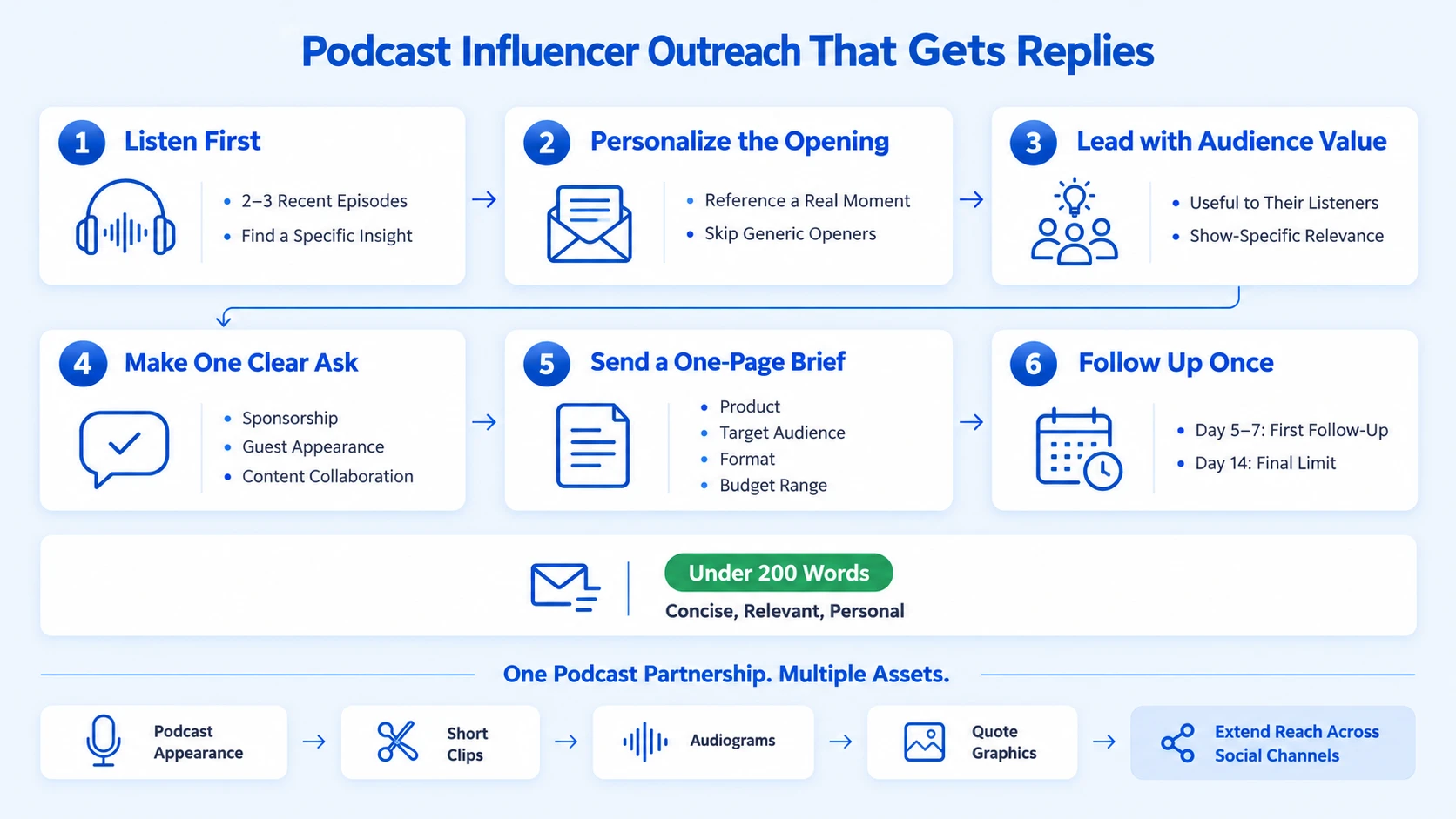
- Listen to two or three recent episodes and note a specific insight, guest moment, or topic that was genuinely useful.
- Write a personalized opening line that references that specific moment. Generic openers get deleted.
- Lead with audience value: Frame your product or sponsorship as something their listeners would find immediately useful, not as a marketing opportunity for you.
- State your ask clearly in one sentence: Are you pitching a sponsorship, a guest appearance, or a content collaboration?
- Attach a one-page brief covering your product, target audience, proposed format (mid-roll, interview, co-produced episode), and budget range.
- Follow up once at five to seven days if no reply. A second follow-up after fourteen days is the maximum before you move on.
Keep the initial email under 200 words. Podcast hosts are often solo operators managing show production, guest booking, and sponsorship entirely themselves.
For B2B teams working on podcast production or looking to launch their own show as a parallel strategy, note that owning the podcast is also an option. Appearing as a guest on aligned shows and hosting your own builds compound thought leadership over time, creating inbound demand from both directions.
Once a partnership is confirmed, build a repurposing plan from day one. Every interview, guest appearance, or sponsored segment can become short-form clips, audiograms, and quote graphics distributed across LinkedIn and Instagram, extending the reach of the original podcast placement without additional spend.
Conclusion
Knowing how to find podcast influencers is a repeatable, scalable process when you treat it like a system rather than a one-off search.
Key takeaways:
- Define your buyer persona, niche authority criteria, and sponsorship alignment requirements before you open any tool.
- Use Podchaser Pro for full intelligence, Rephonic for audience research, and Listen Notes for fast discovery.
- Vet on listener engagement rate and audience demographics, not download numbers alone.
- Micro podcast influencers often deliver stronger ROI for B2B SaaS teams than high-follower shows.
- Every partnership is also a content repurposing opportunity. Clip it, distribute it, and make it earn across every channel.
If you want to turn podcast appearances and sponsorships into a full video content engine, Komet Media's video growth services are built for exactly that workflow.
Frequently Asked Questions
Q1: What is a podcast influencer and how are they different from traditional influencers?
A podcast influencer (or podfluencer) is a show host or frequent guest who has built a trusted, niche audience through long-form audio content. Unlike social media influencers, their influence comes from sustained, in-depth conversations rather than short visual posts, which tends to produce higher purchase intent and recall among listeners.
Q2: How many downloads per episode should a podcast have before I consider a partnership?
There is no universal threshold. For B2B SaaS, a show with 1,500 to 3,000 downloads per episode in your exact niche can outperform a 30,000-download general business show. Prioritize audience demographics and listener engagement rate over raw download numbers when making this decision.
Q3: What is the best free tool to find podcast influencers?
Listen Notes is the strongest free option. It is the fastest, broadest podcast search engine available and is free for the searches most users need. For audience data and contact information, you will need to layer in Rephonic or Podchaser, which have paid tiers.
Q4: How do I know if a podcast audience matches my B2B buyer persona?
Use Podchaser Pro's audience demographic filters to surface job titles, industries, and company sizes represented in a show's listener base. Cross-reference the host's LinkedIn profile and episode guest list. If guests are regularly your buyer persona, the audience typically follows.
Q5: How much does podcast influencer marketing cost for B2B brands?
Average CPMs for podcast ads range from $18 to $50. Micro show sponsorships often fall below this range and offer strong negotiating flexibility for first-time partners. Guest appearances are typically free and often more valuable for thought leadership than paid placements.
Q6: Can I repurpose a podcast sponsorship into other content formats?
Absolutely, and you should. Every sponsored episode, guest interview, or co-produced segment can be clipped into short-form video for LinkedIn and Instagram. This extends your reach without additional spend and supports buyer education across the full funnel. Komet Media's podcast editing and repurposing service is built specifically for this workflow.

