
A Content Repurposing Framework You Can Copy: Step-by-Step Guide
Most B2B teams create one great piece of content, then let it die. A webinar, a demo, a founder podcast episode sits in a folder and reaches exactly the audience who was already paying attention. A structured content repurposing framework fixes that. It turns your best thinking into a distribution system that educates buyers, builds pipelines, and compounds over time, without starting from scratch every week.
TL;DR
- A content repurposing framework extracts maximum value from one long-form asset by converting it into platform-native short-form clips, posts, and written content.
- One pillar video can generate 10–15 derivative assets across LinkedIn, YouTube Shorts, Instagram Reels, TikTok, and email.
- Batch your production, match format to platform, and prioritize evergreen content for the longest shelf life.
- Systems beat one-off posts every time.
What Is a Content Repurposing Framework (and Why B2B Teams Need One Now)?
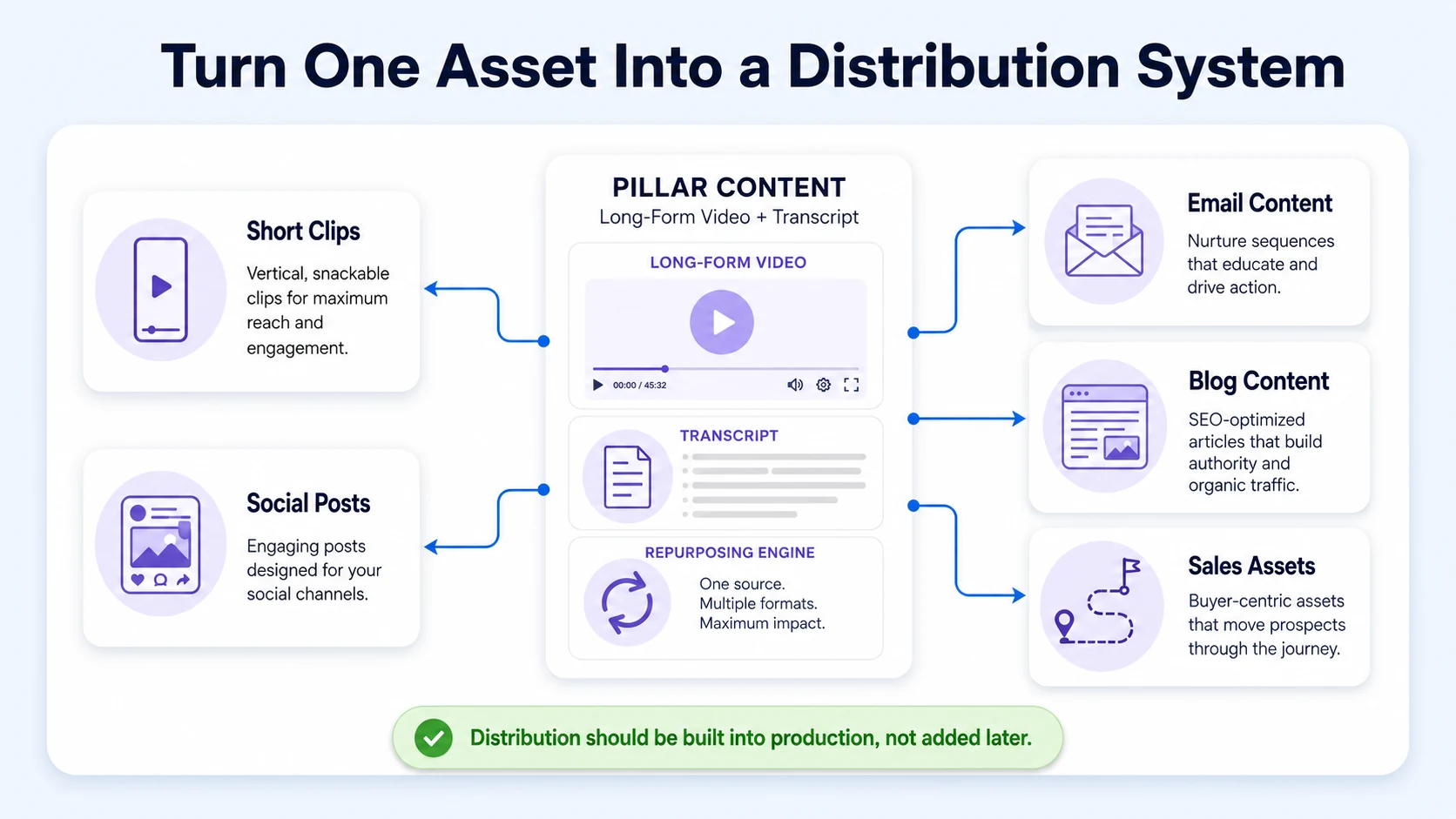
A content repurposing framework is a repeatable system for taking one high-value asset, a webinar, a podcast episode, a product demo, a long-form YouTube video, and converting it into multiple formats distributed across multiple channels. It is not just clipping a video. It is a deliberate workflow: choose your pillar, extract moments, reformat by platform, and distribute with purpose.
Gary Vaynerchuk popularized a version of this idea with his "Document, Don't Create" philosophy and the concept of content atomization: compress a pillar piece downward into micro-content, not the other way around. The logic still holds in 2026, and the data reinforces it hard.
Over half of companies now repurpose their video content into social clips, with LinkedIn leading distribution at 67% of teams, followed by Instagram at 49%, YouTube at 41%, and Facebook at 34%. That adoption curve is not slowing.
Short-form video is the top-performing content format in 2025, delivering the highest ROI of any content type and used by 30% of both B2B and B2C marketers. For B2B SaaS teams specifically, the stakes are higher. Decision-makers increasingly consume content through social platforms before engaging with vendors or entering formal buying processes, creating new opportunities for B2B organizations to build awareness and credibility through video.
If your product knowledge, founder thinking, and customer proof never leave the long-form format they were born in, you are invisible at the exact moment buyers are forming opinions. The reason most teams skip this: they have no system. They treat repurposing as an afterthought, not a production step. A real content repurposing framework changes that by making distribution a built-in part of how content gets made, not a follow-up task that never happens. The business case is blunt.
Content repurposing saves 60–80% of content creation time compared to starting from scratch for each platform. For a lean marketing team or a founder who is already stretched, that efficiency is the difference between consistent presence and sporadic posting.
How to Build a Content Repurposing System Step by Step
Here is the exact repurposing workflow we use at Komet Media and the one you can copy for your own team right now.
- Identify your pillar content: Choose a long-form asset with genuine depth, a webinar recording, a podcast interview, a product demo, a keynote. It should run at least 20–30 minutes and contain repeatable educational value. This is your content repurposing framework anchor.
- Transcribe and highlight: Pull a full transcript. Read through and mark the 8–12 moments that are self-contained, sharp, and useful to a cold audience, stat drops, counterintuitive takes, how-to sequences, and strong opinion statements.
- Edit short clips by platform: Cut vertical 60–90 second clips for LinkedIn, Instagram Reels, and TikTok. Cut horizontal 2–5 minute clips for YouTube. Each clip needs a standalone hook, assuming zero prior context.
- Extract written micro-content: From the same transcript, pull 5–7 LinkedIn text posts, a newsletter section, and 3–5 quote graphics. One pillar recording becomes your entire content calendar for two to three weeks.
- Build a content calendar: Assign each asset a publish date across platforms. Stagger LinkedIn posts, schedule Reels and YouTube Shorts, and drip clips into email sequences that map to buyer stages.
- Distribute with platform intent: Native upload always beats shared links. Caption every video. Using platform-specific hooks, what earns a stop-scroll on TikTok is not the same language that works in a LinkedIn feed.
- Measure and iterate: Track completion rate on short clips, engagement per post type, and downstream traffic. Double down on the clip formats that generate DMs, replies, and demo requests.
Almost 90% of teams reuse webinar content, and a third of webinars are still pulling in plays three months after the live event. Evergreen content is the multiplier, record it once, distribute it for quarters.
How to Repurpose Video Content Across Multiple Platforms
Platform-native formatting is where most teams leave ROI on the table. The same 45-minute webinar becomes different things on different channels. Here is how to think about the major platforms inside your content repurposing framework:
YouTube Shorts has the highest engagement rate at 5.91% of all short-form video platforms, closely followed by TikTok at 5.75%. That makes both non-negotiable distribution channels if you are serious about reach. For B2B SaaS specifically, LinkedIn is the primary buyer channel, but YouTube is the trust builder. 61% of consumers consider YouTube trustworthy for accurate information, according to a Gartner study from July–August 2025. If your product requires explanation, and most SaaS products do, YouTube is where buyers go to verify what they already saw on LinkedIn.
Our short-form video editing service is built around exactly this multi-platform logic: one source recording, formatted and optimized for each platform's native behavior, not just cropped and uploaded. The TikTok algorithm rewards completion rate. Instagram Reels rewards saves and shares. LinkedIn rewards comments and dwell time. Each platform scores content differently, and your clips need to be built for the scoring system they live inside.
The Best Way to Turn One Video Into 10+ Pieces of Content
Content atomization is the operating principle here. One pillar video is not one piece of content. It is raw material. Here is what a single 40-minute webinar recording produces inside a structured content repurposing framework:
- 4–6 short vertical clips (60–90 seconds each) for LinkedIn, Reels, TikTok, and YouTube Shorts
- 1–2 horizontal mid-form clips (3–5 minutes) for YouTube
- 5–7 LinkedIn text posts drawn from key insights
- 1 newsletter edition or email sequence segment
- 3–5 quote graphics for Instagram carousels or Stories
- 1 SEO-optimized blog post built from the transcript
- 1 show notes page for podcast distribution
- Pull quotes for sales enablement decks or outreach sequences
That is 15–25 assets from a single recording. Educational videos, product videos, social videos, and webinars were the most common types of content created in 2025, with over half of companies creating them regularly, and these four also rank as having the biggest impact on business success. The compounding effect is real.
Micro-content drives traffic back to your primary long-form asset , which means each short clip also functions as a top-of-funnel entry point into a longer sales conversation. A 60-second clip on LinkedIn that ends with "watch the full breakdown" creates a direct pipeline from short-form scroll to long-form trust-building, exactly the social media funnel B2B buyers move through before a demo.
Batch content creation is the production model that makes this sustainable. Block one day per month to film or record your pillar content. Process everything in one editing sprint. Distribute over four to six weeks. Repeat. This eliminates the daily "what do I post today" problem entirely.
What Steps Make a Content Repurposing Workflow That Actually Works?
Strategy without process fails. Here is the workflow architecture that separates agencies and teams who consistently publish from those who binge-and-ghost:
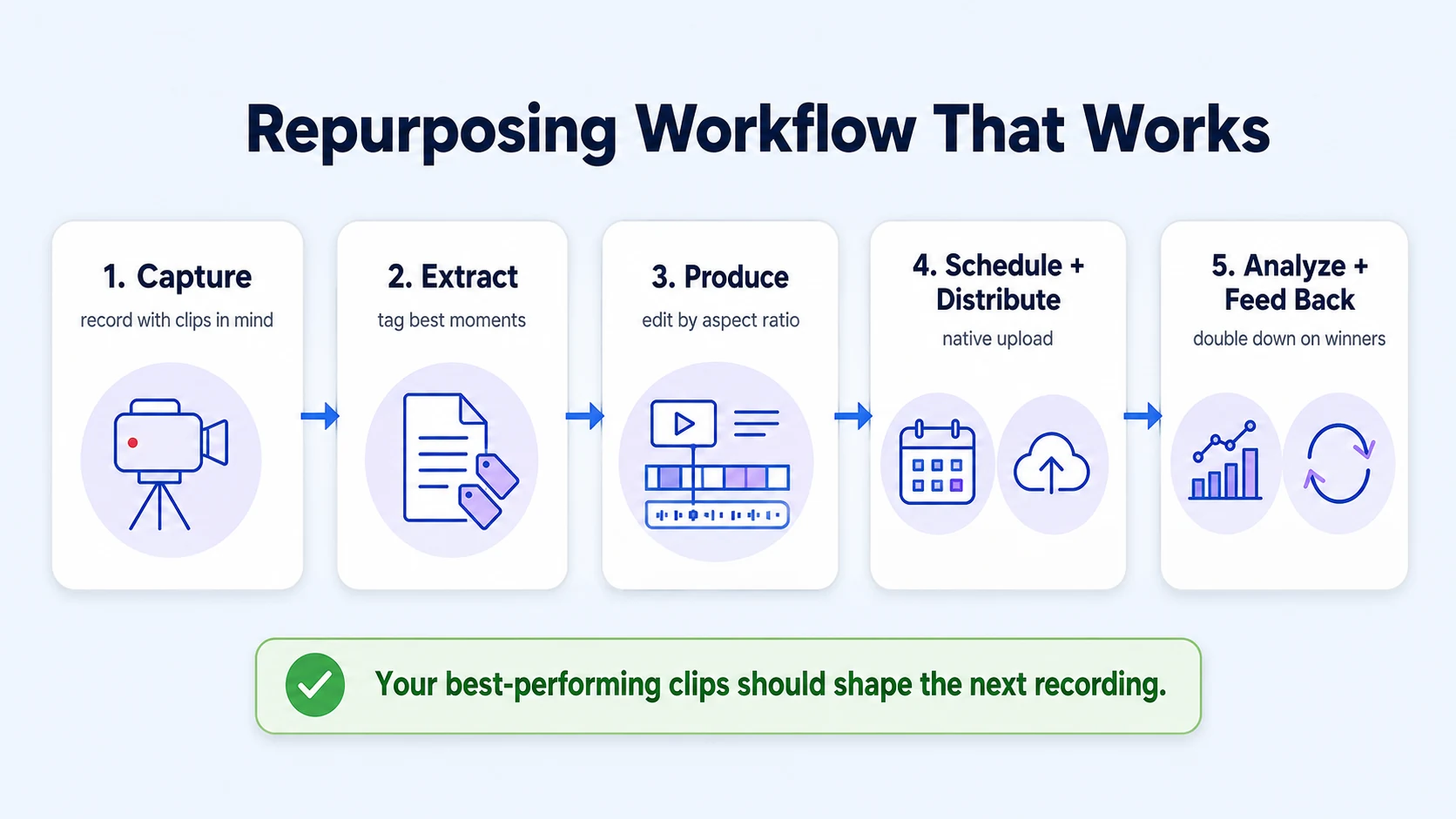
Phase 1: Capture
- Record your pillar content with distribution in mind. Ask questions that generate quotable, self-contained moments. Use a dual-camera setup if possible. Capture b-roll.
- Run every recording through transcription before editing begins. Podcast transcription is the first step in our pipeline for every audio or video asset.
Phase 2: Extract
- Highlight 10–15 clip-worthy moments in the transcript.
- Tag each moment by content type: insight, how-to, story, stat, opinion.
- Assign a platform to each clip before cutting begins. This prevents the common failure of cutting a 16:9 clip and then trying to force it into a vertical format.
Phase 3: Produce
- Edit short clips with captions, branded motion graphics, and platform-specific aspect ratios.
- Edit mid-form and long-form cuts separately.
- Produce written assets in parallel from the transcript, do not write the blog post from scratch.
Phase 4: Schedule and Distribute
- Load everything into your content calendar. Use a tool like Buffer, Publer, or Notion to track status and publish dates.
- Native upload to every platform. Never post YouTube links on LinkedIn if you can avoid it, the algorithm will suppress reach.
Phase 5: Analyze and Feed Back
- Review 30-day performance per asset. Identify the 20% of clips driving 80% of engagement.
- Feed those winning topics back into your next pillar recording. Your content calendar becomes self-correcting.
The companies winning in 2026 are the ones producing consistent, multi-format video content without reinventing the wheel each time. The workflow above is how you get there.
Mistakes to Avoid When Repurposing Video Content
A content repurposing framework only works if you avoid the failure modes that kill most repurposing efforts before they compound.
Mistake 1: Repurposing without re-formatting. Taking a horizontal talking-head video and cropping it to vertical is not repurposing, it is lazy repackaging. Every clip needs a platform-native hook, aspect ratio, captions, and sometimes a different opening line entirely.
Mistake 2: Using only promotional content as source material. Sales pitches do not repurpose well. Educational content, founder POV, product walkthroughs, and customer-problem breakdowns are the source material that generates genuine engagement.A successful short-video B2B strategy focuses on delivering value through expertise, education, and industry insight.
Mistake 3: Skipping captions. 59% of creators use automated captions or transcripts , and those who do not are losing viewers who watch on mute, which is most of them on mobile.
Mistake 4: Repurposing one-off instead of building a system. Doing this once is an experiment. Doing it every month with a documented workflow is a content repurposing framework. The difference is a repeatable process, not willpower.
Mistake 5: Distributing everything everywhere equally. Not every clip belongs on every platform. A deep product walkthrough belongs on YouTube. A sharp founder takes on LinkedIn. A visual product hook belongs on Instagram Reels. Match content type to platform intent, omnichannel marketing does not mean identical posts cross-published.
Mistake 6: Not linking short clips back to a longer asset. 60% of teams use social clips to link back to their website, making social video a traffic driver as much as an awareness play. Every short clip should drive somewhere: a landing page, a full video, a demo booking link, or a lead magnet.
The rule: If your repurposing workflow could be run by someone who does not understand your buyer, it is too generic to convert.
Conclusion
A content repurposing framework is the single highest-leverage system a B2B SaaS team can build in 2026. Here is what to take with you:
- One pillar video, webinar, demo, podcast, or founder interview, generates 15–25 assets when processed through a structured framework.
- Platform-native formatting is non-negotiable: LinkedIn, YouTube Shorts, Instagram Reels, and TikTok each score content differently.
- Batch content creation and a documented workflow turn repurposing from a one-time effort into a compounding distribution engine.
- The goal is not more content. It is more buyers reached, more trust built, and more pipeline generated from the expertise you already have.
If you want to see how this works in practice, explore Komet Media's video growth services or get in touch directly.
Frequently Asked Questions
Q1: What is a content repurposing framework?
A content repurposing framework is a documented, repeatable system for converting one long-form asset (webinar, podcast, video) into multiple platform-native formats, short clips, blog posts, social posts, graphics, distributed across channels. It replaces ad-hoc repurposing with a scalable production and distribution workflow.
Q2: How many pieces of content can I get from one video?
A single 30–45 minute webinar or podcast episode typically yields 15–25 assets: 4–6 short vertical clips, 1–2 mid-form YouTube cuts, 5–7 LinkedIn posts, a blog post, a newsletter section, quote graphics, and show notes. The exact number depends on content density and target platforms.
Q3: Which platform should I prioritize when repurposing B2B video content?
Start with LinkedIn for reach among decision-makers, then YouTube for evergreen search and trust-building. LinkedIn leads repurposed clip distribution at 67% of teams, followed by Instagram at 49% and YouTube at 41%. Prioritize based on where your buyers spend time, not where you are most comfortable posting.
Q4: How is a content repurposing framework different from a content calendar?
A content calendar schedules what gets published and when. A content repurposing framework determines how one asset becomes many. The calendar is distribution planning. The framework is production architecture. You need both, the framework feeds the calendar.
Q5: Do I need new content to start repurposing, or can I use existing recordings?
You can start with existing recordings immediately. Any webinar, podcast episode, product demo, or recorded sales call is valid source material. The content repurposing framework applies regardless of when the original was recorded, though evergreen content (not tied to time-sensitive news) will have the longest distribution runway.
Q6: What should I look for in a video agency that handles content repurposing?
Look for an agency that understands your buyer's journey, not just video production mechanics. They should format clips natively per platform, understand B2B sales cycles, and treat your content as pipeline fuel rather than social media filler. Komet Media's approach is built specifically for founders, marketing leads, and growth teams in B2B SaaS who need repurposing to drive real demand, not vanity metrics.

