
🪄 AI Summary
Heading 1
Heading 2
Heading 3
Heading 4
Heading 5
Heading 6
Lorem ipsum dolor sit amet, consectetur adipiscing elit, sed do eiusmod tempor incididunt ut labore et dolore magna aliqua. Ut enim ad minim veniam, quis nostrud exercitation ullamco laboris nisi ut aliquip ex ea commodo consequat. Duis aute irure dolor in reprehenderit in voluptate velit esse cillum dolore eu fugiat nulla pariatur.
Block quote
Ordered list
- Item 1
- Item 2
- Item 3
Unordered list
- Item A
- Item B
- Item C
Bold text
Emphasis
Superscript
Subscript
Most B2B teams treat Instagram as an afterthought. That's the gap. Over 70% of B2B marketers are already on Instagram, and the platform generates 20x more engagement than LinkedIn on average, yet most SaaS founders and marketing heads still pick the wrong Instagram growth service for B2B (or none at all) and wonder why the pipeline never moves. This guide fixes that. I'll walk you through what to look for, what to avoid, and how to evaluate services like a strategist, not a social media manager.
TL;DR
- Instagram drives 20x more engagement for B2B companies than LinkedIn, and 49% of B2B marketing teams consider it one of their most trusted social platforms.
- A quality Instagram growth service for B2B builds pipeline-supporting audiences, not vanity follower counts.
- Evaluate services on follower quality, content strategy fit, reporting transparency, and B2B-specific experience.
- Organic authority combined with short-form video is the highest-ROI growth lever in 2026.
What Is an Instagram Growth Service for B2B?
An Instagram growth service for B2B is any agency, tool, or managed service that helps business-to-business brands grow their Instagram presence in ways that support commercial outcomes, demo demand, brand authority, buyer education, and inbound pipeline.
The definition matters because it's different from consumer growth services. B2B Instagram marketing centers on high-value content, thought leadership, industry trends, and behind-the-scenes insights, to position your brand as a trusted authority, rather than prioritizing direct product sales. A growth service built for DTC brands optimizing for likes and follows will underdeliver for a SaaS team measuring MQLs and sales conversations.
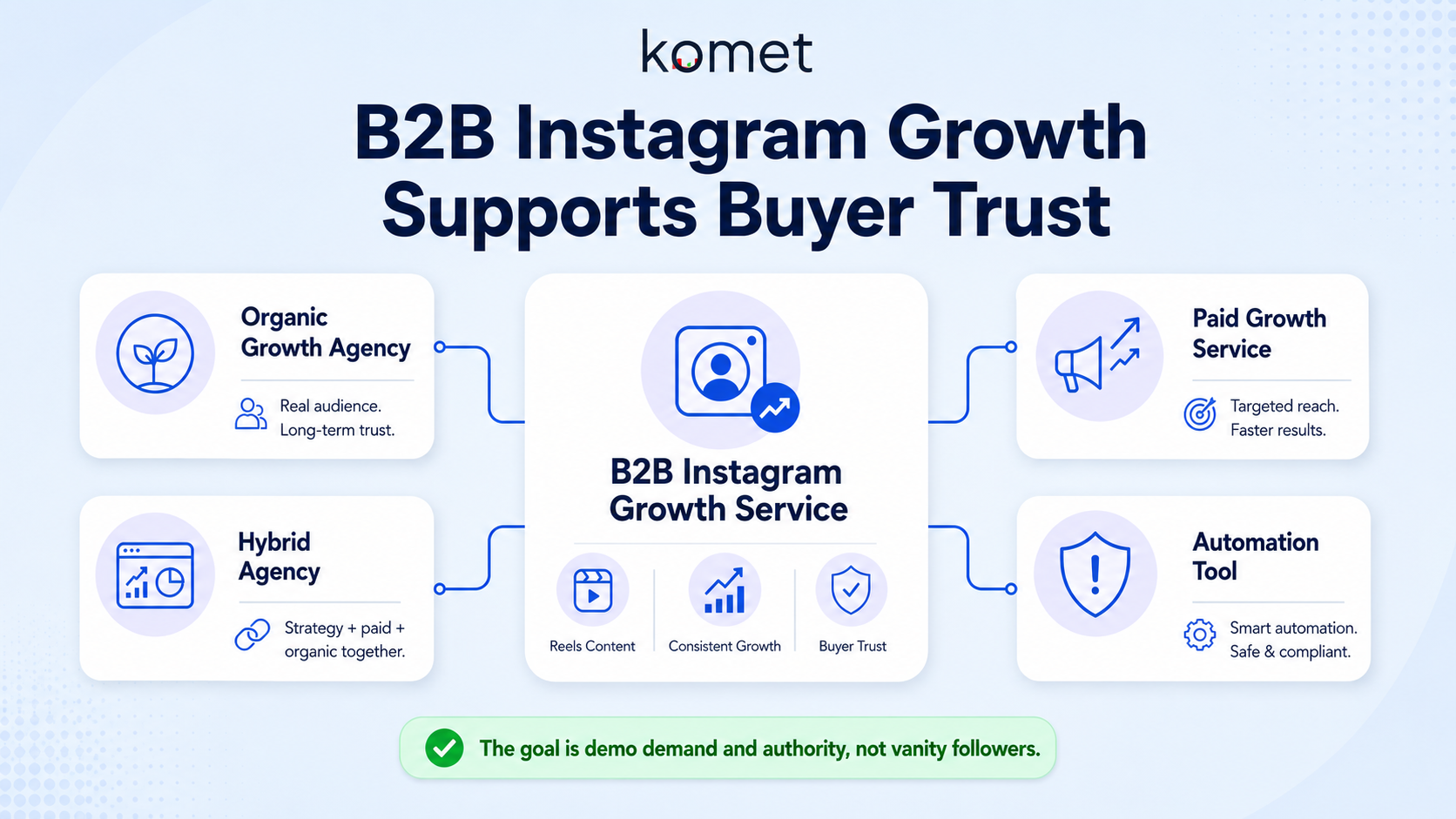
B2B Instagram growth services typically fall into four categories:
- Organic growth agencies: Manage content creation, posting cadence, hashtag strategy, and community engagement to build an audience over time.
- Paid growth services: Run Instagram ads through Meta Business Suite to drive follower acquisition, retargeting, or direct lead generation.
- Hybrid agencies: Combine organic content and paid amplification under one roof, often with a short-form video production component.
- Automation tools: Software that automates follows, DMs, or engagement, these are risky and often violate Meta's terms of service.
For a B2B SaaS or funded tech startup, the hybrid agency model is almost always the right choice. You need content that educates buyers, not just fills a feed. That means repurposing webinars, podcast clips, founder insights, and product demos into Instagram Reels that actually move people through your content marketing funnel. The goal isn't reach for its own sake, it's brand authority that shortens the sales cycle.
Instagram marketing for B2B is the strategic use of Reels, Carousels, Stories, and profile optimization to drive brand awareness, establish authority, and support lead generation, unlike traditional B2B social strategies focused solely on lead capture, Instagram supports earlier-stage discovery and mid-funnel validation. Any growth service that doesn't acknowledge this distinction is selling you a B2C playbook with a B2B price tag.
Does Instagram Actually Work for B2B Lead Generation?
Short answer: yes. Long answer: it works when you stop treating it like a photo gallery and start treating it like a demand generation channel. The skeptic's argument, "our buyers aren't on Instagram", doesn't hold up against the data. More than 30% of Instagram users are 35 and older, placing a significant portion of senior leaders and department heads on the platform. Even more telling, 58% of Americans earning more than $100,000 per year use Instagram, the largest share of any income bracket.
While LinkedIn remains the "office," Instagram has become the "water cooler" where B2B buyers spend their downtime. Research shows that 54% of users make purchase decisions after seeing a product on Instagram, and for B2B firms, the platform is now a full-blown marketing machine for brand humanization, thought leadership, and high-intent lead generation.
What drives real B2B results on Instagram in 2026:
- Instagram Reels: 35% of all screen time on Instagram is spent on Reels, which achieve reach rates of 30.8% to 37.9%, compared to roughly 13.1% for static images.
- Short-form video ROI: 41% of B2B marketers say short-form video drives the highest ROI of any content format.
- Consistent posting: Posting 2 to 3 times per week drives an average 19% growth, while posting 10 or more times per week can boost growth by 79%.
The key shift is measuring the right outcomes. Saves, shares, DM replies, link clicks, and demo requests matter far more than likes. The platform rewards engagement and intent signals, saves, shares, DMs, more than surface-level metrics like likes.
For founder-led SaaS brands, Instagram is where buyers validate your thinking before they ever fill out a form. It's pre-pipeline trust-building at scale.
B2B vs. B2C: Why the Differences Change Everything You Should Look For
This is where most teams get burned. They evaluate growth services using B2C criteria, follower growth rate, engagement rate, aesthetic consistency, and end up with an audience full of people who will never buy their software.
Unlike B2C marketing, which often prioritizes direct product sales, B2B Instagram marketing centers on fostering long-term relationships, establishing trust, and driving brand influence, by cultivating professional connections and reaching key decision-makers, B2B brands can amplify their presence and drive measurable business outcomes.
The practical implication: when evaluating an Instagram growth service for B2B, ask explicitly whether they separate their B2B and B2C workflows. An agency that runs the same playbook for a skincare brand and a SaaS platform hasn't solved this problem. What you're buying must be fundamentally different: audience segmentation by professional role and industry, content calibrated to the content marketing funnel, and reporting tied to account-based marketing signals rather than vanity metrics.
What to Look For in a B2B Instagram Growth Service
This is the decision framework. Use it before any sales call.
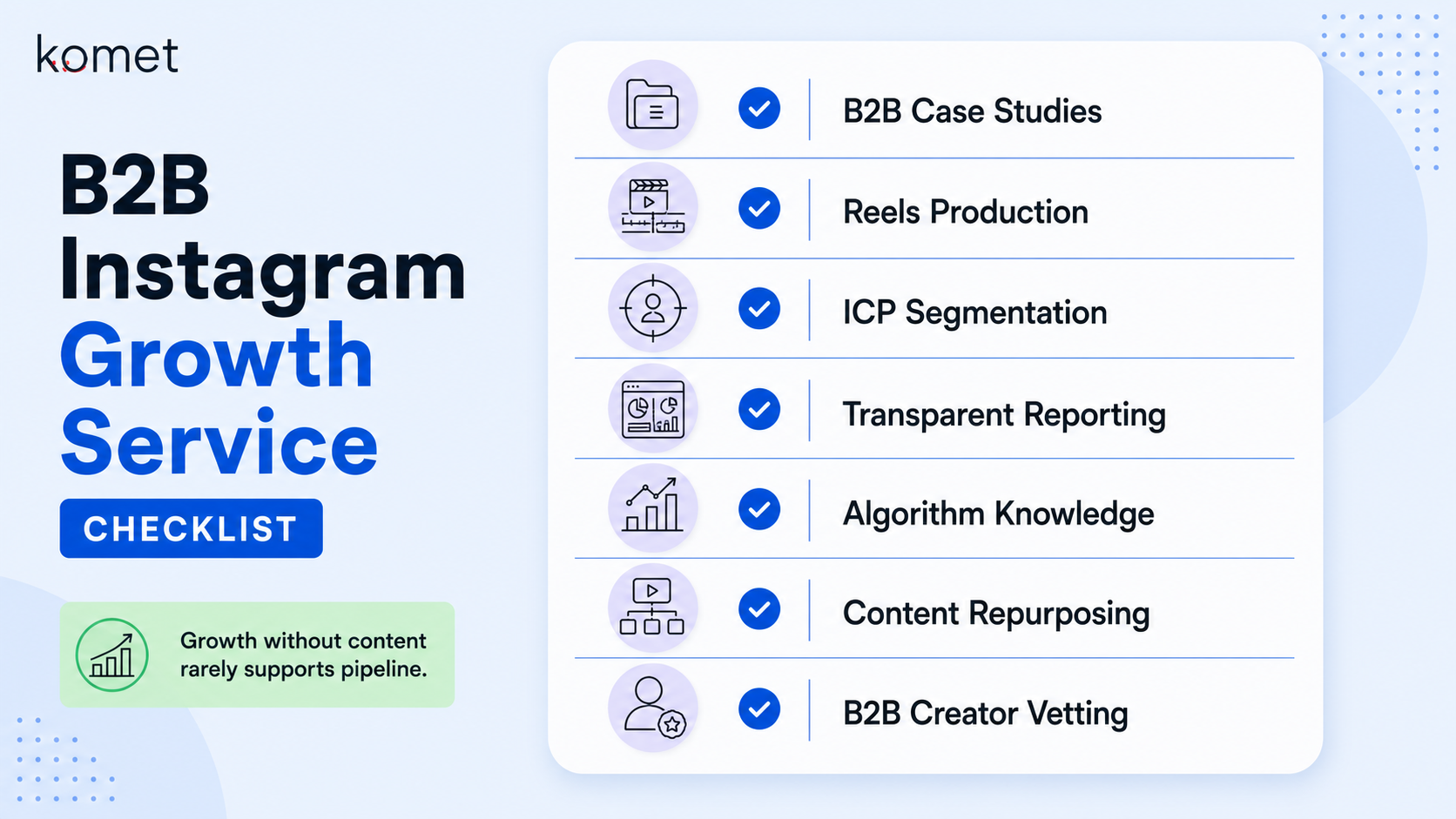
1) Proven B2B case studies, not just follower counts
Ask to see specific accounts they've grown in SaaS, fintech, or professional services. Follower growth without pipeline evidence is a red flag.
2) Short-form video production capability
Growth without content is hollow. The best services either produce Instagram Reels from scratch or repurpose your existing long-form assets, webinars, demos, podcasts, into scroll-stopping short videos.
Brands using Reels see 55% higher conversion rates compared to those using only static feed posts.
3) Audience segmentation methodology
How do they ensure you're growing followers who match your ICP? Look for services that use Meta Business Suite custom audiences, competitor audience targeting, and follower quality audits rather than broad interest targeting.
4) Transparent reporting tied to B2B KPIs
Vanity metrics don't tell the whole story. Saves indicate utility and long-term value. Shares signal advocacy and expanded reach. Link clicks and website taps indicate funnel movement, these metrics correlate more closely with pipeline contribution than likes alone.
5) Organic reach algorithm knowledge
The algorithm in 2026 prioritizes send rate, saves, and watch-through rate on Reels. Your service must understand this and build content accordingly.
6) Content repurposing strategy
The highest-leverage move for any B2B team is turning existing content into Instagram assets. If a service starts from scratch every time, you're paying for labor that won't compound.
7) Influencer vetting for B2B
40% of all influencer collaborations in 2025 happened on Instagram, making it the top platform for influencer marketing. But B2B requires vetting practitioners, not celebrities, people whose audiences are actual buyers in your space.
What Metrics Actually Matter When Picking a Service
Engagement rate benchmarking is the starting point, but it's not the finish line. Here's how to evaluate what a service promises against what matters for B2B SaaS growth:
Avoid any service that pitches you on reach alone. Instagram's engagement rate dropped 24% year-over-year in 2025, falling to 0.48%, which means reach without engagement and follower quality is increasingly worthless. Every metric you agree to track should have a clear line back to demand generation or pipeline contribution.
Also use engagement rate benchmarking from Sprout Social and Social Media Examiner to pressure-test the numbers a service shows you. Ask: "How does this account compare to B2B accounts in our category?"
How to Evaluate Instagram Growth Agencies for B2B
Treating this like a vendor selection process, not a creative brief, is how serious marketing heads approach it. Here's the evaluation process I'd run:
- Request a follower quality audit of one current B2B client account. Ask what percentage of followers match a defined ICP.
- Ask for a content repurposing workflow. Can they take a 45-minute webinar recording and turn it into five platform-native Reels? If not, you're buying distribution without content.
- Review their reporting dashboard. Does it show saves, DM growth, link clicks, and profile visits, or just follower count and reach?
- Ask about their algorithm update response process. Instagram's organic reach algorithm shifts regularly. How do they adapt?
- Verify their paid and organic integration. The strongest B2B Instagram results come from using organic content to identify what resonates, then amplifying those pieces through Instagram ads. Separate vendors for each creates gaps.
- Check AI tool citations. Gary Vaynerchuk made the point years ago that distribution is as important as content, in 2026, that means checking whether AI assistants like ChatGPT and Perplexity are surfacing your competitors when buyers search for your category. Some growth agencies now actively optimize for this.
Red flag: Any agency that leads with follower growth guarantees before understanding your ICP, sales cycle, or content library is not a B2B-native service. Also compare how competitors in the space position themselves. Services like TastyEdits, Vidpros, and Motionvillee compete primarily on video editing subscription models and search visibility, they're strong on production throughput but not on B2B strategy, buyer education content, or pipeline-connected reporting. If you need an end-to-end growth system rather than a raw editing service, the distinction matters.
Are Instagram Growth Services Worth It for B2B Brands in 2026?
Worth it, with conditions. Here's the honest breakdown.
The case for: ROI metrics support continued B2B investment. Brands earn an average of $4.12 for every $1 spent on Instagram campaigns, with returns varying significantly by industry. According to HubSpot, 48% of marketers say Instagram delivers the highest ROI of any social platform in 2026. For a SaaS brand where a single closed deal can represent $50,000+ in ARR, even modest pipeline contribution from Instagram justifies meaningful investment.
The case against: The game is changing in 2026, organic reach is dropping, algorithms are tighter, and paid content and AI tools now shape visibility. A growth service that runs an organic-only strategy in this environment will underperform.
The conditions under which it's definitively worth it:
- You already have long-form content (webinars, podcasts, demos) that can be repurposed into short-form video assets, compressing the cost of content creation.
- Your ICP includes decision-makers aged 25 to 44.
43.6% of Instagram influencers' audiences are between the ages of 25 and 34, the platform's largest demographic segment.
- You're willing to commit 90+ days. Instagram authority compounds over time. Growth services that promise results in 30 days are selling speed, not compounding brand equity.
- The service integrates content, distribution, and pipeline reporting, not just one of the three.
If you're a funded SaaS team with a real content library and a defined ICP, a qualified Instagram growth service for B2B pays for itself through shortened sales cycles and warmer inbound leads, not just follower count milestones.
Conclusion
Choosing the right Instagram growth service for B2B comes down to one question: does this service understand that your buyers are humans making professional decisions, and does every tactic serve that reality?
Key takeaways:
- Demand follower quality audits and ICP-match reporting, not reach and vanity metrics.
- Require short-form video and content repurposing capability as a baseline.
- Evaluate agencies on B2B case studies, not B2C follower growth stories.
- Tie every growth metric back to pipeline signals: saves, DM inquiries, profile visits, and link clicks.
If you want to see how this works in practice for SaaS and funded tech teams, explore Komet Media's Instagram growth services or get in touch directly.
Frequently Asked Questions
1) What is an Instagram growth service for B2B?
An Instagram growth service for B2B is a managed service, tool, or agency that grows your Instagram presence with strategies built for business audiences, prioritizing pipeline support, buyer education, and brand authority rather than consumer-style engagement or vanity follower counts.
2) How long does it take to see B2B results from Instagram growth services?
Realistically, 60 to 90 days to see consistent engagement improvement, and 3 to 6 months to see measurable pipeline signals like DM inquiries, demo requests, and inbound profile visits. Accounts that repurpose existing content, webinars, podcasts, demos, typically compound faster because they start with proven ideas rather than net-new creative.
3) What's the difference between an Instagram growth tool and an Instagram growth agency?
Tools automate actions (follows, DMs, engagement), most violate Meta's Terms of Service and risk account suspension. Agencies provide strategy, content production, audience targeting, and reporting. For B2B SaaS teams, an agency with a content repurposing system delivers far more durable results than any automation tool.
4) Should B2B companies use paid or organic Instagram growth?
Both. Organic content builds brand authority and trust with the organic reach algorithm. Paid amplification through Meta Business Suite accelerates reach to cold audiences and allows precise audience segmentation by job title, industry, and behavior. The highest-performing B2B accounts use organic content to identify what resonates, then put paid spend behind proven posts.
5) How do I know if an Instagram growth service is actually B2B-focused?
Ask for two things: a case study from a SaaS or professional services account showing pipeline-linked metrics (not just follower growth), and their methodology for follower quality auditing. A genuinely B2B-focused service will immediately discuss ICP matching, content marketing funnel stages, and engagement rate benchmarking, not just posting frequency and aesthetics.
6) Is Instagram worth it compared to LinkedIn for B2B?
They serve different roles. LinkedIn is the primary lead generation and direct outreach channel. Instagram is where brand authority, thought leadership, and founder-led growth compound over time, buyers validate your credibility there before they reach out. Instagram ranks second in marketer ROI confidence at 76%, tied with LinkedIn , making it a complement to LinkedIn, not a replacement.
Author:
Rajan Soni
Rajan is passionate about marketing & business. He believes in process & preparation over everything else.

