
🪄 AI Summary
Heading 1
Heading 2
Heading 3
Heading 4
Heading 5
Heading 6
Lorem ipsum dolor sit amet, consectetur adipiscing elit, sed do eiusmod tempor incididunt ut labore et dolore magna aliqua. Ut enim ad minim veniam, quis nostrud exercitation ullamco laboris nisi ut aliquip ex ea commodo consequat. Duis aute irure dolor in reprehenderit in voluptate velit esse cillum dolore eu fugiat nulla pariatur.
Block quote
Ordered list
- Item 1
- Item 2
- Item 3
Unordered list
- Item A
- Item B
- Item C
Bold text
Emphasis
Superscript
Subscript
If you're a SaaS founder or marketing lead trying to figure out what you should actually pay for video, the confusion is real. Pricing varies wildly, proposals rarely explain what drives the numbers, and choosing the wrong model costs you more than money, it costs pipeline. This guide breaks down every major B2B video editing pricing model, the realistic numbers behind each one, and how to choose the structure that fits your content volume, growth stage, and goals.
TL;DR
- B2B video editing pricing models fall into four main categories: hourly, project-based, monthly retainer, and subscription/CaaS.
- Retainers ($2,000–$10,000/month) save 15–25% per video versus per-project billing once you hit 4+ videos monthly.
- For SaaS teams running consistent content pipelines, retainer or subscription beats hourly every time.
- Match the model to your output volume, not your comfort with commitment.
How Much Does B2B Video Editing Actually Cost in 2026?
The honest answer: it depends entirely on which pricing structure you're using, because the same output can cost very different amounts under different models. For B2B SaaS teams scaling video in 2026, standard rates fall into three main categories: experienced freelance editors ($75–$150/hour), traditional video agencies ($4,000–$20,000+ per project), or Creative-as-a-Service models at a flat ~$3,000/month.
At the agency level, the average cost for a video production agency project on Clutch is $42,280.92, with a typical project timeline of 5 months. That figure skews high because it includes full production work with crews, locations, and actors, not pure editing engagements. For editing-focused retainers, the numbers are more accessible.
Video retainers range from $750/month for basic freelancer packages to $20,000+ for full-service enterprise production. The most common tier for growing businesses is $2,000 to $5,000 per month, covering 1 to 2 shoot days, 5 to 6 videos, and strategic planning support. For pure short-form editing (repurposed clips, reels, social cuts from existing footage), unlimited video editing companies that edit content you send them are an attractive option. Pricing for these companies typically starts around $1,000/month and ranges up to $4,000/month.
The number that most B2B buyers miss is the hidden cost sitting outside the invoice. The true cost of video production is rarely just the invoice, it includes the hidden cost of spending hours explaining your UI to a generalist editor, or waiting six weeks for a traditional agency to deliver a simple product explainer while your feature launch gets delayed.
For SaaS and funded tech teams, Komet Media's video editing services are built around exactly this insight: getting a team that already understands product positioning, founder messaging, and buyer education means fewer revision cycles and faster time to pipeline impact.
The benchmark to anchor on: $2,000–$5,000/month retainer for growing B2B teams producing consistent short-form content. Anything below that range may signal a generalist editor without B2B depth. Anything above $10,000/month is enterprise territory requiring full creative partnerships.
What Are the Different B2B Video Editing Pricing Models?
Every B2B video editing pricing model in the market maps to one of four core structures. Understanding how each works is the first step to knowing which one you're actually buying.
B2B agencies price their work in three core ways: monthly retainers, project-based fees, and performance-based compensation. Most engagements use one dominant model with elements of another layered in.
Hourly: Hourly video editing rates typically range from $10 to $300+ per hour, depending on editor experience, editing complexity, and turnaround time. The problem with hourly B2B teams is that it rewards slow work and makes budgeting unpredictable. Hourly billing is the least popular model for ongoing video editing, and for good reason. It incentivizes slow work, makes budgeting unpredictable, and creates an adversarial dynamic where you're watching the clock instead of focusing on quality.
Project-based: Project pricing often works better than hourly for short, clearly scoped videos. Final cost is shaped by footage quality, revision rounds, delivery timeline, software requirements, and the number of deliverables.
Retainer: Retainer-based pricing is a compelling alternative to the traditional per-project model. Instead of negotiating individual project fees, clients pay a recurring fee (usually monthly) for a predetermined amount of video editing services.
Subscription/CaaS: Subscription models run $5,000 to $16,500+ per month as a flat fee with all services included, video, design, animation, and strategy under one plan. Unused budget rolls over. This is the most predictable model for companies needing ongoing multi-format creative production.
For SaaS teams repurposing podcasts, webinars, and demos into short-form clips, the subscription or retainer model almost always wins on cost-per-asset efficiency.
Project-Based vs. Retainer Pricing: Which Is Better for B2B?
This is the core decision most B2B and SaaS teams face. The answer comes down to one variable: consistency of content output. The advantage of project-based pricing is predictability, you know what you're paying, you know what you're getting, and there's a natural evaluation point before committing to ongoing work. The risk is that projects often surface needs for follow-on work, which can escalate costs if you haven't scoped a path to ongoing engagement.
Retainers solve that escalation problem by design. Retainers eliminate overhead and give you a dedicated team that already knows your brand, voice, and product specifications. For a B2B SaaS team running founder-led content, LinkedIn video strategy, or ongoing sales enablement clips, that brand familiarity compounds significantly over time. By month 3–4, your editor produces work that requires minimal revisions because they understand your style intuitively.
The financial case is equally clear: companies producing regular video content save 20–40% with retainer or subscription models that spread costs across a predictable monthly investment.
When to stay project-based:
- You're testing an agency before committing to a retainer.
- You have a single launch asset with a defined end state.
- Your monthly content output is fewer than 2–3 videos.
When to move to a retainer:
- You're producing 4+ videos per month consistently.
- You need turnaround time SLAs and priority scheduling.
- Your pipeline depends on a steady stream of buyer education content.
Retainers work best when you have predictable, recurring content needs. If your monthly video output varies wildly, 2 one month, 15 the next, a retainer either under-serves or over-charges you in any given month.
For SaaS teams repurposing podcast episodes or webinars into short clips on a regular cadence, a retainer is almost always the more efficient choice once the content machine is running.
What Is a Typical Monthly Retainer for B2B Video Editing Services?
The market in 2026 has a fairly clear tiered structure. Here's how to read it:
Standard retainers run $2,000 to $5,000/month covering 1–2 shoot days, 5–6 videos, and strategy sessions. Premium agency retainers cost $5,000 to $10,000+/month with multiple shoot days and dedicated editors. Enterprise retainers range from $10,000 to $20,000+/month for full creative teams and weekly strategy.
One pricing signal B2B buyers miss: retainer savings are real but only kick in at volume. Retainer savings run 15 to 25% less per video compared to per-project pricing when producing 4+ videos monthly.
What retainer agreements typically exclude by default:
- Paid media ad spend
- Motion graphics add-ons beyond standard templates
- Additional channels or formats added mid-engagement
- Rush turnarounds outside agreed SLA windows
Every retainer should have a clearly defined scope specifying the channels managed, the deliverables produced each month, and the reporting cadence. What retainers rarely include without additional cost: major creative productions, third-party ad spend, additional channels added mid-engagement, and landing page development beyond a set number.
For B2B video editing specifically, the retainer should spell out revision cycles, turnaround time SLAs, asset formats (16:9, 9:16, 1:1), and whether motion graphics are included or separately scoped.
What Factors Drive B2B Video Editing Pricing Up or Down?
Understanding the pricing levers lets you negotiate more effectively and avoid paying for scope you don't need.
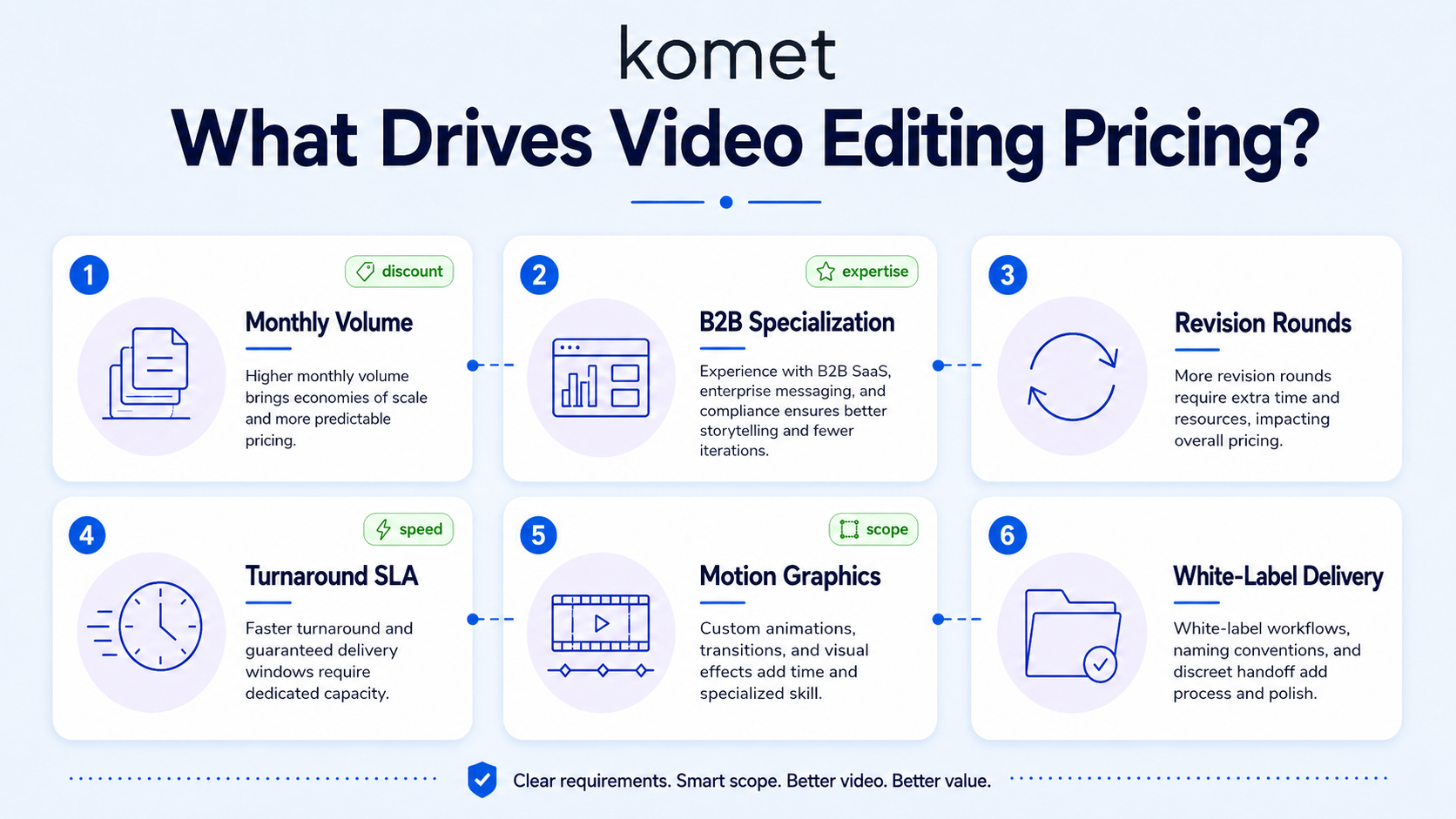
Volume: Volume plays a significant role in pricing. With a higher work volume, the price per video can go down by up to 20–25% as many agencies or editors will offer a volume-based discount.
Editor experience and B2B specialization: The average freelance video editor charges $50–$75/hour, but that average hides huge differences, YouTube editors charge $30–$60/hour while corporate editors command $75–$150/hour. For B2B SaaS, a generalist editor at $50/hour is not the same value as a specialist at $100/hour who already understands product UI, feature demos, and buyer-stage messaging.
Revision cycles: Unlimited revisions on a flat fee sounds appealing, but scope creep around revision requests is the single most common budget killer in deliverable-based contracts. Every additional round costs the agency real hours; those costs either inflate your next quote or degrade the quality of what you get. Clear revision terms in the contract protect both sides.
Turnaround time SLAs: Faster delivery costs more. Retainer clients typically receive 24–48 hour turnaround by default, while per-project clients get 3–5 business days. If your LinkedIn video strategy or sales enablement team needs same-day or next-day clips, that premium needs to be scoped into the agreement explicitly.
Motion graphics and animation: Standard cuts are one price tier; consistent video content like social media clips, brand updates, interviews, or internal communication videos can be handled with template-based systems at lower cost. Custom motion graphics, animated titles, and branded transitions are a separate scope item in most retainer agreements.
White-label video production: If you're an agency reselling video services to B2B clients under your own brand, expect a 15–25% premium for white-label packaging, dedicated communication channels, and no agency branding on delivered assets.
For SaaS teams focused on short-form video editing at scale, the biggest cost driver is almost always revision cycles caused by working with an editor who doesn't understand your product. Solve the expertise problem first, and the pricing model question becomes much simpler.
How Do You Choose the Right Pricing Model for Your B2B Video Needs?
Use this decision framework based on where your team sits right now:
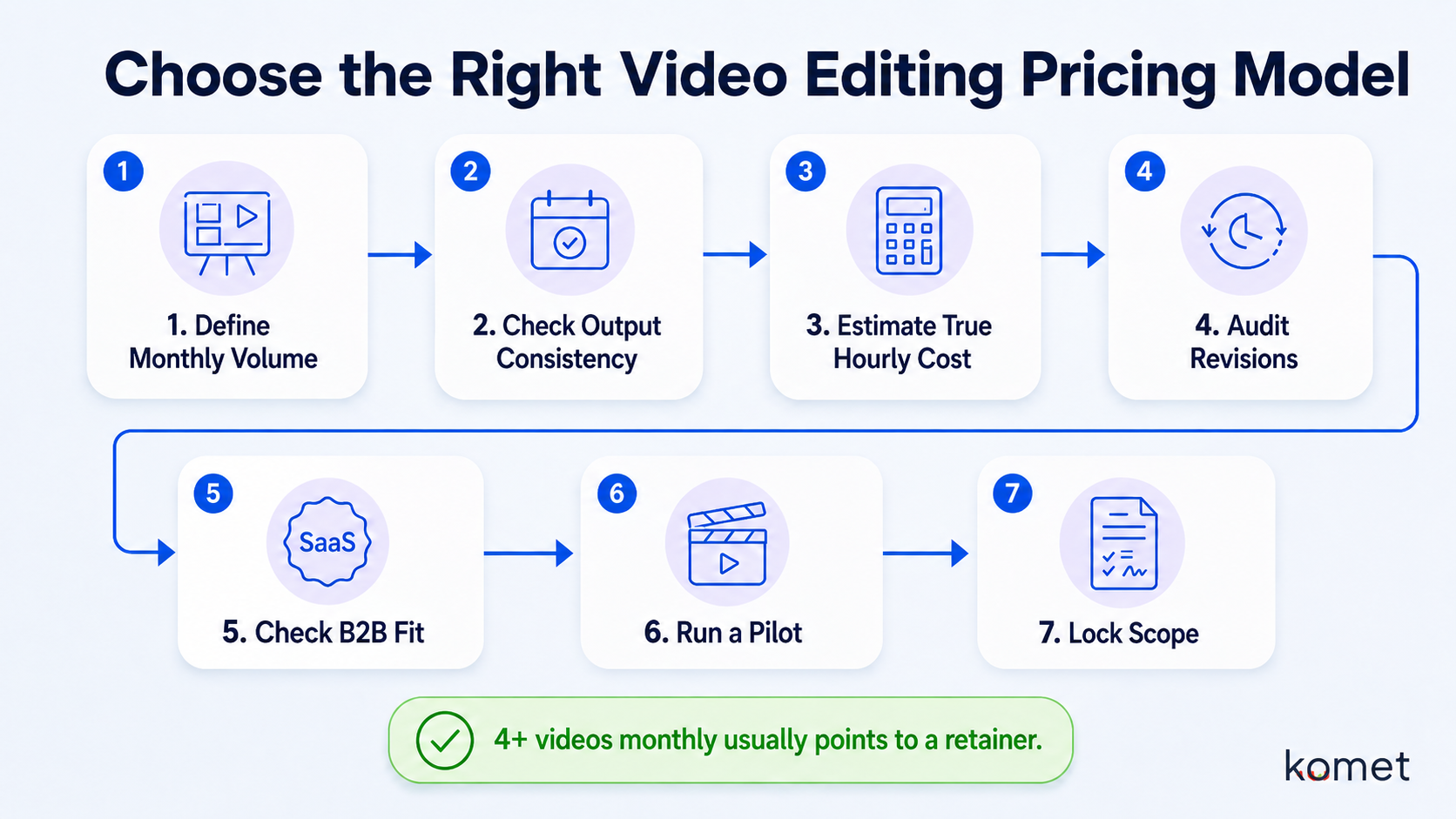
- Define your monthly content volume. Count the actual number of video assets you need per month, social clips, demo cuts, webinar repurposes, LinkedIn videos, sales enablement clips. Be specific.
- Check your output consistency. If it varies by more than 50% month to month, project-based or a flexible subscription with rollover credits is safer than a hard-volume retainer.
- Calculate the true cost hourly. Take your target deliverable volume, estimate hours per asset (a 60-second short-form clip typically takes 3–5 hours), multiply by your editor's rate, then add your internal management time.
- Audit your revision history. If your last three editing engagements ran more than two revision rounds per video, you either have a brief-writing problem or an editor who doesn't understand your product. Fix that before signing a retainer.
- Evaluate specialization fit. A B2B SaaS team building video marketing around product demos, founder content, and pipeline education needs an editor who understands those contexts, not just one who can cut fast.
- Run a project pilot. Project-based engagements are often a useful way to test an agency's capabilities before committing to a longer retainer.
- Lock in scope before you sign. The contract should specify deliverable types, revision rounds, turnaround time SLAs, asset formats, and what triggers an out-of-scope charge.
Decision shortcut: If you need more than 4 videos/month consistently and your content strategy is tied to pipeline and demo demand, a retainer will almost always beat per-project pricing on total cost and output quality within 90 days.
Subscription Video Services vs. Traditional Agency Retainers: What B2B Teams Need to Know
The subscription model (also called Creative-as-a-Service or CaaS) has become a legitimate alternative to the traditional agency retainer, and B2B SaaS teams are among its biggest adopters. The core difference: a retainer typically locks you into a defined deliverable volume (e.g., 8 short clips/month), while a subscription model promises ongoing access to a creative team with output limited only by what you can feed them. Both sit on top of a predictable monthly fee, the difference is in how scope is capped and how overflow is handled.
The subscription model, often marketed as "unlimited video editing", has exploded in popularity since 2023. For SaaS content repurposing pipelines specifically (turning one webinar into 12 clips, or a podcast into LinkedIn shorts), the subscription model's unlimited throughput is a natural fit.
What to watch for in subscription agreements:
- Active queue limits: Most services process one or two requests at a time despite the "unlimited" label.
- Turnaround guarantees: Standard is 1–3 business days per asset for simple cuts; complex motion graphics take longer.
- Editor continuity: Do you get a dedicated editing team or whoever is available that week? For brand-consistent video asset management, continuity matters.
- Rollover credits: Some subscription models allow unused budget to roll over to the next month, which is a meaningful advantage for teams with variable monthly output.
Traditional agency retainers, by contrast, include strategic account management, content planning, and often distribution guidance. For founders running LinkedIn video strategy or executives building personal brand visibility, that strategic layer matters as much as the editing itself.
The practical comparison:
For SaaS teams with a clear content repurposing strategy and existing long-form assets to draw from, a subscription model at the right price point can deliver significant ROI. For teams who need someone to own the creative strategy, a retainer with a specialist agency wins.
Conclusion
Choosing among B2B video editing pricing models is not a question of what sounds cheapest, it's a question of what structure matches your output volume, content strategy, and pipeline goals.
Key takeaways:
- Retainers ($2,000–$5,000/month) deliver 15–25% savings per video once you hit 4+ videos/month.
- Project-based pricing is the right start if you're piloting a new agency or have irregular content needs.
- Hourly billing serves advisory or overflow work only, never ongoing editing pipelines.
- The most expensive variable in any B2B video budget is working with an editor who doesn't understand your product.
Ready to build a video system that actually supports your pipeline? Talk to Komet Media about what the right model looks like for your team.
Frequently Asked Questions
1) What is the cheapest pricing model for B2B video editing?
Project-based billing for a single, clearly scoped deliverable will be the lowest-commitment entry point, typically $400–$1,500 per short-form video depending on complexity. However, if you need volume, it quickly becomes the most expensive model per asset compared to retainers.
2) How many revision rounds should be included in a B2B video editing retainer?
Two rounds is the industry standard for retainer agreements. A first draft plus two revision cycles should get any well-briefed video to final approval. Contracts that allow unlimited revisions often impose a soft queue limit or deprioritize overflow requests.
3) Is hourly pricing ever the right choice for B2B video teams?
Yes, in three specific situations: undefined-scope exploratory projects, editorial consultation or workflow audits, and overflow augmentation when your primary retainer team is at capacity. For any recurring deliverable output, move to project-based or retainer pricing instead.
4) What is scope creep in a B2B video editing contract, and how do I prevent it?
Scope creep is when requests expand beyond the agreed deliverable definition, adding new formats, additional revision rounds, or new asset types mid-month. Prevent it by defining deliverable types, formats, revision limits, and turnaround SLAs in the contract before work begins.
5) Do B2B video editing agencies charge differently for short-form vs. long-form content?
Yes. Short-form clips (60–90 seconds) from existing footage cost significantly less than original long-form productions. Repurposing a webinar or podcast into short-form social clips is one of the highest-ROI uses of a video editing retainer because the raw footage cost is already sunk.
6) How do I evaluate ROI on a B2B video editing retainer?
Track pipeline-connected metrics: demo requests influenced by video content, inbound leads citing video, sales cycle length for prospects who engaged with video versus those who didn't, and content-driven LinkedIn engagement tied to specific video assets. ROI measurement should be agreed on with your agency before the engagement starts.
Author:
Rajan Soni
Rajan is passionate about marketing & business. He believes in process & preparation over everything else.

