
X (Twitter) Video Posting Cadence and Scheduling for B2B SaaS & Ai/Tech Startups: Step-by-Step Guide
If your SaaS or AI startup is posting videos on X without a deliberate cadence, you're leaving a pipeline on the table. X has shifted hard toward video-first distribution, and the algorithm now rewards founders and teams who show up consistently with the right format at the right time. This guide breaks down the exact X (Twitter) video posting cadence and scheduling system we use at Komet Media to help B2B teams turn product knowledge and founder thinking into short-form content that builds trust and generates demand.
TL;DR
- Post 3–5 videos per week on X, with Tuesday–Thursday as your highest-priority days.
- Native video upload beats any external link, always uploading directly to X.
- Peak B2B engagement windows: 9 AM–12 PM and 2 PM–4 PM on weekdays.
- Build a 4-week content calendar before you post anything, and schedule with Buffer, Hootsuite, or Sprout Social.
How Often Should B2B SaaS Companies Post Videos on X?
Frequency is where most SaaS teams get it wrong. They either post once a week and wonder why nothing sticks, or they blast out content every day and watch engagement collapse because quality drops. Quality beats quantity on every platform in 2026. Algorithms have evolved to reward content that keeps people engaged, not content that simply exists. Posting 10 mediocre posts per week hurts more than posting 3 strong ones. For B2B SaaS and AI/tech teams specifically, here is what the data supports:
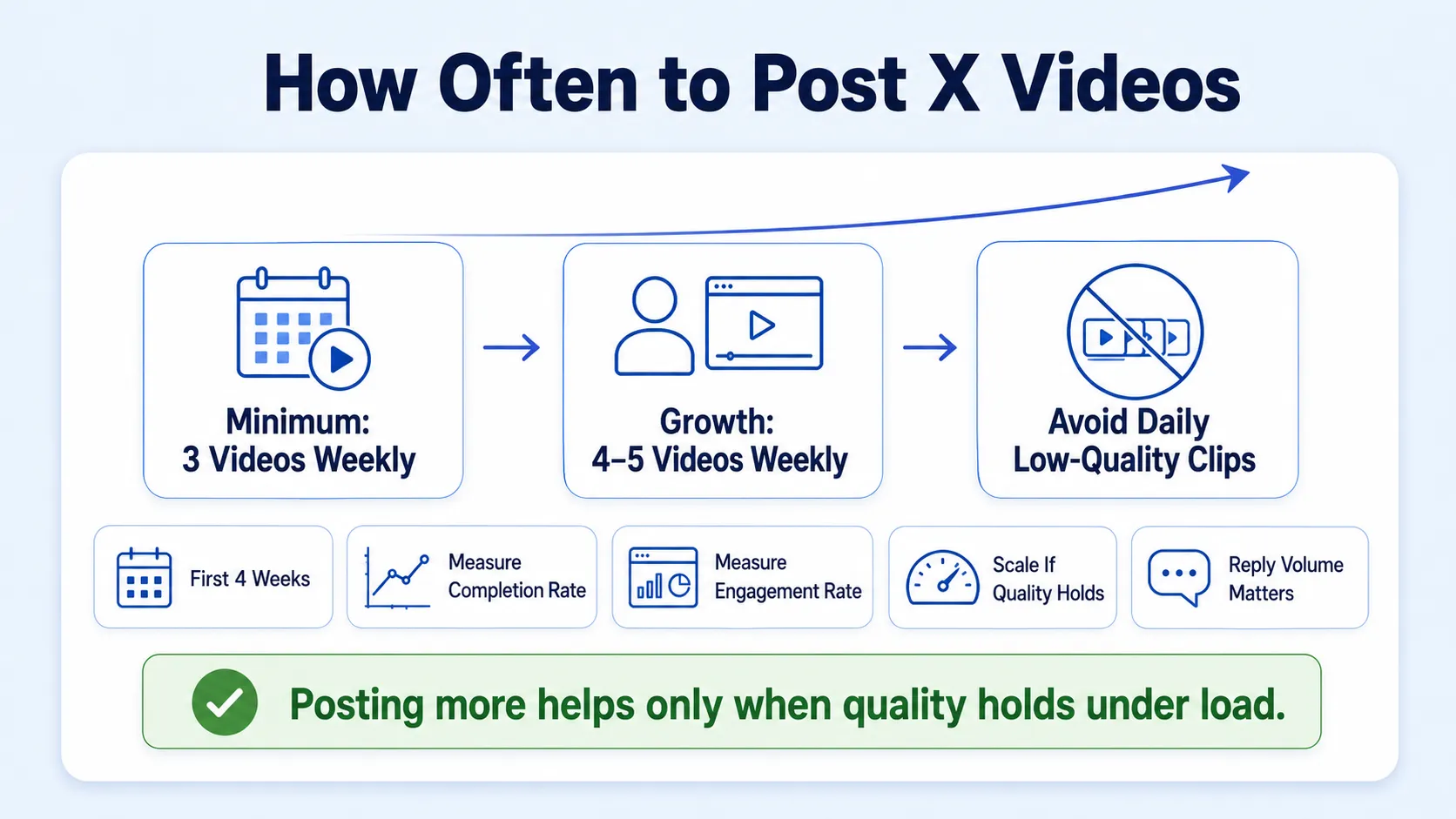
- Minimum viable cadence: 3 video posts per week, enough to build algorithmic momentum without straining production.
- Growth cadence: 4–5 video posts per week, this is the sweet spot for SaaS teams with a content system.
- Maximum without diminishing returns: Buffer recommends posting on X three to four times every day for high-volume accounts, but for B2B video specifically, quality caps you out much earlier than that.
On X, posting more often works in your favor because the timeline is fast-moving and strongly influenced by recency. However, for video, production quality is the constraint. A 60-second product explainer that took real thought will outperform four rushed talking-head clips every time. The counterintuitive part is that posting more can hurt you. Many teams obsess over daily post count and ignore the two variables that change outcomes: reply volume and content quality under load.
My recommendation for B2B SaaS teams building an X video presence from scratch: start at three videos per week for the first four weeks, measure your video completion rate and engagement rate per post, then scale to five if quality holds. The biggest gains usually come from moving from very low posting frequency to a consistent cadence, not from going from five to ten posts per week.
For teams without an existing content library, this is exactly the kind of system we build at Komet Media's video marketing service: a repeatable production engine that keeps cadence consistent without burning out your team.
Best Times to Post Video on X for Tech Startups (2026 Data)
Timing is the multiplier on a good video. Post at the wrong hour and your best content gets buried before it earns a single reply. The best time to post on X is 12–6 PM on Tuesdays, Wednesdays and Thursdays. For B2B SaaS and AI/tech specifically, the morning window is equally strong: For B2B and professional audiences, the most effective time to post is between 9 AM and 11 AM on weekdays, especially from Tuesday to Thursday. These mid-morning hours capture people when they're settled into their workday but not yet overwhelmed by meetings or tasks, a period when professionals are more likely to engage with informative content, thought leadership, and educational posts that position you as a trusted voice.
Here are the priority windows for B2B video on X, ranked:
Success on X in 2026 is driven by engagement velocity. The algorithm treats early likes, reposts and replies as a quality stamp that determines whether your video gets distributed beyond your followers. Post in a dead window and that first-hour signal never fires. Timing still matters for the first 30 minutes (the critical engagement window), but your post can resurface hours later if it performs well initially.
How the X Algorithm Affects Video Reach and Engagement for Startups
Understanding the algorithm is not optional for SaaS teams trying to drive pipeline through X. Here is what actually governs your video's distribution. In January 2026, X replaced its legacy recommendation system with a Grok-powered transformer model that reads every post and watches every video to match users with content.
The most important algorithmic shift for video content: Native video uploaded directly to X outperforms linked YouTube or external video. Short-form video (under 60 seconds) gets the most algorithmic boost. Short-form video under 60 seconds gets the biggest boost; videos that hit 50%+ completion rate get extended reach.
This means your video completion rate is not just a vanity metric, it directly gates whether the algorithm amplifies your video beyond your existing audience. The open-sourced algorithm scoring formula, confirmed in the January 2026 xAI release, shows this weighted engagement hierarchy:
Likes × 1, Retweets × 20, Replies × 13.5, Profile Clicks × 12, Link Clicks × 11, Bookmarks × 10.
What this means for SaaS video strategy:
- Replies beat everything on a per-interaction basis. A single reply is worth 27 times more than a like. A back-and-forth conversation is worth 150 times more.
- Native upload is non-negotiable. Images and videos uploaded directly to X see up to 40% more engagement.
- External links kill reach. Since March 2026, non-Premium accounts posting links receive near-zero median engagement due to algorithmic suppression. X wants users to stay on the platform. The workaround: post your content as native video/text, then add the link in the first reply.
X Twitter Video Posting Schedule for B2B Companies: A Week-by-Week Template
Theory is useful. A repeatable schedule is what actually gets executed. Here is the week-by-week X (Twitter) video posting cadence and scheduling template we recommend for B2B SaaS teams:
Week structure (3-video minimum):
- Monday (optional 4th or 5th post): Repurpose a podcast clip or webinar moment, fast to produce, signals expertise.
- Tuesday (must-post): Founder or product POV video, 45–60 seconds, native upload, no external links in the post body.
- Wednesday (must-post): Buyer education clip, a common objection answered, a feature explained simply.
- Thursday (must-post): Social proof or result, a customer outcome, a stat from your product, or a team win.
- Friday (optional): Repost your best-performing video from the week with a new caption angle.
Roughly 80% of your posts should give something away (insight, a lesson, a useful resource) and about 20% can promote what you sell. Audiences follow you for the value, and the algorithm rewards the engagement that value earns.
For video format: short, captioned clips uploaded directly to X, face-to-camera explainers, screen recordings, and quick demos all work. Captions are not optional. Never skip captions. They are key. Adding them always improves watch time.
At Komet Media's short-form video editing service, we typically repurpose webinar recordings, podcast episodes, and product demos into this exact posting rhythm, giving teams five to ten clips per recorded session.
How to Build a Video Content Calendar for X (Twitter)
A content calendar is the operational backbone of your X (Twitter) video posting cadence and scheduling system. Without it, you are always one busy week away from going dark. Here is how to build one:
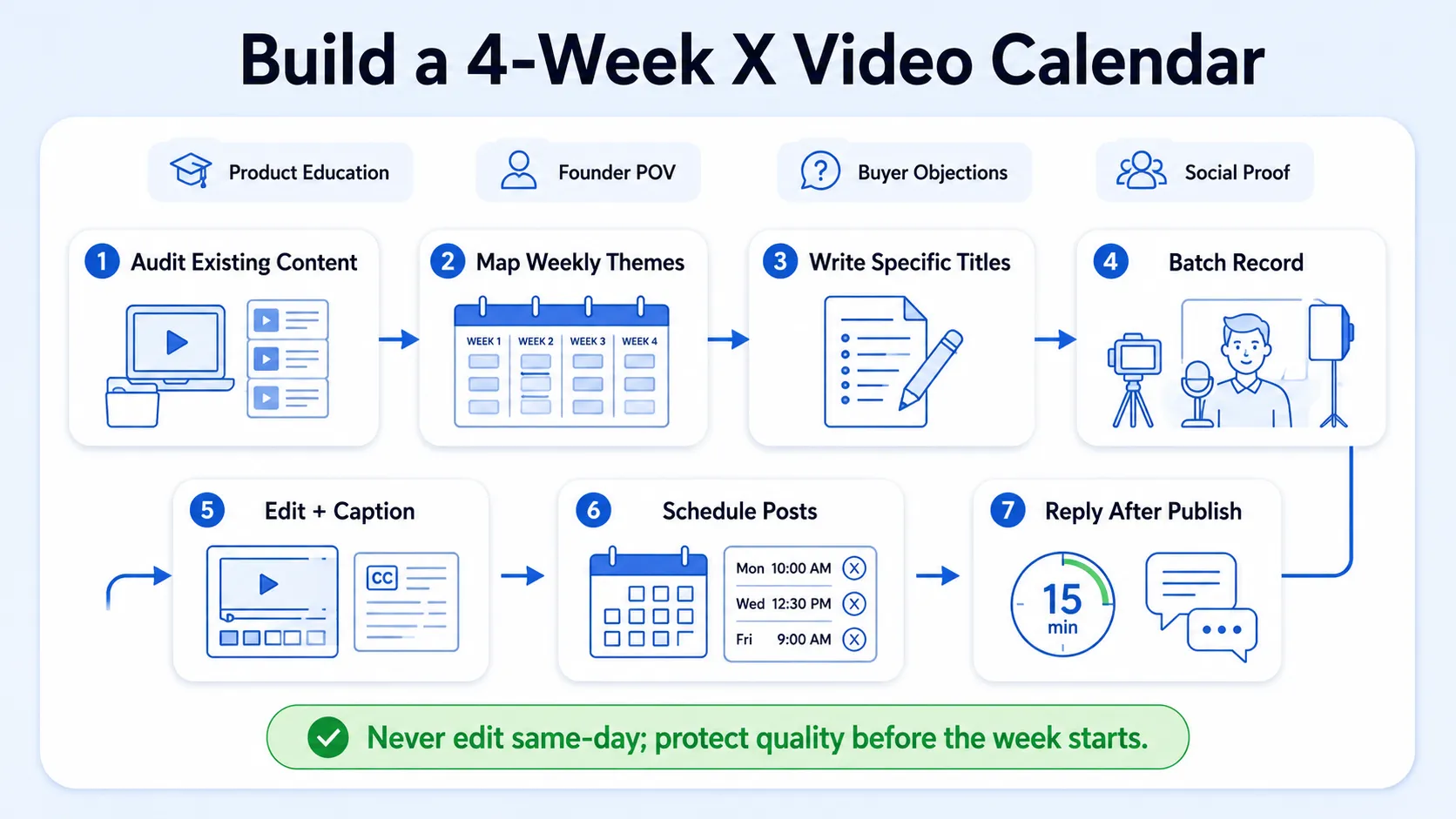
- Audit your existing content. List every podcast episode, webinar recording, product demo, and founder interview you have. Each is a source of 3–5 short clips. (Visit Komet Media's podcast editing service or webinar repurposing for hands-on support.)
- Map four weeks of themes. Assign each week a content pillar: Week 1 = product education, Week 2 = founder POV, Week 3 = buyer objections, Week 4 = social proof.
- Fill the calendar with specific titles. Not "video about onboarding" but "Why most SaaS teams skip this onboarding step (and lose users in week 2)."
- Batch record in one session. Three to five talking-head clips recorded in a single hour gives you a full week of content.
- Edit and caption before the week begins. Never edit same-day. The production pressure kills quality.
- Schedule natively or via a scheduling tool. Buffer, Hootsuite, or Sprout Social all support native X video scheduling.
- Block 15 minutes after each post goes live to reply to every comment, this fires the engagement signals the algorithm weights most.
Posting regularly during peak windows trains X's algorithm to recognize your content as valuable, creating a compounding effect on your reach over time.
Best Practices for Scheduling X Videos: Buffer, Hootsuite, and Sprout Social
Choosing the right scheduling tool affects both your workflow efficiency and your post performance. Here is how the three major options compare for B2B SaaS teams:
Scheduling tools make it easier to plan ahead, batch content, and stick to a consistent posting frequency across social media platforms without posting manually every day.
Critical rules for scheduling video on X:
- Always upload video natively through the tool, not as a link. Most major schedulers now support native X video upload. Confirm this before you commit to a tool.
- Schedule reposts as new posts. Do not use the repost button. Repost the video with a fresh caption angle, it counts as a new piece of content for the algorithm.
- Never schedule links in the post body. Post your content as native text/images or video, then add the link in the first reply.
- Set posting times in your audience's time zone. The best time to post on X changes with the audience's time zone. A UK account peaks at UK morning, and a US Pacific account peaks at Pacific morning.
Engagement peaks between 11 AM and 4 PM on Tuesdays, Wednesdays and Thursdays, build your scheduler queue around these windows for your primary time zone first, then layer in secondary windows if you post more than three times per week.
LinkedIn Cross-Posting, Repurposing, and Maximizing Video Velocity
Your X video content should not live and die on X alone. Every clip you produce is a multi-platform asset, and cross-posting to LinkedIn extends the value of every production hour. Here is how to execute a cross-platform video repurposing system alongside your X (Twitter) video posting cadence and scheduling:
- Record once, post everywhere. A 60-second product explainer recorded for X becomes a LinkedIn native video, a podcast clip (via Komet Media's podcast production service), and a short for Instagram.
- Adjust captions for platform tone. X captions are shorter and more direct. LinkedIn captions run slightly longer with a professional framing. Same video, different hook.
- Space LinkedIn cross-posts by 24–48 hours. Do not post the same clip to X and LinkedIn simultaneously. Stagger to extend the content's total shelf life.
- Track platform analytics separately. Impression share on X and engagement rate on LinkedIn will differ. Let platform-specific data inform format and length choices.
US social media users were projected to spend 61.1% of their time on social networks watching videos in 2025, up from 33.3% in 2019, the video consumption habit is platform-agnostic. Your buyers are watching short-form wherever they are. Meet them on both X and LinkedIn with the same content system.
Content velocity, publishing volume over time, compounds. Account-level engagement averages persist for 30+ days, and recent post performance affects future post reach. A flop today reduces the algorithmic lift on tomorrow's post. This is why consistent, high-quality output matters more than any single viral clip.
For teams that want to scale this without adding headcount, the answer is a video repurposing system. One webinar or podcast episode, properly repurposed, can fuel four weeks of X video content.
Conclusion
Nailing your X (Twitter) video posting cadence and scheduling is one of the highest-leverage moves a B2B SaaS or AI startup can make in 2026. The platform rewards consistency, native uploads, and conversation, and video is now the top format for algorithmic reach.
Key takeaways:
- Post 3–5 native videos per week, anchored to Tuesday, Wednesday, and Thursday.
- Hit the 9–11 AM and 12–2 PM windows in your audience's local time zone.
- Keep videos under 60 seconds, always captioned, always uploaded natively.
- Build a 4-week content calendar and batch-produce to protect cadence and quality.
If your team needs help building this system, Komet Media works with B2B SaaS and AI/tech teams to turn existing content into short-form video pipelines that drive real pipeline and founder-led growth.
Frequently Asked Questions
Q1: How many videos per week should a SaaS company post on X?
Three to five videos per week is the right range for most B2B SaaS teams. Three is the minimum to build algorithmic momentum. Five is the ceiling before production quality suffers. Start at three, measure completion rate and engagement rate, then scale up only if quality holds.
Q2: Does posting frequency on X affect B2B video reach and engagement?
Yes, directly. Account-level engagement averages persist for 30+ days, and a flop today reduces the algorithmic lift on tomorrow's post. Consistency matters more than peak-volume weeks. A steady cadence at quality beats sporadic bursts.
Q3: What is the ideal video length for X posts targeting B2B buyers?
Native video uploaded directly to X outperforms linked external video, and short-form video under 60 seconds gets the most algorithmic boost. For B2B SaaS, aim for 30–60 seconds for educational clips and up to 90 seconds for product demos.
Q4: Should I use Buffer, Hootsuite, or Sprout Social to schedule X videos?
All three support native X video scheduling. Buffer suits lean teams and founders. Hootsuite fits mid-market teams managing multiple accounts. Sprout Social is best for growth teams who need deep analytics and AI-driven optimal send times. Choose based on team size and reporting needs.
Q5: Can I repost the same video on X and LinkedIn?
Yes, but stagger them by 24–48 hours and adjust the caption for each platform's tone. X rewards brevity and directness. LinkedIn rewards context and professional framing. Same clip, different packaging, this is core content velocity strategy.
Q6: What is a good engagement rate for B2B video posts on X in 2026?
A good engagement rate on X in 2026 is between 1% and 3%. The average account sits around 0.5–1%. Rates above 3% indicate strong niche authority, and anything above 6% is exceptional, typically seen on smaller, highly focused accounts. For B2B SaaS video, targeting 1–2% is a realistic and meaningful benchmark.

