
How to Write Hooks That Stop the Scroll: Step-by-Step Guide
Most B2B content dies in the first three seconds, not because the idea is bad, but because the opening is wrong. If you're a SaaS founder, marketing head, or growth team trying to turn product thinking into a pipeline, knowing how to write hooks that stop the scroll is the single highest-leverage skill you can build right now. This guide gives you the psychology, the frameworks, the platform tactics, and the exact steps, everything we apply at Komet Media to build video systems that educate buyers and drive inbound demand.
TL;DR
- Up to 50% of viewers drop off in the first three seconds, your hook is your entire first impression.
- Strong hooks use pattern interrupts, curiosity gaps, and emotional triggers, not intros, logos, or "Hi, I'm..."
- Platform matters: TikTok, Instagram Reels, and YouTube Shorts each reward different hook timing and energy.
- Test, measure skip rate, and iterate, hooks are a data problem, not a creativity problem.
Why Most Social Media Posts Get Ignored (and What Actually Makes a Hook Work)
The attention economy is not getting more forgiving. According to a 2025 Tubular Labs analysis of 50 million short-form videos, the average scroll-past rate increased from 62% to 78% between 2024 and 2025. Audiences are faster than ever at dismissing content that doesn't immediately earn their time.
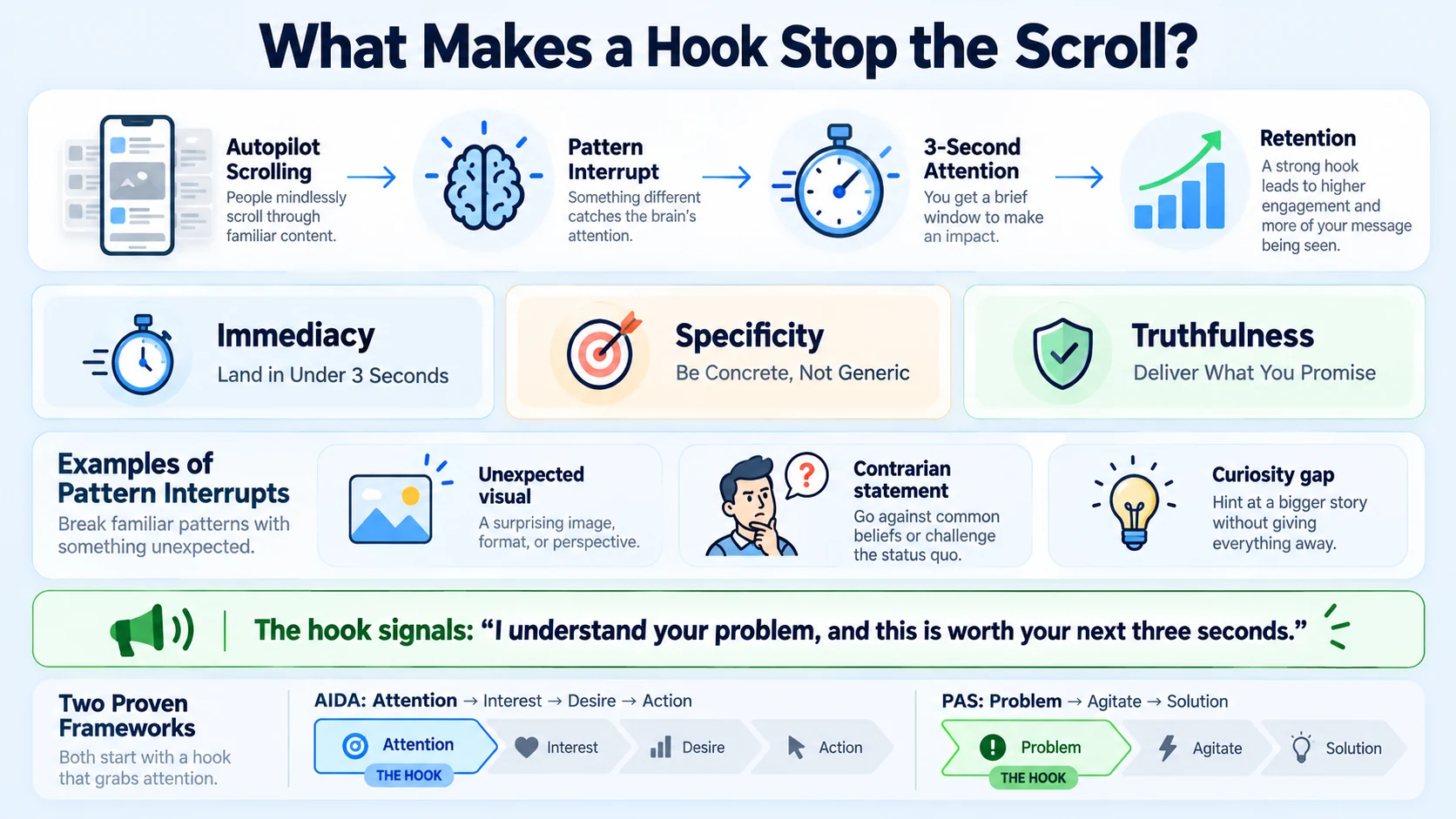
The reason? The brain is on autopilot while scrolling. When someone moves through a feed, they're pattern-matching for anything that breaks the expected flow. Effective hooks create pattern interrupts through unexpected visuals, contrarian statements, or curiosity gaps that force active attention.
Three qualities separate a hook that works from one that gets scrolled past:
- Immediacy: It has to land in under 3 seconds.
- Specificity: Generic hooks get ignored while specific ones stop thumbs.
- Truthfulness: A hook that promises something the content never delivers burns trust and tanks your retention on future posts.
For B2B specifically, the stakes are higher. Your buyer is a skeptical founder or VP of Marketing who will immediately dismiss anything that feels like it's wasting their time. The hook isn't just a creative device, it's a positioning statement. It signals: "I understand your problem, and I have something worth three more seconds of your life."
David Ogilvy understood this long before short-form video existed. His core principle from classical copywriting still applies: the headline (your hook) is where 80% of the advertising dollar is spent. 84.3% of viral TikTok videos in 2025 utilized specific psychological hook triggers within the first 3 seconds. Ogilvy's instinct and the algorithm's data agree: open strong or don't open at all.
The AIDA model (Attention, Interest, Desire, Action) and the PAS framework (Problem, Agitate, Solution) both start with the same job, stop the scroll, then earn the right to explain. The hook is the "A" and the "P", it's the entry point to every framework in your content playbook.
How to Grab Attention in the First 3 Seconds of a Post
The first-frame retention window is shorter than most teams realize. You have 1.3 to 3 seconds to grab attention. According to Facebook/Meta internal data, 65% of people who watch the first three seconds of a video will watch for at least ten seconds, and 45% will stick around for thirty. That compounding return makes the opening the only frame that truly matters. Here's the exact process I use for every hook we write at Komet Media:
- Lead with the tension, not the topic. Don't say "I'm going to talk about lead generation." Say "Your demo request form is killing your pipeline." One states a subject; the other creates cognitive dissonance that demands resolution.
- Use the curiosity gap. Open a loop the viewer needs to close. "The reason your best content gets 200 views isn't what you think" forces the brain to seek completion.
- Make the first visual do work. A hook in 2026 does three jobs in roughly 1.5 seconds: interrupt the scroll, register a specific promise, and earn the next 1.5 seconds. The interrupt is visual. The promise is verbal or textual.
- Cut the cold open. "Hi, I'm…", nobody cares who you are until you give them a solid reason to care. Introduce yourself, if you really must, at the 30-second mark.
- Start mid-action. Don't start with a slow intro or logo animation. Drop viewers directly into the most compelling moment.
- Keep on-screen text to 5–12 words. The ideal length for an on-screen text hook is 5 to 12 words.
A video with a weak hook never gets a chance to convert, no matter how good the rest of it is. The hook is the gate. Everything else sits behind it.
How to Write Hooks That Stop the Scroll: The Step-by-Step Framework
Learning how to write hooks that stop the scroll comes down to a repeatable process, not creative luck. Here's the framework we use with B2B SaaS and funded tech teams at Komet:
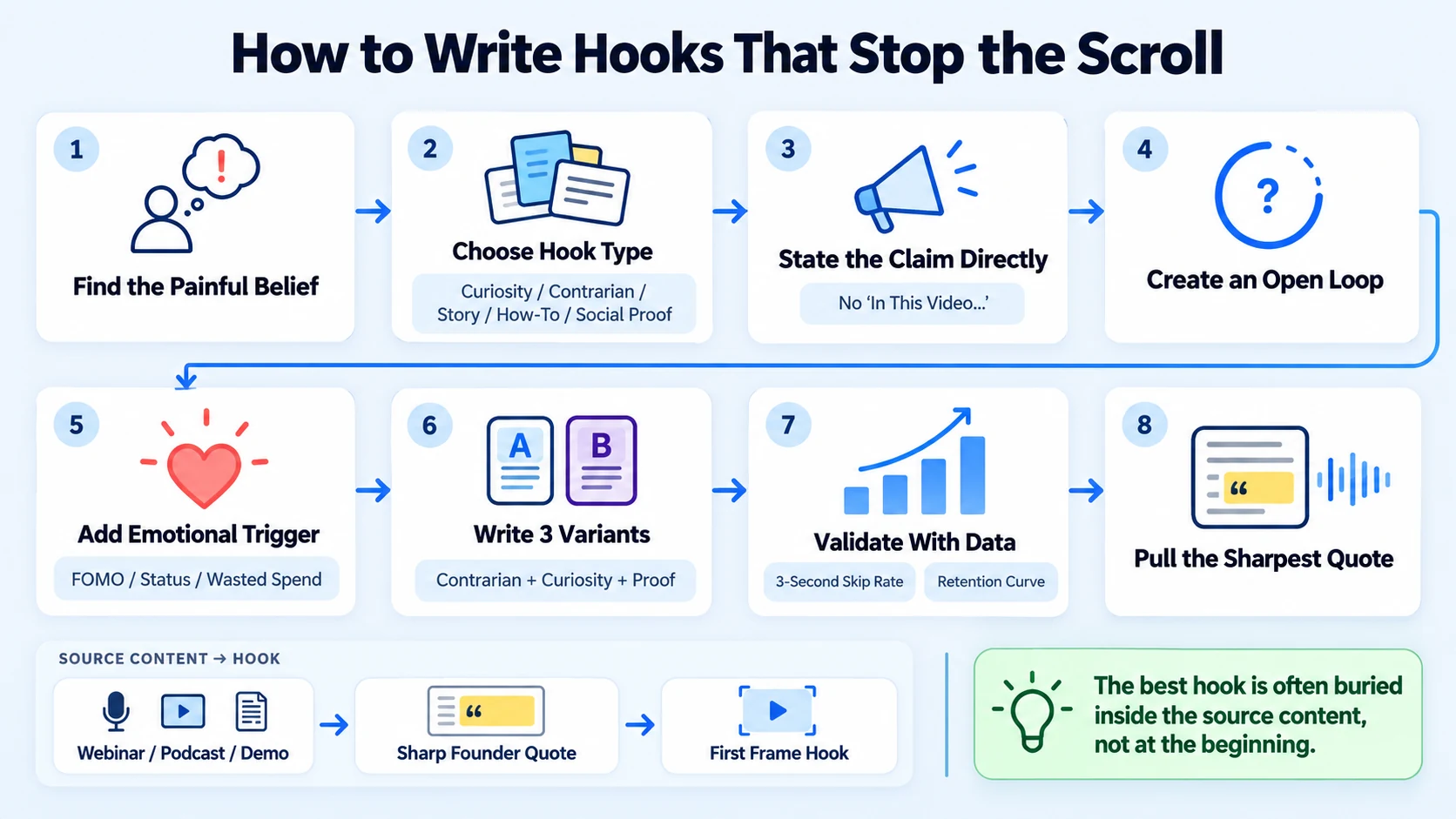
- Identify the single most painful belief your buyer holds. What does your ICP believe right now that's wrong, or that's holding them back? That belief is the tension your hook exploits.
- Choose a hook type. Curiosity, contrarian, story, how-to, and social proof hooks each drive different results. Match the type to the platform and the funnel stage.
- Write the hook as a statement, not a setup. Avoid "In this video I'll explain…", state the claim directly: "SaaS teams using this content system are cutting CAC by 30%."
- Apply the open loop technique. Introduce a question, conflict, or result that only makes sense after watching. The viewer's brain will resist scrolling past an unresolved loop.
- Layer in an emotional trigger. Fear of missing out, professional status, or the fear of wasted spend, B2B buyers feel these acutely. Name the emotion in the opening line.
- Write three variants of every hook. A contrarian version, a curiosity version, and a social proof version. Test all three.
- Validate with data. Since August 2025, Instagram scores it for you: Reels Insights now reports a skip rate, the share of viewers who leave inside the first 3 seconds, alongside a retention curve. Use that number to pick winners, not gut feel.
- For content repurposing specifically, turning webinars, podcasts, and demos into short clips, the hook is rarely in the intro of the source material. It's buried 12 minutes in, when the founder says something sharp. That's the pull quote. That's your first frame.
Best Opening Lines and Hook Examples for B2B and Social Media
The best opening lines share one trait: they force a response. Here are proven hook structures with B2B SaaS examples applied:
Retention Rabbit's 2025 YouTube Report analyzed over 150 million minutes of video and found that clips with a clear value proposition in the first 15 seconds achieve 18% higher retention at the one-minute mark. The opening line sets that value proposition, the rest of the script just delivers on it. According to a 2025 TikTok Creator Digest, the lifespan of a trending hook format dropped from 8 weeks in 2023 to 3.5 weeks in 2025. Rotating hook types regularly isn't optional, pattern fatigue is real.
How to Write Hooks for Different Social Media Platforms
Platform-native content is a non-negotiable part of how to write hooks that stop the scroll in 2026. The same opening line performs very differently across TikTok, Instagram Reels, and YouTube Shorts because each platform has distinct viewer behavior, algorithm signals, and hook windows.
TikTok's internal data shows that 63% of top-performing videos introduce their key message or hook within the first 3 seconds. On YouTube Shorts, creators who front-load their core premise in the first two seconds see an average 38% higher swipe-through rate compared to those who open with context-setting or intros. LinkedIn deserves separate attention for B2B teams.
A hook designed for TikTok's sound-on, full-screen, rapid-scroll environment fails on LinkedIn's sound-off, partial-screen, professional context. On LinkedIn, your caption's first line is the hook, the first line of a caption functions as a subject line: it's the only text visible before the "more" truncation, which means it has to earn the tap entirely on its own.
For our clients at Komet Media's short-form video editing service, we build platform-specific hook variants into every repurposing workflow; the same clip gets a different first frame for each distribution channel.
Why Some Posts Stop the Scroll and Others Get Ignored: Common Hook Mistakes
Knowing how to write hooks that stop the scroll is partly about knowing what to avoid. Videos with a strong hook have a 65% higher retention rate in the first 10 seconds, but that only works when you don't self-sabotage the opening. The most common hook failures in B2B content:
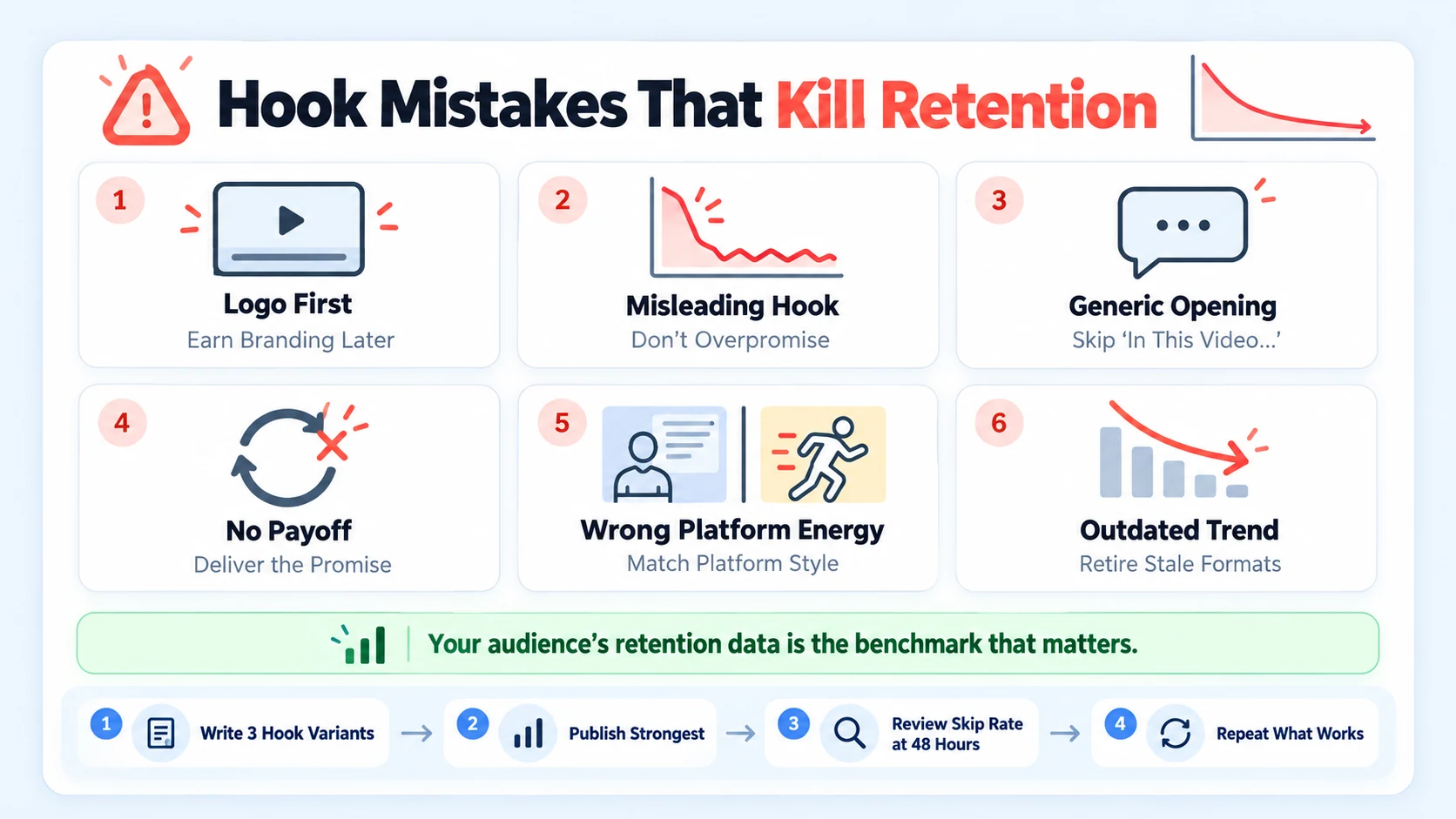
- Starting with a logo or branded intro: Moving brand logos and title cards from the first three seconds to the end of the video consistently improves average retention by 15 to 30 percent. The brand still appears, it just earns its placement after the viewer has decided to stay.
- Overusing dead hook formats: Audiences in 2026 punish hooks that overpromise. 58% of users reported unfollowing accounts that consistently used "misleading hooks," and TikTok's algorithm now tracks "early exit rate" as a negative signal.
- Generic opening lines: "I'm going to share some tips" or "In this video we'll cover…" signal nothing specific. By the time you get to your interesting point 15 seconds in, 70% of your potential audience has already swiped.
- Not paying off the hook: A hook that promises something the content never delivers burns trust and tanks your retention on future posts.
- Mismatching energy to platform: TikTok rewards energy run 20% higher than other platforms, the same delivery that works on LinkedIn reads as frantic on TikTok and flat everywhere else.
- Recycling trending formats past their shelf life: After TikTok's September 2025 algorithm change, recycled formats lost 40–60% of their reach.
For video marketing teams running consistent output, the fix is systematic: build a hook testing protocol into your content calendar. Write three hook variants per clip, publish the strongest, and review skip rate within 48 hours. What works for your specific audience is the only benchmark that matters.
Conclusion
Hooks are infrastructure, not decoration. Every piece of content your team produces, every webinar clip, podcast pull-quote, or product video, lives or dies in its first 1.5 seconds. Here's what to take forward:
- Lead with tension, not topic, force a question the viewer has to resolve.
- Match hook type and energy to the platform, TikTok, Reels, Shorts, and LinkedIn each demand different opening mechanics.
- Cut logos, intros, and setup from the first three seconds without exception.
- Test three hook variants per piece, measure skip rate at 48 hours, and iterate on data, not instinct.
Frequently Asked Questions
Q1: What is a scroll-stopping hook and how do I write one?
A scroll-stopping hook is an opening line, visual, or statement that interrupts a viewer's autopilot scrolling behavior within 1.5–3 seconds. Write one by leading with a specific tension, unexpected claim, or open loop, and avoiding any setup, intro, or context-setting in the first frame.
Q2: How long should a hook be for short-form video?
Keep on-screen text to 5–12 words and deliver the verbal hook within the first 1.5–2 seconds of audio. The hook arc can extend to 5–6 seconds total, but the attention interrupt must land instantly or the viewer is already gone.
Q3: What are the best hook types for B2B SaaS content?
Contrarian hooks ("everyone says X, here's why it's wrong"), curiosity gap hooks, and social proof hooks with specific results work best for B2B SaaS buyers. They trigger intellectual engagement rather than pure entertainment, which matches how professional audiences scroll.
Q4: How do I know if my hook is working?
Instagram grades your hook directly: Reels Insights shows skip rate (viewers lost in the first 3 seconds) and a retention curve. On TikTok, watch for early drop-off in your analytics. A strong hook holds above 60–70% three-second retention, measure this within 48 hours of posting.
Q5: Should I write different hooks for different platforms?
Yes, always. Platform context determines hook mechanics. LinkedIn is predominantly sound-off and professional, lead with strong on-screen text and a contrarian B2B take. TikTok rewards high energy and immediate visual tension. YouTube Shorts rewards front-loading your core premise in the first two seconds with no preamble.
Q6: How often should I change my hook formats?
Rotate regularly. The audience learns to recognize and skip a pattern within 4–6 weeks, and the lifespan of a trending hook format dropped from 8 weeks in 2023 to 3.5 weeks in 2025. If you're publishing consistently, test a new hook structure every 3–4 weeks to stay ahead of pattern fatigue.

