
How to Start a Successful Podcast: Step-by-Step Guide
Most executive podcasts do not fail because the host is boring. They failed because nobody decided what the show was for, and the founder ran out of time by episode six. If you want to start a podcast as a founder or CXO, the real work is designing a show that fits your calendar and supports a clear business goal. This guide covers how I approach that: choosing the purpose, planning the first season, protecting your time, and turning each episode into content that keeps working after it publishes.
Quick Answer
To start a podcast that lasts as a founder or CXO, define one business goal, plan a short first season, batch recordings, record video, and turn every episode into clips. Consistency matters more than launch-day polish.
Why Executives Start a Podcast, and Why Many Stop
A business podcast gives an executive something few other formats do: a reason to have long, thoughtful conversations with the people they most want to know. Customers, prospects, investors, future hires, and industry peers all say yes to podcast invitations more readily than to sales meetings.
The audience is there. The Infinite Dial 2026 from Edison Research at SSRS found that 58% of Americans age 12 and older consumed a podcast in the last month. Among 35 to 54 year olds, the age range that includes many executive buyers, the figure was 68%. These are general population figures, not B2B buyer data, but they show that podcasts reach the working professionals most executives want to influence.
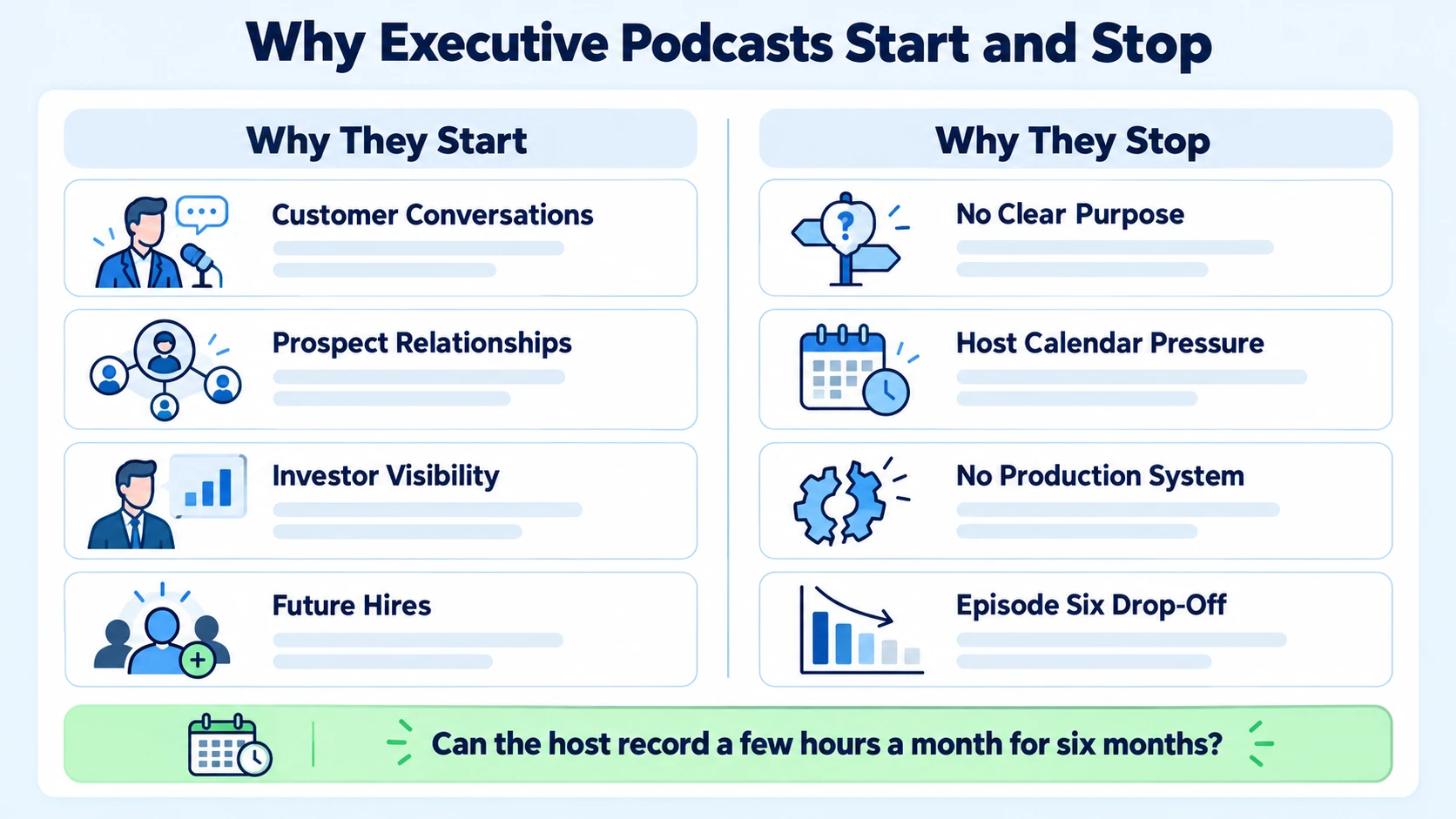
The problem is staying power. According to Listen Notes data reported by Podcast News Daily, the ecosystem is approaching 3.8 million podcasts, while about 519,700 had been active in 2026 by mid-year. In other words, most shows that have ever launched are no longer published. Executive shows are especially vulnerable, because the host's calendar is always under pressure.
Here is the honest test I use before helping anyone start a podcast: can you commit to recording a few hours a month for at least six months? If not, a shorter video series or occasional guest appearances on other shows may serve you better.
Decide What the Show Is For Before You Record
Most podcast failures start before the first recording. The founder has a vague goal like "build our brand" and no clear listener in mind.
I ask every executive to pick one primary goal:
You can serve more than one goal over time. But a show that tries to serve all five from episode one usually serves none of them well.
The goal shapes everything else. A pipeline show might feature heads of operations at target accounts, recorded as genuine peer conversations. A hiring show might feature your own engineers explaining hard problems they solved. A VC or PE firm might build a show around how operators navigate specific stages of growth, which also supports deal sourcing.
Next, choose a format that fits your strengths:
- Interview show. You host guests. This is the easiest format to sustain and the best for relationship building.
- Solo show. You share your own views. It requires strong opinions and good preparation.
- Co-hosted show. Two executives discuss topics. Chemistry matters, and scheduling is harder.
- Panel or roundtable. Several guests discuss one topic. It can be rich but harder to edit into clips.
Founders often ask whether they should start a podcast or a newsletter first. The answer depends on how you think best. If you write clearly and enjoy it, a newsletter is cheaper to run. If you think out loud and build relationships through conversation, a podcast usually suits you better, and it produces video you can reuse across channels.
For most founders and CXOs, I recommend starting with interviews. They lower preparation time and create natural reasons to connect with valuable people.
Plan the First Season, Not the Forever Show
One mistake I see repeatedly is launching an open-ended weekly show with no end date. The pressure of "forever" is what makes executives quit. A season gives you a finish line.
I usually suggest a first season of about eight to ten episodes. That is enough to learn what works, build a small library, and decide whether to continue, without committing to an endless schedule.
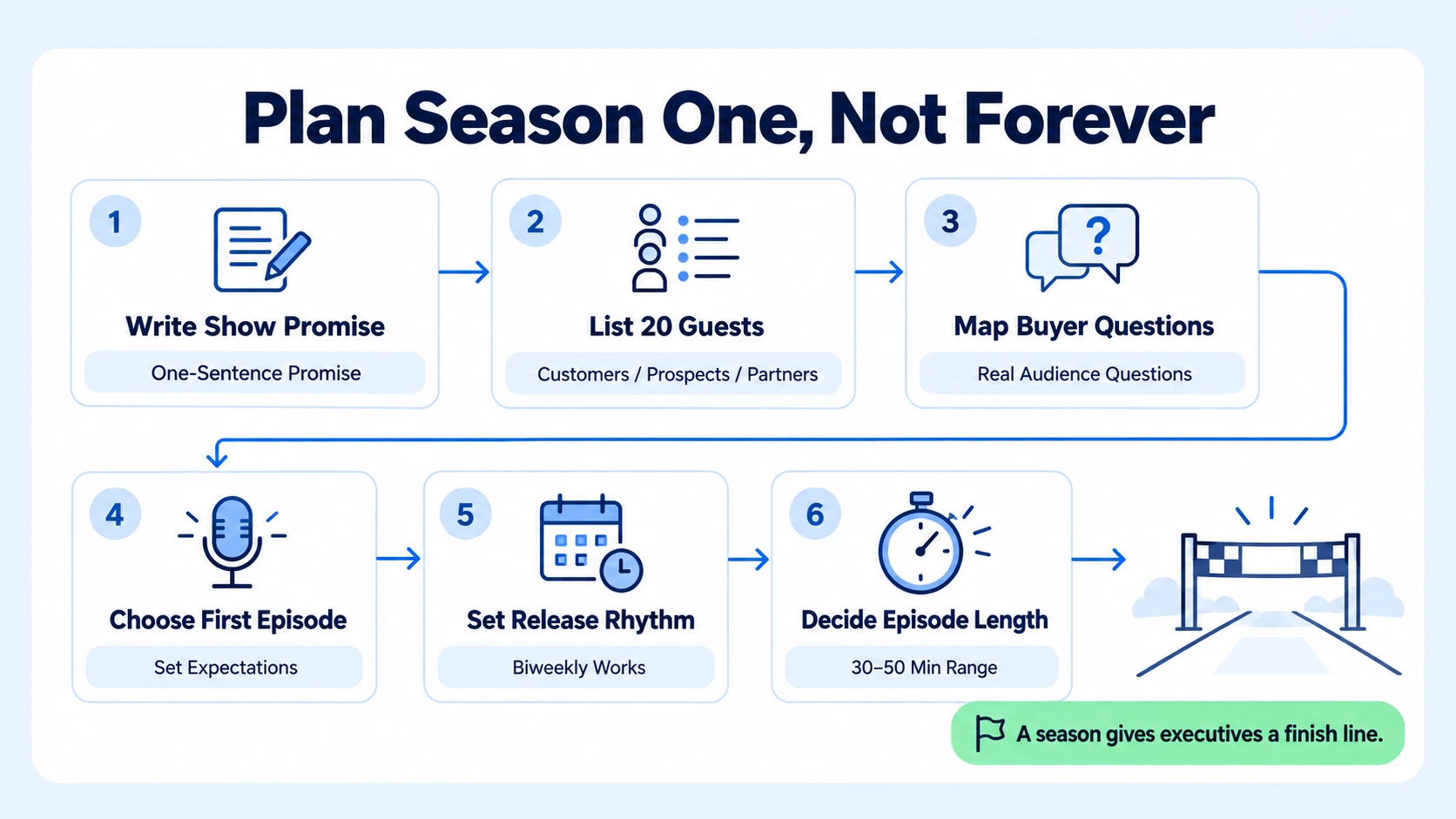
How we plan a first season:
- Write the show promise in one sentence. For example: "Conversations with operations leaders about scaling teams without losing quality."
- List twenty possible guests. Aim for a mix of customers, prospects, partners, and respected voices. Expect some to decline.
- Map topics to buyer questions. Each episode should answer something your audience actually asks.
- Choose your first episode carefully. It sets expectations for everything after it. Our guide on what your first episode should be about covers this decision in more depth.
- Set a release rhythm you can keep. Every two weeks is often more sustainable for executives than weekly.
- Decide the episode length. For most business shows, the right length is whatever the conversation needs, not a fixed number. Many executive interviews land between 30 and 50 minutes.
Guest strategy deserves special attention. For B2B companies, the guest list is also a relationship list. Inviting a target account's operations leader to share their expertise is a genuine, non-salesy way to start a relationship. Our guide on finding the right podcast guests goes into sourcing and outreach.
Think about naming early as well. A show name that describes the listener's problem, such as a focus on scaling operations teams, is easier to find and share than a clever name that needs explaining. Your company name can appear in the description rather than the title.
Protect Your Time with a Production System
Executives do not run out of ideas. They run out of time. The system around the show matters more than any piece of equipment.
Here is how I split the work when an executive wants to start a podcast without it taking over their week:
With that split, many executives can keep their time to a few hours a month: recording, plus short reviews.
Batch your recordings. Record two or three episodes in one half-day session rather than spreading them across the month. Batching cuts setup time and keeps the release schedule safe when travel or a launch takes over your calendar.
Record video, not just audio. The same Edison study found that 57% of Americans age 12 and older have both listened to and watched a podcast. YouTube reported more than 1 billion monthly active viewers of podcast content as of January 2025. That is a platform-wide figure, but it shows that video is now part of how many people consume podcasts. Video also gives you the raw material for short clips.
Keep the setup simple. A quiet room, a decent microphone, good lighting, and a stable camera matter more than an expensive studio. For remote guests, record each participant locally on a separate track when possible, so the editor can fix audio issues later.
Prepare the guest, not a script. Send three or four core questions in advance. Ask for specific stories and examples. Executives sound best when they are having a real conversation, not reading.
If you want a partner to handle production end to end, our podcast production service covers planning, recording support, editing, and distribution.
Launch, Distribute, and Repurpose Every Episode
A polished episode with no distribution plan is still an underused asset. Most executive podcasts reach far fewer people than they could, because the team stops at publishing the full episode.
Prepare the launch basics. Before you go public, have the essentials ready: a clear show name, cover art, a short trailer, hosting set up to distribute to the major podcast apps and YouTube, and a simple landing page. Teams that start a podcast without these basics often lose their first wave of attention to small, avoidable problems.
Launch with more than one episode. Releasing two or three episodes at launch gives new listeners a reason to follow, rather than judging the show on one conversation.
Turn every episode into clips. One 40-minute interview can usually produce several strong short clips, a few quote cards, a newsletter summary, and show notes. Those assets reach people who will never listen to the full episode. I would rather produce six strong clips than fifteen weak ones.
Use LinkedIn as your main channel. For most founders and CXOs, LinkedIn is where buyers, investors, and candidates already pay attention. Video on the platform has grown: Digiday reported that total video viewership on LinkedIn increased 36% year over year for the period from October 30, 2024, to January 29, 2025, based on company figures.
Make guests part of distribution. Send every guest their clips and suggested captions. Guests who share the episode bring their own networks, which often include exactly the people you want to reach.
Give sales and recruiting their own clip libraries. A clip of a respected customer explaining a problem can support a sales follow-up. A clip of your engineering lead describing a hard technical challenge can support hiring.
Use email. A short newsletter with each new episode and one key takeaway keeps your most engaged audience close, on a channel you control.
How to Know Whether the Podcast Is Working
Do not judge an executive podcast by downloads alone. A show with a modest audience can be very valuable if the right people listen and the guest list builds relationships that matter.
Match metrics to your goal:
Attribution will be imperfect. A listener may hear five episodes, connect on LinkedIn, and book a meeting months later. Add a "how did you hear about us" field to your forms, ask your team to note podcast mentions, and review results after each season.
Qualitative signals matter too. Notice when a prospect says they heard a specific episode, when a candidate quotes something the host said, or when a guest introduces you to a peer. These moments rarely show up in dashboards, but they are often the clearest evidence that the show is working.
At the end of season one, ask three questions: Did the guest list create valuable relationships? Did the clips reach the right people? Can the host keep up this rhythm? If the answers are mostly yes, plan season two using what you learned.
Conclusion
A podcast can be one of the most useful things a founder or executive builds. It creates reasons to talk with valuable people, captures your thinking in your own voice, and produces months of content from a few hours of recording.
The decision that matters is not whether to start a podcast. It is whether you will design one that fits your calendar and serves a clear goal. Pick one purpose, plan a short season, batch your recordings, and treat every episode as the starting point for clips and distribution. That is how an executive show survives past episode six.
FAQ
1) What does it take to start a podcast as a founder or CXO?
You need a clear goal, a defined listener, a short first season plan, a simple recording setup, and a team or partner to handle editing and distribution. The executive's main job is to show up prepared and have good conversations.
2) How much does a founder podcast cost?
Costs vary with format and scope. Freelancers often charge per episode, while agencies price by monthly scope. At Komet Media, engagements typically fall in the range of about $2,500 to $5,000, depending on episode volume, video production, clip count, and distribution support.
3) How much time does the executive need to commit?
With a strong production system, many executives spend a few hours a month: one batched recording session, short prep reviews, and quick approvals of clips. Without a system, time demands grow quickly.
4) How long should each episode be?
As long as the conversation stays valuable. Many executive interviews land between 30 and 50 minutes, but a tight 25-minute episode is better than a padded hour.
5) Should we produce video or audio only?
Record video if you can. It supports YouTube distribution and gives you raw material for short clips on LinkedIn and other platforms, which is where much of the reach comes from.
6) Should we hire a freelancer or an agency?
A freelancer can handle editing well. An agency fits better when you need guest coordination, production, editing, clips, and distribution handled as one system, which is often what busy executives need.
7) Is a podcast right for every company?
No. It works best when the executive has a clear point of view, enjoys conversations, and can commit to a consistent schedule. If that is not realistic, a short video series or guest appearances on established shows may be a better start.
8) How does Komet Media help founders and CXOs launch a podcast?
We help with show strategy, guest planning, recording support, editing, clips, and distribution, so the executive can focus on the conversations. We also create original video from scratch for leaders who prefer a different format. If you want to talk it through, you can book a call with our team.

