
Repurposing Long-Form Content Into Instagram Reels for B2B SaaS: Step-by-Step Guide
Most B2B SaaS teams produce webinars, podcasts, demos, and founder interviews, then let them collect dust. That's a pipeline problem. Repurposing long-form content into Instagram Reels for B2B SaaS is one of the highest-leverage moves a growth team can make right now, and the data backs it up. Instagram adoption among B2B marketers has surged to 61% in 2026, up from 42% in 2023, with Instagram and LinkedIn now running neck-and-neck as the top two platforms for B2B thought leadership. This guide shows you exactly how to do it.
TL;DR
- Short-form video drives the highest ROI of all video formats for 41% of B2B marketers.
- One webinar, podcast, or demo can produce 8 to 12 Reels with a systematic atomization process.
- Reels reach 36% more users than carousels and 125% more than photo posts for smaller accounts.
- Structure every Reel around a single insight, a strong hook, and a buyer-education angle to support the pipeline.
What Types of Long-Form Content Work Best for Instagram Reels in B2B SaaS?
Not all long-form content converts equally. The goal is source material that already contains opinion, insight, or demonstration because the edit is mostly selection and framing, not invention.
Best source formats, ranked by yield:
The content atomization strategy breaks down substantial pieces of content like podcasts, webinars, or in-depth reports into numerous smaller, highly focused assets, individually optimized for social media platforms. That's the operating model here. For B2B SaaS specifically, the highest-performing Reel types are micro-demos, founder hot takes, and buyer education clips.
SaaS companies using short videos to show one feature or workflow at a time help buyers understand value quickly without feeling overwhelmed. A 45-second clip showing one workflow beats a two-minute product tour on Instagram every time.
For podcast-first teams, the repurposing yield is even higher. A single podcast episode can produce audiogram-style Reels, quote overlays, and talking-head clips simultaneously. The constraint isn't the source material, it's having a system to extract it consistently.
The rule: If a moment in your long-form content answers a buyer's question, solves a named pain, or challenges a market assumption, it belongs in a Reel.
Step-by-Step: How to Repurpose Long-Form Content Into Instagram Reels for B2B SaaS
This is the exact process I use at Komet Media for SaaS clients. Execute it in order.
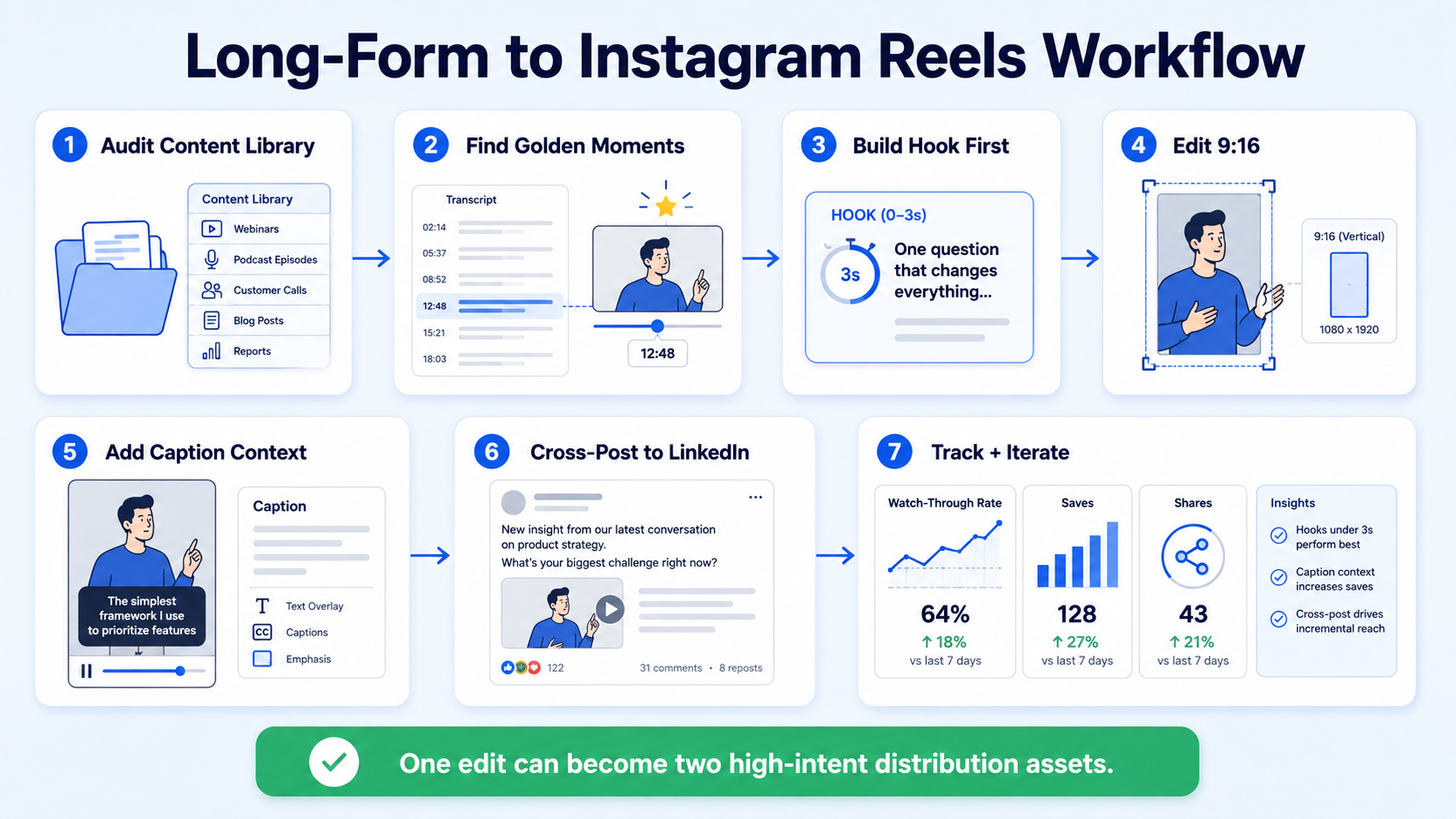
- Audit your content library: List every webinar, demo, podcast, and interview recorded in the last 12 months. Prioritize assets where a founder or subject-matter expert is on camera, those perform better with the Instagram algorithm than screen-only recordings.
- Identify Golden Moments: Watch or skim transcripts for moments that contain a concrete insight, a surprising stat, a process step, or a clear pain/solution pairing. Timestamps these clips, targeting 45 to 90 seconds of raw material per Reel.
- Build your hook first: The first 2-3 seconds determine watch time. Write the hook as a text overlay or spoken line before you edit the rest. A strong hook framework for SaaS: problem statement ("Most SaaS teams waste their webinar content"), contrarian take ("Cold outreach is dead"), or a data tease ("We doubled demo requests from one clip").
- Edit for vertical format: Crop to 9:16, add captions (85% of Reels are watched without sound), and apply brand-consistent text overlays. Tools like CapCut, Adobe Premiere Pro, and Canva all handle vertical video format natively.
- Add a caption with context: Write 100-150 words that frame the Reel's insight, include 3-5 niche hashtags, and end with one clear CTA aligned to your buyer journey, whether that's "link in bio to watch the full demo" or "drop your biggest challenge below."
- Cross-post to LinkedIn: The same vertical clip repurposed for Reels works on LinkedIn's short-form feed. Short-form video editing done once distributed across two high-intent channels is a 2x content multiplier with zero extra production cost.
- Track and iterate: Monitor watch-through rate, saves, and shares, not just likes. These three signals indicate genuine buyer engagement rather than passive scroll behavior.
How to Repurpose a Webinar Into Instagram Reels (B2B Conversion Model)
Webinars are the single richest source format for repurposing long-form content into Instagram Reels for B2B SaaS. A 45-minute webinar typically contains 10-15 extractable moments worth turning into standalone content. A webinar, podcast episode, customer interview, or leadership presentation can now be converted into multiple short-form video assets using AI-powered editing tools. But the edit strategy matters more than the tools.
The Webinar-to-Reels breakdown:
- Opening hook (0:00-3:00): Pull the host's or speaker's opening problem statement. This is almost always Reel-ready with minimal cutting.
- Key framework segment: If a speaker walks through a 3-step process or a framework, cut each step as its own Reel. Three steps = three clips.
- Audience Q&A moments: These are gold. The questions reveal real buyer objections. Turn the answer, not the question, into a 60-second standalone insight.
- Data or stat callouts: Any moment a speaker cites a specific number deserves its own clip with a text overlay reinforcing the figure.
- Closing CTA or recap: The final summary is often the clearest distillation of the webinar's value proposition and makes a strong "learn more" Reel.
For teams running ongoing webinar programs, building this extraction process into your post-event workflow turns a one-time live event into 30 days of Reel content. Today's decision-makers prefer concise, impactful content, and companies are finding success by aligning content with the buyer's journey and repurposing existing long-form content into snackable segments. The webinar is your pillar. The Reels are your distribution engine.
Video caption optimization is often the step teams skip. Every caption should include the insight, the context of where it came from ("from our live demo with 400 SaaS marketers"), and the next step for a curious buyer.
B2B SaaS Instagram Reels Strategy: Building a Repeatable Content System
One-off Reels don't build pipelines. A repeatable content system does. Here's how to think about repurposing long-form content into Instagram Reels for B2B SaaS as a system rather than a tactic. B2B SaaS marketers must adopt a systematic Pillar and Micro-Content framework, an integrated methodology that embeds repurposing into the entire content lifecycle, designed to systematically convert high-value long-form video assets into a portfolio of targeted, derivative assets.
This is exactly the model we build for clients.
The content system has four operating layers:
- Pillar input cadence: Commit to one long-form asset per week, whether a recorded podcast, team webinar, or founder-led AMA. This is the raw material pipeline.
- Extraction sprint: Block two hours post-recording for clip selection. Identify 5-8 moments per asset and log them in a shared content calendar with timestamps.
- Production batch: Edit all clips from one source in a single session. Batching reduces context-switching and keeps visual style consistent across a week's worth of Reels.
- Distribution + repurposing loop: Post on Instagram, cross-post to LinkedIn, and embed the best-performing clips in sales email sequences for buyer education at the bottom of the funnel.
Short-form video is often associated with consumer marketing, yet the latest research shows strong performance across B2B environments, as decision-makers increasingly consume content through social platforms before engaging with vendors or entering formal buying processes.
This matters for SaaS marketing funnel design. Reels at the top of the funnel build brand awareness and establish SaaS thought leadership. The same clips embedded in sales sequences become sales enablement. One asset, multiple funnel stages. Businesses report an average 29% increase in ROI after integrating Reels into their marketing plans. That number compounds when Reels are part of a connected system rather than one-off posts.
Common Mistakes B2B SaaS Brands Make With Instagram Reels
Most SaaS teams either don't post Reels at all or post them wrong. Both outcomes waste pipeline opportunities.
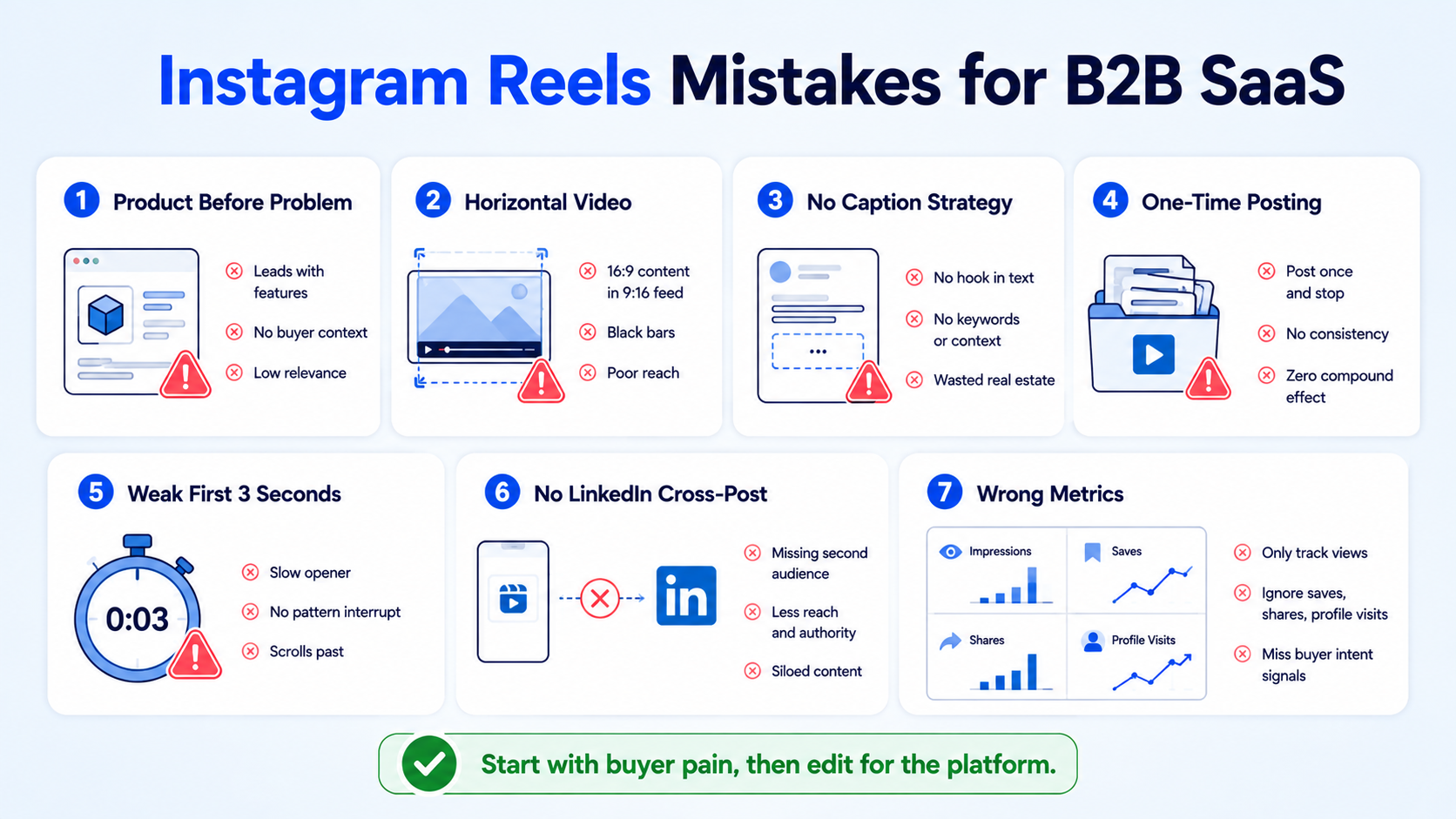
Mistake 1: Starting with the product, not the problem. B2B buyers on Instagram are not in buying mode. They're in learning mode. A Reel that opens with a product feature gets scrolled past. A Reel that opens with a named pain point earns a watch.
Mistake 2: Horizontal video in a vertical world. Vertical video is the default for B2B social because most decision-makers consume content on mobile devices. Posting a 16:9 webinar recording without reformatting to 9:16 signals a brand that doesn't respect the platform's native format.
Mistake 3: No caption strategy. The caption is a second piece of content. Teams that write "New video up!" instead of a 120-word insight-driven caption are leaving engagement and follower growth on the table. Video caption optimization is a skillset, not an afterthought.
Mistake 4: Treating every Reel as a one-time post. Repurposing is not a sprint, it's a system. Posting one Reel from a webinar and moving on means 90% of extractable value from that asset never reaches your audience.
Mistake 5: No hook in the first 3 seconds. Hooking viewers in the first 3 seconds is essential because the Instagram algorithm rewards watch time and completion rate, both of which are won or lost in the first three seconds. Scroll-stopping content starts before the first sentence is finished.
Mistake 6: Ignoring cross-posting. LinkedIn cross-posting of the same vertical clip takes 90 seconds and doubles the audience. SaaS teams that treat Instagram and LinkedIn as entirely separate content strategies double their production costs for no reason.
Mistake 7: Not measuring the right signals. Impressions don't indicate pipeline interest. Saves, shares, and profile visits from Reels are more meaningful demand generation signals and should be in your weekly reporting.
How the Instagram Algorithm Amplifies Repurposed B2B Content in 2026
Understanding the Instagram algorithm is not optional if you want Reels to drive brand awareness metrics and demand generation. The algorithm increasingly favors Reels for non-follower distribution, with Reels reaching 36% more users than carousels and 125% more than photo posts for smaller accounts. For early-stage SaaS brands building organic reach, this is the biggest structural advantage the platform offers. Meta's Q1 2026 earnings call confirmed that daily Reels plays crossed 260 billion across Instagram and Facebook combined, representing a 30% year-over-year increase from 2025. The distribution pool is enormous.
What the algorithm actually rewards in 2026:
- Completion rate: Reels watched to the end or re-watched signal quality. Short, insight-dense clips (under 60 seconds) tend to outperform longer clips on this metric.
- Saves: The single strongest algorithmic signal for B2B content. When a buyer saves a Reel, they're bookmarking it for a future buying decision. Optimize captions to explicitly prompt a save: "Save this if you're planning your 2026 content strategy."
- Shares to DMs or Stories: Sharing behavior tells the algorithm this Reel is worth showing to similar users. Educational B2B content gets shared in Slack channels, team DMs, and founder group chats constantly.
- Engagement rate optimization via timing: Post when your target audience (founders, marketing heads, growth teams) is actually active. For B2B SaaS, Tuesday through Thursday, between 7-9am and 12-2pm in your primary market timezone, typically shows stronger engagement rate optimization results.
According to Sprout's 2026 Social Media Content Strategy Report, 60% of consumers interact with brand content on Instagram at least multiple times a week, meaning a consistent Reels cadence keeps your brand in active consideration even between sales touchpoints. The content atomization approach Gary Vaynerchuk's team pioneered as a pillar content model maps directly onto the Instagram algorithm's behavior: post consistently, post specifically, and let the platform's reach engine do the distribution work that would otherwise require a paid media budget.
Conclusion
Repurposing long-form content into Instagram Reels for B2B SaaS is not a social media tactic, it's a pipeline strategy. The core takeaways:
- Webinars, podcasts, and demos contain 10-15 extractable Reels each. One recording session should produce a month of content.
- The Instagram algorithm in 2026 actively amplifies Reels to non-followers, making it the best organic reach lever for growing SaaS brands.
- Saves, shares, and watch-through rate are your real B2B demand signals, not likes.
- Cross-posting to LinkedIn from the same vertical clip doubles your reach with zero additional production cost.
If you want a done-for-you system, Komet Media's video growth services are built specifically for SaaS and AI teams that need pipeline, not just content.
Frequently Asked Questions
Q1: How long should Instagram Reels be for B2B SaaS marketing?
Between 30 and 90 seconds is the effective range for B2B Reels. Clips under 60 seconds earn higher completion rates, which the Instagram algorithm rewards with wider distribution. Lead with the insight in the first 5 seconds and cut everything that doesn't directly support it.
Q2: How many Reels can I realistically produce from one webinar?
A 45-minute webinar typically yields 8 to 15 Reels when systematically extracted. Each framework step, Q&A answer, key stat, and problem-framing moment is a standalone clip. Most teams underestimate this yield because they've never built an extraction workflow.
Q3: Do B2B buyers actually use Instagram to research SaaS products?
Yes, and the behavior is growing. Decision-makers increasingly consume content through social platforms before engaging with vendors or entering formal buying processes. Instagram is part of the pre-pipeline brand awareness phase, not a late-stage sales channel.
Q4: What editing tools work best for repurposing B2B SaaS content into Reels?
CapCut handles fast vertical edits with auto-captions. Adobe Premiere Pro is the standard for polished, brand-consistent production. Canva is useful for text-overlay Reels from blog posts or stat callouts. For higher-volume or done-for-you short-form editing, a dedicated video production partner eliminates the internal bottleneck entirely.
Q5: Should I post the same Reel on Instagram and LinkedIn?
Yes. The same 9:16 vertical clip formatted for Instagram Reels posts natively on LinkedIn's short-form feed. LinkedIn cross-posting takes under two minutes and reaches a B2B audience actively in a professional mindset. One edit, two high-intent channels, doubled buyer touchpoints.
Q6: How do I measure whether Reels are actually contributing to the pipeline?
Track saves, profile visits from Reels, DM inquiries referencing specific clips, and UTM-tagged link clicks from the bio. Combine that with CRM source attribution to connect inbound leads back to specific video content. Saves and direct outreach from Reels are the clearest early pipeline signals.

