
How a Content Repurposing Engagement Works: Step-by-Step Guide
I'm Rajan Soni, Founder and Video Director at Komet Media. Most B2B teams I talk to are sitting on a goldmine of webinars, demos, podcasts, and founder thinking, and doing nothing with it after the first 48 hours. That's the problem a content repurposing engagement solves. This guide breaks down exactly how a content repurposing engagement works, phase by phase, so you know what to expect before you start.
TL;DR
- A content repurposing engagement converts your existing long-form content into short-form video, social assets, and sales enablement material.
- The process runs from content audit through to multi-platform distribution and performance tracking.
- Most B2B engagements span 4–8 weeks for the foundation phase, then operate on a monthly production cycle.
- The output: a repeatable video production pipeline tied directly to pipeline, demo demand, and buyer education.
What Is a Content Repurposing Engagement?
A content repurposing engagement is a structured partnership where an agency audits your existing content library, identifies the highest-value assets, and transforms them into formats built for the channels where your buyers actually spend time. It is the strategic practice of transforming existing content into new formats tailored for different platforms and audience preferences. Unlike a one-off video project, an engagement is a system, with defined phases, deliverables, timelines, and feedback loops.
For B2B SaaS and funded tech teams, the inputs are almost always already there: product demos, founder interviews, webinar recordings, sales call transcripts, and podcasts. Creating high-value content such as podcasts or videos is just the beginning; maximizing its impact through effective content repurposing strategies is crucial for B2B companies, and a video podcast can be a powerful starting point for establishing market dominance.
The case for doing this at the engagement level rather than ad hoc is straightforward. Repurposing delivers a 32% ROI improvement on average. Transforming long-form content into videos, social posts, and email sequences extends reach without proportional cost increases, enabling smaller teams to maintain competitive content volumes while preserving quality standards across formats.
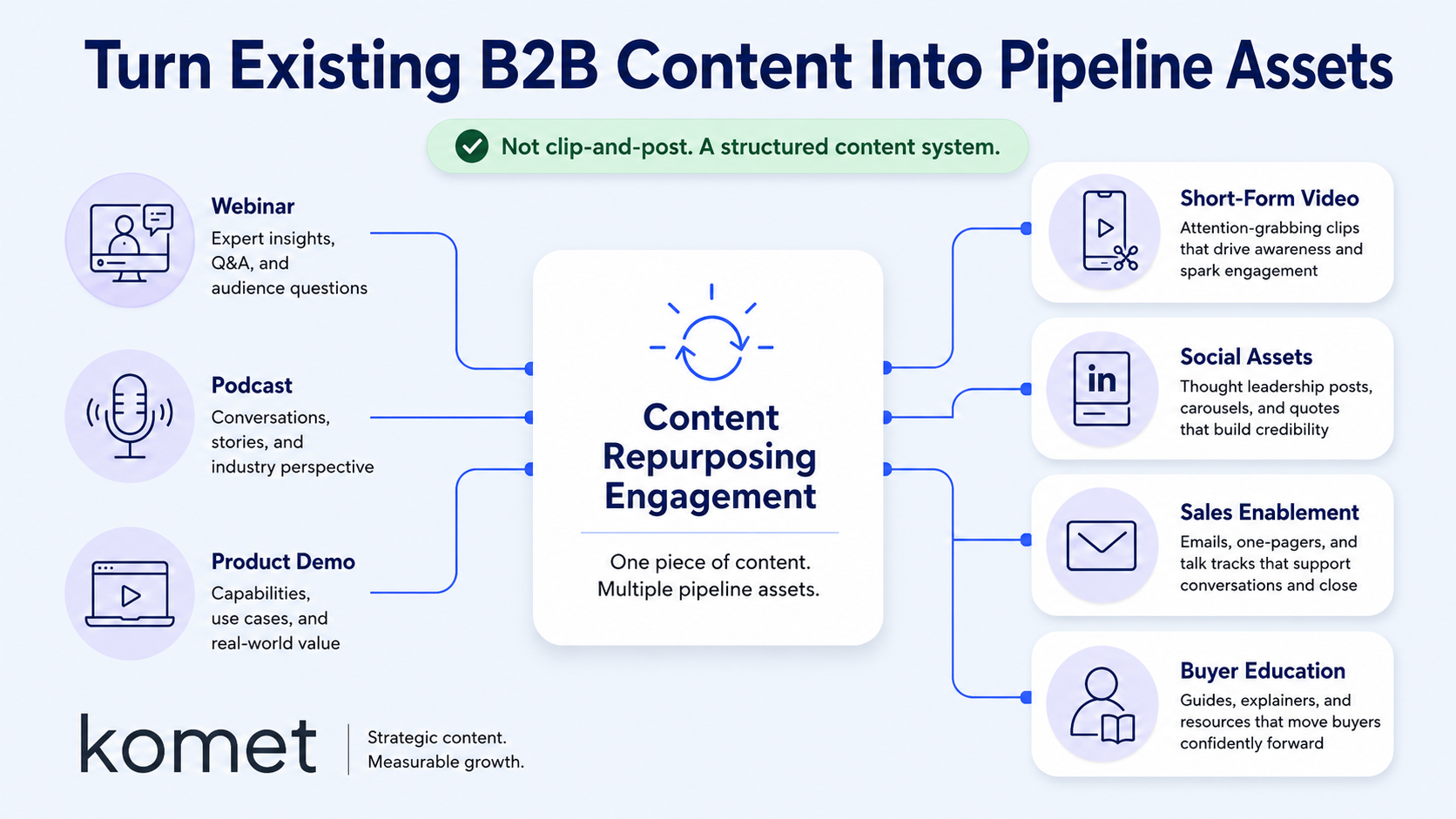
The engagement model matters because it replaces reactive, one-off content creation with a repeatable content strategy framework. Every deliverable connects back to a content pillar, every clip maps to a stage of the buyer journey, and every distribution channel is intentional. This is how a content repurposing engagement works at the strategic level, not just "clip and post," but a video production pipeline aligned to revenue.
At Komet Media, an engagement starts with two inputs: what content already exists and what business outcomes are being chased. Pipeline, demo demand, founder visibility, and sales enablement are the four most common. The repurposing workflow is built backward from those goals.
Phase 1: Content Audit and Inventory, Where the Engagement Starts
No engagement should begin without a content audit. This is the discovery phase where you take stock of what exists, what's worth transforming, and what's already working.
The foundation of successful content repurposing begins with a comprehensive audit of your existing content library, cataloging all content assets, evaluating their performance metrics, and identifying pieces with untapped potential. High-performing blog posts, successful social media campaigns, and engaging video content often serve as excellent candidates for repurposing.
Here is how I run the content audit phase in a Komet Media engagement:
- Gather your content inventory: Pull every long-form asset, webinar recordings, podcast episodes, founder talks, demo videos, sales decks, and transcripts. Organize them by topic, date, and estimated engagement.
- Score each asset: Rate assets on relevance to current ICP pain points, production quality, and evergreen potential. Prioritize assets from the last 12 months.
- Map to content pillars: Group assets under 3–5 core content pillars (e.g., product education, founder POV, customer proof, competitive differentiation).
- Identify repurposing potential: For each asset, note what formats it could become, short-form video clips, LinkedIn carousels, quote graphics, email sequences.
- Flag gaps: Note where the content library is thin so new content can be produced to fill those gaps.
The output of Phase 1 is a content inventory document that becomes the backbone of the editorial calendar. Start by gathering all your content URLs and organize them into a spreadsheet to get a clear overview of your digital assets. Focus on evergreen content, content that consistently drives traffic and engagement over time. This phase typically takes 3–5 business days for a team with 6–24 months of existing content. Teams with less than six months of recorded content will supplement with new production from Day 1.
Phase 2: Strategy and Editorial Calendar, Building the Repurposing Workflow
With the audit complete, the engagement moves into strategy. This is where a content repurposing engagement works differently from a freelance editing subscription: every clip gets a strategic brief, not just an edit.
The strategy phase outputs three things:
- Content pillars confirmed: The 3–5 themes that anchor all short-form output and align to buyer pain points.
- Audience segmentation: Which formats and messages target which buyer roles (e.g., technical clips for developers vs. ROI-framed clips for CFOs).
- Editorial calendar: A 30–60 day publishing schedule mapping each asset to a platform, format, and publish date.
The key to successful video repurposing lies in understanding platform-specific requirements and audience behaviors. Short-form vertical videos dominate platforms like TikTok and Instagram Reels, while longer-form content performs better on YouTube and LinkedIn. Different platforms require different content approaches, but the core message can remain consistent.
For a typical B2B SaaS team, the distribution channels in scope are LinkedIn (primary), YouTube Shorts, and Instagram Reels for brand storytelling. The most effective B2B distribution channels in 2024 were social media platforms at 90%, blogs at 79%, email newsletters at 73%, and webinars at 56%, repurposing one asset systematically into all key channels represents the highest-efficiency content distribution model.
The editorial calendar also sets content velocity. Most engagements target 8–16 short-form video clips per month from existing long-form sources. That output level keeps pipelines visible without burning your team on new content creation. Brand storytelling and content pillars defined at this phase govern every subsequent deliverable. If this step is rushed, everything downstream drifts.
Phase 3: Content Transformation, How Short-Form Video Gets Produced
This is the execution core of how a content repurposing engagement works. Each long-form asset in the editorial calendar enters the video production pipeline and is transformed into platform-native short-form video clips, with supporting assets built around them.
The production process for each asset:
- Transcription and review: The source recording is transcribed and reviewed for high-value moments, insights, bold claims, stats, and story beats that land in under 90 seconds.
- Clip selection: The best 3–8 moments are flagged as candidate clips. Each is evaluated for standalone value (can a viewer understand and act on this without context?).
- Edit and format: Clips are edited for vertical or square format, captions added, branded openers and closers applied, and pacing tightened for social consumption.
- Supporting assets produced: Each clip brief generates companion assets, a LinkedIn text post, a pull-quote graphic, or a short email copy block for sales enablement.
- Review and approval: The client team reviews a batch of 4–8 clips before distribution begins. Feedback is addressed in one revision round.
This process is more than a simple copy-paste of a transcript. It requires editing for clarity, restructuring for readability, and optimizing for specific channels. For B2B firms, this directly supports SEO, thought leadership, and lead generation by turning spoken expertise into discoverable, shareable written assets.
Video's role continues expanding, with 61% planning increased investment in 2025. Video content delivers ROI 49% faster than text-based assets, making it increasingly attractive for B2B organizations seeking accelerated returns.
Our short-form video editing service is purpose-built for this exact stage. The production brief connects every clip back to a content pillar and a buyer outcome, so nothing is produced just to fill the calendar.
Phase 4: Distribution and Multi-Platform Publishing, Getting the Content to Buyers
Production without distribution is just storage. This phase is where the asset library goes live and starts generating engagement metrics, impressions, and pipeline signals.
The distribution workflow in a Komet Media engagement:
- Platform accounts confirmed: LinkedIn, YouTube, Instagram, and any other channels scoped in the strategy phase are connected and optimized.
- Publishing schedule activated: Clips go live per the editorial calendar. Posting times are selected based on platform algorithm behavior and audience activity windows.
- Copy published with each clip: Every short-form video ships with a native caption written for that specific platform, not the same copy pasted across four channels.
- Sales enablement packaged: A selection of clips and supporting assets is delivered to the sales team monthly as a "this month in content" pack, directly usable in outreach and follow-up sequences.
- Podcast and webinar clips cross-posted: If the team has a podcast or runs webinars, highlights are distributed through dedicated channels. Our podcast marketing service and webinar support integrate directly with this phase.
When you repurpose a webinar into blog posts, FAQ pages, and video clips, all reinforcing the same core subject, you create the kind of multi-format topical authority that AI engines use to identify credible sources. Omnichannel marketing through repurposed content also has compounding effects on AI visibility. Research suggests that 28% of ChatGPT citations come from pages that don't appear on Google's first page, making content ecosystems an increasingly important channel beyond traditional SEO.
Phase 5: Measurement, Optimization, and Content Lifecycle Management
This is the phase most teams skip, and the reason most content repurposing efforts stall after 60 days. A structured content repurposing engagement works because it closes the loop between output and outcomes.
The measurement framework covers:
By comparing the performance of original and repurposed content, you can fine-tune your approach for even better results. The first step in effective measurement is knowing which metrics matter most for your goals. Instead of tracking everything, prioritize metrics that directly contribute to your objectives, start with engagement metrics like click-through rates, views, and social interactions.
Content lifecycle extensions through updates and refreshes improved organic traffic by 28% in 2025. Evergreen content that is refreshed and redistributed consistently outperforms new content created from scratch. Monthly, the engagement review covers three questions: What performed best? What should be repurposed again? What gaps in the content strategy need to be filled next cycle? This review drives the next editorial calendar and keeps the repurposing workflow self-improving over time.
Every quarter, audit your top-performing content and identify new repurposing opportunities. For teams using our video marketing service, this phase feeds directly into paid distribution decisions, the best-performing organic clips become the creative foundation for paid video campaigns.
How Long Does a Content Repurposing Engagement Take?
The timeline question comes up in every intro call. Here is a realistic breakdown:
The foundation phase runs 4–8 weeks. After that, the engagement operates on a monthly production and distribution cycle. Teams with an existing content library of 10+ hours of recorded material move faster. Teams starting from scratch run parallel: audit and new production happen simultaneously.
Content repurposing saves 60–80% of content creation time compared to starting from scratch for each platform. This efficiency gain allows marketing teams to support broader campaigns with fewer incremental resources while maintaining high quality content standards.
The most important variable is not timeline, it is source material quality. A well-run podcast production or webinar recorded with clear audio and a structured format will yield three times the usable clips compared to a poorly structured Zoom call.
Conclusion
A content repurposing engagement is not a quick win project. It is a system, audit, strategy, production, distribution, and measurement, that compounds over time. Here are the key takeaways:
- The audit is the foundation. Skip it and you are producing content on guesswork.
- Strategy before production. Every clip needs a brief tied to a buyer outcome, not just a timecode.
- Distribution is non-negotiable. Produced content that doesn't ship is dead inventory.
- Measurement closes the loop. What gets tracked gets optimized; what gets optimized drives pipeline.
If your team is sitting on webinars, demos, podcasts, or founder thinking and none of it is reaching your buyers, let's talk.
Frequently Asked Questions
Q1: What is a content repurposing engagement?
A content repurposing engagement is a structured agency partnership that audits your existing long-form content, builds a repurposing strategy, produces short-form video and supporting assets, and distributes them across your channels on a repeating monthly cycle. It is a system, not a one-off project.
Q2: How does a content repurposing engagement work for B2B SaaS teams specifically?
For B2B SaaS, the engagement takes product demos, webinars, founder interviews, and sales calls and turns them into short-form video clips, LinkedIn posts, and sales enablement assets. The output supports pipeline, demo demand, and buyer education without requiring your team to create new content from scratch.
Q3: What deliverables should I expect from a content repurposing engagement?
Expect a content audit document, defined content pillars, a monthly editorial calendar, 8–16 short-form video clips per month, platform-native captions, a monthly sales enablement pack, and a performance review report each cycle.
Q4: How long does a content repurposing engagement take to show results?
The foundation phase takes 4–8 weeks. Distribution typically launches in Week 5–6. Early engagement signals (views, saves, inbound messages) appear within the first 30 days of publishing. Pipeline-level results typically show within 60–90 days of consistent distribution.
Q5: What content do I need to have ready before starting an engagement?
You need at least 3–5 hours of recorded long-form content, webinars, podcasts, demos, or founder interviews. If you have less, the agency can run new recording sessions in parallel with the content audit to build the asset library from Day 1.
Q6: How do agencies like Komet Media structure content repurposing engagements differently from video editing subscriptions?
Subscription editing services clip and deliver. A structured engagement connects every deliverable to a content strategy, buyer journey stage, and distribution channel. The difference is strategy-led production versus volume-led production, and that gap shows up directly in content ROI.

