
Batching Video Production to Save Hours Each Week: Step-by-Step Guide
Many B2B teams treat video as a series of isolated emergencies. They record one video, edit one video, publish it, and start over. This cycle burns out founders and leaves marketing teams struggling to fill the calendar. The alternative is building a predictable system. Batching Video Production to Save Hours Each Week changes how you approach content. It shifts your team from reacting to an empty feed to managing a structured pipeline. I have seen strong businesses unlock months of publishing just by changing how they schedule their time.
What Is Batching Video Production?
Batching Video Production to Save Hours Each Week means recording and editing multiple assets in one scheduled block rather than individually. This system reduces setup time, speeds up the approval loop, and ensures a consistent publishing schedule for business channels.
Why Should You Consider Batching Video Production?
I built Komet Media because I saw strong businesses sitting on valuable recordings without turning them into useful content. Many teams do not have a content shortage. They have a production and distribution problem.
When a marketing team or a founder records a single video every few days, they waste resources. They spend time setting up lights, checking audio, and getting into the right mindset for the camera. Then, the editing process starts from scratch for that one file. This fragmented approach is why so many B2B video strategies fail after three weeks.
According to Wistia's 2025 State of Video Report, maintaining a consistent publishing schedule remains one of the largest hurdles for internal marketing teams. Consistency requires systems, not just effort. Implementing Batching Video Production to Save Hours Each Week allows marketing leaders to separate the act of recording from the act of publishing.
You sit down once, record four podcast episodes or a dozen short thought-leadership clips, and hand them off to your production partner. Your content calendar is full for the month, and your subject-matter experts can return to running the business.
Connecting batching to commercial outcomes
A polished video with no distribution plan is still an underused asset. When you batch your production, you give your team the time required to plan distribution properly.
Instead of scrambling to post a video on Friday afternoon, your team can review a month of finalized assets. They can align those videos with upcoming product launches, sales initiatives, or hiring pushes. Research from the Content Marketing Institute shows that B2B organizations with documented content workflows report significantly higher ROI from their media investments.
When you batch, you stop thinking about "making a video" and start thinking about "deploying an asset."
How Do You Build a Batching Video Production Workflow?
A dependable production system removes guesswork. In my experience, editing is rarely the only problem. The bottleneck usually happens before the files even reach the editor.
Here is the step-by-step workflow we use to help venture capital firms, private equity leaders, and SaaS founders build a recurring publishing engine.
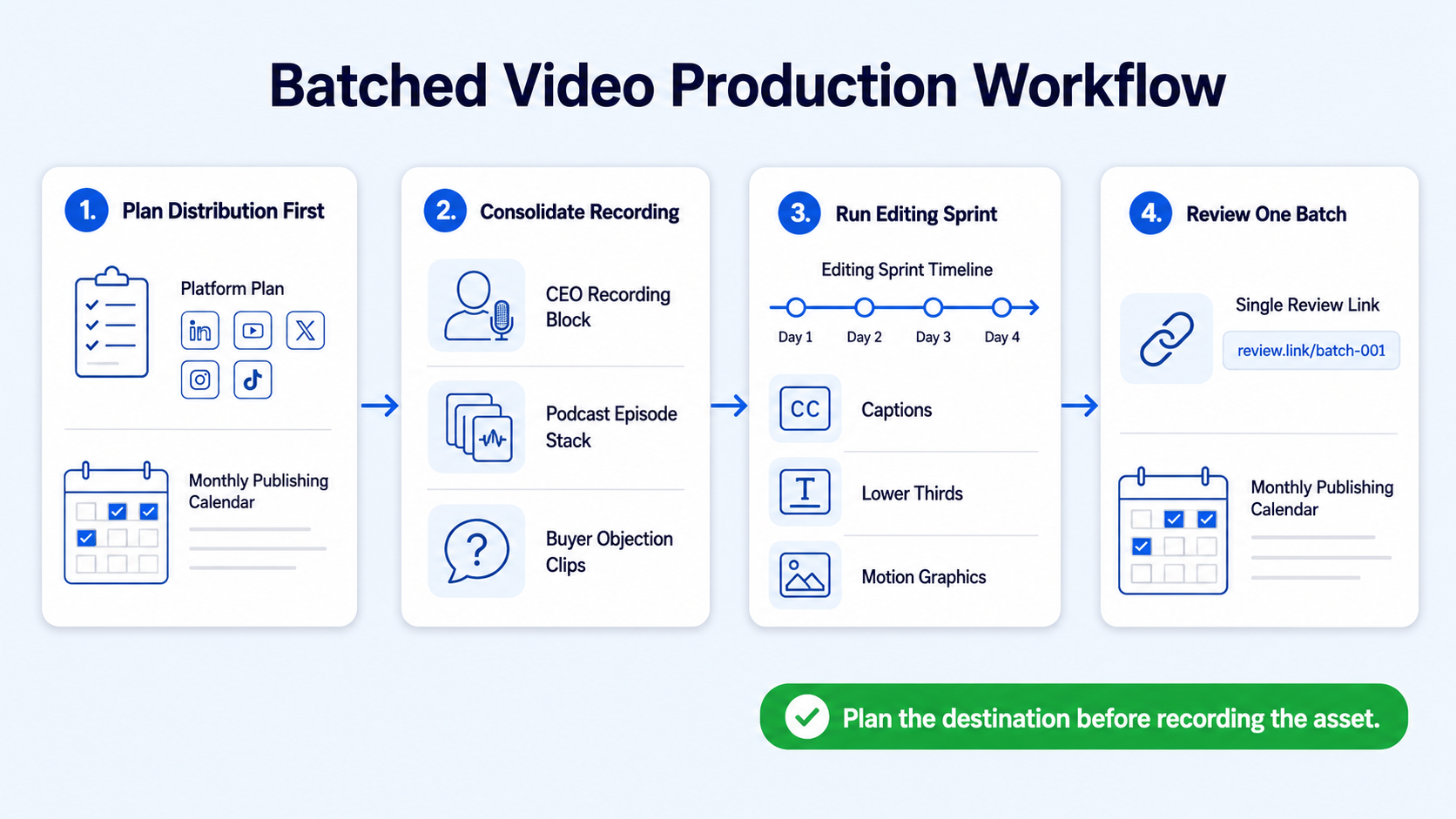
Step 1: Define the distribution plan first
I usually look at the distribution plan before deciding how the master recording should be edited. You cannot batch effectively if you do not know where the content is going.
Decide in advance:
- Which platforms will host the full recording.
- How many short clips you need for LinkedIn or YouTube Shorts.
- Whether the sales team needs specific formats for email outreach.
- Which formats require custom motion graphics or text slides.
If you are solving inconsistent content production for B2B teams, this planning stage is mandatory. It tells the recording subject exactly what they need to deliver.
Step 2: Consolidate the recording schedule
Do not ask your CEO to record one video every Tuesday. Ask them to block out two hours on the first Thursday of the month.
During this block, you can capture:
- Four structured podcast episodes.
- A deep-dive interview regarding industry trends.
- Ten direct-to-camera answers to common buyer objections.
- Product update summaries for the upcoming quarter.
When we edit a founder interview, we look for clear arguments, proof points, stories, and buyer objections. By grouping the recording into one session, the speaker builds momentum. Their delivery becomes more natural, and the overall audio and video environment remains perfectly consistent across all assets.
Step 3: Centralize the post-production sprint
Once the files are captured, the batch moves to the editing team. This is where video editing services must operate like a machine.
Instead of receiving files randomly throughout the month, the editing team receives the entire batch. A structured post-production sprint includes:
- Syncing all multi-camera angles and external audio.
- Cleaning background noise and balancing audio levels globally.
- Reviewing the transcripts to mark strong moments for social clips.
- Cutting the master episodes and exporting the short-form derivatives.
- Applying brand-approved captions, lower thirds, and motion graphics.
Because the editor is working on the entire batch at once, they do not need to constantly reopen project files or reload branding assets. This is how quality scales without increasing turnaround time.
Step 4: Streamline the review and approval loop
One of the largest hidden time sinks in B2B marketing is the review process. When videos are submitted one at a time, internal stakeholders suffer from review fatigue. They take days to approve a 60-second clip.
When you process files in a batch, you send a single review link containing all assets for the month. The marketing director or managing partner reviews the batch in one sitting. They provide unified feedback. The editing team executes one round of revisions, and the entire month of content is locked for distribution.
Where Do Batching Workflows Usually Break Down?
Even with good intentions, Batching Video Production to Save Hours Each Week fails when teams ignore the fundamentals of production management.
Poor source file management
You cannot edit what you cannot find. When internal teams record a batch of videos, they often leave files scattered across local hard drives, Zoom cloud storage, and unorganized Google Drive folders. A professional system requires strict file naming conventions and a central repository.
Lack of editorial direction
More clips do not always produce more reach. Strong selection matters more than volume. I would rather produce six strong clips than fifteen weak ones. When teams batch their recordings without a clear content strategy, they end up with hours of footage where nobody says anything useful.
Founder-led video works when the founder has something specific to say. Production quality helps, but it cannot replace a clear point of view.
The endless revision cycle
Batching requires discipline during the review stage. If your legal or compliance team requires two weeks to approve every single word, the batching system will stall. You must establish a clear Service Level Agreement (SLA) for internal feedback. If feedback is not submitted within 48 hours, the asset should be considered approved for publishing.
Should You Choose an Internal Team or an External Partner?
Many SaaS companies and venture firms debate whether to build this system internally or hire an external partner. The right choice depends on your internal capacity and commercial goals.
The limits of internal editors
Hiring a junior videographer often seems like the logical next step. However, a junior editor rarely understands the strategic difference between a podcast export and a high-converting LinkedIn video. They become overwhelmed by the volume of a true batching system. They spend their time rendering files rather than studying platform algorithms or distribution tactics.
The agency partnership model
We have seen SaaS teams publish more consistently once they stop handling every asset as a separate project. An agency partner brings a refined workflow to the table.
At Komet Media, our commercial model is built around recurring partnerships, typically ranging from $2,500 to $5,000 per month depending on volume and scope. This covers the entire system. We handle the content selection, the deep editing, the platform adaptation, and the final packaging.
You provide the raw expertise during your recording block. We provide the finished content calendar.
How Do You Measure the Success of a Batched Video System?
Do not judge every video only by views. You must match metrics to the purpose of the asset. A highly targeted video for video editing for founders and CEOs might only get 500 views, but if three of those viewers are qualified investors, the video has done its job.
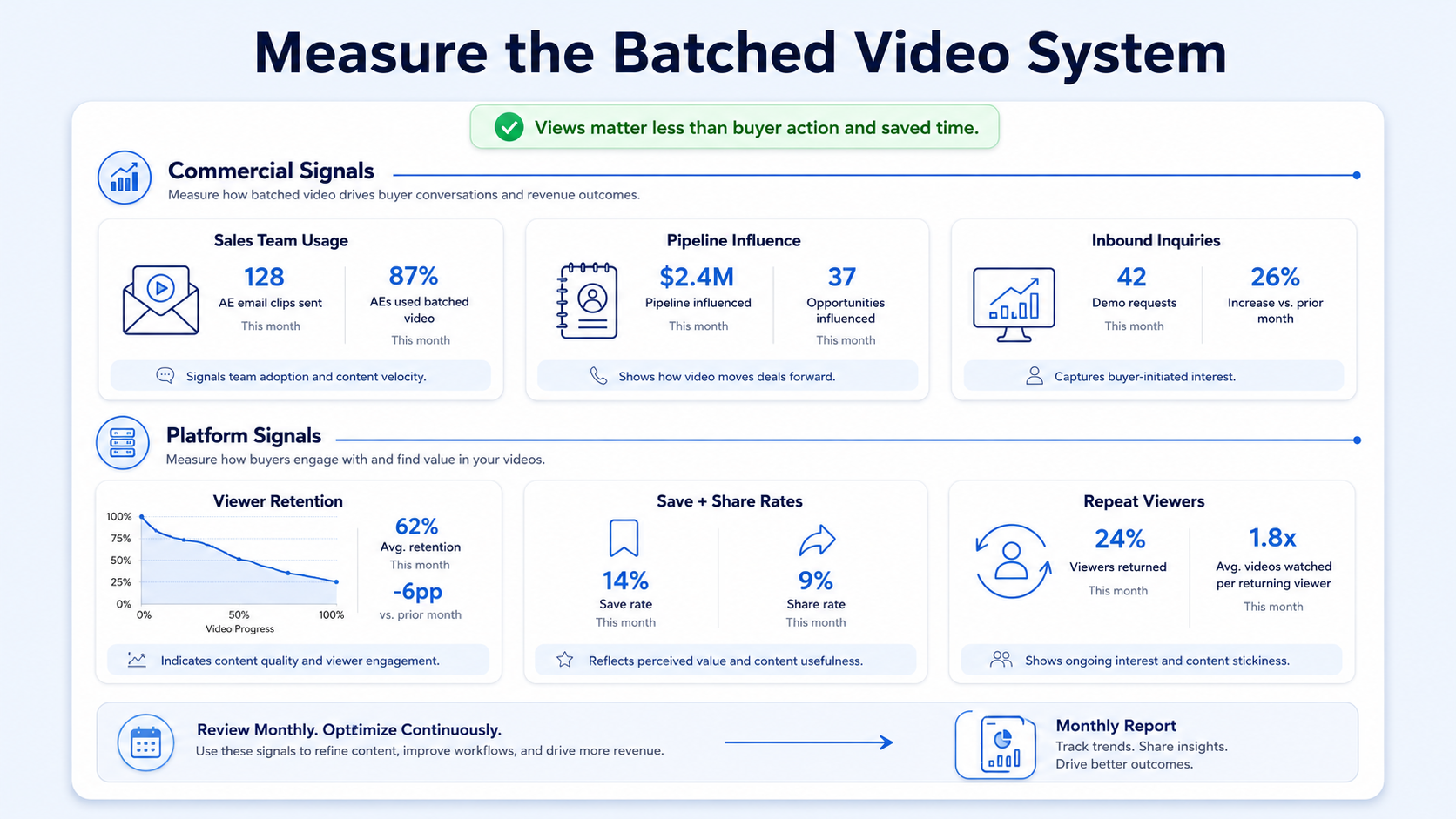
Commercial and pipeline metrics
When reviewing the performance of your batched content at the end of the month, look beyond social media dashboards.
Track the following commercial signals:
- Sales team utilization: Are your account executives using the newly batched clips in their follow-up emails?
- Pipeline influence: Are prospects mentioning your podcast or LinkedIn videos on discovery calls?
- Inbound inquiries: Is there a sustained lift in website visits or demo requests aligned with your publishing schedule?
Platform engagement metrics
Platform data helps you refine the next batch of recordings. According to official LinkedIn business guidelines, professional audiences prioritize clear, actionable insights over heavy entertainment.
When reviewing your batch, measure:
- Viewer retention: Where do viewers drop off? This tells you if your hooks are too slow.
- Save and share rates: A saved video is a strong signal of authority. It means the buyer found your insight valuable enough to reference later.
- Repeat viewers: A successful content engine builds a returning audience, rather than just capturing random algorithmic spikes.
Attribution may be imperfect. Use several signals rather than relying on one dashboard metric. If you notice a steady increase in qualified pipeline and a decrease in time spent managing content, your batching system is working.
Is Batching Video Production Right for Your Business?
Building a regular content engine is no longer optional for businesses that want to command authority in their category. However, producing that content should not consume your entire week.
Adopting Batching Video Production to Save Hours Each Week is fundamentally a commercial decision. It allows you to trade a small, concentrated block of time for a massive, sustained presence in your market. Editing creates the asset, but a proper batching system ensures you actually have the time and energy to distribute it effectively. Focus your internal talent on the core business, and let a structured production workflow handle the rest.
Frequently Asked Questions About Batching Video Production
What does a batching workflow look like?
A typical batching workflow involves scheduling one block of time to record multiple videos or podcast episodes. Those files are then sent to an editing team simultaneously. The team edits, captions, and formats all the assets at once, delivering a full month of content in a single review package.
How much does it cost to outsource video batching?
Professional video batching and repurposing usually operate on a retainer model. For a B2B agency that handles content selection, editing, and platform adaptation, expect a recurring investment ranging from approximately $2,500 to $5,000 per month. Final pricing depends on the required volume and production complexity.
How long does Batching Video Production to Save Hours Each Week take to set up?
Setting up the system usually takes two to three weeks. This time is used to align on your brand guidelines, create custom motion graphics, build a reusable brief template, and execute the first recording session. Once established, the monthly cycle runs automatically.
What deliverables should I expect from a monthly batch?
Deliverables depend on your strategy. A standard B2B batch might include two full-length podcast episodes, ten short-form clips optimized for LinkedIn and YouTube Shorts, and clean transcripts for blog repurposing. Every asset is delivered ready for immediate publishing.
Should we use a freelancer or an agency for batched content?
Freelancers are useful for occasional, project-based edits where you manage the creative direction. An agency is better suited for businesses that need dependable production, repurposing, and distribution systems without having to manage the daily workflow themselves.
Is an internal team better for managing video volume?
An internal team is excellent if you have the budget to hire a dedicated producer, a video editor, and a content manager. If you only have one marketing generalist, asking them to handle heavy video volume usually leads to burnout and inconsistent publishing.
Does this approach work for venture capital firms?
Yes. Venture capital firms rely heavily on partner expertise and thought leadership. Batching allows managing partners to record their insights during a single dedicated session, ensuring the firm maintains high visibility among founders and limited partners without disrupting deal flow.
How does Komet Media handle Batching Video Production to Save Hours Each Week?
We operate as your dedicated production partner. We help you plan the content, process your master recordings, select the most commercially valuable moments, and deliver polished assets across all your required platforms. We connect your creative decisions directly to your business goals.

